From an email by Jocie to the Botany Group on November 8.
The “shroom season” is winding down, and we will move on to other topics soon, but not quite yet!
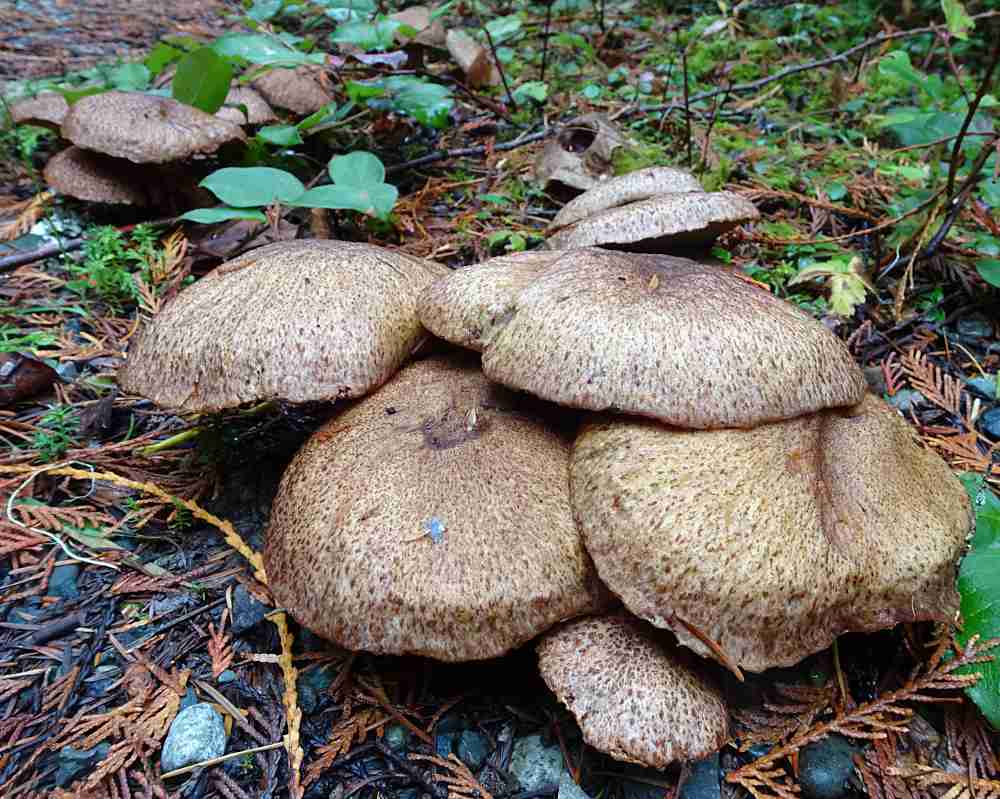
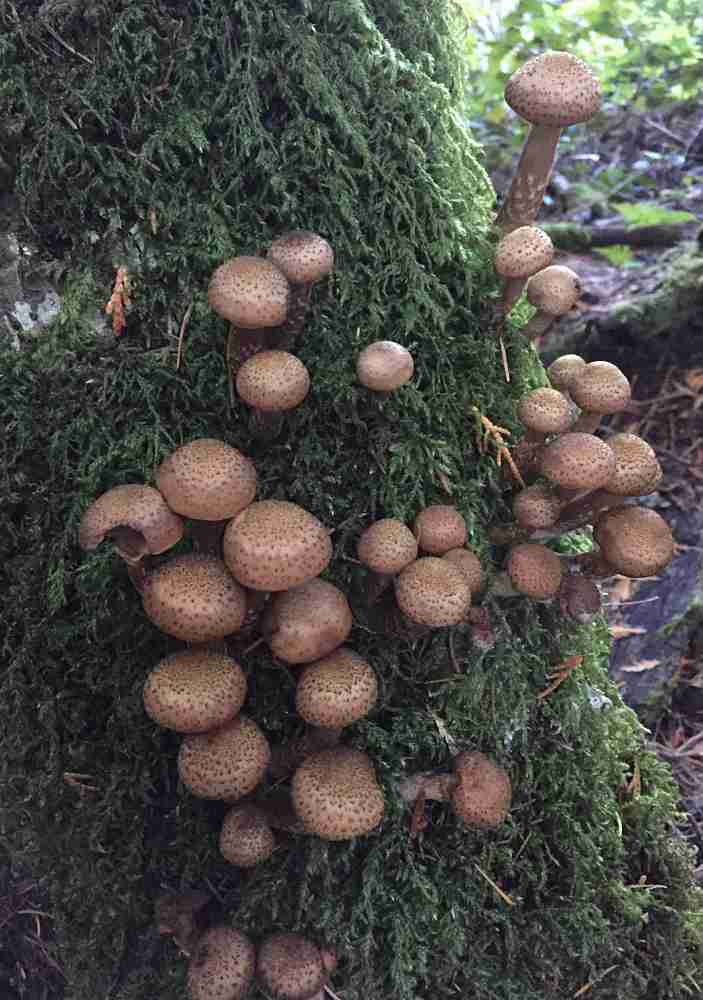
Here are a few fungi in the genus Tricholomopsis. As far as I know, there are only 2 species in this genus in our area. Both of these usually grow on rotten conifer wood.
[Click a photo to enlarge it.]
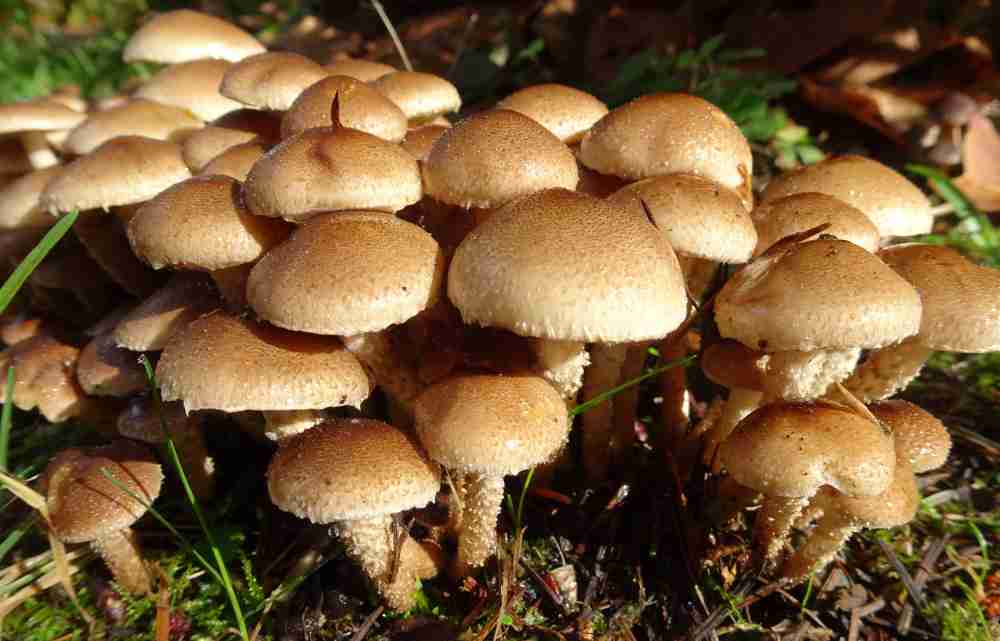
and 2. Plums & custard (Tricholomopsis rutilans). From a beach log on the upper shore at Seal Bay. The plum-coloured cap and stipe and creamy-yellow gills complement each other nicely.
(1)
(2)
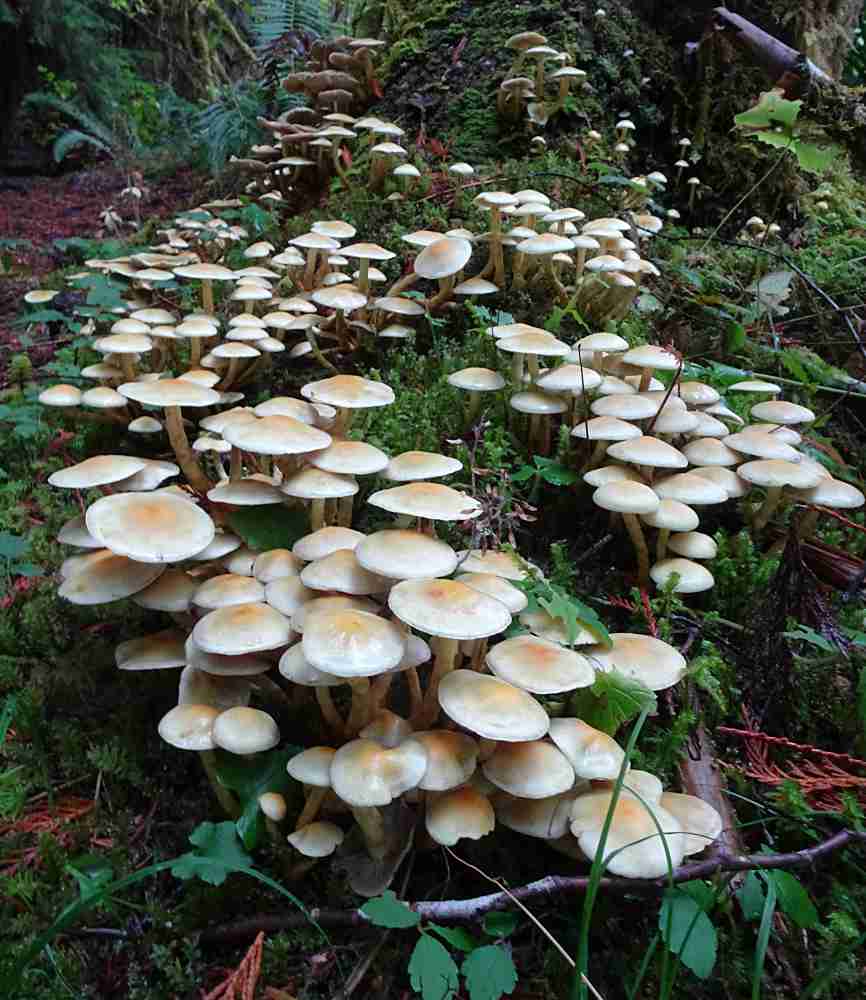
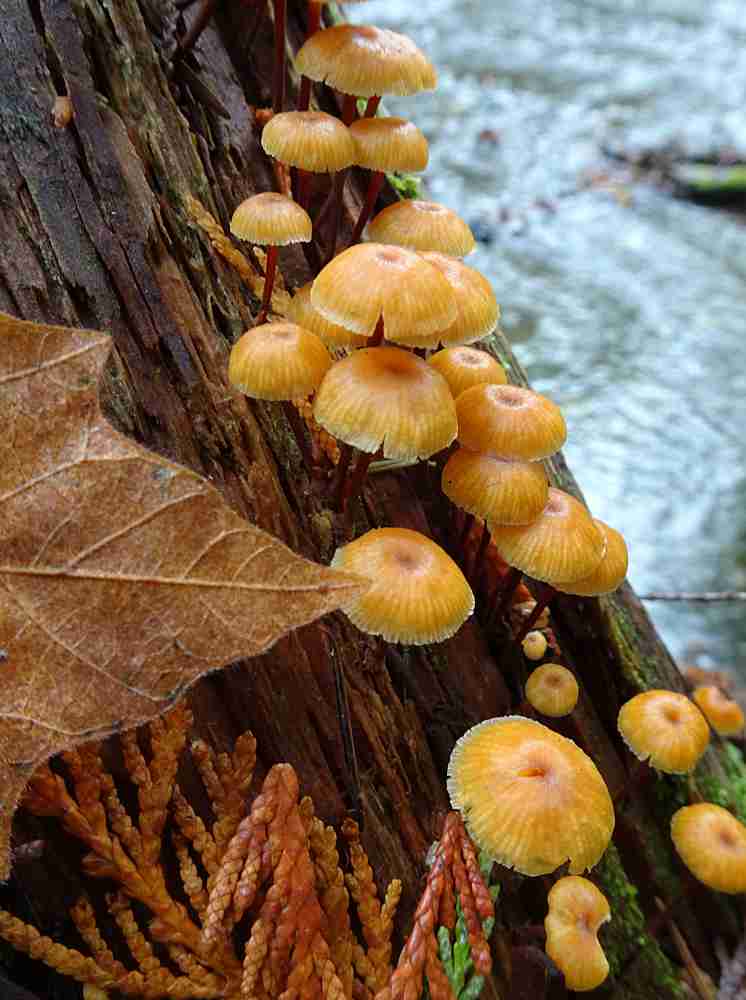
Decorated mop (Tricholomopsis decora). This fancy yellow fungus has fibrils and scales on the cap that become dark brown at the centre. Photographed here from the Rosewall Creek trail.
(3)
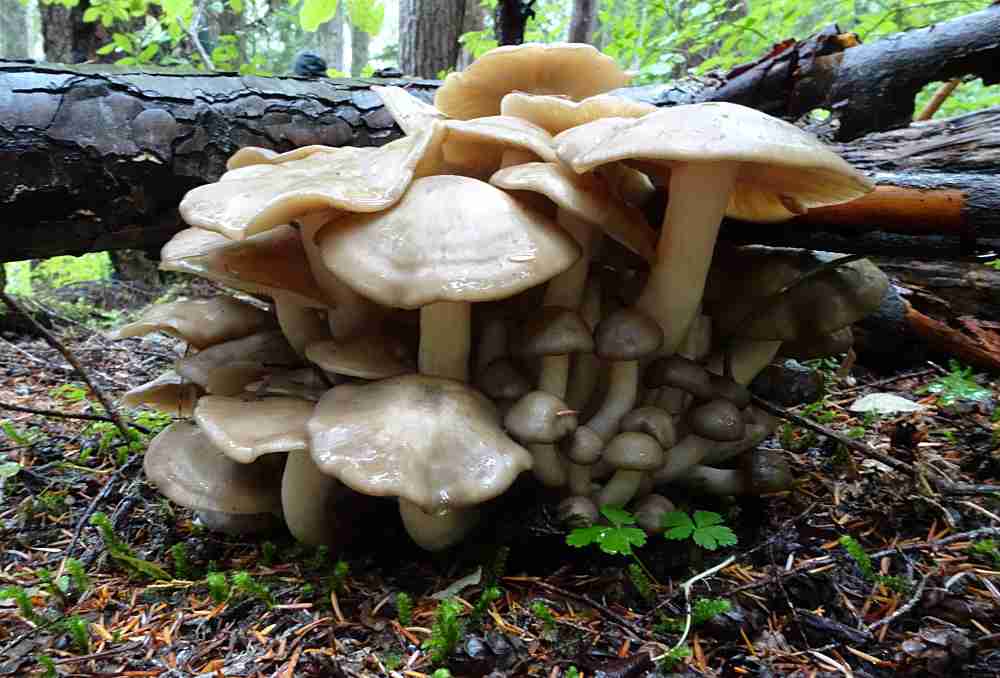
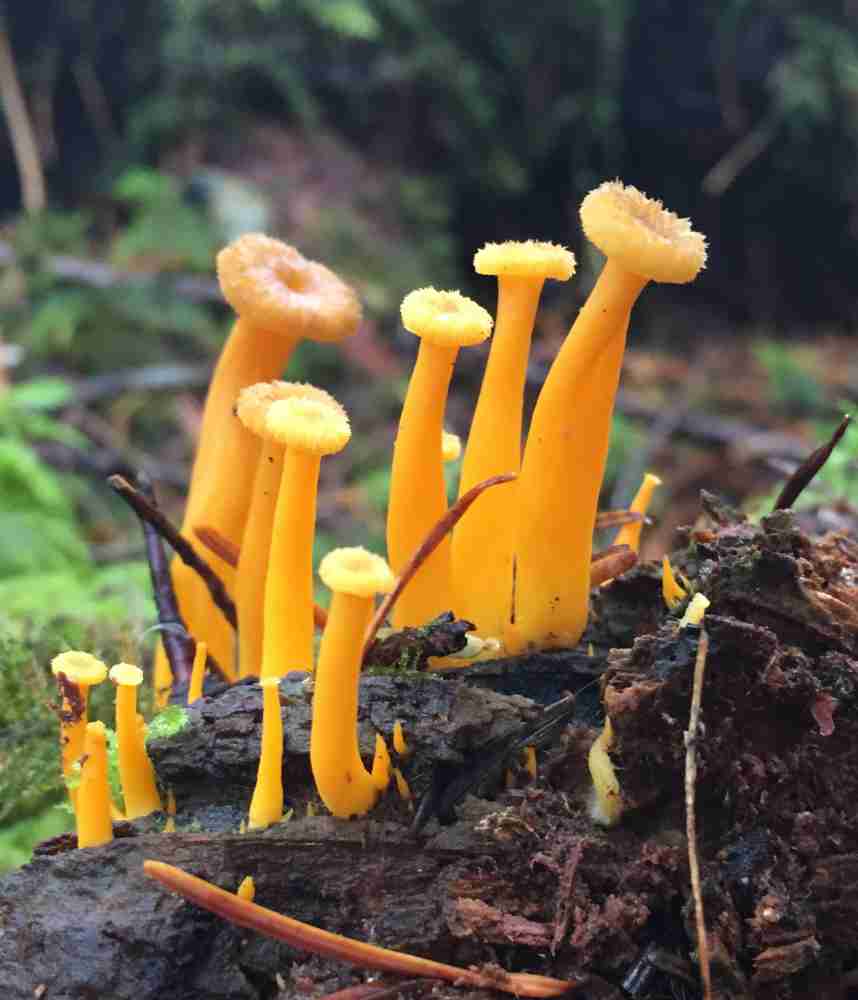
An older specimen of the decorated mop from the Buttle Lake area. This one was almost ready to keel over and looks quite different from the young version, but the yellow colour and brown fibrils in the centre of the cap are distinctive.
(4)
Posted inPlants and fungi|Comments Off on Plums-and-custard and the decorated mop
From an email by Jocie to the Botany Group on November 7.
Many of you have likely heard about the discovery of the death cap mushroom in the Comox Valley. Here is some more information from Alison M.:
Re: the confirmation of the death cap Amanita phalloides in Comox, obviously my earlier comment on its not having been seen in the valley should be corrected. It was found in association with Corylus avellana, hazelnut trees from Mack Laing’s orchard, so clearly in keeping with its preference for hardwoods of European origin.
I am assuming that the spores came from an introduced ornamental, with a variety of vectors possibly including deer or squirrels. It would be interesting to know how long the mycelium could have been present without fruiting.
For further information, see web pages at the following sources:
From an email by Jocie to the Botany Group on October 31.
During these days of social distancing it’s heartening to see troops of gregarious fungi gathering in the woods…quite heedless of human disasters.
Here are some groups and clusterings I’ve come across this fall in various locations: Miracle Beach Park, Rosewall Creek trail, Ralph River campground & Shepherd’s creek trail, and Bevan trails (along the upper Puntledge).
[Click a photo to enlarge it.]
1. Pholiota terrestris.
2. Sulphur tuft (Hypholoma fasciculare).
3. Fried chicken (Lyophyllum decastes).
4. Lake’s boletus (Boletus lakeii).
5. Honey mushroom (Armillaria sp.).
6. Xeromphalina sp.
Yellow foot (Craterellus tubaeformis). I think this is right, though this one looks more brightly yellow than any I’ve ever seen.
From an email by Jocie to the Botany Group on October 24.
There are some spectacular displays of “big laughing gym”, also known as “western jumbo gym” (Gymnopilus ventricosus) at Seal Bay Park. You can find it about 3/4 of the way down the main beach trail (on the right) that descends down the ravine. Just before the beach, fork to the right and just past the little bridge (just before the beach) there are several more clumps on the left.
The common name comes from the hallucinogenic properties that some other members of this genus have. However, Gymnopilus ventricosus is actually not psychoactive.
This shroom grows in bright yellow clusters on rotting logs, snags and stumps. Older specimens have a distinctive ring.
[Click a photo to enlarge it.]
Posted inPlants and fungi|Comments Off on Big laughing gym at Seal Bay
From an email by Jocie to the Botany Group on October 23.
Lobsters & corals bring to mind sea creatures, but these are actually just strange, exotic-looking fungi!
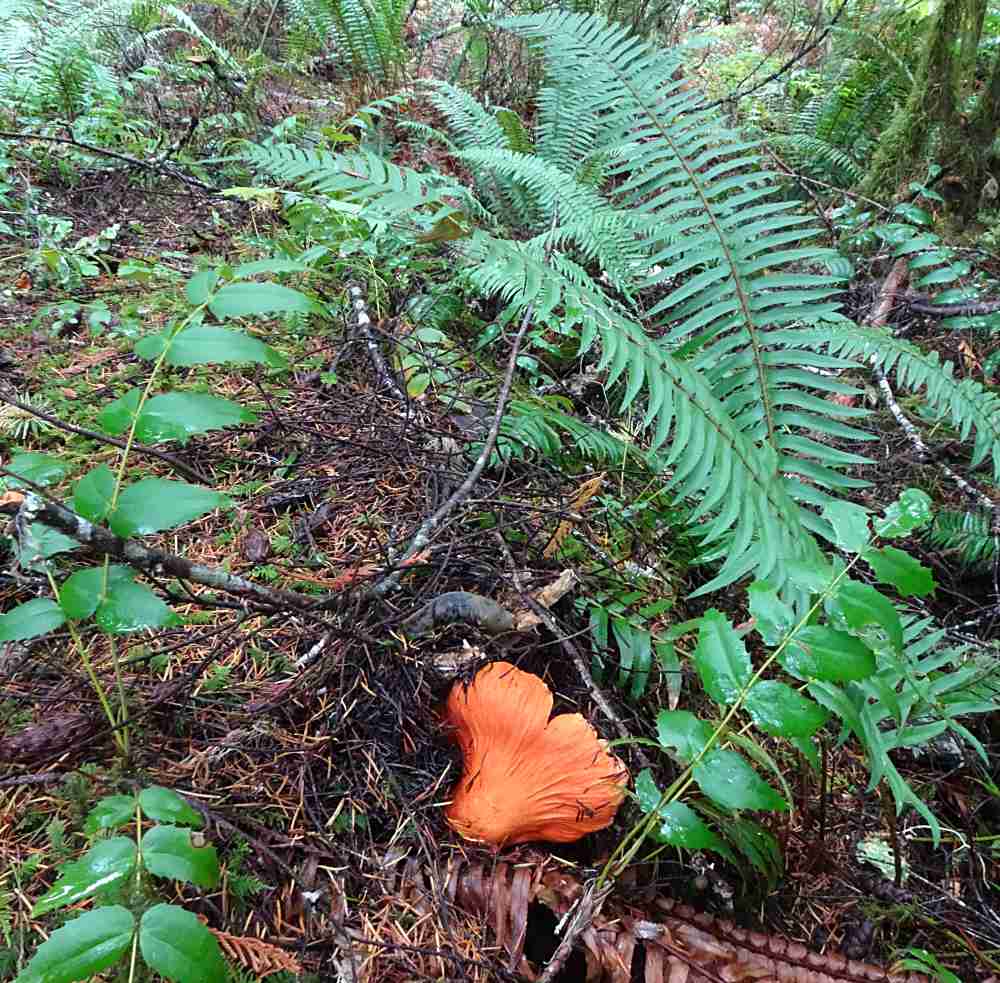
My Mom, Betty, and I were having a great time looking at shrooms in the Buttle Lake area last weekend, and happened upon a patch of lobsters, all with their own unique character (see photos #1-4). The bright salmon-colour is quite a knockout!
[Click a photo to enlarge it.]
(1)
(2)
(3)
(4)
Note that the lobster is a combination of two fungus species: Hypomyces lactifluorum, which is a parasite that forms an orange crust on Russula brevipes (a rather boring looking white shroom). Young lobsters are considered a good edible.
In the same area there was an array of colourful corals (photos #5-8), including one that formed a large mass (last photo).
Note by Alison M. to the Botany Group, distributed by Jocie on October 20.
Notes on shades of green, blue and purple in gilled mushrooms
Still in the category of gilled shrooms, shades of greens and blues are not commonly found in the world of fungi and are often fast fading. [Click a photo to enlarge it.]
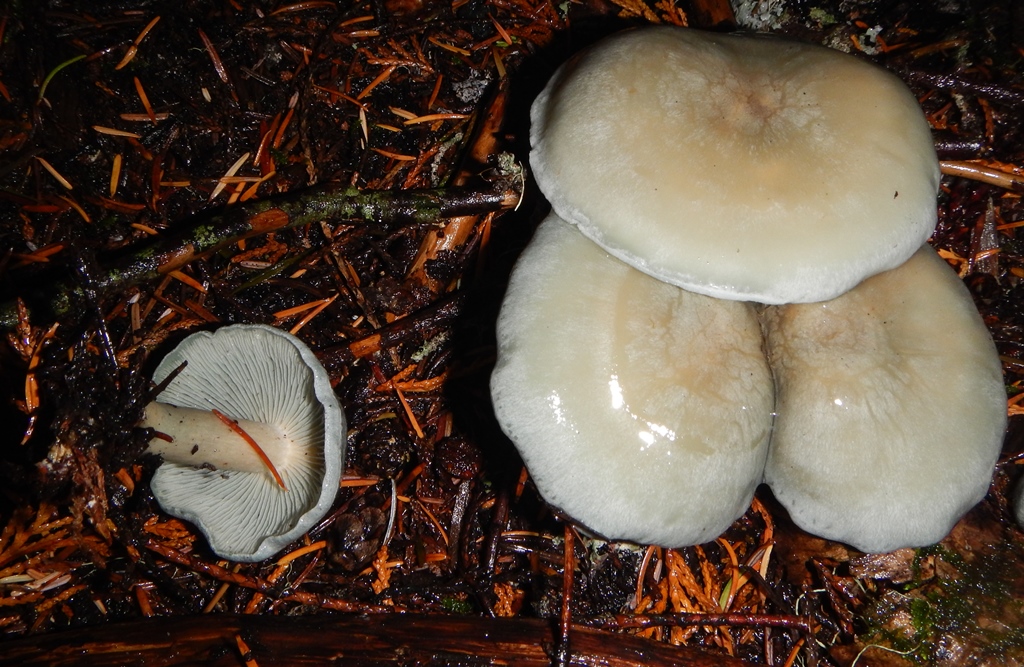
A couple of examples have appeared in the past month, one up in Paradise Meadows: Clitocybe odora var. pacifica – blue-green anise clitocybe (photo #1) and the other down in the valley on Tsolum River Road: Stropharia aeruginosa – no common name (#2–#4). The former, as its name suggests, is recognisable by its anise-like odour as well as by the blue-green tinge. This Stropharia ends up looking very much like the common Stropharia ambigua with a yellowish cap, as well as the distinctive cottony remnants of its veil around the rim of the cap and on the stipe, and its purple/charcoal spore. It is only in the semi-opened shroom that the blue-green is visible.
(1) Clitocybe odora var. pacifica
(2) Stropharia aeruginosa
(3) Stropharia aeruginosa
(4) Stropharia aeruginosa
Another green-capped fungus is the elusive Hygrocybe psittacina – parrot mushroom (#5), which I have found once in the past 10 years, near the confluence of the Browns and Puntledge Rivers. It lost its brilliant green within a day.
(5) Hygrocybe psittacina
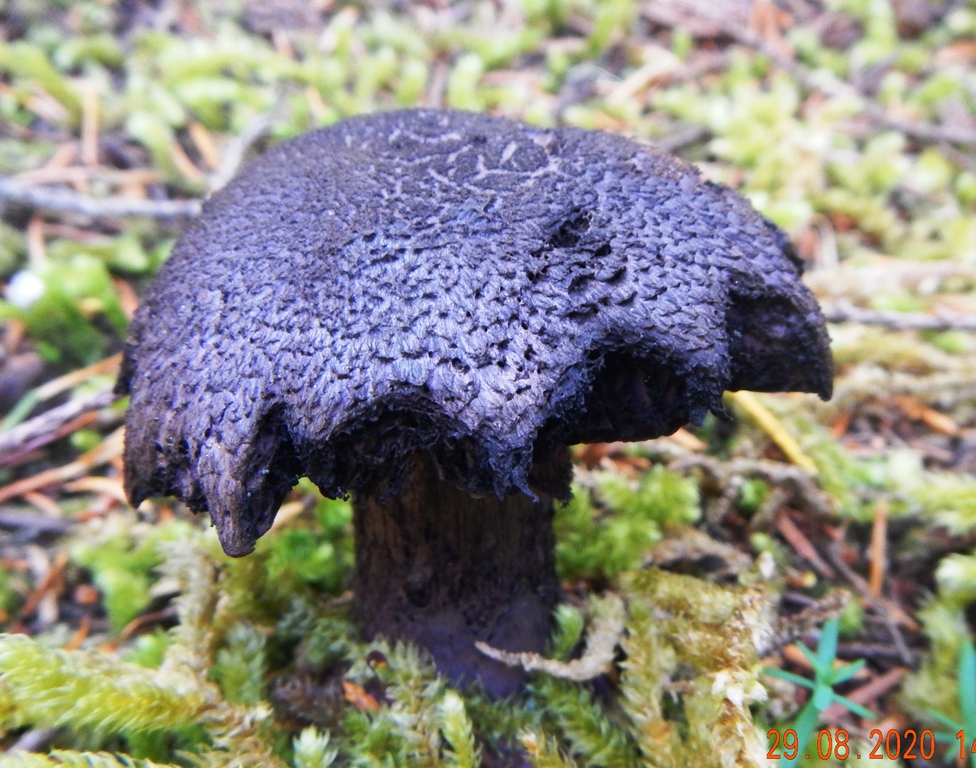
Deeper blues include Arrhenia chlorocyanea(#6 ) from Kin Beach a few years ago, and Polyozellus multiplex – blue chanterelle (#7), which we found in late June on the Elk River Trail. It can be closer to black than blue, depending on age.
(6) Arrhenia chlorocyanea
(7) Polyozellus multiplex
Popping up at the moment on the purple end of the spectrum is Laccaria amethysto-occidentalis(#8), which appears without fail on the edge of our field.
(8) Laccaria amethysto-occidentalis
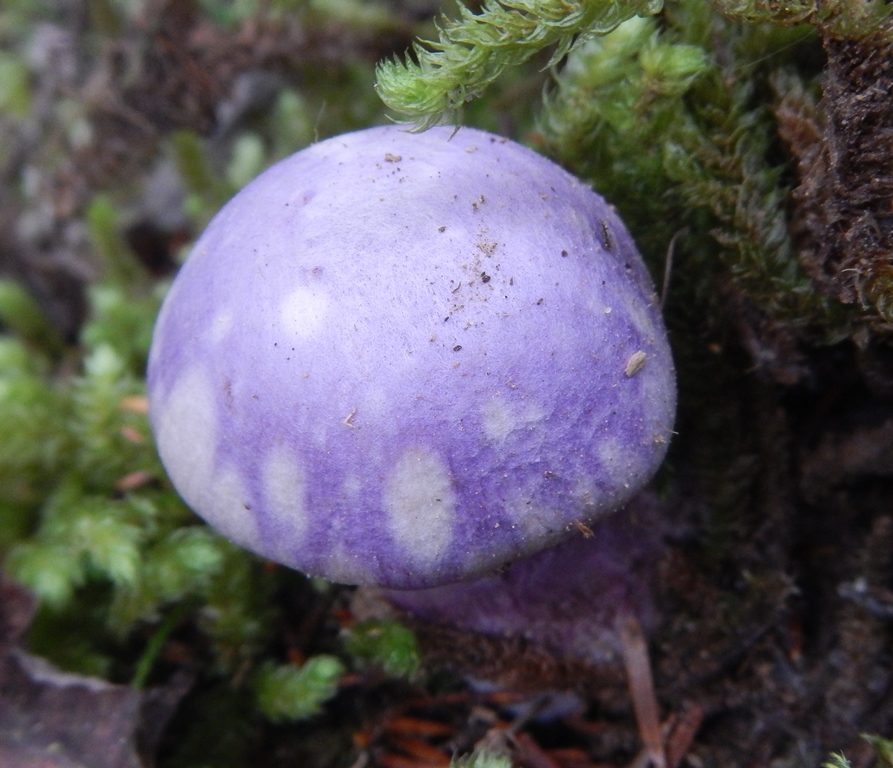
There are many members of the genus Cortinariusthat have lilac or purple caps, or lilac stipe and gills with a beige cap (#9 & #10), the latter showing the typical cortina or cobweb-like remnants of the veil, from which the genus gets its name, and the typical cinnamon brown of the spores.
(9) Cortinarius sp.
(10) Cortinarius sp.
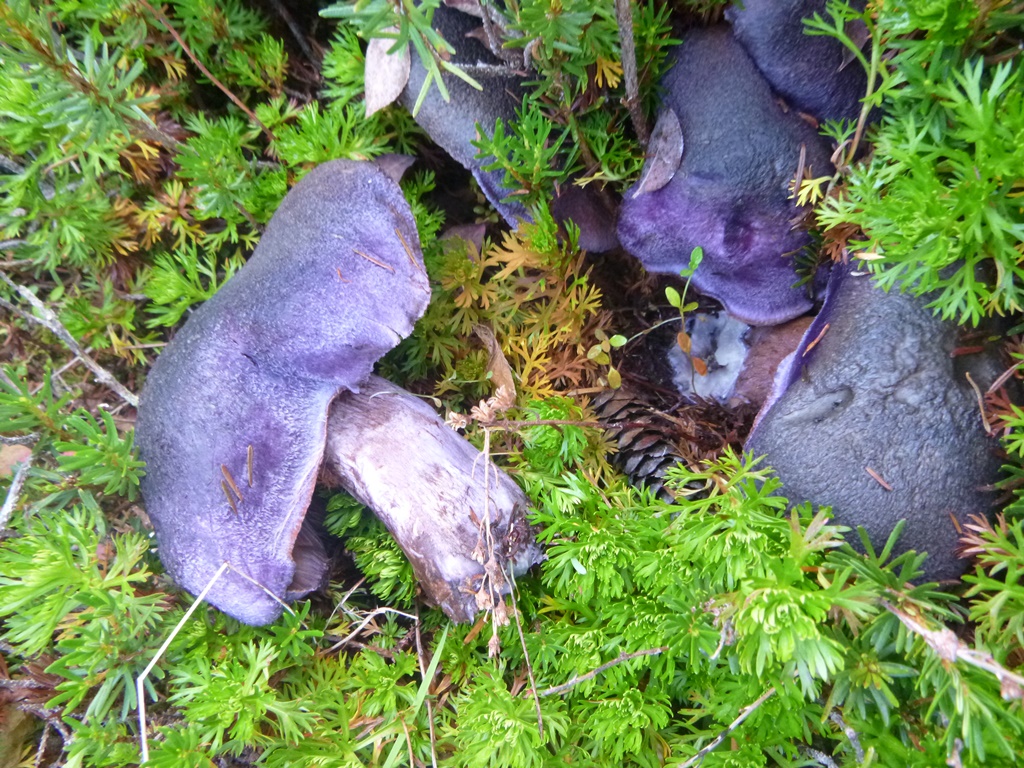
Finally the deep purple Cortinarius violaceus –violet cort, stands out stunningly against the green leaves of the Luetkea pectinata – partridgefoot (#11 and #12). And #12 shows the artistic endeavours of a red squirrel.
(11) Cortinarius violaceus
(12) Cortinarius violaceus
All these examples come from the subalpine.
Posted inPlants and fungi|Comments Off on Greens, blues and purples (Alison’s fungi notes, part 3)
From an email by Jocie to the Botany Group on October 17.
There are many coral fungi fruiting just now…this is a strangely beautiful group of fungi, often arising mysteriously from the forest duff. Amazing!
Corals, often in the genera Ramaria or Clavulina, are characterized by being highly branched, with tips that point upward.
According to one of my books, “identifying coral fungi can be a truly difficult endeavour.” With that in mind, thus far I’ve just been looking at and admiring the forms and colouration of the corals, without many attempts at identification (note that any identifications here are questionable, because I’m really not sure of the ID, and don’t have the time to fully investigate!)
Here are a few from my collection so far [click photo to enlarge]. If any of you have seen corals on your walks, send your photos to add. If you are sure of the identification of any of these, let me know!
This subalpine coral is from the Lake Helen Mackenzie area in Strathcona Park. It could be the upright coral Ramaria stricta.
A bright pink coral from Miracle Beach Park (from last fall), could be the neon pink coral Ramaria araiospora var. rubella.
A pale pink coral with yellow tips. It might be the yellow-tipped coral Ramaria formosa.
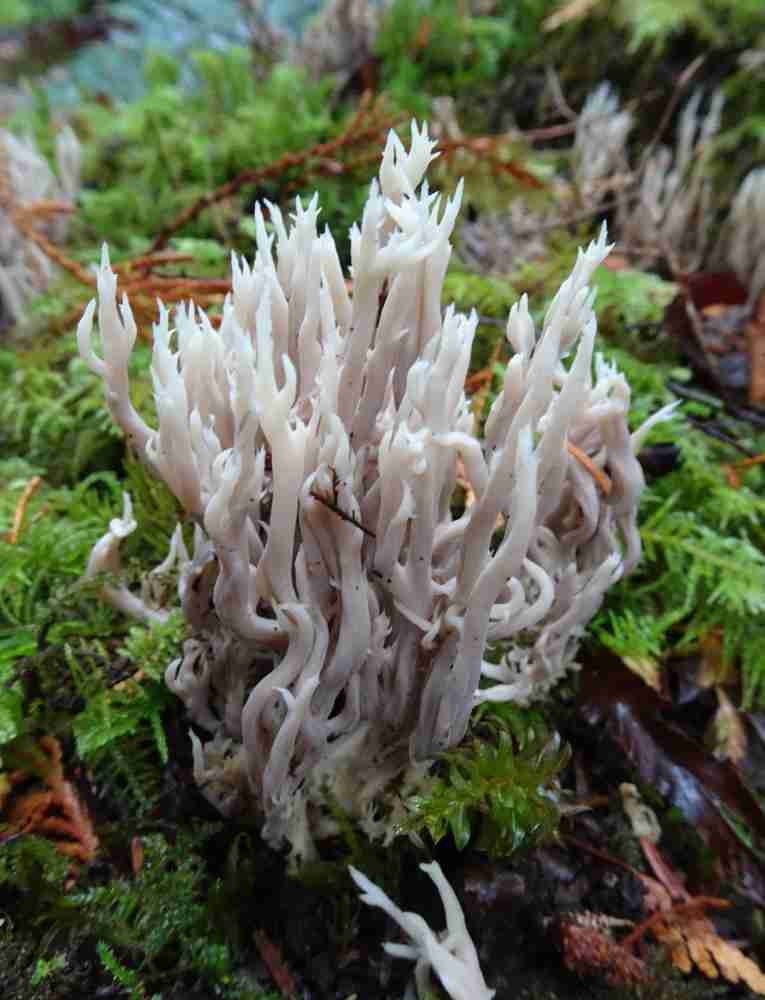
A light grey, twisting coral, from the Cumberland forest.
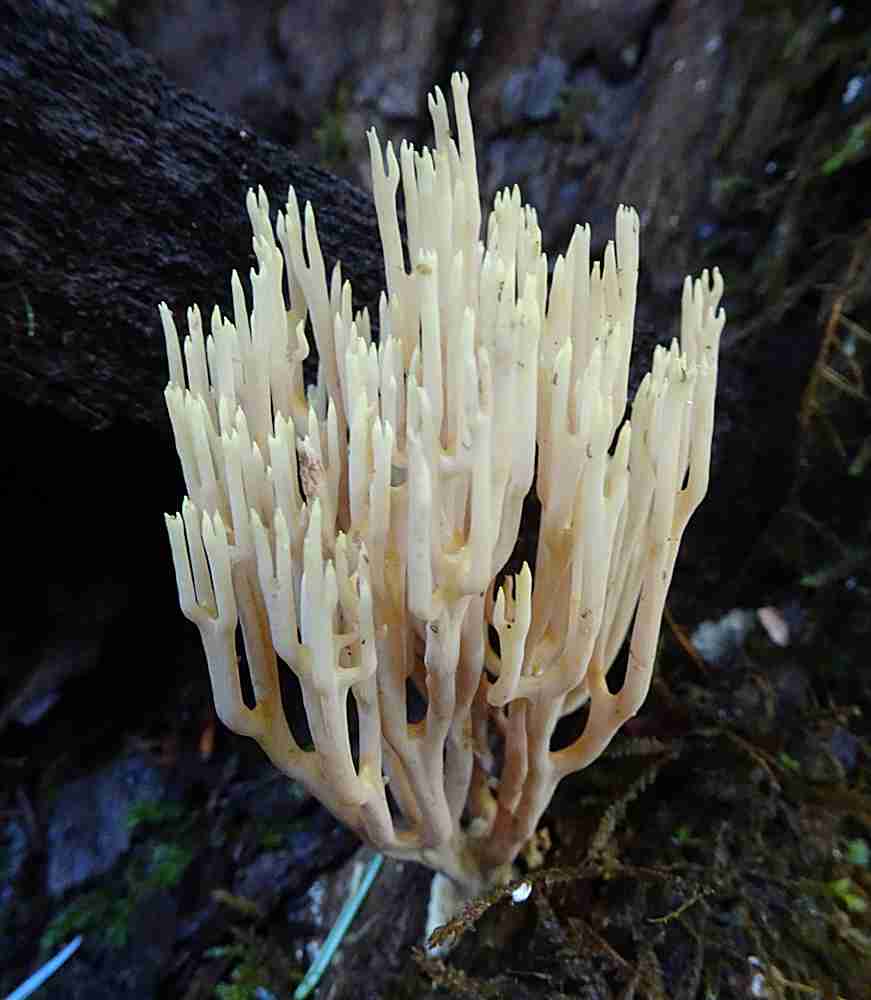
A pale yellow coral, also from Cumberland forest.
An elegant whitish coral, might be another example of the upright coral Ramaria stricta.
Members of Comox Valley Nature (and others) may be interested in a native flora presentation and walk to be held in the Duncan area on October 29. This event will be led by Genevieve Singleton who is a friend of the CVN Botany Group. We have enjoyed previous outings with Genevieve, such as when she led us on a walk in the Mt. Tzuhalem Ecological Reserve and other locations in that area to view Garry oak ecosystems in 2018.
For details, click on the image to enlarge it. Note that there is a small charge for this event.
Posted inNews, Plants and fungi|Comments Off on Cowichan native flora presentation and walk
Alison has provided us with an excellent handout which outlines the different types of fungi. If you are new to fungi this is a great reference (available to CVN members – contact Jocie).
And a few photos [click photo to enlarge]…
From Alison’s yard: a baby amanita that looks like an egg about to hatch!
Kyle F. sent in a strange slime mould (shades of white, pink and black) from Kitty Coleman Park. Loys has done some detective work on this photo, which looks like it might be Stemonitopsis typhina. Another slime to add to the Botany Group photo collection!
Posted inPlants and fungi|Comments Off on More notes on fungi and slime moulds
From an email by Jocie to the Botany Group on October 10.
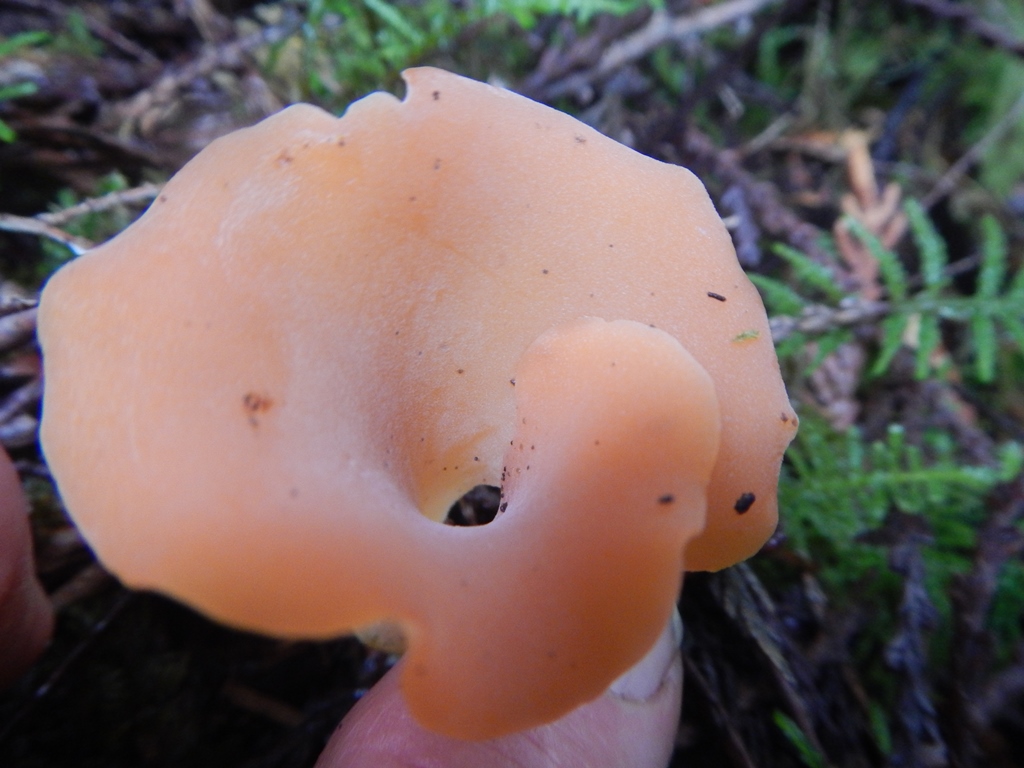
Here are some photos and notes from Alison M. about the lovely apricot jelly fungus.
Alison’s notes
I’d like to add these photos of Tremiscus helvelloides, which would I think come under wonderful if not weird fungi – the common name is apricot jelly. We saw it on the Shepherd’s Creek trail (Buttle Lake area) October 1st. I have also found it on the road to Diver’s Lake, before one gets to the edge of the forest. Georgia O’Keeffe would have been delighted with both the contours and the colour. [Click photo to enlarge it.]
Posted inPlants and fungi|Comments Off on Apricot jelly, anyone?
Join the Comox Valley Conservation Community for a day long celebration of the watersheds and waterways that connect us all in the Comox Valley!Learn about restoration and habitat enhancement projects, salmon cycles, drinking water, forests, creeks, wetlands and estuaries – and so much more. Art projects, kids activities, volunteer engagement opportunities, hands on learning and guided walks – all looking out over the beautiful Puntledge River.Comox Valley Nature will be there with our new outreach tent. Come by and say hello, and try our bird identification game. We can also show you why native plants are best for your garden, and how to spot invasive species.Pack a picnic and stay for the day! Saturday Sept 19th from 9 am – 3 pmin Puntledge Park 1111 1st , Courtenay ...
In her memoir, Pacific Northwest author Caroll Simpson recounts the highs and lows of running a remote fishing lodge on her own following the untimely death of her husband, and of falling in love with the natural world. Simpson tells stories of living in the remote wilderness and managing the lodge, becoming an accidental environmental activist, fending off wild animals, working as an angling guide and finally, fighting off a proposed mining operation and participating in the development of a government land management plan as a spokesperson for the wilderness tourism industry.While Simpson welcomed paying guests at Ookpik Lodge, unwanted house guests included a woodchuck, a pack rat, and martens. Simpson constantly had to watch out for grizzlies, moose, and cougars. Storms and extreme weather also provided fodder for hair-raising tales. All this makes for wonderful storytelling.Caroll’s story is essentially a love story. In an essay for Sierra Club, Simpson wrote: “I developed an immense passion for flora and fauna. Just walking back and forth on the 300’ dock several times a day, I was exposed to the unbelievable beauty of the northern spectrum of water life: the golden eagle soaring above, the osprey and kingfisher diving and coming up with fish for their hatchlings, the muskrats and otters looking for an easy meal, the tireless beaver working into the late evening sunsets. All of these creatures and more expressed their generational ownership of this small piece of the world. In return each was given my utmost respect and admiration…As I listened to the loons at the end of each day and the owl and the wolf in the night, I felt blessed to be witnessing such beauty. “On September 20th, join Comox Valley Nature and Save Our Forests Team for an afternoon of storytelling about this remarkable time spent living on a remote British Columbia lake.The event is being held at the Comox United Church Hall. (250 Beach Drive, Comox) Admission is by donation. Doors open at 2:30; the event begins at 3:00 p.m. There will be time for Q&A after the presentation, as well as books available for purchase. Tea/coffee and cookies - including forest-themed cupcakes - will be available for a donation.Join us, and prepare to fall in love. ...
🎟️ Get your tickets to the Project Watershed 2026 Keeping It Living Dinner today! projectwatershed.ca/2026-keeping-it-living-dinner/Every ticket holder makes a difference. 💙 🎟️ Get your tickets to our 2026 Keeping It Living Dinner today! projectwatershed.ca/2026-keeping-it-living-dinner/When community and local businesses invest in conservation, our entire ecosystem benefits. Ticket sales directly support habitat restoration, scientific research, and environmental education, while the generosity of our sponsors helps offset event costs, ensuring that more of the funds raised can go directly toward this important work. Thank you to our incredible sponsors and dinner attendees for believing in the power of community-led conservation. Odlum Brown Community and Northwest Hydraulic Consultants, 40 Knots Winery, CNB Together, we're keeping our watersheds living. 🌿 Hope to see you September 12, 5 - 8 pm at 40 KNOTS Winery #KeepingItLiving #ProjectWatershed #CommunitySupport #Conservation #ComoxValley ...
The City of Courtenay is developing a long-term vision for Bill Moore Park and Dogwood Park to guide future improvements. To help guide these decisions, three initial concepts have been developed, and there is an opportunity for you to offer your input.The latest survey on the City website engagecomoxvalley.ca/bill-moore-and-dogwood-park asks for feedback on three concept plans and specifically which concept you prefer. The three concepts present a range of recreation possibilities and there is room on the survey for your comments.Dogwood Park is a 2.32‑hectare nature park featuring mature forested areas, natural habitat and a small wetland. Only Concept A will maintain the intact forest areas in Dogwood Park. Concepts B and C propose increased recreation in the park including an off leash dog park, disc golf course, pump track (a purpose built track for children’s cycling) and nature play areas. While the planners may say that no trees or few trees will be taken down to accommodate this, the under-story will not survive this level of trampling and fragmentation. The trees as well as all the wildlife who now call that area home will disappear over time. For those of us who value this forest, Concept A is the only option that makes sense.Dogwood Park is one of the few islands of green for many, many blocks. It provides habitat for wildlife, shade, retains water and acts as a carbon sink. On the architect's base plan of current conditions it is now characterized as an "underutilized space". The City has heard from sports enthusiasts but not nature lovers. Let them know why you value an intact forest and your connection to it. The survey is open until Sept 15. ...
The Canadian Coalition for Invasive Plant Regulation (CCIPR) wants the federal government to establish a regulatory body for the horticultural industry and create a national database identifying invasive plants and their risks in different regions. "Even if we don't prohibit them, we need to let the public know when there is potential harm," said CCIPR co-founder Cathy Kavassalis. "We do this on other products, and we should do it on plants too. It's just common sense."In July, Nanaimo council passed a motion to pursue a bylaw amendment restricting the sale of plants on a list maintained by the Invasive Species Council of B.C. A week later, Surrey moved to ban sales by businesses including nurseries, large retail chains and florists. Kavassalis said a problem that could be addressed at higher levels of government is being pushed down to municipalities."These are all patchwork solutions that, in some ways, just waste a lot of resources," she said. The CCIPR says a national database could give provinces, territories, retailers and gardeners a shared source of information about which plants pose risks in different regions. Kavassalis also wants invasive plants removed from shelves or clearly labelled.For more on this story visit www.cbc.ca/news/science/invasive-plants-sale-federal-regulation-9.7312362 or see our link in bio ...