From an email by Jocie to the Botany Group on October 9.
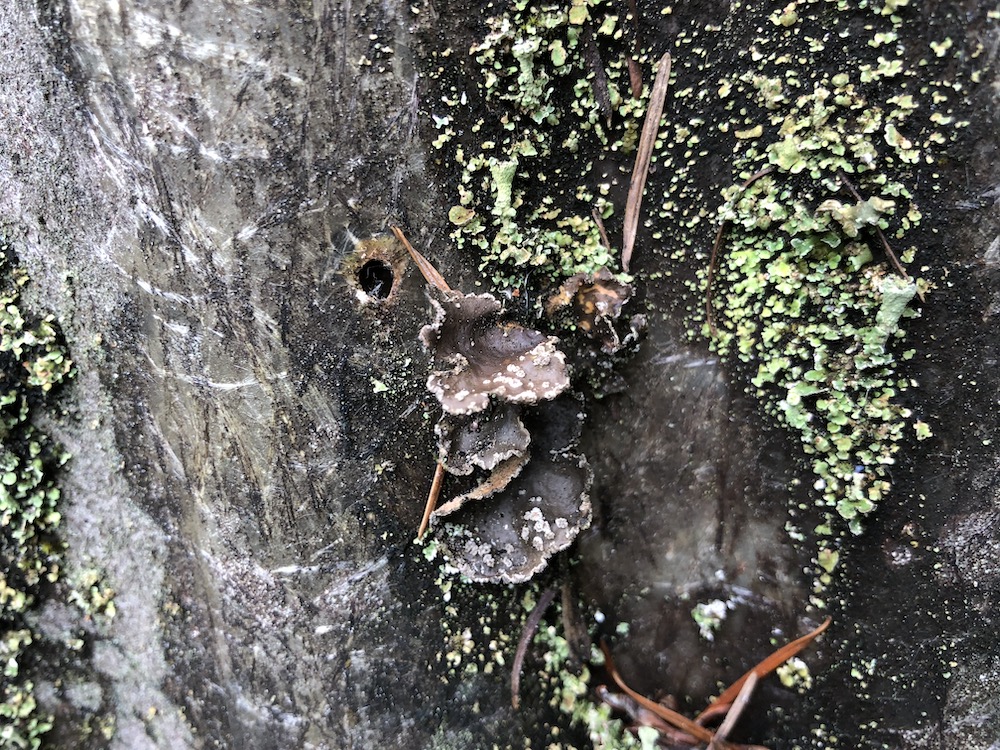
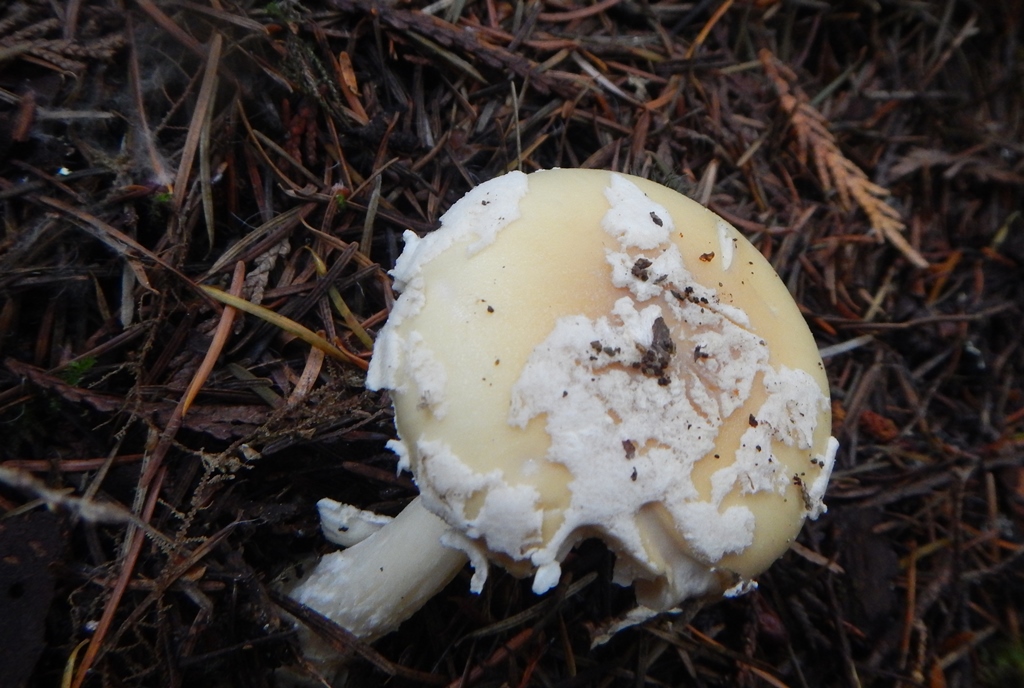
The fun of fungi is never knowing what will turn up from one year to the next…every year I seem to find fungi that are new to me. This is a vast and difficult group of organisms to study—humbling but inspiring!
Here are a few highlights of things I’ve seen lately:
Strawberries and cream, also known as the blood fungus (Hydnellum peckii): spectacular when fresh, a favourite!
Cauliflower (Sparassis crispa): edible, but too beautiful to eat.
Angel wings (Pleurocybela porrigens): edible, and likewise too beautiful to eat!
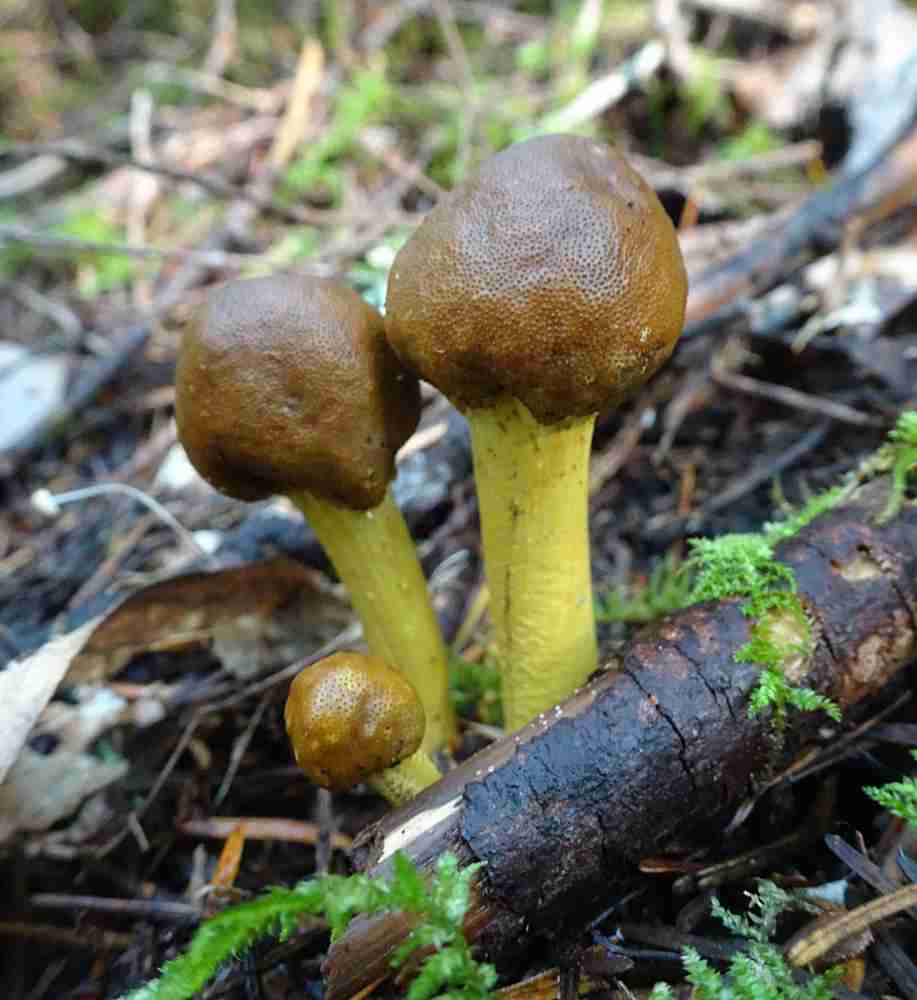
Round-headed truffle club (Tolypocladium capitatum): these strange little shrooms grow from an underground truffle, Elaphomyces. Note the pimply texture of the cap.
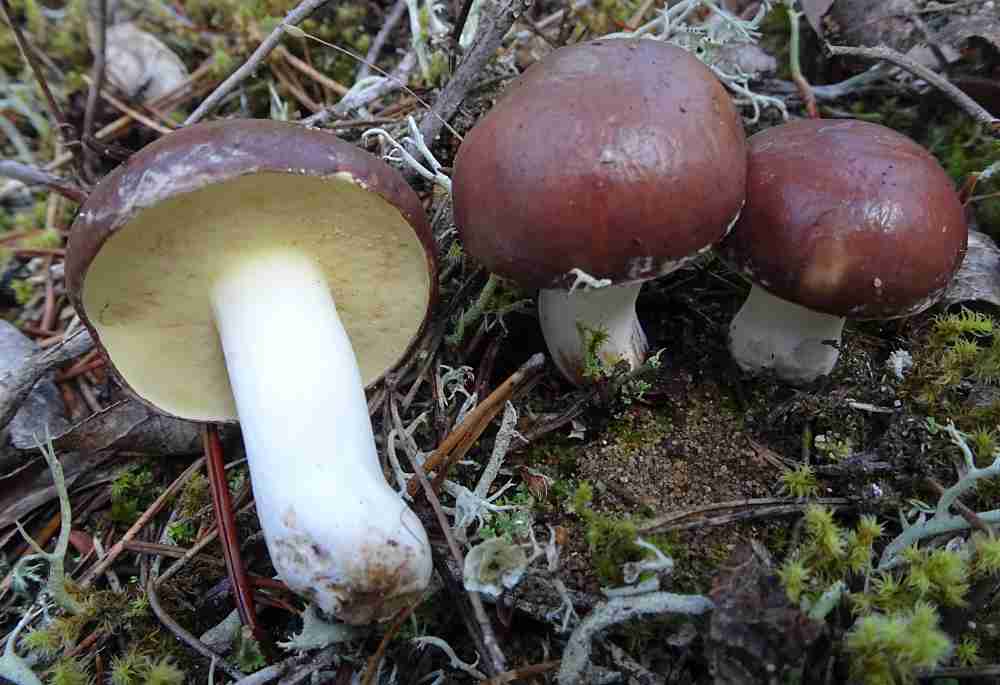
Slippery jack (genus Suillus).
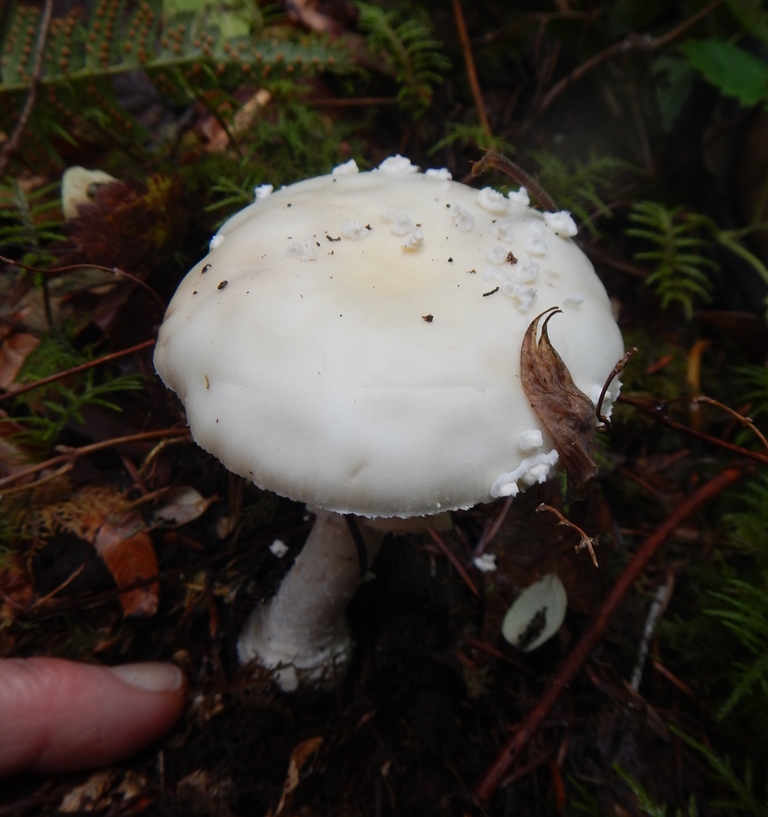
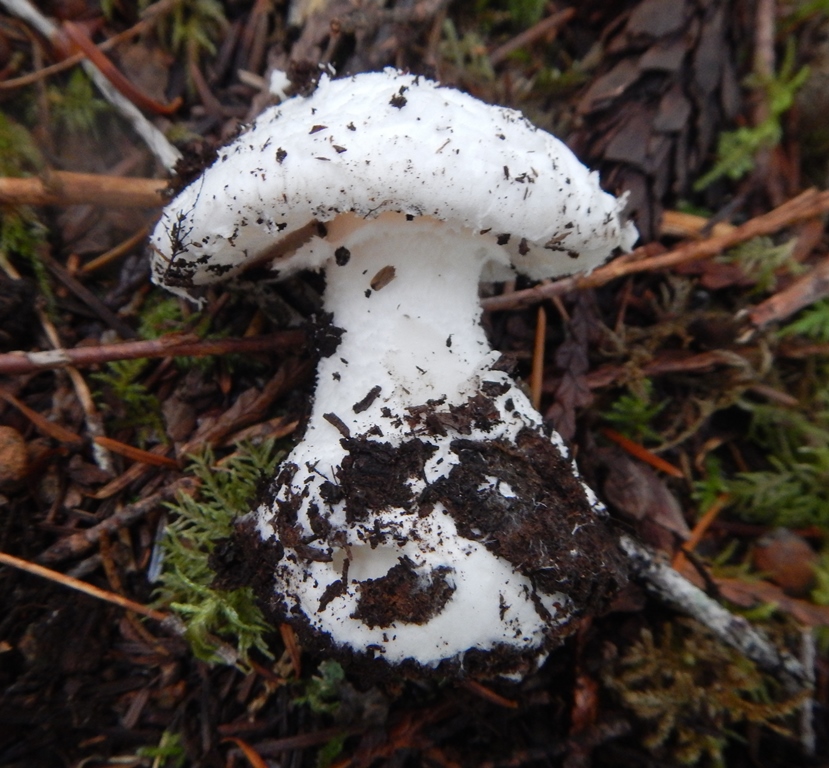
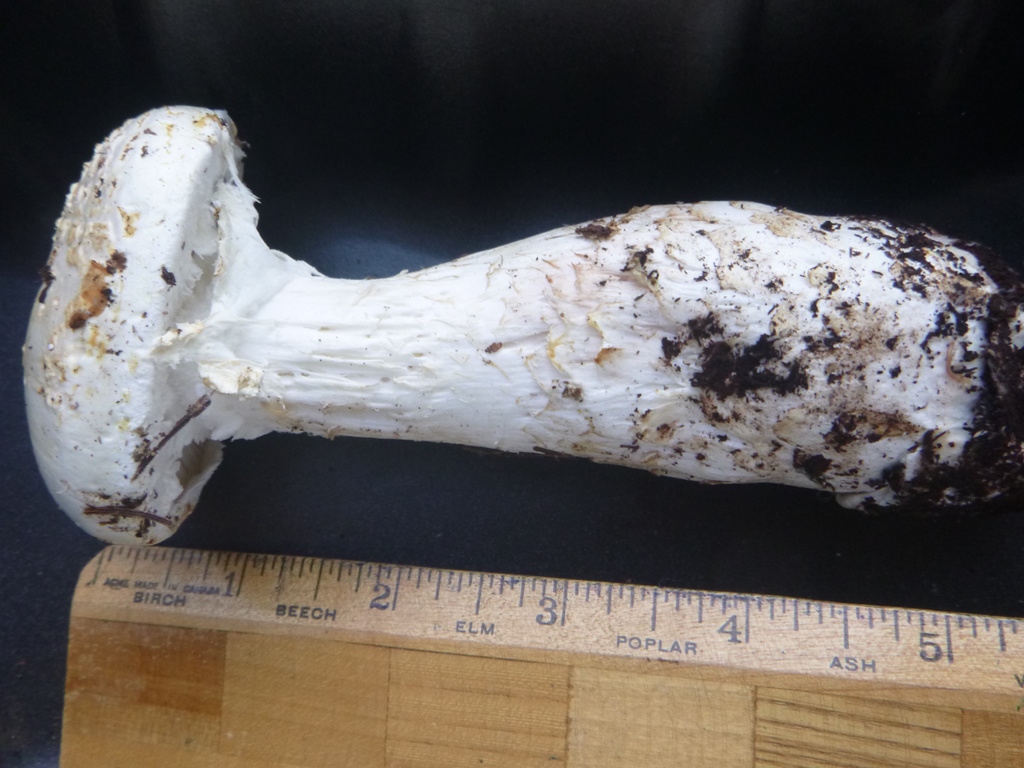
Lastly is a slime mould (not a fungus) that I stumbled upon while fungi-looking. Coral slime (genus Ceratiomyxa) is tiny, with finger-like clusters that look like miniature anemones. On a rotting log.
Most of these are from an area of small lakes north of Campbell River, where I was hunting for chanterelles (sorry, can’t disclose the exact location!).
The strawberries and cream and slippery jacks are from the Merville Woods (Williams Beach Road).
Posted inPlants and fungi|Comments Off on Weird random fungi (and a slime)
Note by Alison M. to the Botany Group, distributed by Jocie on October 2.
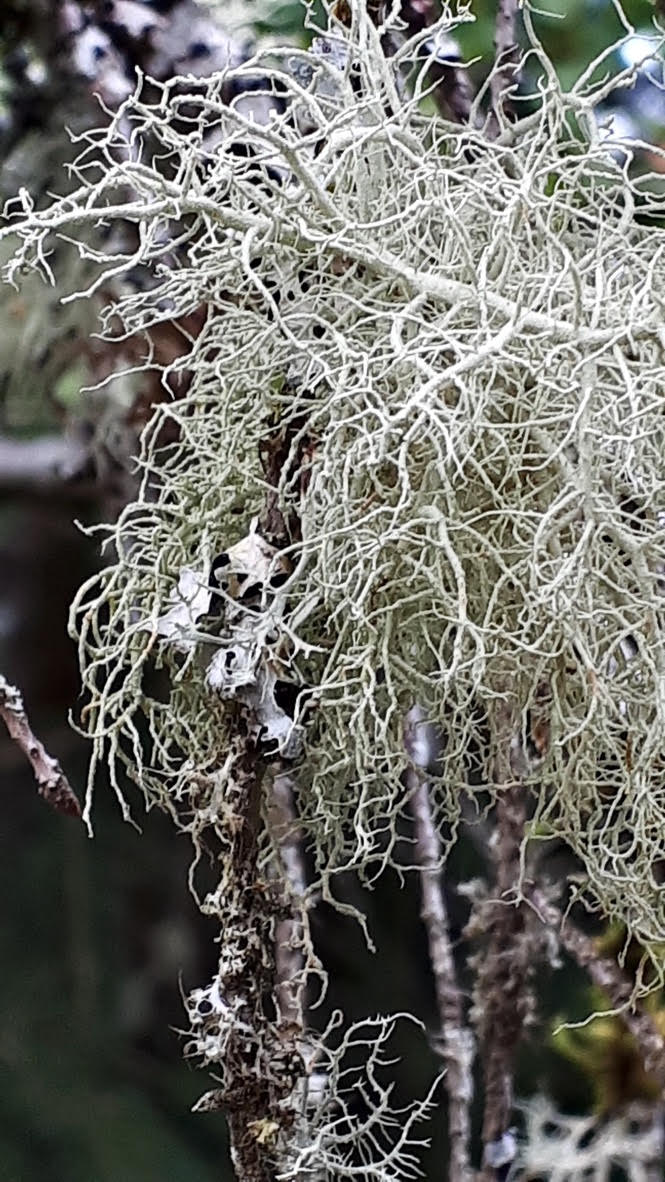
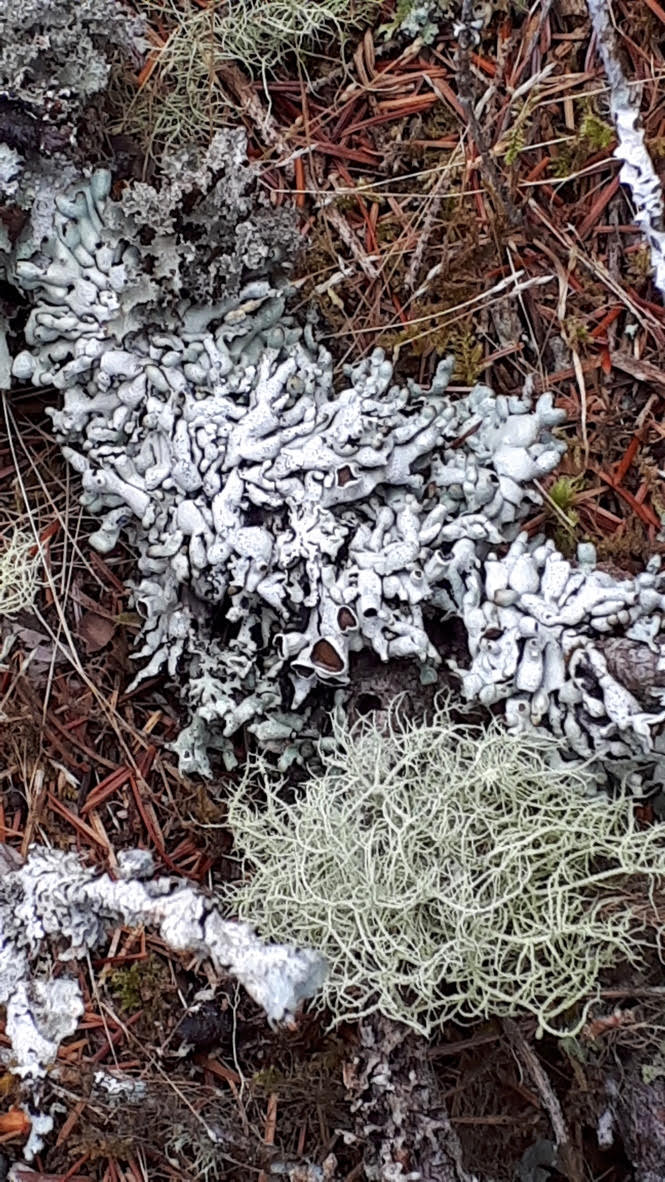
Sticta limbata
This is a lichen Loys found on the aging fibreglass “window” on our garage, about 100 feet from the house. Amazing what is right under our noses. [Click photo to enlarge.]
Global Status “Vulnerable” G3G4; Canada “N3N4”; BC “S3S4”.
Sticta limbata is rare in the Appalachians, and it is rare from the Californian Santa Cruz Mountains northward into Oregon in the North Coast Ranges. Additionally, this foliose lichen is known from Alaska southward and rarely inland to British Columbia. The species also occurs in Europe, Australia, and New Zealand. The lichen grows on bark (on beech trees – Fagus sp. – in the high elevations of the Appalachians) or over mosses on trees.
From an email by Jocie to the Botany Group on September 26.
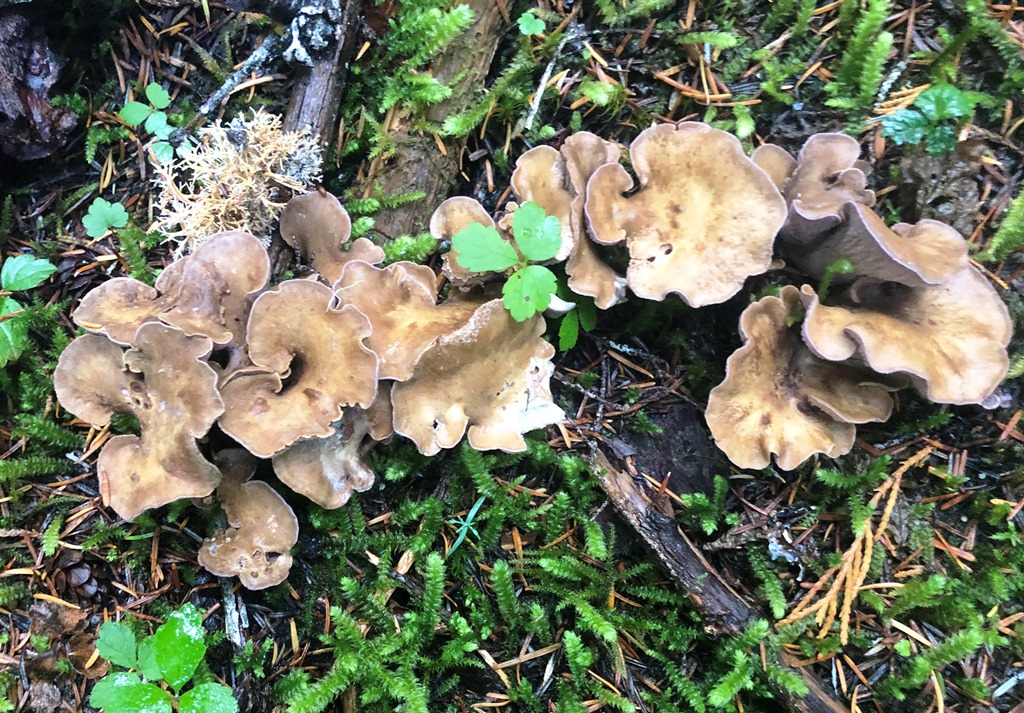
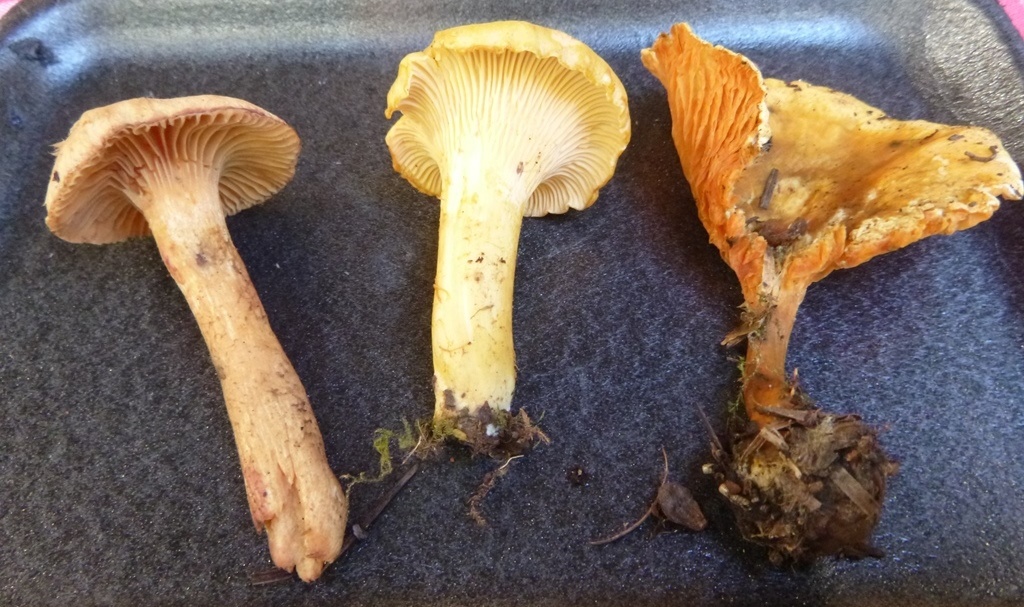
Jan S. passed along these wacky looking chanterelles!
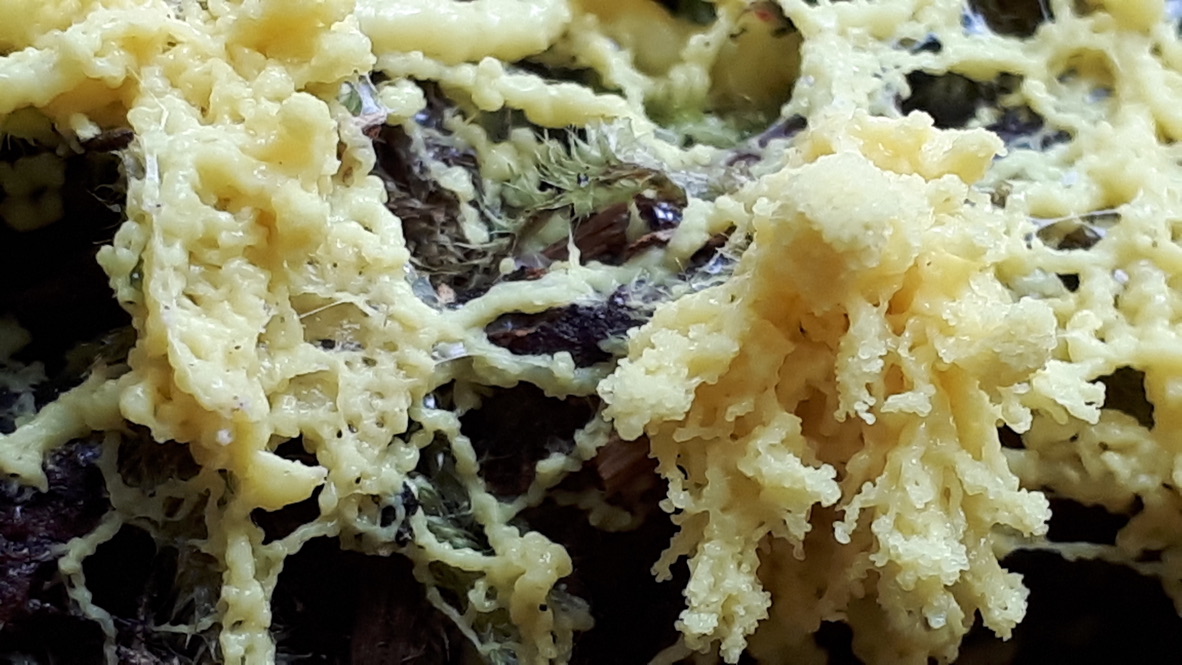
Also, some close-up photos from Sharon N. of slime moulds from Nymph Falls.
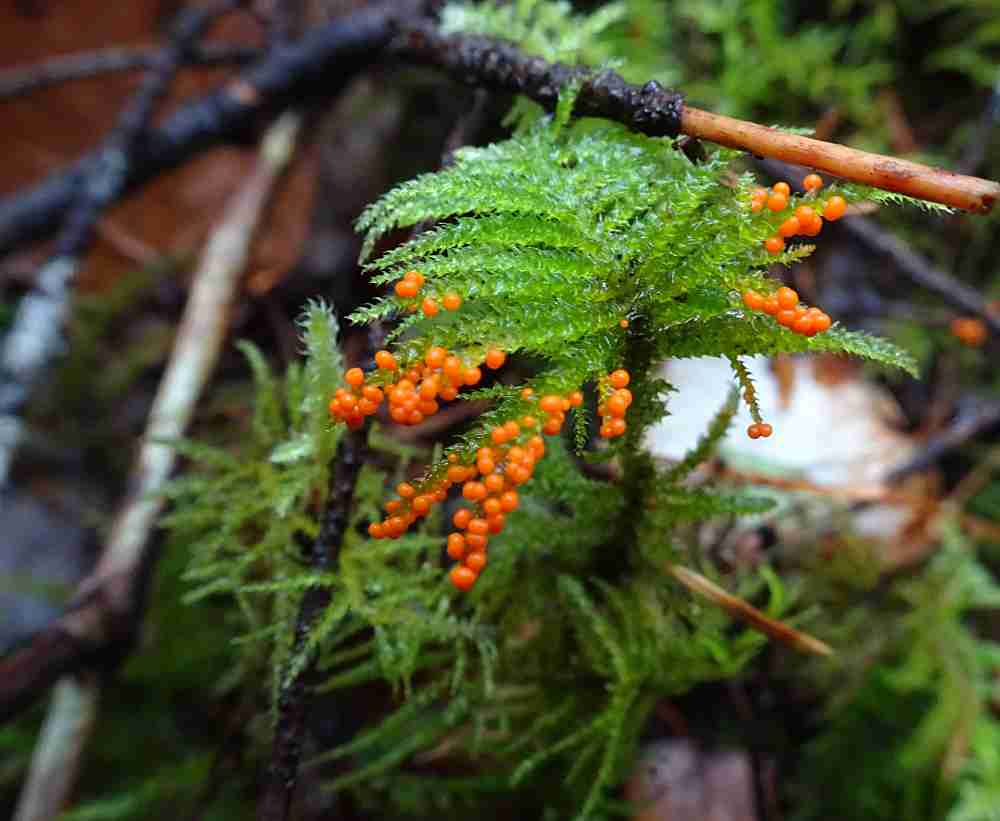
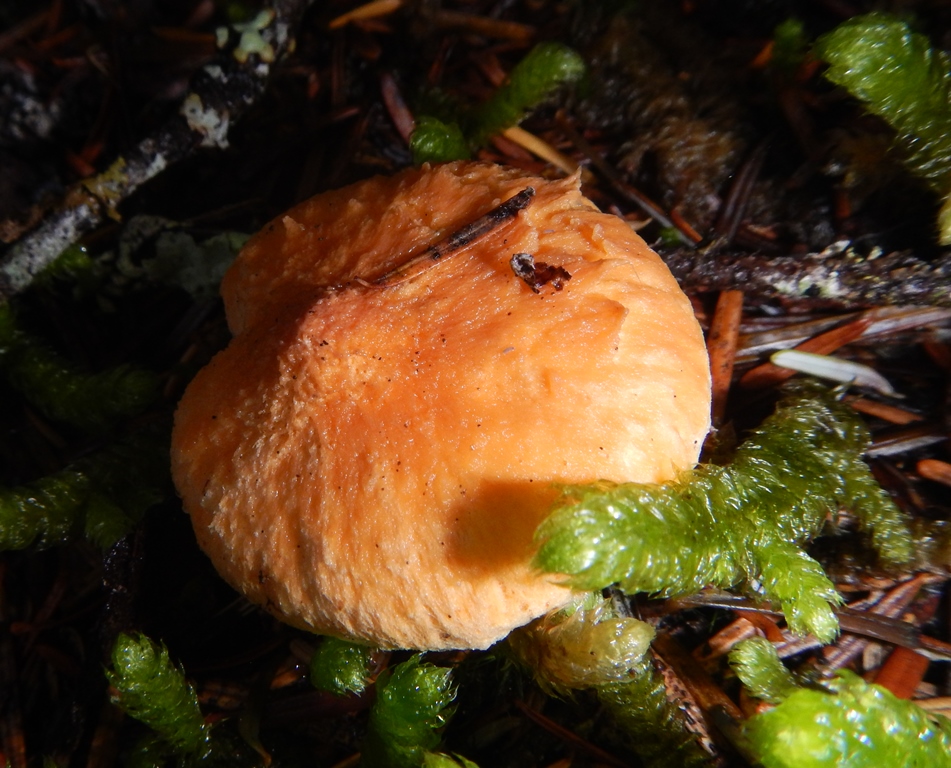
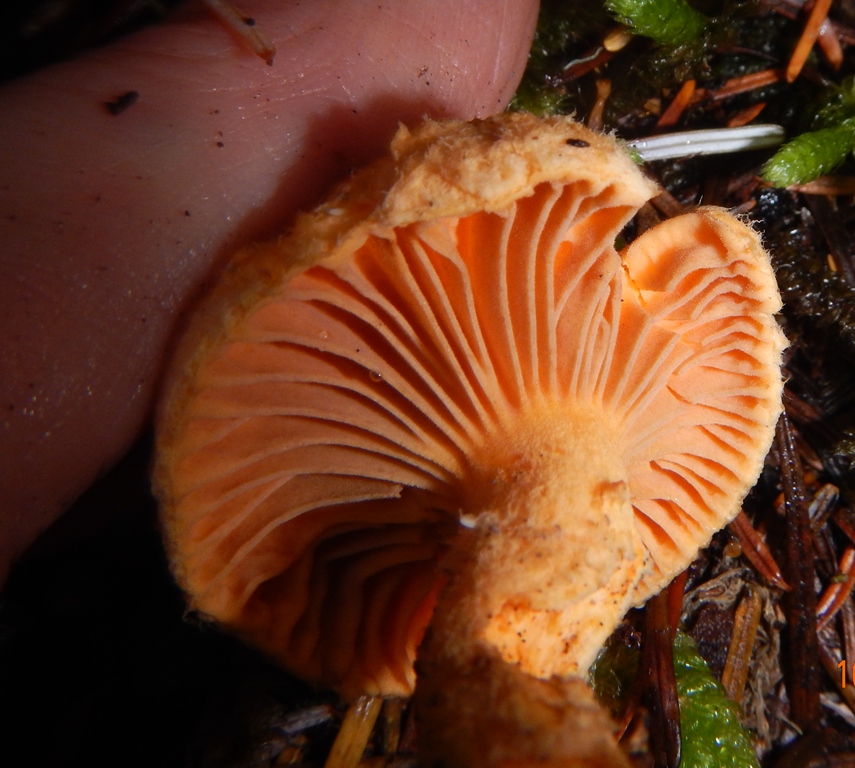
While looking for chanterelles last week I found dots of tiny orange slime on some Oregon beaked moss (Kindbergia oregana). I haven’t ID’d it yet…if any of you know what this diminutive slime is, let me know.
Since we are in shroom season…send in your fungi pics! I might not be able to ID them for you; if not, our local expert Alison might give it a shot.
Comox Valley Nature is pleased to host a free online lecture by Jackie Hildering. The lecture entitled The Return of Giants! is on Sunday October 18, 2020, 7:00 – 9:00 pm.
[Click image to enlarge.]
Given the current situation with the Covid-19 virus, Comox Valley Nature has made arrangements to have a live, online webinar for Jackie’s presentation. You will need to pre-register:
The fortunate increase of humpbacks along BC’s coast is a game changer for vessels of all sizes. It is essential for boaters to know how unpredictable humpbacks can be. They are often oblivious of boats and do not have the biosonar/echolocation of toothed whales like Orca. They can suddenly surface after long dives and are often moving in unpredictable patterns whereby, if it is assumed that they are travelling in a straight line, risk of collision is increased.
The preliminary results of research by the Marine Education & Research Society (MERS) also indicate how severe a threat entanglement is, with about 50% of the humpback whales having scarring from entanglement. These are the survivors. Most whales that die from collision or entanglement sink to the bottom of the ocean.
Join the webinar to learn about the wonder of humpbacks and about how to reduce threats to both whales and boaters.
Jackie is a cofounder of Humpback Whale Researcher & Education and is the Communications Director for MERS. Jackie taught biology and administered international schools in the Netherlands for 14 years and since returning to BC in 1999, has worked as a marine naturalist and naturalist trainer striving to create positive environmental change. Her work has included being the local Department of Fisheries and Oceans Education Coordinator, Communications Director for the SOS Marine Conservation Foundation and Community Liaison for the ‘Namgis First Nation’s KUTERRA land-based salmon farm. She uses her underwater photography and storytelling as “The Marine Detective” to increase awareness of the biodiversity, mystery and fragility of life in the NE Pacific Ocean. For Jackie’s full bio, please visit the MERS website here.
This is an excellent opportunity for the public to learn more about the humpback whales in our area.
If you are new to Comox Valley Nature, find out more about us here.
Posted inGuest Speakers, News|Comments Off on Public invited to learn about humpback whales in our waters
Contributed by Alison M. Click an image to enlarge it.
Amanitas are amongst the most stunning, but toxic fungi.
In general, most species in the Amanita genus are easily recognizable through the following features (see illustration 1): a cap with “warts” which are the remnants of the universal veil that encased the embryonic fruiting body; at the base a distinct volva out of which the fruiting body grew, a ring around the upper part of the stem/stipe, again part of the universal veil; white spores.
(1)
(2) Amanita muscaria
First, the most commonly observed Amanita muscaria (fly agaric, photo 2) with its bright red cap and white warts. There is not total agreement on the varieties we have in the Pacific Northwest including A. muscaria var. flavivolvatus and A. muscaria var. alba (see MatchMaker for details).
(3) Amanita pantherina
(4) Amanita gemmata
(5) Amanita sp.
(6) Amanita sp.
Common to our area is also a brown species with white warts, Amanita pantherina (photo 3), as well as two with yellow caps and white warts – Amanita aprica and Amanita gemmata (photo 4). The former tends to appear in the spring, the latter in the fall. There is a broad colour range from bright to dull, apricot shades to pale lemon (photos 5 & 6). To add to the confusion, very young A. muscaria can be quite yellow in appearance.
Two white amanitas in our area:
Amanita silvicola (photo 7), which has a short stubby stipe emerging from a round volva and is covered with lots of cottony tissue.
(7) Amanita silvacola
Amanita smithiana, which by contrast has a long stipe, emerging from a bulbous base that tapers towards the “root” end (photos 8 & 9). Hence the latter might be mistaken for Tricholoma magnivelare (pine mushroom, photo 10) which of course has no warts, and is recognizable by its sweet cinnamon smell. As always, PICKER BEWARE.
(8) Amanita smithiana
(9) Amanita smithiana
(10) Tricholoma magnivelare
This September, Kate and Gary found an early stage Amanita pachycolea (western grisette) on a path in their woods (photo 11). We located a mature example on the trail to McKenzie Lake in the Park. The cap is striate, often without warts, and the stipe is quite slender, emerging from a volva that is constricted half way up (photos 12 & 13).
(11) Amanita pachycolea – young
(12) Amanita pachycolea – cap
(13) Amanita pachycolea
A final word on the two most prominent amanitas with lethal amatoxins (the photos here are scanned from Siegel and Schwarz, Mushrooms of the Redwood Coast):
Amanita ocreata,(western destroying angel), spring fruiting, with hardwoods (including various oak species) in California; not to my knowledge this far north (photo 14).
Amanita phalloides (death cap), fruiting possible year round, with hardwoods (photo 15). It was introduced from Europe on the roots of the cork oak, and has become naturalized in California. It has spread north mostly through the movement of nursery ornamentals, and has reached Victoria and south Vancouver Island & Salt Spring Island (?), but has not been observed in the Comox Valley. [Editor’s note: Subsequent to this post, death caps have been observed here; see this later post.]
(14) Amanita ocreata
(15) Amanita phalloides
Posted inPlants and fungi|Comments Off on Amanitas (Alison’s fungi notes, part 2)
Mark and Pat W. recently contacted the Birding Group when a pair of unusual (at least to most of us) birds was spending time feeding in their back yard for about a week. From the mobile phone photos provided, several members helped identify the birds as Wilson’s Snipe, which the CVN bird checklist informs us is “fairly common” in late September.
CVN member and professional photographer Bruce Moffat took up Mark and Pat’s invitation to come and see the birds. Luckily they were still present, and Bruce soon shared these photos with the group [click a photo to enlarge it].
Bruce was particularly keen to see these birds because he (and some others) had set himself the challenge of photographing 150 bird species on Vancouver Island in the 2020 calendar year. Although he had already exceeded that goal (!), he had upped the target to 165 species to keep the challenge going.
Notes and photos provided to the Botany Group by Alison M. Click a photo to enlarge it.
Part 1: Fungi with veins and folds
As you will have noticed with the cooler wetter weather, fungi are starting to appear. Jocie has already presented the much sought-after golden chanterelle along with a delicious looking soup. In the list below are a few good edibles, but most of the fungi to be found in the woods, whether in the valley or up in the subalpine, are best admired in their environment. And always remember “when in doubt…leave it out .”
One of the distinctive features of Craterellus formosus (golden chanterelle) is the blunt vein-like folds (not gills) on the underside of the cap where the spores reside (see this previous post). This is one of the 14 major morphological groups of fungi (in the list used by the Pacific Northwest Key Council ). Below are other fungi that have similar fertile surfaces.
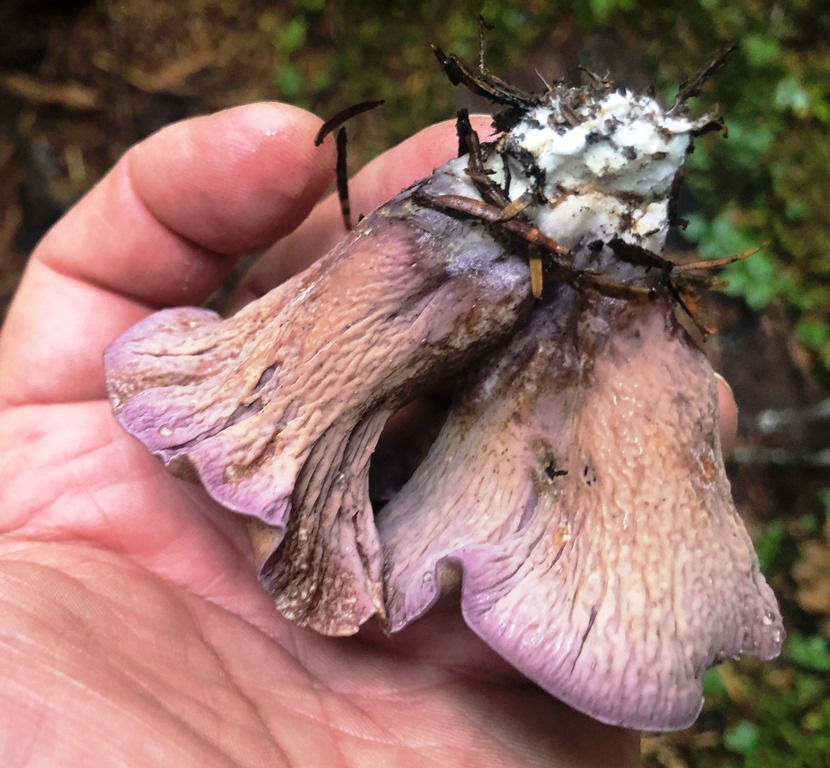
One of these is the Gomphus clavatus , commonly known as pig’s ears, also a good edible, if you get to it before the fly larvae tunnel through the flesh. The blunt veins are a purplish colour contrasting the dingy beige of the cap. In terms of flavour it is not unlike the chanterelle, although it has been known to cause gastrointestinal upset in some people.
Gomphus clavatus – cap
Gomphus clavatus – underside
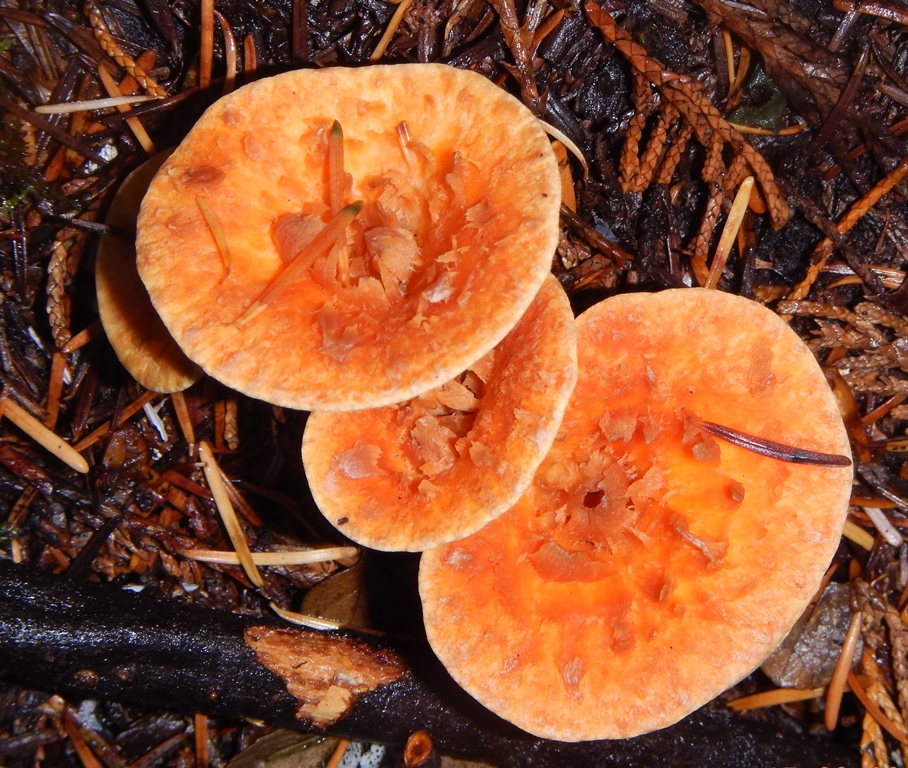
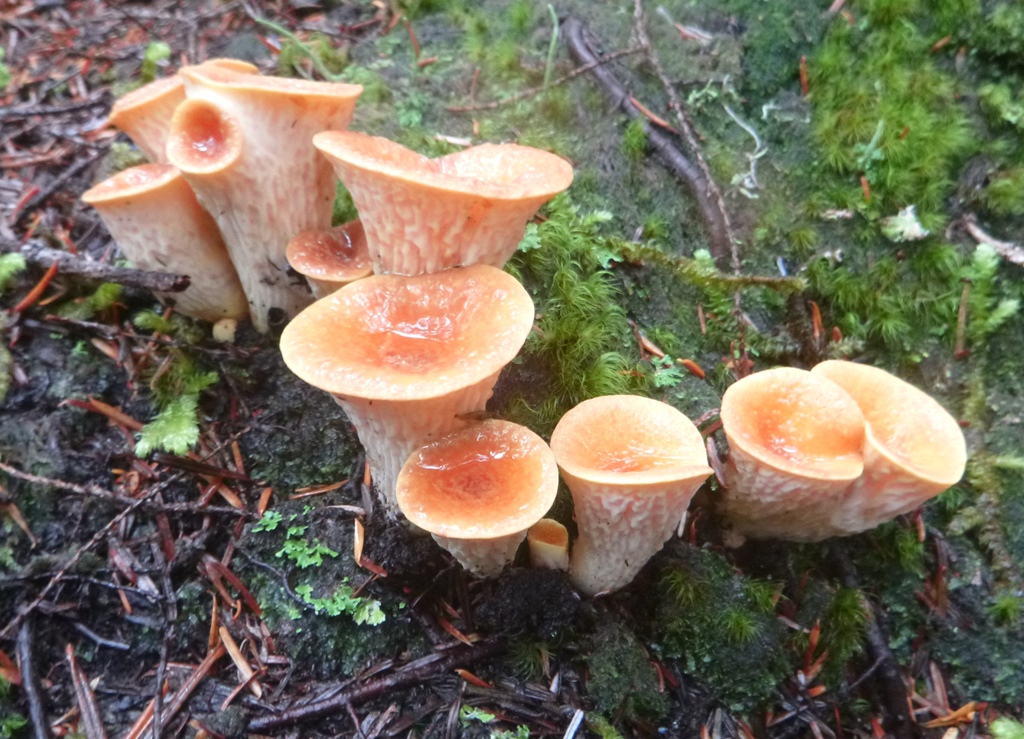
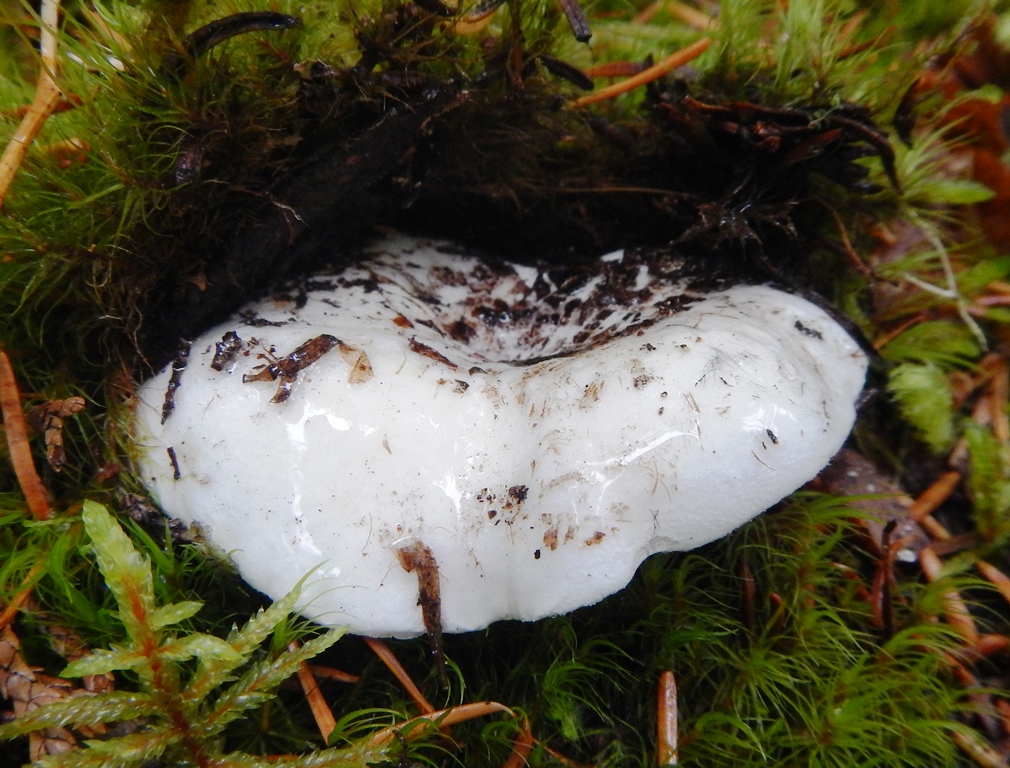
The so-called woolly chanterelleTurbinellus floccosus (formerly Gomphus floccosus) also has blunt veins and a vase shape. It starts out as a series of cylindrical tubes as in seen in the lower centre of the second photo and is a brilliant red colour on the cap when mature. In texture it is extremely tough, and so inedible.
Turbinellus floccosus – cap
Turbinellus floccosus – underside
The underside of the so-called lobster mushroom – Hypomyces lactifluorum – also has the appearance of blunt ridges. It is the product of a parasitic take-over of a Russula brevipes by the hypomyces. The blunt ridges are the only trace left of the original gills of the russula. The lobster is a good edible, even though its original form, like most russulas, is bitter and unpalatable.
Hypomyces lactifluorum
Russula brevipes – cap
Finally a word on look-alikes in the first photo below. Seen from afar, Chroogomphus tomentosus (on the left) can fool you into thinking “chanterelle”, but its cap is rounded (middle photo). not flat or depressed, and as soon as you turn it over (last photo) you will see sharpish deep gills, ending just below the cap, not the blunt veins of the chanterelle, and a hint of the dark spore (chanterelles have a white spore). The fungus on the right in the first photo is Hygrophoropsis aurantiaca, which has sharp gills (sorry, not the best specimen here). It is a lurid orange in colour with thin flesh and thin stipe. So always look closely under the cap of your putative chanterelle.
Chanterelle and look-alikes
Chroogomphus tomentosus – cap
Chroogompnus tomentosus – underside
Happy foraging!
Posted inPlants and fungi|Comments Off on Alison’s fungi notes, part 1
From an email by Jocie to the Botany Group on September 25.
It’s that time of year again, when the fruiting fungi start to magically appear after the rain.
Here’s a few photos of the Pacific golden chanterelle (Cantharellus formosus). They often have a lovely vase shape with a fluted cap…very decorative! I recently went for a short foray and found enough to make soup….
If you missed the fascinating presentation by Dan Strickland on his research into the Canada Jay in Strathcona Park (see the announcements here and here), a recording of the webinar is now available, courtesy of the Canadian Society of Environmental Biologists:
Join the Comox Valley Conservation Community for a day long celebration of the watersheds and waterways that connect us all in the Comox Valley!Learn about restoration and habitat enhancement projects, salmon cycles, drinking water, forests, creeks, wetlands and estuaries – and so much more. Art projects, kids activities, volunteer engagement opportunities, hands on learning and guided walks – all looking out over the beautiful Puntledge River.Comox Valley Nature will be there with our new outreach tent. Come by and say hello, and try our bird identification game. We can also show you why native plants are best for your garden, and how to spot invasive species.Pack a picnic and stay for the day! Saturday Sept 19th from 9 am – 3 pmin Puntledge Park 1111 1st , Courtenay ...
In her memoir, Pacific Northwest author Caroll Simpson recounts the highs and lows of running a remote fishing lodge on her own following the untimely death of her husband, and of falling in love with the natural world. Simpson tells stories of living in the remote wilderness and managing the lodge, becoming an accidental environmental activist, fending off wild animals, working as an angling guide and finally, fighting off a proposed mining operation and participating in the development of a government land management plan as a spokesperson for the wilderness tourism industry.While Simpson welcomed paying guests at Ookpik Lodge, unwanted house guests included a woodchuck, a pack rat, and martens. Simpson constantly had to watch out for grizzlies, moose, and cougars. Storms and extreme weather also provided fodder for hair-raising tales. All this makes for wonderful storytelling.Caroll’s story is essentially a love story. In an essay for Sierra Club, Simpson wrote: “I developed an immense passion for flora and fauna. Just walking back and forth on the 300’ dock several times a day, I was exposed to the unbelievable beauty of the northern spectrum of water life: the golden eagle soaring above, the osprey and kingfisher diving and coming up with fish for their hatchlings, the muskrats and otters looking for an easy meal, the tireless beaver working into the late evening sunsets. All of these creatures and more expressed their generational ownership of this small piece of the world. In return each was given my utmost respect and admiration…As I listened to the loons at the end of each day and the owl and the wolf in the night, I felt blessed to be witnessing such beauty. “On September 20th, join Comox Valley Nature and Save Our Forests Team for an afternoon of storytelling about this remarkable time spent living on a remote British Columbia lake.The event is being held at the Comox United Church Hall. (250 Beach Drive, Comox) Admission is by donation. Doors open at 2:30; the event begins at 3:00 p.m. There will be time for Q&A after the presentation, as well as books available for purchase. Tea/coffee and cookies - including forest-themed cupcakes - will be available for a donation.Join us, and prepare to fall in love. ...
🎟️ Get your tickets to the Project Watershed 2026 Keeping It Living Dinner today! projectwatershed.ca/2026-keeping-it-living-dinner/Every ticket holder makes a difference. 💙 🎟️ Get your tickets to our 2026 Keeping It Living Dinner today! projectwatershed.ca/2026-keeping-it-living-dinner/When community and local businesses invest in conservation, our entire ecosystem benefits. Ticket sales directly support habitat restoration, scientific research, and environmental education, while the generosity of our sponsors helps offset event costs, ensuring that more of the funds raised can go directly toward this important work. Thank you to our incredible sponsors and dinner attendees for believing in the power of community-led conservation. Odlum Brown Community and Northwest Hydraulic Consultants, 40 Knots Winery, CNB Together, we're keeping our watersheds living. 🌿 Hope to see you September 12, 5 - 8 pm at 40 KNOTS Winery #KeepingItLiving #ProjectWatershed #CommunitySupport #Conservation #ComoxValley ...
The City of Courtenay is developing a long-term vision for Bill Moore Park and Dogwood Park to guide future improvements. To help guide these decisions, three initial concepts have been developed, and there is an opportunity for you to offer your input.The latest survey on the City website engagecomoxvalley.ca/bill-moore-and-dogwood-park asks for feedback on three concept plans and specifically which concept you prefer. The three concepts present a range of recreation possibilities and there is room on the survey for your comments.Dogwood Park is a 2.32‑hectare nature park featuring mature forested areas, natural habitat and a small wetland. Only Concept A will maintain the intact forest areas in Dogwood Park. Concepts B and C propose increased recreation in the park including an off leash dog park, disc golf course, pump track (a purpose built track for children’s cycling) and nature play areas. While the planners may say that no trees or few trees will be taken down to accommodate this, the under-story will not survive this level of trampling and fragmentation. The trees as well as all the wildlife who now call that area home will disappear over time. For those of us who value this forest, Concept A is the only option that makes sense.Dogwood Park is one of the few islands of green for many, many blocks. It provides habitat for wildlife, shade, retains water and acts as a carbon sink. On the architect's base plan of current conditions it is now characterized as an "underutilized space". The City has heard from sports enthusiasts but not nature lovers. Let them know why you value an intact forest and your connection to it. The survey is open until Sept 15. ...
The Canadian Coalition for Invasive Plant Regulation (CCIPR) wants the federal government to establish a regulatory body for the horticultural industry and create a national database identifying invasive plants and their risks in different regions. "Even if we don't prohibit them, we need to let the public know when there is potential harm," said CCIPR co-founder Cathy Kavassalis. "We do this on other products, and we should do it on plants too. It's just common sense."In July, Nanaimo council passed a motion to pursue a bylaw amendment restricting the sale of plants on a list maintained by the Invasive Species Council of B.C. A week later, Surrey moved to ban sales by businesses including nurseries, large retail chains and florists. Kavassalis said a problem that could be addressed at higher levels of government is being pushed down to municipalities."These are all patchwork solutions that, in some ways, just waste a lot of resources," she said. The CCIPR says a national database could give provinces, territories, retailers and gardeners a shared source of information about which plants pose risks in different regions. Kavassalis also wants invasive plants removed from shelves or clearly labelled.For more on this story visit www.cbc.ca/news/science/invasive-plants-sale-federal-regulation-9.7312362 or see our link in bio ...