CVN members will be interested in Dr. John Neilson’s report to Conservancy Hornby Island on the need to protect herring in our area. The report is titled “The Science Case for a Marine Protected Area in Lambert Channel: Conservation Benefits for Pacific Herring,” and you can download it here.
CTV Vancouver Island reported on this. You can see their video here.
An online article by mycomoxvalleynow.com also covers this story in more detail. See it here.
The TV story gives equal time to the fishing industry which, of course, disputes the call for more protection. Read John’s report and the media coverage and judge for yourself.
From an email by Kelly to the Birding Group on November 23.
Today the last sample was taken from Courtenay Airpark Lagoon. All 17 weekly samples were shipped today to Guelph University for analysis.
The sampling team consisted of myself, Shirley C., Rick H., Gael A., Linda G. and Gordon S.. Well done team!
Some photos are attached. The last photo shows the filter disks. [Click a photo to enlarge it.]
For those hearing this for the first time, the samples are to assist Bettina Thalinger (University of Guelph) with her research for a method to identify bird species at remote sites.
Posted inBirds|Comments Off on eDNA sampling project completed
From an email by Jocie to the Botany Group on November 22.
Alison M. has put together an informative overview of some of the toothed fungi: hydnums and hydnellums.
[Click a photo to enlarge it.]
Alison’s notes
Well into November there are still gilled mushrooms popping up in the valley – species of the Inocybe genus and Stropharia tend to be among the later fungi in the sequence. I still have chanterelles appearing. This however is the time when some of the toothed fungi come into their own, fungi that have little spines (rather than gills) as the spore-bearing part of the mushroom.
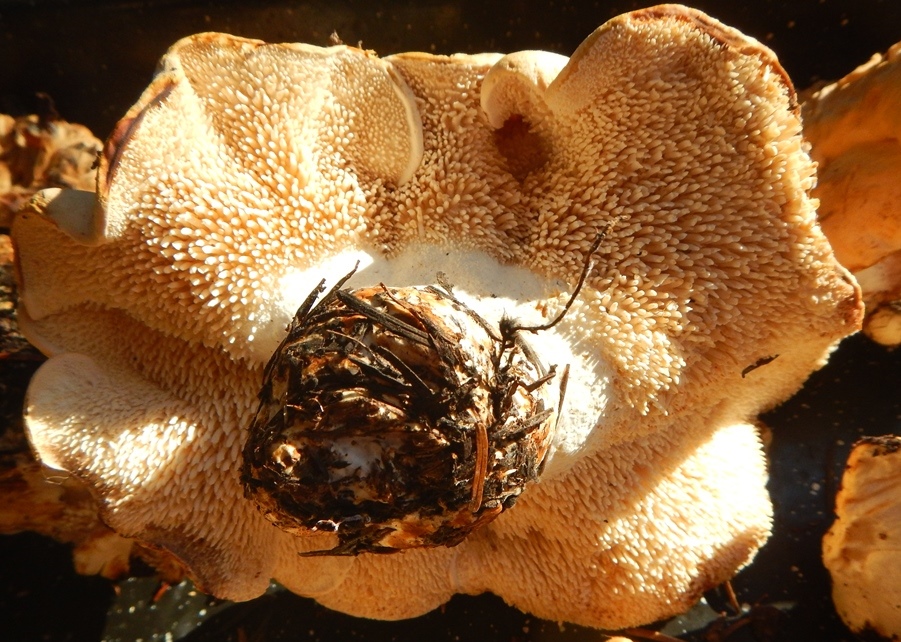
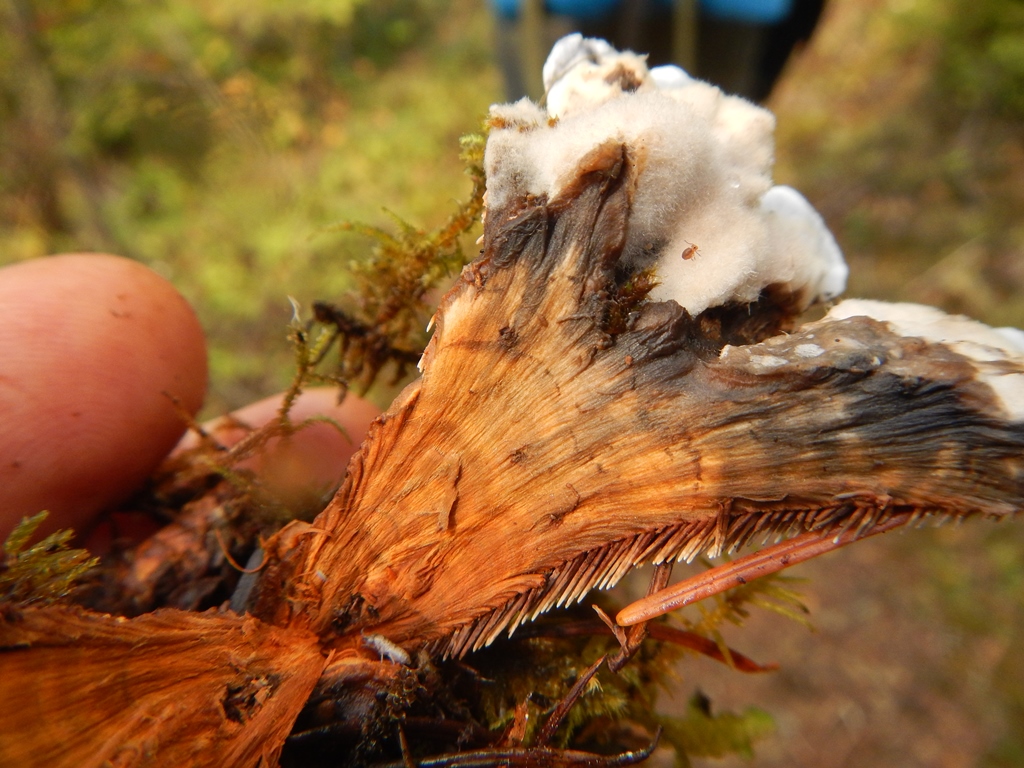
So first the Hydnumgenus – commonly known as the hedgehog. Hydnum is the Latinized from of Greek hudnon, a word Theophrastus appears to use for “truffle”, so I am not entirely sure why it was chosen for the genus name. In the valley the smaller Hydnum umbilicatum is common (photo #1 from Tsolum River Road) and also in the lower elevation areas over at Buttle Lake. Its name comes from its depressed cap like a belly-button. Hydnum repandum (#s 2,3) has a paler, less regular cap, and is larger, growing up to 25 cm in diameter ( 3 times the size of H. umbilicatum). It tends to grow at higher elevations. Photo #3 illustrates the spines. The dense flesh will tolerate several degrees of frost, and it is an excellent edible (the little spines tend to come off in the cooking, and can be rubbed off in advance if you are concerned about aesthetics).
(1) Hydnum umbilicatum
(2) Hydnum repandum
(3) Hydnum repandum
Next the Hydnellum genus – the formation of the name suggests a diminutive form of Hydnum (but as with the name hydnum itself the formation doesn’t entirely make sense to me). Jocie has already illustrated the best known Hydnellum peckii in its attractive early stage (#4), which is often called strawberries and cream, cranberry scone or …, but although it looks inviting, it is extremely acrid. As it grows the coloured droplets disappear, the cap becoming wrinkled and folded, sometimes covered in a whitish hypomyces, sometimes with darker droplets merging to give the impression of a jam tart, and the spines on the underside develop (#s 5- 7). Eventually the cap becomes a dark brown, and it becomes like other members of the genus as they age. Other species include Hydnellum aurantiacum (orange- #s 8-9) , which also shows droplets, this time golden orange in its early stages, and H. careruleum (blue- #10), though in the latter case the blue/grey cap does not have obvious droplets. There are three further members of the genus noted in the SVIMS list which I have not yet found.
(4) Hydnellum peckii
(5) Hydnellum peckii
(6) Hydnellum peckii
(7) Hydnellum peckii
(8) Hydnellum aurantiacum
(9) Hydnellum aurantiacum
Finally, Pseudohydnum gelatinosum = “jelly-like false hydnum”, better known as cat’s tongue, or spirit gummy bear (#11). In the jelly fungi category, its teeth or spines make the naming obvious. You will find it commonly on dead logs or branches on the ground from late fall into winter in most of our forested areas in the valley.
From an email by Jocie to the Botany Group on November 21.
Photo 1 shows a harvest of winter chanterelles or yellow foot (Craterellus tubaeformis) from Kate. This is a smaller, more delicate species of chanterelle that often has a dimple in the middle of the cap. It is a good edible, if you can find it!
(1) Winter chanterelles
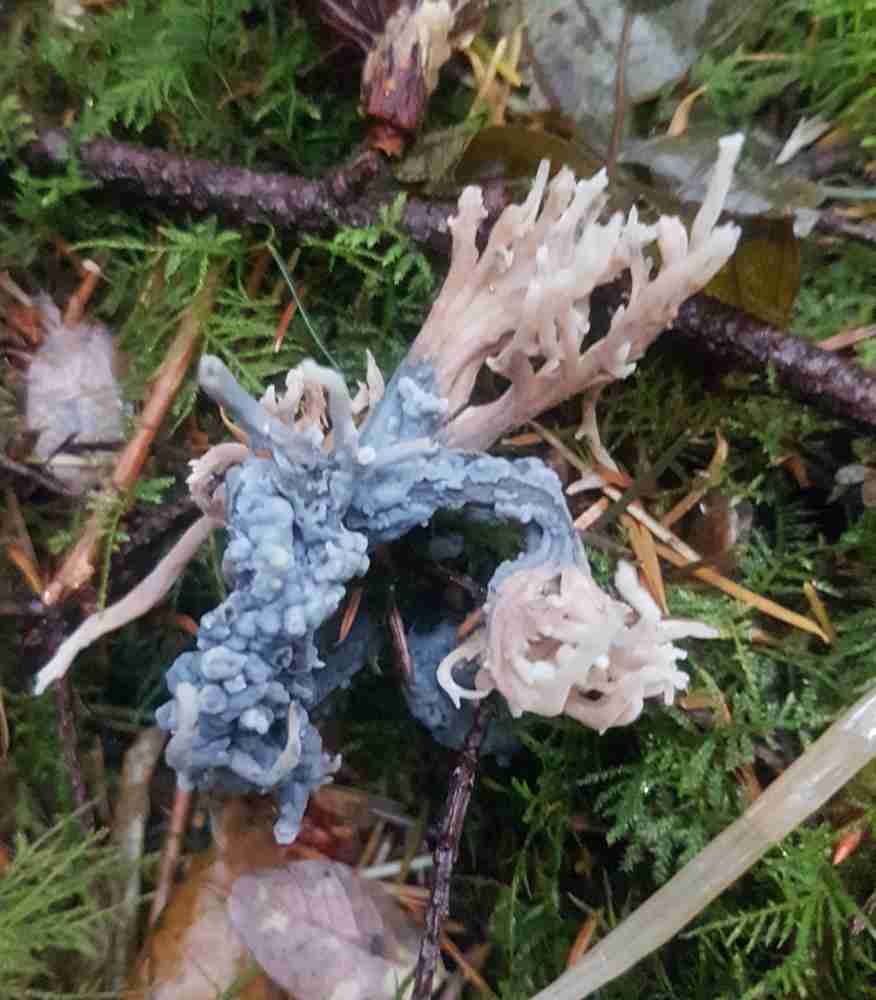
Photo 2 is a coral fungus (possibly one of the crested corals in the genus Clavulina) taken by Kyle from the Beaver Lodge lands. Note the strange blue-grey colour taking over the base. In one of my books (Mushrooms of the Redwood Coast) it says that Clavulina can be parasitized by a fungus called Helminthosphaeria clavariarum (isn’t that a mouthful?) which “distorts the fruiting body to a bluish gray to dark gray color.” That is my guess on what might be going on there, but if any of you have thoughts/suggestions on this let us know!
(2) Parasitized Clavulina ?
Posted inPlants and fungi|Comments Off on Winter chanterelles and blue-turning coral
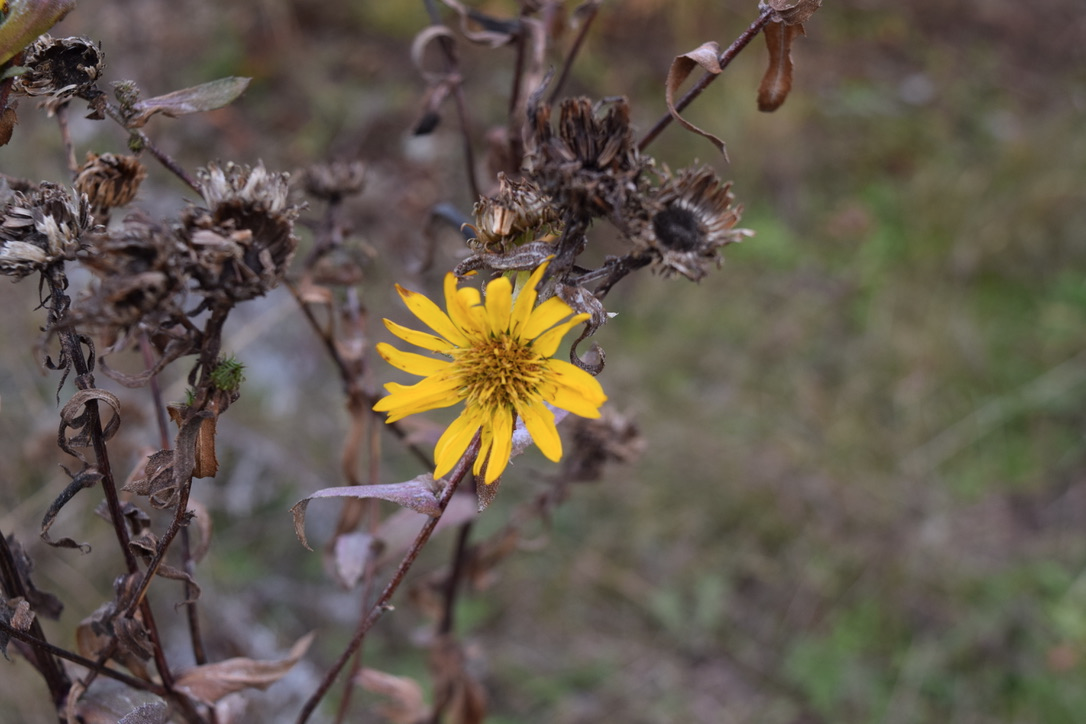
I walked through Kin Beach Park a few days ago and was struck by the winter colours and how striking the silvers and rusts were against the green of the mosses.
Grindelia with its last bloom of autumn at Kin Beach
CVN’s November webinar was Establishing a baseline of microplastics in marine food webs: a case study in Baynes Sound, B.C., presented by oceanographer Natalie Mahara. If you missed this event or would like to see it again, the recording is now available here. To access it you will need to provide your name and email address.
For more information about this talk, see the announcement in our earlier post.
Posted inGuest Speakers|Comments Off on Recording available for microplastics talk
From an email by Jocie to the Botany Group on November 14.
Cortinarius is the biggest genus of gilled mushrooms in the world, with thousands of species. The Pacific coast is a hotspot for “corts,” with a rich abundance and diversity. A few distinct features of this genus:
Many have a “cortina” (from the Latin word for curtain) that forms a cobweb-like veil over the developing gills. Traces of the veil often appear as a ring-like band of fibrils on the stipe (stem).
Spore prints are typically rusty-brown.
All grow in soil or humus (never on wood) and are ectomycorrhizal.
Species in this genus come in a variety of sizes and colours. Some have brightly coloured gills (yellow, orange, red), and others have shades of green, lilac or purple. In a shaft of sunlight the gills can be spectacularly bright and satiny. Many more species are brown & dull, and these have a more subtle beauty.
Here are some examples of Cortinarius that I have seen this fall. These are all from four locations: Buttle Lake area, lakes north of Campbell River, the Merville Woods, and Miracle Beach Park. Note that #6 & 7 are a review of the lilac and purple corts discussed by Alison earlier in her debrief on green, blue and purple shrooms.
[Click a photo to enlarge it.]
This yellow-gilled cort might be Cortinarius croceus.
An orangy-gilled cort, possibly Cortinarius cinnamomomeus.
A red-gilled cort, likely Cortinarius smithii.
Close-up of the red gills of the above.
A beautiful “viscid” cort that looks like it is covered in a glaze (which reflects the canopy above!) Possibly Cortinarius vanduzerensis. Note the purple blush at the base of the stipe.
A lilac-coloured cort (there are many different lilac-toned species, which all look very similar!). Note the cortina on the stipe, which shows nicely here.
From an email by Jocie to the Botany Group on November 10.
[Click a photo to enlarge it.]
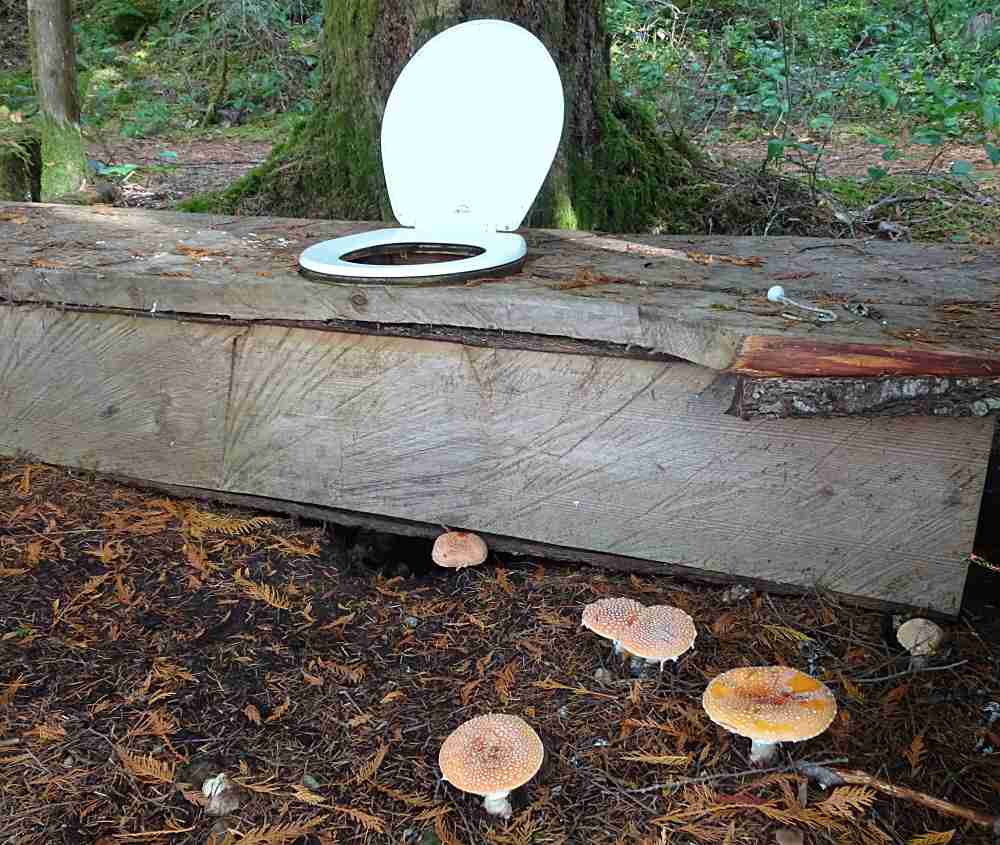
Here are some fly agarics (Amanita muscaria) growing in an unusual spot! (More down the hole, but I didn’t look too closely.) You never know where this cosmopolitan shroom will pop up!
I have seen a variety of button forms of this iconic species…some studded with warts, some hot-orange without warts, and others the size of an orange. Always interesting! Here are photos of some fly agaric forms:
Warty button
Wartless button
Orange-sized
Classic amanitas (from the edge of a Comox parking lot)
There is nothing else that really looks like the fly agaric, though I was almost fooled by a tricholoma (I think this might be Tricholoma zelleri which in some books is the same thing as Tricholoma focale) at Merville Woods the other day. It was large and bright orange, but had a more slimy cap, and scaly stipe.
On May 14 of this year, CVN’s guest speaker Dr. John Reynolds presented a very informative webinar on how to use the iNaturalist online platform for recording and viewing nature observations from around the world. Following the tutorial part of the presentation, John discussed and showed examples of the BC Parks project in iNaturalist.
If you missed this presentation (or want to see it again), a recording is available at this location. You only need to provide your name and email address to have access to it.
iNaturalist is photo-based — just take a photo of any animal, plant or fungus that you observe and upload it to the platform. It has both a smartphone app and a website. Anybody can use the system. If you can’t provide an identification of the species yourself, iNaturalist has a recognition function that can suggest the identity. Other members will help with the identification if needed, and after another member confirms the identification, your observation becomes “research grade” and can be used by researchers.
Many geographically defined “projects” exist in iNaturalist. Using the location information associated with your photo, iNaturalist automatically adds it to any relevant projects.
CVN strongly encourages our members to participate in iNaturalist, and this presentation is a great way to get started. Also, you can find references to other iNaturalist resources in this earlier post.
Comox Valley Nature is pleased to host a free online lecture by Natalie Mahara. The lecture entitled “Establishing a baseline of microplastics in marine food webs: a case study in Baynes Sound, B.C.” is on Sunday November 15, 2020, 7:00 – 9:00pm.
Given the current situation with the Covid-19 virus, Comox Valley Nature has made arrangements to have a live, online webinar for Natalie’s presentation. You will need to pre-register:
Microplastics have emerged as one of the most ubiquitous global pollutants and can enter the marine food web either via direct consumption or by trophic transfer by consuming animals that have taken up microplastics. Researchers from the University of British Columbia worked closely with the Association for Denman Island Marine Stewards and the K’ómoks Guardian Watchmen in 2019 to establish a baseline of microplastic concentration and composition in and around Baynes Sound, and to estimate microplastic consumption and uptake by zooplankton, larval herring, and juvenile herring.
(Photo courtesy of Natalie Mahara)
Natalie is a biological oceanographer with a particular fondness for the smallest components of marine food webs. Born and raised in Vancouver, Natalie chose to study at the University of British Columbia for her BSc and MSc degrees where she developed her passion for the interdisciplinary field of oceanography. She has worked on projects including describing estuarine plankton dynamics, understanding how zooplankton communities range across productivity regimes, reporting microplastics in marine food webs, and untangling the mystery of juvenile salmon diets.
This is an excellent opportunity for the public to learn more about the potential impacts of microplastics in our area.
If you are new to Comox Valley Nature, find out more about us here.
Although CVN lectures are free, donations from non-members who attend are always appreciated.
Posted inGuest Speakers, News|Comments Off on CVN invites the public to learn about microplastics in Baynes Sound
Join the Comox Valley Conservation Community for a day long celebration of the watersheds and waterways that connect us all in the Comox Valley!Learn about restoration and habitat enhancement projects, salmon cycles, drinking water, forests, creeks, wetlands and estuaries – and so much more. Art projects, kids activities, volunteer engagement opportunities, hands on learning and guided walks – all looking out over the beautiful Puntledge River.Comox Valley Nature will be there with our new outreach tent. Come by and say hello, and try our bird identification game. We can also show you why native plants are best for your garden, and how to spot invasive species.Pack a picnic and stay for the day! Saturday Sept 19th from 9 am – 3 pmin Puntledge Park 1111 1st , Courtenay ...
In her memoir, Pacific Northwest author Caroll Simpson recounts the highs and lows of running a remote fishing lodge on her own following the untimely death of her husband, and of falling in love with the natural world. Simpson tells stories of living in the remote wilderness and managing the lodge, becoming an accidental environmental activist, fending off wild animals, working as an angling guide and finally, fighting off a proposed mining operation and participating in the development of a government land management plan as a spokesperson for the wilderness tourism industry.While Simpson welcomed paying guests at Ookpik Lodge, unwanted house guests included a woodchuck, a pack rat, and martens. Simpson constantly had to watch out for grizzlies, moose, and cougars. Storms and extreme weather also provided fodder for hair-raising tales. All this makes for wonderful storytelling.Caroll’s story is essentially a love story. In an essay for Sierra Club, Simpson wrote: “I developed an immense passion for flora and fauna. Just walking back and forth on the 300’ dock several times a day, I was exposed to the unbelievable beauty of the northern spectrum of water life: the golden eagle soaring above, the osprey and kingfisher diving and coming up with fish for their hatchlings, the muskrats and otters looking for an easy meal, the tireless beaver working into the late evening sunsets. All of these creatures and more expressed their generational ownership of this small piece of the world. In return each was given my utmost respect and admiration…As I listened to the loons at the end of each day and the owl and the wolf in the night, I felt blessed to be witnessing such beauty. “On September 20th, join Comox Valley Nature and Save Our Forests Team for an afternoon of storytelling about this remarkable time spent living on a remote British Columbia lake.The event is being held at the Comox United Church Hall. (250 Beach Drive, Comox) Admission is by donation. Doors open at 2:30; the event begins at 3:00 p.m. There will be time for Q&A after the presentation, as well as books available for purchase. Tea/coffee and cookies - including forest-themed cupcakes - will be available for a donation.Join us, and prepare to fall in love. ...
🎟️ Get your tickets to the Project Watershed 2026 Keeping It Living Dinner today! projectwatershed.ca/2026-keeping-it-living-dinner/Every ticket holder makes a difference. 💙 🎟️ Get your tickets to our 2026 Keeping It Living Dinner today! projectwatershed.ca/2026-keeping-it-living-dinner/When community and local businesses invest in conservation, our entire ecosystem benefits. Ticket sales directly support habitat restoration, scientific research, and environmental education, while the generosity of our sponsors helps offset event costs, ensuring that more of the funds raised can go directly toward this important work. Thank you to our incredible sponsors and dinner attendees for believing in the power of community-led conservation. Odlum Brown Community and Northwest Hydraulic Consultants, 40 Knots Winery, CNB Together, we're keeping our watersheds living. 🌿 Hope to see you September 12, 5 - 8 pm at 40 KNOTS Winery #KeepingItLiving #ProjectWatershed #CommunitySupport #Conservation #ComoxValley ...
The City of Courtenay is developing a long-term vision for Bill Moore Park and Dogwood Park to guide future improvements. To help guide these decisions, three initial concepts have been developed, and there is an opportunity for you to offer your input.The latest survey on the City website engagecomoxvalley.ca/bill-moore-and-dogwood-park asks for feedback on three concept plans and specifically which concept you prefer. The three concepts present a range of recreation possibilities and there is room on the survey for your comments.Dogwood Park is a 2.32‑hectare nature park featuring mature forested areas, natural habitat and a small wetland. Only Concept A will maintain the intact forest areas in Dogwood Park. Concepts B and C propose increased recreation in the park including an off leash dog park, disc golf course, pump track (a purpose built track for children’s cycling) and nature play areas. While the planners may say that no trees or few trees will be taken down to accommodate this, the under-story will not survive this level of trampling and fragmentation. The trees as well as all the wildlife who now call that area home will disappear over time. For those of us who value this forest, Concept A is the only option that makes sense.Dogwood Park is one of the few islands of green for many, many blocks. It provides habitat for wildlife, shade, retains water and acts as a carbon sink. On the architect's base plan of current conditions it is now characterized as an "underutilized space". The City has heard from sports enthusiasts but not nature lovers. Let them know why you value an intact forest and your connection to it. The survey is open until Sept 15. ...
The Canadian Coalition for Invasive Plant Regulation (CCIPR) wants the federal government to establish a regulatory body for the horticultural industry and create a national database identifying invasive plants and their risks in different regions. "Even if we don't prohibit them, we need to let the public know when there is potential harm," said CCIPR co-founder Cathy Kavassalis. "We do this on other products, and we should do it on plants too. It's just common sense."In July, Nanaimo council passed a motion to pursue a bylaw amendment restricting the sale of plants on a list maintained by the Invasive Species Council of B.C. A week later, Surrey moved to ban sales by businesses including nurseries, large retail chains and florists. Kavassalis said a problem that could be addressed at higher levels of government is being pushed down to municipalities."These are all patchwork solutions that, in some ways, just waste a lot of resources," she said. The CCIPR says a national database could give provinces, territories, retailers and gardeners a shared source of information about which plants pose risks in different regions. Kavassalis also wants invasive plants removed from shelves or clearly labelled.For more on this story visit www.cbc.ca/news/science/invasive-plants-sale-federal-regulation-9.7312362 or see our link in bio ...