Botany Outing Report: Fungi and Soup, Nov 19th, 2018

Botany Group Report  : November  19th Outing Tsolum River Road

The range of fungi for later November was still large.  Of note we identified many large Russula brevipes – short- footed russula- that heaves up moss, turf, branches etc. ( see photo + slug). We also found one Russula xerampelina  – shrimp russula  (specimens of which were in the soup).  We saw lots of Inocybe species, and the Hypholoma fasciculare – sulfur tuft – in its various stages from young button to degraded soggy  brown “mush”.  Curiosities included the Pseudohydnum gelatinosum  – cat’s tongue (see photo)  and Nidula candida -bird’s nest fungus.  I failed to find a specimen of Xylaria hypoxylon – carbon antlers, so see attached photo taken on the Tuesday.  Also, another intriguing late fall fungus that eluded me on Monday (Jocie not being with us!)  was the Auriscalpium vulgare   “earpick fungus” .   It falls into the tooth/spine morphological group and is another example of a fungus with very specific environment – Douglas fir cones – see attached photos.


Cat’s Tongue                                                                   Carbon Antlers


Lactarius w orange latex                                        Russula brevipes

The Lactarius that we found near the end of the walk turns out to be Lactarius aestivus,   not in Truedell and Amirati (where it would still be subsumed under Lactarius deliciosus var. deliciosus.)  It was larger than the Lactarius subflammeus, of which we saw hundreds, and much more robust, with orange (not white) latex (see photo).

Here is the general entry on L. aestivus  from Matchmaker ( no photo however) :

Features of Lactarius aestivus include 1) viscid, orange, zonate cap, 2) subdecurrent to decurrent, crowded, orange gills, 3) orange and whitish stem that may be scrobiculate, 4) scanty bright orange milk, 5) grayish green staining of some parts (but not extensive and conspicuous), 6) fruiting under true fir and hemlock.   (scrobiculate means pitted with indentations , in other words it is not a smooth straight -sided stalk).  All these macro characteristics fit.   See photo  attached.

It is well illustrated and described in Siegel and Schwarz “Mushrooms of the Redwood Coast”  and they note that in their opinion it is the best tasting of the “deliciosus” group.  It is less grainy and firmer, which is my experience.  I did pick and cook up more caps (the stipe is too tough).

Next Gathering : Christmas Potluck lunch  Monday Dec. 10th, 12.30 pm

Posted in Field Trips, Plants and fungi | Comments Off on Botany Outing Report: Fungi and Soup, Nov 19th, 2018

Guest Speaker: Terry Thormin, Sun. Nov. 18, 2018

CVN invites the public to learn about Nature Photography

Comox Valley Nature is pleased to host a public lecture. Join Terry Thormin for an illustrated talk entitled: “Nature Photography in the Comox Valley” The lecture is on Sunday Nov. 18, 2018 and will start after introductions at 7pm in the Rotary Room of the Filberg Seniors Centre 411 Anderton Ave, Courtenay.

The Comox Valley has a diversity of ecosystems ranging from marine intertidal estuaries, rivers, marshes, forest and subalpine mountain habitats. These habitats are home to an abundance of organisms. Nature photography is critical for documenting habitat and species diversity in the area. These images can also serve as a record of biodiversity and can generate an increased interest in nature by the general public.

Terry Thormin is a very accomplished photographer with an impressive collection of images that include landscapes, plants, fungi and a variety of animals such as insects, spiders, fish, reptiles, birds and mammals. Terry has worked for a private ecological consulting company based in Edmonton, Alberta, doing mostly bird work, and much of it in the Canadian Arctic. He also freelanced for a couple of years before joining the staff of the then Provincial Museum of Alberta (now the Royal Alberta Museum) as a foreground artist working on dioramas. He then switched to the newly formed Invertebrate Zoology Program where he stayed until he retired in 2006. He now lives in Comox on Vancouver Island, B.C.

This is an excellent opportunity for the public to learn more about nature in the Comox Valley and nature photography.

Posted in Guest Speakers | Comments Off on Guest Speaker: Terry Thormin, Sun. Nov. 18, 2018

Botany Outing Report: Paradise Meadows, Oct 15th, 2018

Report on October 15th walk 

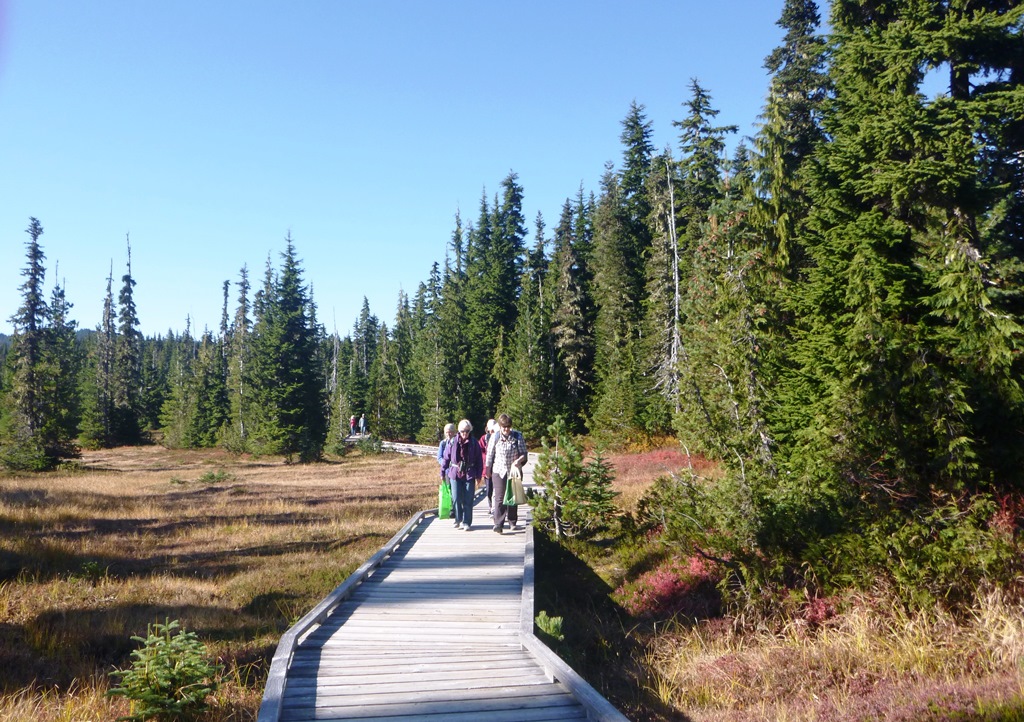
For those who missed the report at our last general CVN meeting, for the October 15th gathering we had a glorious day to meander around the Paradise Meadows loops, collecting the SWI plant signs to store for the winter. In fact it was Frank N. who collected most of them while the rest of us enjoyed the fall colours of the vaccinia  etc. and investigated a number of interesting fungi.  There were still lots of berries on the bog and dwarf blueberries, and so it was not surprising to learn that one of our group who went up earlier saw wet imprints of bear paws on the boardwalk.  By the time we walked around the Boardwalk was dry. Among the fungi, Ruth identified a new bracket polypore for the Paradise Meadows list, namely Porodaedalea pini, on the trunk of a still living abies species. It is one of the species that causes white-rot in heartwood. We found a number of different species of Cortinarius – the one in the photo taken by Sharon is  Cortinarius phoenicius var. occidentalis, commonly called western red dye since the rich burgundy of both cap and gills is much prized by those who use fungi for dyeing.

Then we shared lunch with the Canada jays on the picnic table outside the Wilderness Centre.

Posted in Field Trips, Plants and fungi | Comments Off on Botany Outing Report: Paradise Meadows, Oct 15th, 2018

Upcoming Botany Group Meeting November 2018

Upcoming Botany group Meeting

First of all, our next Gathering will be on Monday November. The forecast at this point seems to call for showers.  However, we will have a walk around our woods first to see the latest crop of fungi.  This year has been good for a whole lot of species that did not even make an appearance in the past two years.  We can talk about Mushroom Identification and then for lunch there will be mushroom soup -with amongst other ingredients Russula xerampelina, which were abundant a couple of weeks ago and easy to identify (for once) using the characteristic features listed in  Siegal & Schwarz, Mushrooms of the Redwood Coast (which includes many species that are to be found all the way up to our coast).

Russula xerampelina: key characteristics
·         cap colour variable, mostly purple to reddish brown
·         gills creamy when young, yellowish to ochre with age
·         stipe creamy, often blushed with pink tones
·         stipe staining slowly yellow then brown when scratched or even handled
·         stipe has firm exterior and pithy core
·         taste mild  ( many russulas are very bitter – test on the tip of your tongue)
·         odour slightly fishy or like shrimp ( more obvious in older specimens)

The attached photo should illustrate the stipe staining slowly yellow when scratched.  When cooked the red of the cap turned the whole flesh pink ( another reason for the common name shrimp russula?)

It would be appreciated if you let me know that you are coming, to give me a rough idea of numbers for soup , coffee and tea.

Posted in Field Trips, Plants and fungi | Comments Off on Upcoming Botany Group Meeting November 2018

Guest Speaker: Scott Wallace, Sun. Oct. 21, 2018

CVN invites the public to learn about

Comox Valley Nature is pleased to host a public lecture. Join Dr. Scott Wallace for an illustrated talk entitled: “Can the Species at Risk Act Recover Southern Resident Killer Whales?” The lecture is on Sunday Oct. 21, 2018 and will start after introductions at 7pm in the Rotary Room of the Filberg Seniors Centre 411 Anderton Ave, Courtenay.

The Southern Residents are a distinct population of killer whales who frequently use the Salish Sea during the summer months. They have been legally protected under the provision of the Species at Risk Act for nearly 15 years. During this time the population has suffered from increased threats of prey reduction, contaminants and disturbance. The population is now at its historically lowest number and has not had a successful birth in over three years. This talk will discuss the biological, political, and legal challenges of protecting this unique population.

Dr. Scott Wallace is a marine ecologist employed by the David Suzuki Foundation as a Senior Research Scientist. Scott is an educator, author, activist, naturalist and scientist whose career has focused on marine conservation. His work at the David Suzuki Foundation is centered on species at risk, healthy oceans, citizen science and sustainable fisheries. He has taught several university and college level courses focused on the marine and coastal ecology of British Columbia. Scott sits on several fishery advisory boards. He holds a Ph.D. from the University of British Columbia.

This is an excellent opportunity for the public to learn more about Southern Resident Killer Whales.


Comox Valley Nature is a non-profit society affiliated with BC Nature, consisting only of unpaid volunteers. CVN fulfills its educational mandate by hosting monthly lectures, organizing free weekly guided hikes for members, and a free monthly walk open to the public.  Comox Valley Nature also supports specialized groups (Birding, Botany, Garry Oak Restoration, Wetland Restoration, Photography and Young Naturalists Club) which have separate monthly activities.  Membership in BC Nature and Comox Valley Nature is $30 per adult and $40 for a family.

Founded in 1966, it is one of the oldest environmental societies on the North Island.  Meetings and lectures of the Comox Valley Naturalists Society are held on the third Sunday of most months at the Florence Filberg Centre, 411 Anderton Ave., Courtenay.  Meetings and guided walks are open to the public, including children and youth.  Lecture is free, though a $4 contribution from non-members is appreciated. New memberships are always welcomed.

Anyone interested in this lecture or participating in CVNS activities can also contact us at the website www.comoxvalleynaturalist.bc.ca

Posted in Guest Speakers | Comments Off on Guest Speaker: Scott Wallace, Sun. Oct. 21, 2018

VIGIRM Conference 27th and 28th October 2018, Courtenay

OCTOBER 27th & 28th, 2018

VANCOUVER ISLAND AND GULF ISLANDS REGIONAL SEMINAR
Hosted by Comox Valley Nature

October 27th, 2018: Florence Filberg Centre, 411 Anderton Ave., Courtenay BC

Schedule:

09:30 am         Registration open
10:30 am         Seminar starts: Chaired by John Neville. Meeting will have 4 discussion periods:       Topic one:       Shoreline Concerns: started by Sharon Niscak,Comox Valley Nature
Topic two:       Wetlands Preservation: started by Genevieve Singleton,Cowichan Valley Nature
Topic three:     Invasive Species: started by Jim Boulter, Comox Valley Nature                        Topic four:       Biodiversity & Development: started by Loys Maingon, Comox Valley Nature

12:00 pm         Lunch Break; light lunch at hall, featuring soup, sandwiches and fruit

13:00 pm         Grant Scott:               Are BC Herring in Dire Straits?
13:45 pm         Randal Mindell:         South Coast Fossil Conservation
14:30 pm         Coffee break
14:45 pm         Michael Motek:          Native Plants: Restoration is for the Birds
15:30 pm         Loys Maingon:          Forgotten Wetlands, Future Water Quality, Freshwater & Marine Biodiversity
4:15 pm           Discussion
4:30 pm           Closing remarks and social until 6 pm closing

October 28th 2018: Field trips;
All Car Pooling occurs at Filberg Centre, 411 Anderton Ave., Courtenay

Coal Hills with Loys Maingon: Car pool at Filberg at 9:00 am, Trailhead at 9:30 am

Morrison Creek Headwaters with Jan Gemmell and Jim Palmer Car Pool at Filberg at 10:00 am

Cape Lazo with Will and Alison Marsh: Car pool at Filberg at 12:30 pm, Trailhead at 1:00 pm

Posted in Conference | Comments Off on VIGIRM Conference 27th and 28th October 2018, Courtenay

Upcoming Walks: October 2018 – February 2019

MASTER SCHEDULE:
Variances only  announced by Loys Maingon

Questions: 

CVN Walks October 2018 -February 2019 .PDF
CVN WALKS:  October 2018 to February 2019
All walks minimum 2 hrs
PARTICIPANTS SHOULD MEET EITHER AT CARPOOLING LOCATION OR AT TRAILHEADS
Carpooling at either Old Downtown Courtenay Thrifty’s or Country Market north of Courtenay
Day, date and Month Carpooling place and time Destination Difficulty
Sunday October 7 Thrifty’s  8:30am Nile Creek (PUBLIC) easy hike
Sunday October 14 Country Market  8:30am Elk River Trail easy hike
Saturday October 20 Country Market  8:30am Ripple Rock easy hike
Sunday October 28 Coal hills Special EVENT  VIRM (October 27 and 28)
Sunday November 4 Trailhead Nymph Falls (PUBLIC) level walk
Sunday November 11 Thrifty’s  8:30am Comox Lake Reserve hike
Saturday November 17 Thrifty’s  8:30am Ships Point / Mud Bay level walk
Sunday November 25 Trailhead (Bates Rd) Seal Bay Park Marine side stair walk
Sunday  December 2 Country Market  8:30am Pub to Pub/Oyster River level walk
Sunday December 9 Trailhead (Tsolum River Road) Tsolum Spirit Park level walk
Saturday December 15 Trailhead Kye Bay Beach level with cobbles
BREAK
Sunday January 6 Country Market  8:30am Pub to Pub/Oyster River (PUBLIC) level walk
Sunday January 13 Trailhead (Powerhouse Rd.) Puntledge  Park/ Ruth Masters Level walk
Saturday January 19 Trailhead DND Entrance.) Goose Spit level with cobbles
Sunday January 27 Condensory Bridge Condensory Bridge to Air Park level walk
Sunday February 3 Trailhead (Bates Rd.) Seal Bay, Melda’s Marsh level walk
Participants are expected to wear good hiking shooes and rainproofs and to assume their own safety.
Walks are for CVN members. Only walks Marked “PUBLIC” are open to the general public.


Posted in Weekend Walks | Comments Off on Upcoming Walks: October 2018 – February 2019

Shoreline Outing Summary: Cape Lazo, Intertidal Food Webs, September 20th, 2018

Hey Everyone,
Just before the weather turned ugly, we made is out to the shoreline below the cliffs at Cape Lazo. We were trying to make sense of some of the feeding relationships along the shoreline. As we get more experience and exposure, we’ll be able to figure out more of these complex intertidal food webs, where everything seems to eat everything. I’ll break down the experience into (1) Observations (2) Follow-up points and (3) Links for further consideration.

(1) Observations
We noted the primary producers in various states of life and decay. Living seaweeds, algal crusts and phytoplankton (seen under the microscope in water samples taken from Cape Lazo) are the photosynthetic organisms that pull carbon (and nitrogen, phosphorous et al.) out of the water to create the organic matter that ultimately fuel the rest of the ecosystem. Their productivity is governed by nutrient availability, sunlight and how clear the water is- low light penetration is a limiting factor, particularly for the seaweeds.
We saw a number of organisms who feed directly on the seaweeds and algae– small limpets (Lottia sp.), snails (periwinkles– Littorina sp.) and shore crabs (Hemigrapsus sp.). We looked at the modified legs of the shorecrab, whose diet consists mostly of diatoms, green algae (eg. Ulva) and red algae. A potpourri of indiscriminate filter feeders/suspension feeders (mussels, oysters, bryozoans, sponges) consume the phytoplankton, zooplankton (including larvae) and detritus that happens to go there way as water is passes through.
Higher up the shoreline, we saw a melange of decaying/fermenting seaweeds. There are organisms that feed quite specifically on this decaying layer. We say Sand fleas and an indeterminate annelid worm. These organisms are in turn fed on by other invertebrates (eg. the fast moving wolf-spiders common on the shoreline) as well as larger birds. Many of you have seen the gulls poking at the sand above the high-tide line. They are foraging for sand fleas, among others.
Further down the shore, we saw swathes of small acorn barnacles completely shattered and removed from their rocky substrate. After some speculation, we noted a star-shaped pattern to this activity matching the shape of the purple sea star. This unsuspecting predator pulls apart the plates and valves of its prey and then inserts its stomach to digest the contents held within. By this means, it preys on barnacles, mussels, snails, chitons, limpets and even urchins. While we didn’t witness it on Thursday, we did trade horror stories about watching large gulls consume whole sea stars.
We saw a variety of other feeding relationships– the circular borings of the molluscan radula into shells- likely the work of a gastropod. We tried to figure out what some of the gulls, harlequin ducks, cormorants and scoters were eating, as all were numerous. Unclear for now.
(2) Follow up points
We tried three methods for observing feeding relationships
-direct observation (works well for small creatures who don’t feed exposed)
-spotting interactions with binoculars then visiting the scene of the crime (will work with birds with a little patience)
-fecal analysis. The scat, frass, pellets and plops of the intertidal can usually be matched to the organism that left them. Some organisms (herons, crabs, minks, otters) leave very clear records of their diet in their scat. Others (gulls), not so much.
A fourth means is to actually take a live or recently dead sample and look at the gut contents. This may be ethically uncomfortable for some.
(3) Links for Further Consideration
Shirley brought a hard copy of Kozloff’s Marine Invertebrates of the Pacific Northwest. This is the most comprehensive key to shoreline (and all other marine) life in our region. The paperback version can be had for about $50, but the keys themselves are all available online, courtesy of Dave Cowles.
FEEDING RELATIONSHIPS: Shoreline Group Member David I. passed along a link to a very comprehensive, evidence-based site from Thomas Carefoot, an emeritus professor of biology from UBC. A Snail’s Odyssey looks at the major invertebrate groups of the shoreline and breaks down their feeding, reproduction, predators, physiology, locomotion and more based on study data that he has been curating for decades. Most of the data and syntheses are very local.
Another email incoming about our next outing.
See you soon,
Randal
Posted in Field Trips, Shoreline and Marine | Comments Off on Shoreline Outing Summary: Cape Lazo, Intertidal Food Webs, September 20th, 2018

Jensen Keltie, CVN Bursary Recipient, 2018

Jensen Keltie is a graduating grade 12 student from Vanier Secondary School.
The Bursary Committee chose Jensen for her outstanding academic achievement, her active participation in conservation and environmental issues and her contribution to the Vancouver Island University’s Deep Bay Marine Field Station in Bowser as a summer student and volunteer for several years. Her involvement at the station in various research projects on marine organisms and aquatic animal husbandry encouraged her to pursue a Bachelor of Science program with a focus on marine biology at Dalhousie University in Halifax this fall. As a marine biologist, Jensen’s goal is to participate in projects that promote awareness and conservation of marine life and support environmental stewardship. We wish Jensen much success in her studies and future endeavours! Congratulations!


Posted in Bursary | Comments Off on Jensen Keltie, CVN Bursary Recipient, 2018

Upcoming Walk: Sunday, 29th July 2018, Hike to Aston Pond

SUN. July 29, 8:30am: Hike to Aston Pond (near Panther Lake)

A long day hike (14 km round trip)  with biologist Loys Maingon on subalpine pond ecology. Pack a lunch. Meet at Parking area on Strathcona Parkway just off Highway 19 at 8.30 am to carpool -a vehicle with good clearance necessary for logging road access. Sturdy footwear is essential – be prepared for sudden changes in the weather in the mountains. Always carry water. No dogs, please. Participants should always check the SWI website for  any changes in scheduling or trail conditions, 24 hours before the scheduled hikes. (http://strathconapark.org). For more information and to pre-register email: . Note : due to uncertainties as to the condition of the trail, participants should carry equipment for an overnight stay.

Posted in Field Trips, Weekend Walks | Comments Off on Upcoming Walk: Sunday, 29th July 2018, Hike to Aston Pond