Botany Outing Report: May 2019

On May 6th at Kin Beach Park, six of us including Helen, spent a couple of hours uprooting more of the invasive Lamium galeobdolon (yellow archangel) as well as equally aggressive Aegopodium podagraria (goutweed) under the watchful eye of the archangel goddess, still perched in the bush above. Lunch was somewhat disturbed by the Snowbirds in practice before they were due to leave the Valley.  I had thought they were already gone!!  Then Helen took some of the group around the Park, to identify the spring flowers still in bloom, including Lomatium nudicaule (Indian consumption plant/barestem desert- parsley) and Delphinium menziesii (Menzies larkspur).

On May 13th eight of us meandered from Salmon Point through the gravel flats to Woodhus slough, with John B. in the lead, noting most of the late spring flowers in bloom.  Near the start of the trail Betty pointed out the remnants of a huge bank of Delphinium menziesii (Menzies larkspur) – much of it had been levelled in the development of a residential property. The plants were just coming into bloom – photo 1.  And amongst them and spreading along the trail towards the slough was Valerianella locusta – commonly known as corn salad, a garden escapee that seeds itself vigorously – photo 2, from my garden. John pointed out where later in the summer we should be able to see a large array of  Spiranthes romanzoffiana (ladies tresses).  Outstanding were the numbers of Lomatium nudicaule (Indian consumption plant/barestem desert parsley) all the way to the Slough and beyond. Close in the gravel flats the plants were mixed in with a pink sea of Plectritis congesta (seablush)- photo 3.  Other flowers of note included Eriophyllum lanatum (woolly sunflower/Oregon sunshine), Lathyrus japonica (beach pea), Toxicoscordion venenosum ( death camas), Rosa nutkana (Nootka rose) and Lonicera hispidula (hairy honeysuckle) – photo 4.

We then drove on to the Oyster Bay Shoreline Protection Park, primarily to see the red-listed Balsamorhiza deltoidea (deltoid balsamroot) in bloom.  The largest clump, somewhat protected from view by the low spreading branches of a Douglas fir, is flourishing happily – photo 5.  Unfortunately, one of the plants out in the open had been dug up, while the blooms had been cut from another.   We should have a sign made to inform the public that these plants are rare and should be left untouched.  When the OB Shoreline Protection Society came to an end, CVN did receive a portion of its remaining funds, so we as a group could ask the executive for funds towards a sign and approach the SRD with a proposal to place a sign in the park.
Posted in Field Trips | Comments Off on Botany Outing Report: May 2019

Shoreline Outing Report: Denman Island, April 24th 2019

Hey Everyone,

Yesterday’s trip to Denman intersected with ideal spring weather. We visited two bedrock  shorelines– one on the east side of the island and another on the west. Some notes to follow up on things we saw.
(1) Geology and Trace Fossils
Both shorelines were composed of alternating beds of mudstone and sandstone that were formed on the sea floor about 80 million years ago. At the first beach, we saw abundant trace fossils, particularly large, branching burrows that were broadly parallel to the layers (bedding) in the sedimentary rock. These are interpreted elsewhere in the region as the pathways that decapod crustaceans (crabs, shrimp, lobster) maps through the sediments. We also saw the well cemented ellipsoidal concretions in the bedrock where fossils have been found, though we had no luck with the one that we split.
The geology of Denman and Hornby Islands is well-studied. There is this wonderful map from the BC Geological Survey as well as studies that describe how the conglomerates, sandstones and mudstones of these islands formed on the sea floor by the movement of materials in gravity flows from submarine channels out onto the open sea floor. .
(2) Oyster Leases
On the west side of the island, we saw systems of boulder placement, rebar, rope and netting associated with oyster aquaculture. This large PDF MAP from DFO shows that we were walking one of the most intensely cultivated shores in the province. This document is an overview of the legal regulations for aquaculture as well as the licensing fee formulas. Oyster leases and operations for sale are listed on the BC Shellfish Growers website.  We saw some serious modifications and garbage related to these aquaculture operations– it will be instructive if we can figure out what the environmental obligations are for these operators.
(3) Life
We saw lots of creatures, sessile and motile, solitary and colonial. Member of the group who were there, please let me know if I am forgetting things. Some of you were taking great pictures of molluscs and their eggs. As an aside, apparently some nudibranchs (the group that includes that barnacle nudibranch) can lay MILLIONS of eggs. We should do a count next time.
Beach One- Bedrock Shoreline 1km south of Fillongley Provincial Park
Black Pine Seaweed (Neorhodomela larix)
Nori/Sushi Seaweed (Porphyra)
Sea Lettuce (Ulva)
Rockweed (Fucus)
Sea cauliflower (Leathesia)
Sea Felt (Pylaiella littoralis)
Soda Straws (Scytosiphon)
Rusty Rock (Hildenbranda)
Plumose Anenome (Metridium sp.)
Kelp Crab (Pugettia producta)
Black Clawed Crab (Lophopanopeus bellus)
Rock Crab (Cancer productus)
Oregon Shore Crab (Hemigrapsus oregonensis)
Dungeness Crab (Metacarcinus magister)– maybe graceful crab
Hermit Crab (Pagarus sp.)
Coastal Shrimp (Heptacarpus sp.)
Mossy Chiton (Mopalia muscosa)
Barnacle nudibranch (Onchidorus bilamellata)
Limpet (Lottia digitalis)
Pacific Oyster (Crassostrea gigas)
Dogwinkle (Nucella lamellosa)
Moon snail (Neverita lewisii)
Bryozoans (Schizoporella sp.)
Purple  Cockscomb (Anoplarchus purperescens)
Tidepool Sculpin (Oligocottus sp.)
Beach Two: Bedrock Shoreline at end of Hinton Road, West Side
Black Pine Seaweed (Neorhodomela larix)
Turkish towel (Mastocarpus sp.)
Sea Lettuce (Ulva)
Rockweed (Fucus)
Sea cauliflower (Leathesia)
Sea Felt (Pylaiella littoralis)
Soda Straws (Scytosiphon)
Rusty Rock (Hildenbranda)
Flatworms (Notocomplana)
Ribbon worm (Tubulanus polymorpha)
Clam Worm (Neries vexillosa)
Fibreoptic Hydroid (Abietineria greenei)
Yellow Sponge (Halichondria panicea)
Bryozoan (Schizoporella)
Violet tunicate (Botrylloides violaceus)
Wrinkled tunicate (Pyura haustor)
Midshipmen (Porichthys notatus)
Purple  Cockscomb (Anoplarchus purperescens)
Tidepool Sculpin (Oligocottus sp.)
Japanese Mud Snail (Batalaria (with Pagarus)
Moon snail (Neverita lewisii)
Sea jingle (Pododesmus)
Pacific oyster (Crassostrea gigas)
Lemon Dorid (Archidoris montereyensis)
Hind’s Chiton (Mopalia hindsii)
Bright aeolid nudibranch (Flabellina sp)
Sea star (Pisaster ochreus)
White Sea cucumber (Cucumaria pallida)
Plumose anenome (Metridium)
Big red (Painted?) anemone (Urticina grebelnyi)
See you soon,
Randal
Posted in Field Trips, Shoreline and Marine | Comments Off on Shoreline Outing Report: Denman Island, April 24th 2019

Botany Group Report – April 1st Outing to the Comox Lake Bluffs Ecological Reserve

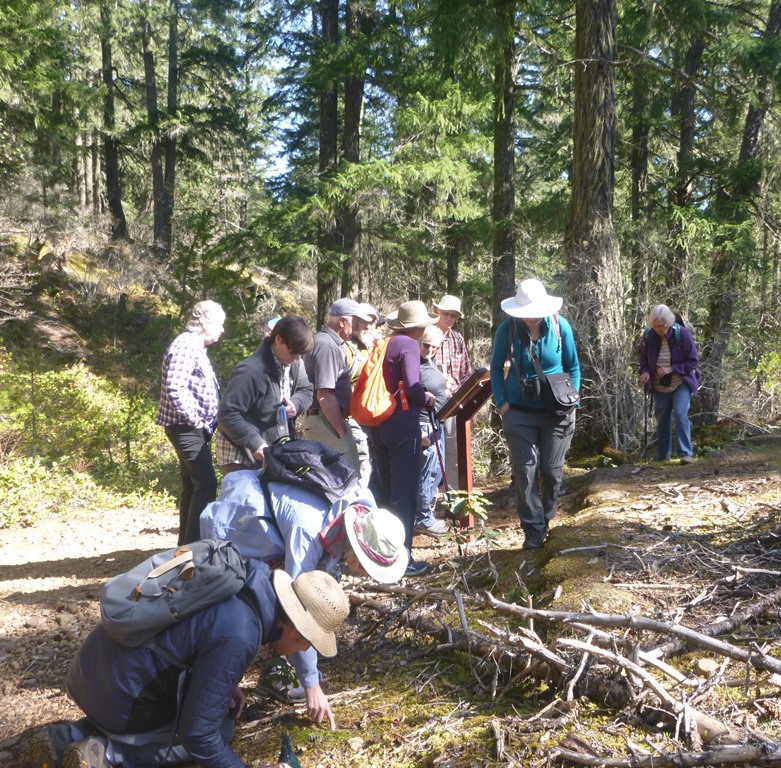
15 of us had a glorious day in the shade of the forested areas, and out in the sun on the old road that skirts around behind the open bluffs (which we avoided because of the extreme aridity).  The hot dry weather of the latter half of March after the prolonged arctic temperatures has not been kind to vegetation in general.  There was very little to see of spring blooms – some manzanita shrubs and chickweed monkey flower.  So the choice of a “Moss walk was fortuitous – mosses and liverworts can be “revived”  by a misting of water, an essential part of leader Randal’s equipment.  Attached is the list of the mosses that Randal highlighted for us arranged according to habitat.

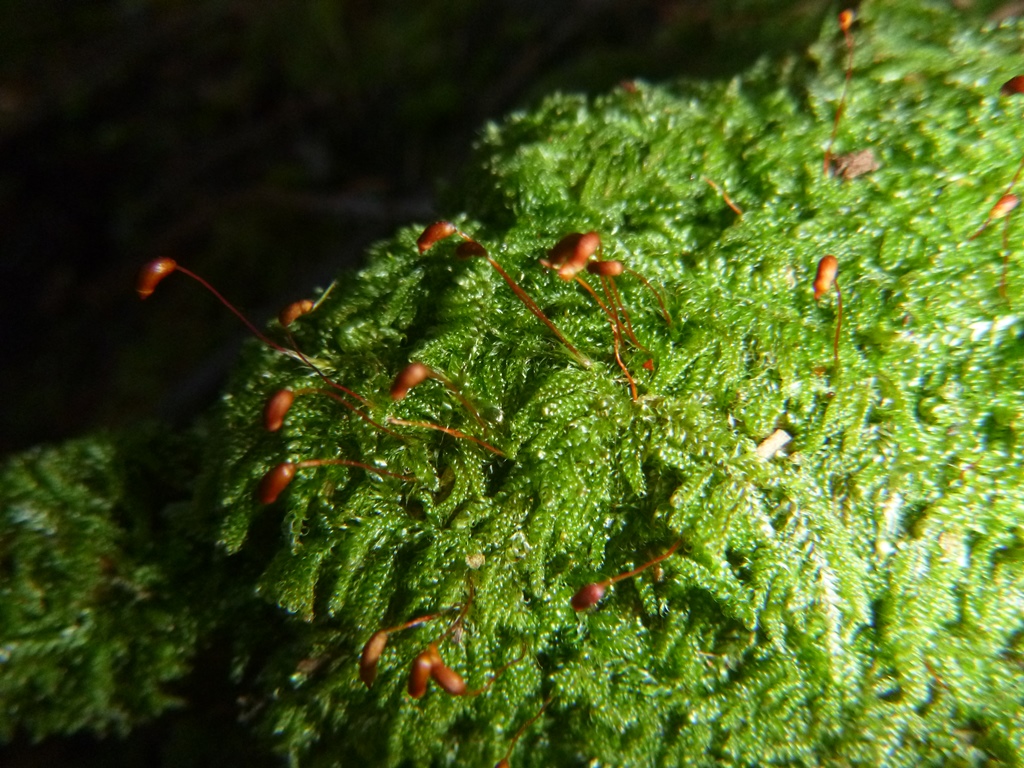
Photos attached : one of the group near Mandy’s sign beside the path out to the open Bluffs and one of the tiny Hypnum circinale moss with its bright chestnut sporophytes (apologies that the focus is poor).


With the recent rain, lots of plants have perked up and even in deepest coldest Merville the fawn lilies, toothwort and woodland violet are finally in bloom.  Today on CVN weekend walk along the south side of the Puntledge down from the dam we saw  the open Bog area both the male and female flowers of the Myrica Gale (sweet gale), in addition to the swamp lantern, but the Kalmia and Labrador Tea were showing only a few new leaves.  Attached is a photo of the female flower of the sweet gale ( held still by blue-gloved hand!). These tiny (1.5 cm long)exquisite flowers are one of the many treats to be seen in the “Puntledge Bog” – well worth a visit.

Reminder – next gathering tomorrow at Kin Beach,   10: 30 am.   

For the  removal of a patch  invasive yellow archangel ( Lamium galeobdolon)  please bring gloves, a small hand fork and/or secateurs if you have (plus kneeling pad if needed).  The uprooted plants will be put onto the Park burn-pile.   For more information call Helen.

The plan is to do the hard work first, then have a walk around the Park to see what is in bloom, followed by snack lunch at the picnic benches (weather permitting).

Alison

Posted in Field Trips, Plants and fungi | Comments Off on Botany Group Report – April 1st Outing to the Comox Lake Bluffs Ecological Reserve

Botany Outing Report: April 1 2019

Greetings all,

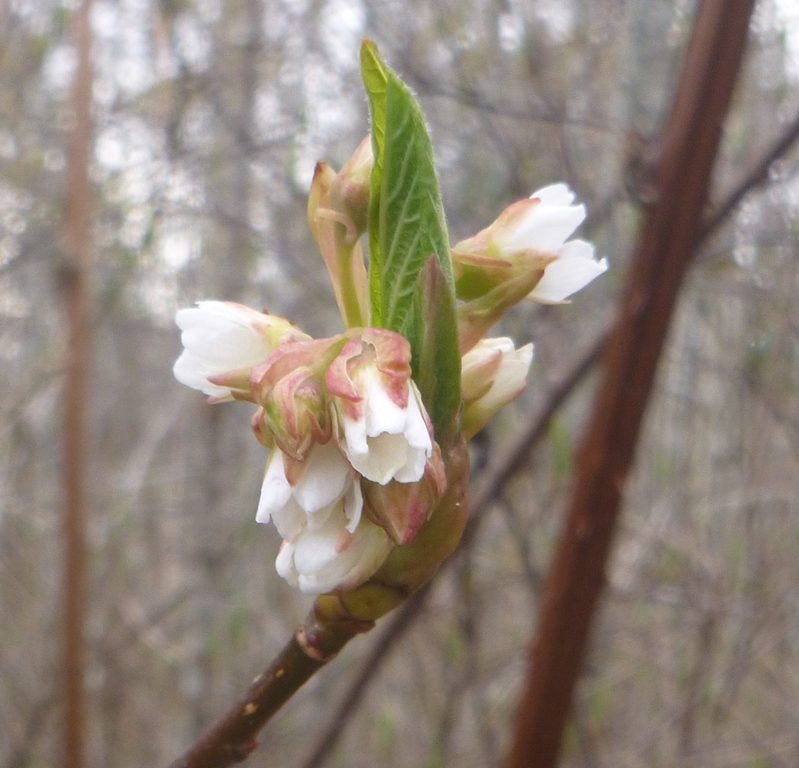
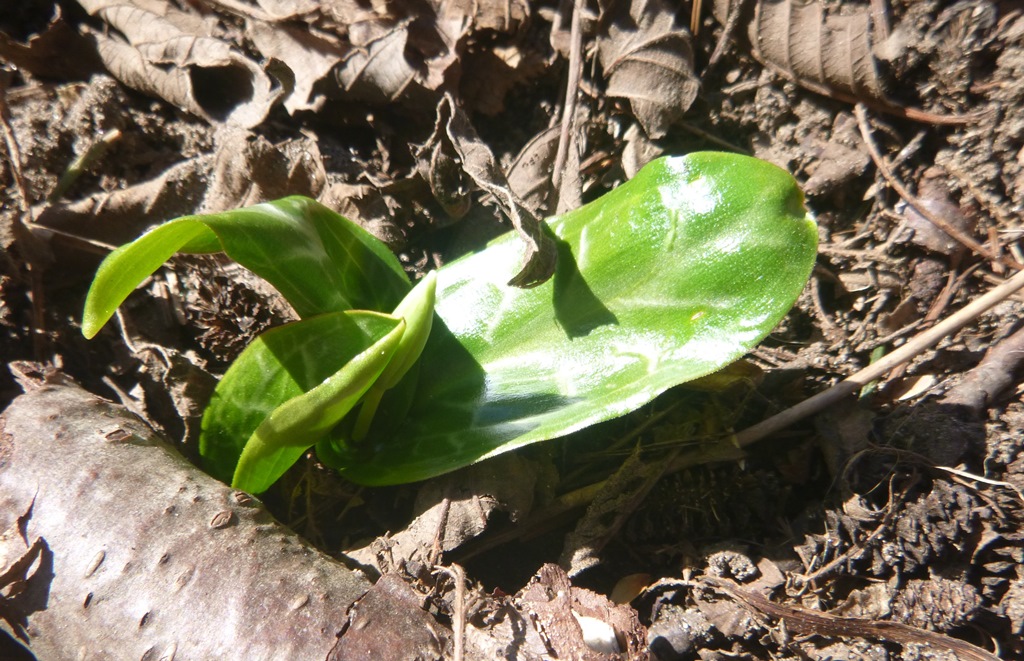
Spring is suddenly upon us.  Luise reported that there were goldstars (crocidium multicaule) blooming on Hornby on Sunday 17th; check out Point Holmes, usually one of the earliest spots here on the mainland. The coltsfoot (Petasites palmatus) that produced its bud by the third week of January, finally opened March 9th.  On the CVN walk along the Campbell River Estuary out to Baikie island we saw  fawn lilies (Erythronium sp. ) pushing up through the silt and dead leaves along the river, and the Indian plum (Oemleria cerasiformis)  was starting to flower.  No doubt the latter is blooming along the Airpark path too;  if anyone has seen fawn lilies along the river banks in Courtenay let us know. ( Photos of all except the goldstar are attached.)

Next outing:  April 1st, Comox Lake Bluffs Ecological Reserve.  11 am at the Trailhead.

To get to the trailhead, drive out Laketrail Road, till you meet Comox Main; turn left on Comox Main and follow past the entrance to Courtenay and District Fish & Game, over the bridge at the dam and on about a kilometer to a parking area on the left-hand side of the road.    You can check Google maps    Comox Lake Bluffs Ecological Reserve :  https://goo.gl/maps/ykbkCxHjDBA2   (not sure if the link will work – webmail is not user friendly!)  Attached is the BC Parks map of the Reserve and a list of Bryophyts compiled last year by Randal and Terry Taylor.

The plan is to focus on bryophytes, with Randal in the lead , since it will be early (maybe) for many of the spring flowers. ( We will save that for a later date. ) Note that if there is a large crowd of us, we will spend our time on the trail through the forest and up the old road.  Because of the sensitivity of the actual bluffs area Mandy would like to restrict the numbers of boots treading on the fragile plants on the rock faces.  Parks is apparently working on establishing a designated walkway or the like with cordons.

Bring your lunch and suitable footwear for an uneven trail, rocky in places.

Enjoy the sun,  Alison


Posted in Field Trips, Plants and fungi | Comments Off on Botany Outing Report: April 1 2019

Shoreline Outing Summary: Mission Road Pleistocene Deposits, Mar 13th, 2019

Roughly twenty shoreline members made it out on Wednesday to investigate 12,500 year old sand deposits laid down 10m below sea level back when the the waves would have been lapping at the spot where today you find the front entrance of the Home Depot at Lerwick & Ryan roads. We collected quite a few shells from a number of mollusc species (see annotated photograph below) and looked at a brief window of the local Pleistocene sediments. To follow up on some of the things we were curious about, there are some notes, diagrams and photographs below.
 
What did we find?
We found 12,500 shell deposits that showed a diversity of sizes and shapes indicative of a natural concentration of shell material driven by water currents. In the 250ml plastic container of shells, we had the following
Barnacles (Balanus sp.)
Tubeworms (Serpula vermicularis)
Scallops (Chlamys sp.)
Limpet (Acmaea sp.)– with bore hole from (?) gastropod radula
Mussels (Mytilus sp.)
Butter Clam (Saxidomus giganteus)
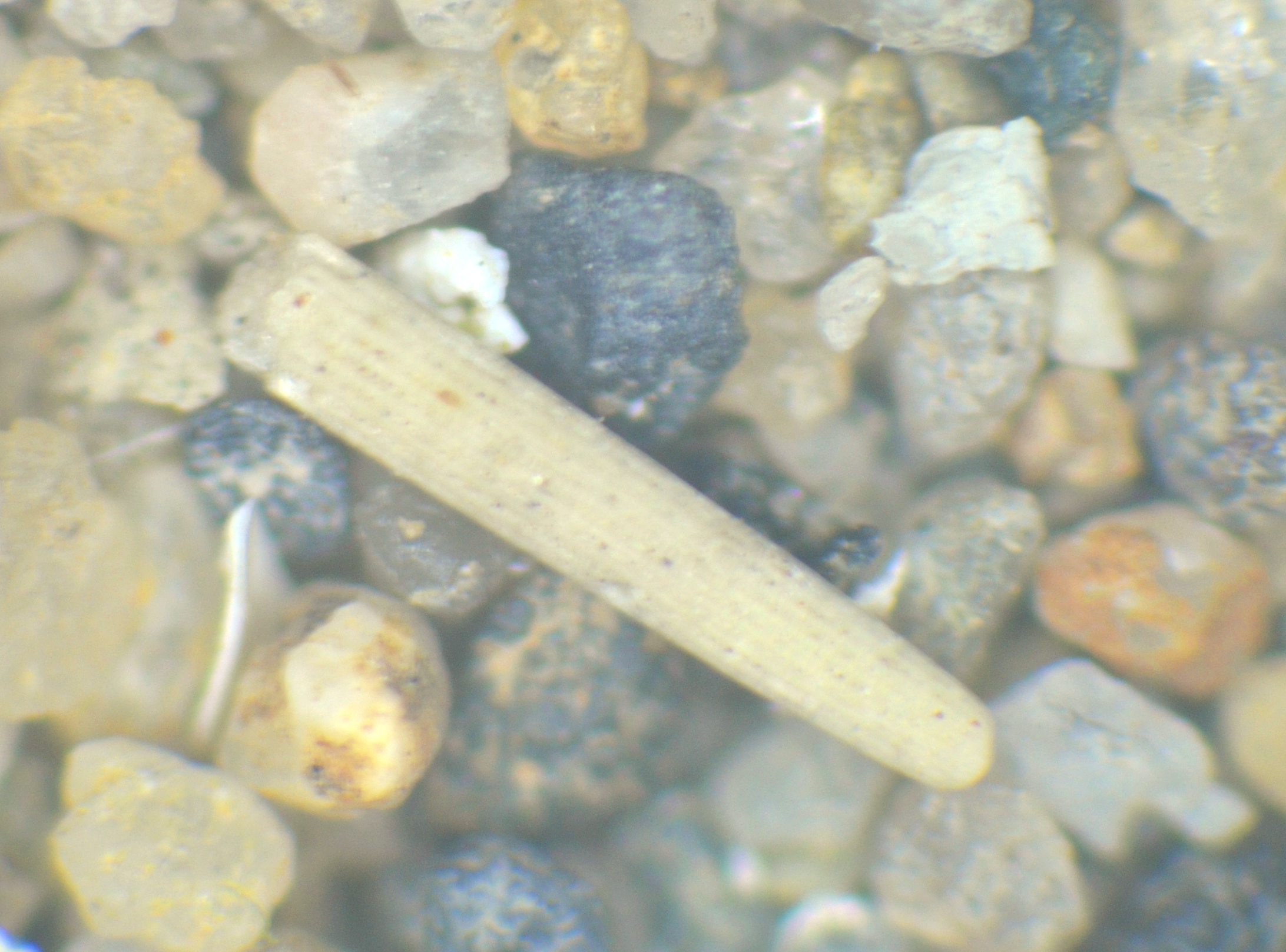
Echinoderm spines (see pictures– in the fine sediments)
Echinoderm spine (rod-shaped fragment among 1/2mm sand grains.
What is the sequence of unconsolidated sediments in our area and how old are they? 
The shells, bones & wood excavated from the site give a corrected age of around 12,5000 years based on radiocarbon dating. We were digging through the “Capilano” and/or “Salish Sediments”, layers that were deposited along the sea floor (and shore) after the ice had retreated. Looked down an excavated face in the quarry and saw poorly-layered glacial till (“Vashon Drift”) beneath (material melted out of the ice sheet). This in turn would be underlain by stratified sand and clays of the Quadra Sands, which were deposited by waters running off the leading edge of the ice sheet as it retreated and advanced sometime between 20-30,000 years ago. The Quadra Sands are the sediments that make up most of the Willemar Bluffs in Cmox as well as the cliffs around Seal Bay, Denman Island and Quadra Island. I am pasting below a chart showing the ages, composition and sequence of major layers of sediment in our region from Jan Bednarski’s (Geological Survey of Canada)  2015 report on surficial deposits just south of Deep Bay.
Preservation
John was remarking on how well-preserved the shells are given their age and how porous the sediments were. These shells would be subject to all the chemical weathering that the pore waters could bring about. Perhaps the density of shell material acted as a buffer to keep acids from leaching away too much of the material. As many of you saw, some of the mussels still had a hint of nacre left on them, meaning that the organic matter has not completely broken down, either.
These types of materials are broadly referred to as sub-fossils. True fossils are old and encased in consolidated sediments. Really it doesn’t matter– these are evidence of ancient life in our region just around the time that we start to see physical evidence for human habitation in our region. The assemblage of shells is interpreted to represent a cold water community akin to what would be seen around 60 degrees north today.
Randal
Posted in Field Trips, Shoreline and Marine | Comments Off on Shoreline Outing Summary: Mission Road Pleistocene Deposits, Mar 13th, 2019

Guest Speaker: Ann Eriksson, Salish Sea Nearshore Habitat Recovery Project, 17. March 2019

CVN invites the public to learn about the Salish Sea Nearshore Habitat Recovery Project

Comox Valley Nature is pleased to host a public lecture. Join Ann Eriksson for an illustrated talk entitled: “Salish Sea Nearshore Habitat Recovery Project (SSNHRP)”. The lecture is on Sunday March 17, 2019 and will start after introductions at 7pm in the Rotary Room of the Filberg Seniors Centre 411 Anderton Ave, Courtenay.
Recovery of native eelgrass (Zostera marina) habitats. Photo by Ann Eriksson

SeaChange Marine Conservation Society is a not for profit marine conservation organization based in Brentwood Bay, BC. Since 1998 SeaChange has focused on conservation and restoration of marine life in the Salish Sea, primarily through education and the recovery of native eelgrass (Zostera marina) habitats. In 2017, SeaChange was granted funding support from the Coastal Restoration Fund through the Department of Fisheries and Oceans for a five year project, the Salish Sea Nearshore Habitat Recovery Project (2017-2022). Now in Year 2, the goal of this project is to recover ecosystem health and increase resiliency of nearshore marine intertidal and subtidal habitats for all species of salmon and the critical forage fish upon which they depend and are most affected by anthropogenic activities. Activities include removal of underwater debris to expand potential eelgrass habitat, restoration of damaged, degraded or destroyed eelgrass habitats, and improvement of marine riparian areas where feasible in sites utilized by juvenile salmon and spawning forage fish. This regional approach is possible because of successful long-term partnerships with local First Nations, BC Parks, other community and stewardship groups, local businesses, and Fisheries and Oceans Canada. Come and hear about progress of the project and how you can get involved.

Biologist and author Ann Eriksson is the SSNHRP Technical Coordinator for the Gulf Island Region. Ann lives on Thetis Island and is a founding director of the Thetis Island Nature Conservancy. Her most recent book, Dive In! Exploring Our Connection with the Ocean is a non-fiction title for children about ocean conservation.

This is an excellent opportunity for the public to learn more about the Salish Sea Nearshore Habitat Recovery Project.

Comox Valley Nature is a non-profit society affiliated with BC Nature, consisting only of unpaid volunteers. CVN fulfills its educational mandate by hosting monthly lectures, organizing free weekly guided hikes for members, and a free monthly walk open to the public. Comox Valley Nature also supports specialized groups (Birding, Botany, Marine & Shoreline, Conservation, Garry Oak Restoration, Wetland Restoration, Photography and Young Naturalists Club) which have separate monthly activities. Membership in BC Nature and Comox Valley Nature is $30.
Founded in 1966, it is one of the oldest environmental societies on the North Island. Meetings and lectures of the Comox Valley Naturalists Society are held on the third Sunday of most months at the Florence Filberg Centre, 411 Anderton Ave., Courtenay. Meetings and guided walks are open to the public, including children and youth. Lecture is free, though a $4 contribution from non-members is appreciated. New memberships are always welcomed.
Anyone interested in this lecture or participating in CVNS activities can also contact us at the website http://comoxvalleynaturalist.bc.ca/

Posted in Guest Speakers | Comments Off on Guest Speaker: Ann Eriksson, Salish Sea Nearshore Habitat Recovery Project, 17. March 2019

Outing: Shoreline and Botany, Miracle Beach, 4th March 2019

Between the Botany group and the Shoreline group, we had a big turnout on a lovely late winter day. Conditions were so great, in fact, that we were hardly bothered by the lack of seaweeds that were supposed to be the focus of the day. Betty was giving demonstrations on how to press seaweeds, replete with finished examples of lovely red algae and miniature bull kelp, among others. 
A few notes:

  • A seaweed reading and resource list is attached as a PDF. I intended to hand this out with a little preamble about what to be on the lookout for, but didn’t want to interrupt a pleasant lunch. 
  • Sharon N. followed up on a question about whether any seaweeds could be used for dying of fibres. She passed along a paper that used a green algae from Malaysia as a natural source for green coloration of textiles using boiling water and “ammonia-fermentation”. I’m sure Sharon would agree that there would be a lot of interest in a local seaweed that could be used as a dye. 
  • There was talk about using seaweed as fertilizer and food. Sharon also kicked up this old DFO report on uses of marine plants. Forgive the antiquated language, but I paste an excerpt from the publication below to catch the attention of those who might be excited at the thought of making beverages, knife blades or insulating materials from local seaweeds. This old (1961) publication has a short discussion of impacts of seaweed harvesting

“There is a variety of uses of algae that can be recorded in connection with human activities. Rhodymenia palmata is used in Kamchatka to prepare a strong alcoholic drink. The Alaskan Indians and Eskimos are reported to make a brew called hoochenoo from Nereocystis. Methods have been proposed for the manufacture of manna-like substances from certain species of Laminaria containing a considerable amount of sugar and mannitol. A candied peel and pickles have been prepared from the fleshy stipe of Nereocystis”.   

  • On the fertilizer front, Roger and Betty were talking about the use of dead, fermenting piles of seaweed on their garden. VIU’s Marine Field Station down in Deep Bay did a study on the utility, logistics and impacts of seaweed piles as a fertilizer. Of interest to our group– they monitored when the largest volume of seaweed washed up. We will plant out outing for late October next year (see chart below of shore seaweed biomass v. calendar date)
  • There was a lot of interest in the flatworms. There are lots of interesting things about flatworms. This video shows a high-resolution sequence of their regenerative ability. Lastly, no mention of flatworms would be complete without mention of their famous “Penis Fencing”. You can chose to watch this video or not, but be assured it is very biological and very interesting. 
  • Crustose seaweeds. We saw a dark “tar spot” that I was erroneously referring to as Ralfsia-like. While some of these dark spots may have been that tar-spot genus, others showed young Turkish washcloth (Mastocarpus) emerging. There was also a lively, red crust.
  • Jocie snagged a thin, brown-green filamentous seaweed that at first blush looked like cyanobacteria. How do you distinguish between uniseriate (single-cell thick) seaweeds and cyanobacteria? Broadly speaking, algae are relatively more robust (they can take more tensile stress). Under the microscope, the difference is much clearer. Cyanobacteria, by virtue of being prokaryotic organisms, have no membrane bound organelles. A simple stain shows nuclei if you have a true alga. The little mucky looking seaweed that Jocie saw turns out to be a brown alga. Sea felt
  • Some seaweeds have remarkably complex life histories. We saw some encrusting phases and some leafy phases of red alga. We saw young sea lettuce, which alternate between haploid (gametophyte) and diploid (sporophyte) that are morphologically and functionally identical . The preceding links show lovely life cycles.
  • What did we see? 
    • Rockweed (Fucus)
    • Sea Lettuce (Ulva)
    • Black pine (Neorhodomela)
    • “Laver”/Sushi Seaweed (Porphyra)
    • Turkish towel (Chondracanthus)
    • Turkish Washcloth (Mastocarpus)
    • Sea Lace (Microcladia)
    • Sea felt (Pylaiella)
    • Rusty rock (Hildenbrandia)
    • Unidentified tubular species. 
  • Lastly– the peaks in the distance to the north and east. Peakfinder is a handy website and app for making sense of landscapes. According to that site, the Matterhorn-like peak was Mt. Denman, and the tall peak to the left was Mt. Doogie Dowler. 

Thanks again to Betty for hosting and demonstrating and sharing all of her knowledge.
See you soon, Randal

Posted in Field Trips, Plants and fungi, Shoreline and Marine | Comments Off on Outing: Shoreline and Botany, Miracle Beach, 4th March 2019

Shoreline Outing Summary: Miracle Beach, Night outing, Jan 19th, 2019

Hi Everyone,
Here is my take on last night’s wonderful outing at Miracle Beach

Thirteen naturalists caught a break in the weather to survey the sand flats of Miracle Beach Provincial Park. Under the light of a full moon, the group lamped up to catch the 10:30 pm low tide. Some of the highlights from the outing included

·         Moonsnails (Neverita lewisii)
·         Pipefish (Syngnathus leptorhynchus)
·         Leather Stars (Dermasterias imbricata)
·         Purple Sea Star (Pisaster ochreus)
·         Kelp Crabs (Pugettia sp.)
·         Decorator crabs (Oregonia gracillis)
·         Aeloid Nudibranch (Hematina trophina ?)
·         Sand anemone (species uncertain)
·         Eccentric Sand Dollars (Dendraster eccentric)
·         Large hermit crabs (Pagarus sp.)
·         Horse Clams/Gapers (Tresus sp.)
·         Nuttall’s Cockle (Clinocardium nuttallii)
·         Whelk shells (occupied by hermit crabs)
·         Tube worm casings galore

Sand Dollars

There were a few remarkable things we saw in the throughs between sand bars. There was a remarkable density of oblique-to-vertically-oriented sand dollars. I counted more than 100 in a 1 m2 at my feet and then got tired of counting. This video from the California Academy of Sciences gets into the physics of their orientation and morphology as it related to feeding and currents and might be of interest to those who were taken with their orientation & form.

Pipefish

Ian pointed out that he has noticed pipefish around pilings and amongst eelgrass beds whilst kayaking. We found them in groups loitering casually in sandy depressions. What were they doing just hanging out here? These relatives of the seahorse feed on crustaceans (maybe the small translucent-brown shrimp or copepods?). Like the seahorses, the males hold the eggs during development. We didn’t notice any brood pouches. Maybe we caught them just being pipefish, living around the eelgrass and feeding on little shrimp.

Lewis’ Moonsnail

We saw one unhappy moonsnail with a semi-retracted foot, while Diane found a vigorous specimen cruising the low-tide line looking for some mollusk to murder. Ian and Betty clarified that the moonsnails are vicious predators, using their muscular foot and abrasive radular to drill holes through the shells of bivalves and gastropods so that they may feed on the soft tissues within. This website by Tom Carefoot digs into the research about the mechanics and efficacy of moonsnail feeding.

A seaslug of uncertain affinities

Forgive the lack of photographs, but it was dark. Near the end, we saw a translucent white nudibranch with reddish-pink cerata (fleshy/hairy outgrowths along the back) that terminated in a creamy yellow bulb. If anyone has a confident ID of this, let us know. The keys pointed towards Hematina (Flabellina) trophina, but at that point they were using the flange of the vas deferens as an identifying character. Never the less, the broader group “Aeolids” in this environment have an interesting feeding feature. All over the beach were tubeworm sheaths. It turns out species in this group feed on hydroids (like Obelia) that grow on the outer surface of these tubeworm casings.

Night outings

It was informally resolved that we try a late summer evening outing to catch bioluminescence in action. Another winter low tide outing will be planned for next year.

Upcoming

Betty Brooks has invited botany and shoreline group members over in February to look into a demonstration of seaweed pressing and survey the tatters of seaweeds onshore in the late winter. Exact details will be mailed out soon. 

Posted in Field Trips, Shoreline and Marine | Comments Off on Shoreline Outing Summary: Miracle Beach, Night outing, Jan 19th, 2019

Guest Speaker: John Neilson, Tuna, Swordfish & Sharks, Sun. Jan. 20, 2019

(Bluefin tuna swimming off Nova Scotia. Photo courtesy of M. Stokesbury)

CVN invites the public to learn about the really big fish of Canada

Comox Valley Nature is pleased to host a public lecture. Join Dr. John Neilson for an illustrated talk entitled: “The really, really big marine fish of Canada: tuna, swordfish and sharks”. The lecture is on Sunday January 20, 2019 and will start after introductions at 7pm in the Rotary Room of the Filberg Seniors Centre 411 Anderton Ave, Courtenay.

Canada’s oceans are home to many of the largest and most fascinating fish species on earth. The world record bluefin tuna was caught in Canadian waters, and 1000 pounders are still caught with some regularity. Swordfish are also caught, often in a harpoon fishery that Ernest Hemingway would have appreciated. Canada is also home to some iconic shark species, including Greenland shark in Arctic waters, thought by some to be the longest-lived vertebrate in the world. In the Canadian Pacific Ocean, the magnificent basking shark is now on the brink of extinction after misguided attempts to eradicate them. John Neilson will provide an overview of the status of selected large fish species in all three of Canada’s oceans.

John Neilson holds a Ph.D. in fisheries science from Simon Fraser University, and has had a thirty year long career with the Department of Fisheries and Oceans. During the last part of his DFO career, Dr. Neilson headed the large pelagics program on the Atlantic Coast. Currently, he is a Co-Chair of the Marine Fish Specialists Subcommittee of COSEWIC, the Committee on the Status of Endangered Wildlife in Canada.

This is an excellent opportunity for the public to learn more about the large marine fish of Canada and their management.

Posted in Guest Speakers | Comments Off on Guest Speaker: John Neilson, Tuna, Swordfish & Sharks, Sun. Jan. 20, 2019

Shoreline Outing Summary: Williams Beach, High Tide, November 28th, 2018

We had a good turnout on a mild and bright Wednesday morning at Williams Beach for the second highest tide of the year. While confined to a narrow strip of shore between the gentle waves and the slippery, imbricate logs, we managed to see quite a lot. The following are some notes and observations related to the outing.

(1) Shoreline Erosion and Sea Level Change
Around these very high tides, particularly in wet and stormy weather, is when you can see the ocean eating away at the shore. With rising seas, shoreline erosion with increase. In our region, changes in sea level have both global and regional underpinning. On the global level, the melting of glaciers and ice sheets is taking a volume of water previously sequestered on land and returning it to the oceans. Increased ocean temperatures also also lead to some thermal expansion of the volume of the oceans. The IPCC 2017 assessment and modeling of sea level rise attributes about 20 cm of sea level rise over the last 100 years to this flux from ice to ocean. Furthermore, it predicts anywhere from another 20 to 100 cm rise by 2100.

Locally, sea level change is complicated by two other factors– land level changes associated with tectonic activity (earthquakes and crustal flexure driven by the accumulation of strain near the subduction zone) and the slow rebound of the Earth’s crust in our area after it was buried under 1-2km of ice at the peak of the ice age. Locally, a recent paper by Fedje et al. provided evidence for sea levels being almost 200m higher. The map below is from the linked paper and shows the location of paleoshorelines in the Quadra Island area circa 14,000 years ago. We saw a much more recently exhumed shoreline just above the present beach.

(2) The Midden
We saw the dense concentration of clam shells in the bank from which Betty pulled a stone pestle some years ago. There was some discussion about how to distinguish human deposits of shell material from the “lags” of shells that typically accumulate by wave, tidal and current sorting. Some criteria: the biological composition of the shell material, vertical and lateral extent of the deposit and the prevalence of interstitial cobbles and sand. The troughs in which shells naturally accumulate tend to follow depositional bedforms  that are either laminated or swooping and typically on the scale of ~1m or less in lateral extent and typically around  cm-scale vertically.

(3) Stuff thrown up by the ocean.
We found a potpourri of seaweeds. Below from left to right are some of the common ones- Saccharina sp. (Sugar Kelp), Nerocystis sp. (Bull kelp), Sargassum sp. (Japanese Gum Weed), Ulva sp. (Sea Lettuce), Constantia sp. (Cup & Saucer), Chondracanthus sp. (Turkish Towel)  and Gracilaria sp. (Red Spaghetti).

Gary discussed how their colours and depths are controlled to some extend by the types of chlorophyll present in the species. Some of the more drmatic coloration at this time of year has more to do with the breakdown and loss of chlorophyll and pigments.

We saw some interesting animals, most notably a pacific sand lance (presumably hanging out in the abundant sands just below the high-tide line at Williams Beach) and a large sponge kicked up by the surf from the subtidal flats.

The identification of sponges is challenging as keys focus on spicule characters. The spicules are structural elements, typically rods of mineral material that are encased in organic compounds. I prepped out some spicules using standard household bleach and found these lovely ~100 micron spicules (“Tylostyles”) of SiO2. Turns out this thing is called “Dead Man’s Fingers”, Homaxinella amphispicula. It is a demosponge, which is to say a mixture of organic structural elements and mineralized ones. It is a subtidal species, so likely kicked up during a very strong storm around the wave base.

There are upcoming late night low tides. The plan is to head to miracle beach at night with headlamps to see what is stirring. I’ll send around a date later this week.
Thanks everyone for coming out and contributing.
See you soon,
Randal

Posted in Field Trips, Shoreline and Marine | Comments Off on Shoreline Outing Summary: Williams Beach, High Tide, November 28th, 2018