From an email by Jocie to the Botany Group on June 9.
John B. took this spectacular photo of a “peloric foxglove.” This is a mutation where a bilaterally symmetrical flower (zygomorphic) mutates into a radially symmetrical flower (actinomorphic). It happens quite often with foxgloves apparently! Charles Darwin was the first to use the term “pelorism” for this phenomenon.
Our family loves to cycle and it is our usual mode of transport whenever possible. For viewing special trees in our community, cycling just seems to be the natural way not only to see the nominated trees but to have an adventure in our rich urban and rural forests. If we notice some areas with not so many trees, that is also part of our awareness.
A Google map (see below, and download it here) is a great tool for laying out a cycle route. However, we would have made the following adjustments to the Google route using our local cycle and urban forest knowledge. We live in Comox so this route starts there. This would be a nice cycle outing for us. We would visit two more of the nominated trees, the Garry oak on Denman Island and the Douglas fir off of Aldergrove Drive, as separate trips. These are great days for slow travel, delaying gratification and being on the path, and not just aiming for a destination!
The first location for us is just down the hill from Comox on Comox Road at the Regional District Pump Station just next door to the Kus-kus-sum site. The Saskatoon tree that was nominated there beside the pumping station driveway has blue flagging tape to help locate it beside a large Sitka spruce. This is a much taller Saskatoon than we would normally see.
Continuing north along Comox Road and the Old Island Highway we head next to Headquarters Road, following it to the Piercy Road connector. Just over the new bridge at the Tsolum River and after crossing Dove Creek Road, look north in a field for the large Douglas fir nominated there. The Onnes Farm is across the road to the south.
Continue on Piercy to Condensory Road and turn left to return to downtown Courtenay and 580 Duncan Avenue. Look for the pomegranate tree on the 6th Street side of the Comox Valley Art Gallery just across from the library.
Continue up 6th Street to McPhee and turn left to find 780 McPhee (Little Sparks Daycare) and the northern catalpa nominated there.
Heading down McPhee to the Train Station on Cumberland Road, you can get onto the Rotary Trail. Take the trail and enjoy this wild forest in the city as far as Bill Moore Park and the crossing to 21st Street. Going west on 21st you will reach Willemar Avenue and turn right to find 1805 Willemar and the Pacific dogwood nominated there.
Return the way you came to Bill Moore Park and take the path to the left that will wind through to Dogwood Drive. Go left at Dogwood which will lead to 19th Street. Continue east on 19th for an easy crossing of Cliffe Avenue. and take the Courtenay Riverway trail from there south to the Courtenay Airpark. Look for the Rotary Skypark Playground where it meets the Courtenay Riverway Heritage Walk path. There are three Garry oaks planted there and the nominated Garry oak has its own sign. This tree was planted by CVN and Frank Hovenden in 1995.
The Courtenay Riverway path continues south as far as Millard Road where you will have to head to the Island Highway to keep going south. Taking a left off the highway onto Chinook, you will be able to catch the Royston Seaside Trail all the way to Marine Drive. This will take you to Greig Avenue on your right. It is a yellowcedar at 3964 Greig that is the last nominated tree for our cycle day.
If you are feeling strong though, continue on to the ferry to Denman Island, have a leisurely cruise and pay very little for it because you are cycling. After leaving the ferry on Denman, stay on Denman Road to Lacon Road and turn right, following Lacon to Hinton where you turn right again. Hinton will take you to a beach where you hike north to the first cabin and next to it is the nominated Garry oak.
Perhaps you live at the north end of Courtenay and it is easy for you to incorporate the tree near Aldergrove Drive. Follow your favourite cycle route to get you to Coleman Road off of the Island Highway. At the east end of Coleman Road turn left onto Aldergrove Drive and go to the end and park. Take the first walking path to the left (not towards the beach), past the yellow gate and signs noting that you are entering Kitty Coleman Beach Park and this trail will lead to the large nominated Douglasfir. You can’t miss it as it makes all the other large trees look like toothpicks!
Have fun and cycle safe! Let us know about your adventure.
Posted inTree(s) of the Year|Comments Off on Tree of the Year 2020: Cycle Tour Challenge
Although there will be only one winner of the Tree of the Year contest, all the nominated trees have interest and value. The CVN Board suggests that members (in household groups only) get out and enjoy these trees as part of their nature activities this season.
Judy W. nominated this yellow cedar (Callitropsis nootkatensis, formerly Chamaecyparis nootkatensis) in Royston. The seedling was collected by Ted Grieg and planted outside their house when their son Jim went away to WW II.
Murray L. nominated a Saskatoon berry (Amelanchier alnifolia) that lives near the estuary pump station on Kus-Kus-Sum. It is one of the largest Saskatoon berry trees he has seen.
Steph N. nominated this Indian bean tree (Catalpa bignonioides) on McPhee Road.
Luise H. and David I. nominated a very large Garry oak (Quercus garryana)on Denman Island. The girth of this tree is about 3.2 metres.
Suzanne G. nominated this highly visible dogwood tree (Cornus sp. ) on Willemar Avenue.
Pat F. nominated a large Douglas fir (Pseudotsuga menziesii) that is just over the Tsolum River on the connector heading north, after Onnes Farm.
Joy D. nominated a yellow cedar tree as well, this one up in Paradise Meadows. Joy reports that the tree served as a growth gauge for David.
Karen F. nominated a very large Douglas fir at the east end of Kitty Coleman Beach Park that is listed on the BC Parks website as being a special feature.
Loys M. nominated a pomegranate tree (Punica granatum) spotted by Randal M. in downtown Courtenay on 6th St. outside the Comox Valley Art Gallery.
Karen C. nominated the Garry oak that was planted by Comox Valley Nature and Frank H. at the Airpark in Courtenay in 1995.
Jocie passed along these additional photos and notes from John B. to the Botany Group on June 2.
The beautiful coastal woodfern (Dryopteris arguta) is blue-listed and grows on my friend’s cliffs on Denman Island.
Hairy honeysuckle (Lonicera hispidula) is showing at several beach sites.
Menzies’ larkspur (Delphinium menziesii) is from Williams Beach.
And these other three delights were just asking to be photographed:
Deltoid balsamroot (Balsamorhiza deltoidea) from Oyster Bay.
[And from a previous communication, John noted wryly:] One of the “easily seen” deltoid balsamrootplants at Oyster Bay is in full beautiful bloom, though for how much longer with the re-emergence of clodhoppers and RVs I hate to guess. The other 3 “easily seen” plants have all had their flowers CUT OFF. Perhaps for dashboard or mantelpiece decoration.
From an email by Jocie B. to members of the Botany Group on May 30.
John B. sent in these great photos of more outstanding estuary blooms. I’m not sure if these are blooming yet so if you want to go looking you might want to wait for a while. Note that the traveler’s joy (Clematis vitalba), though pretty, is an introduced species. Here are John’s notes on where you can find them:
There is a lot of Henderson’s checker-mallow in front of the Rotary lookout. Easiest access is down through the vegetation at the right corner of the lookout, but left corner has some good plants too.
The traveler’s joy is right by the roadside path at the corner where Lewis park sort of becomes Headquarters R0ad.
The beggarticks (including the rare Vancouver Island version) is down in the still-tidal, very muddy, very grown over, estuary, behind Lewis Park. It also grows at Woodhus Slough.
Jocie passed this message from Alison M. to the Botany Group on May 31.
Paradise Meadows on May 30
In the past two weeks the warm weather and rain have cleared the boardwalks and paths of the treacherous rotting snow from the loops in Paradise Meadows, and there is an amazing array of the early spring flowers to be seen already.
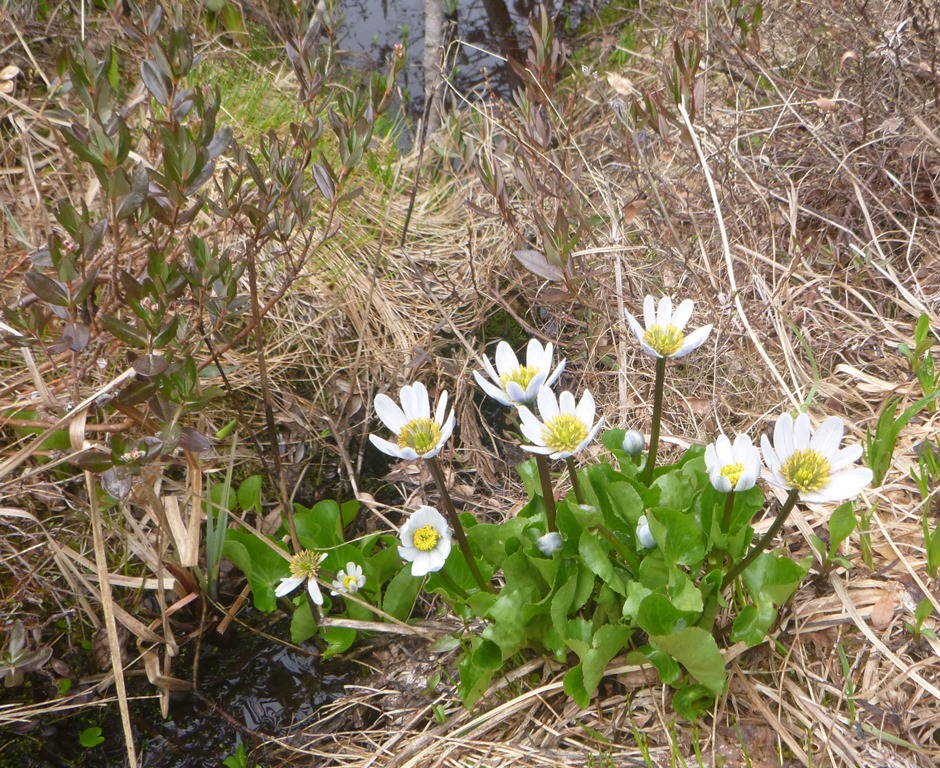
Alpine white marsh-marigold
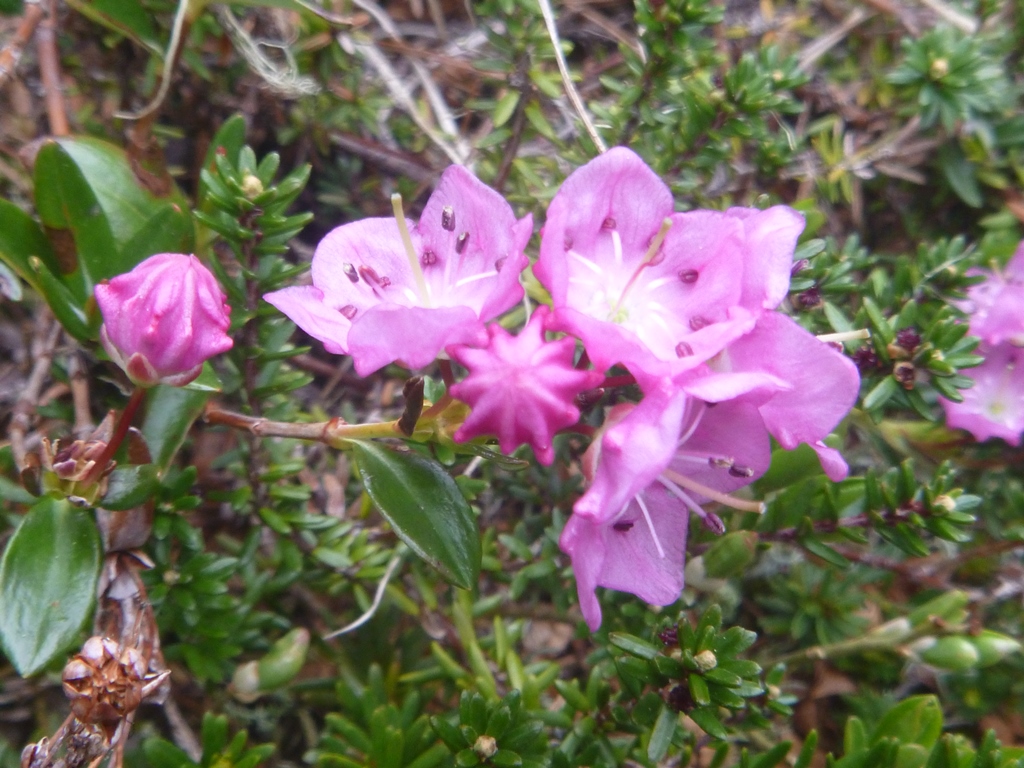
Western bog-laurel
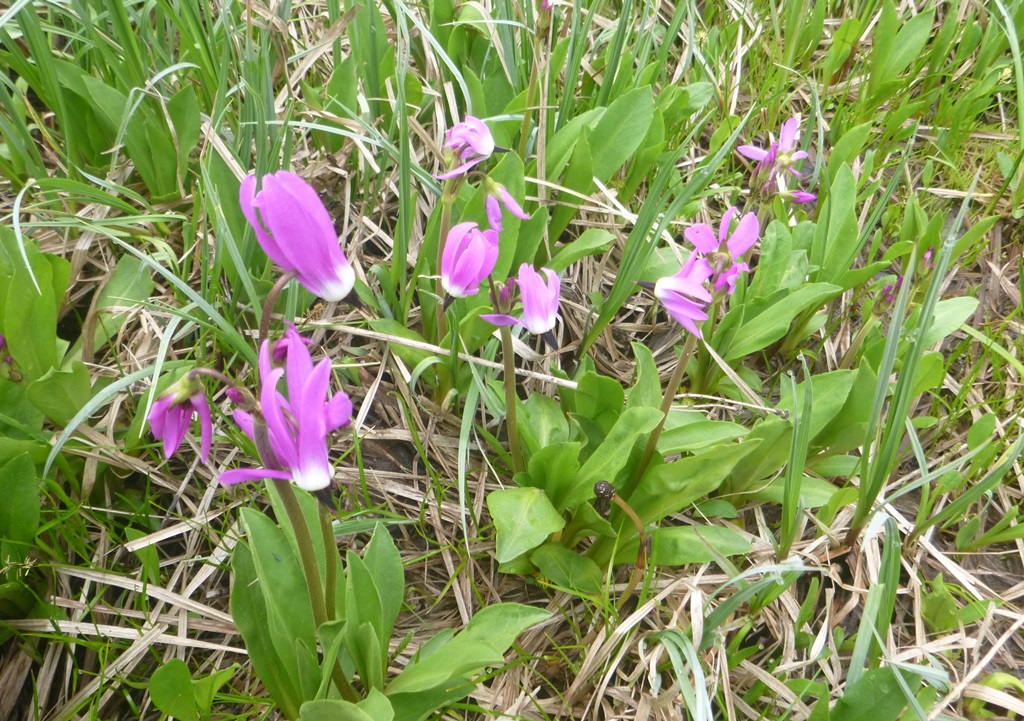
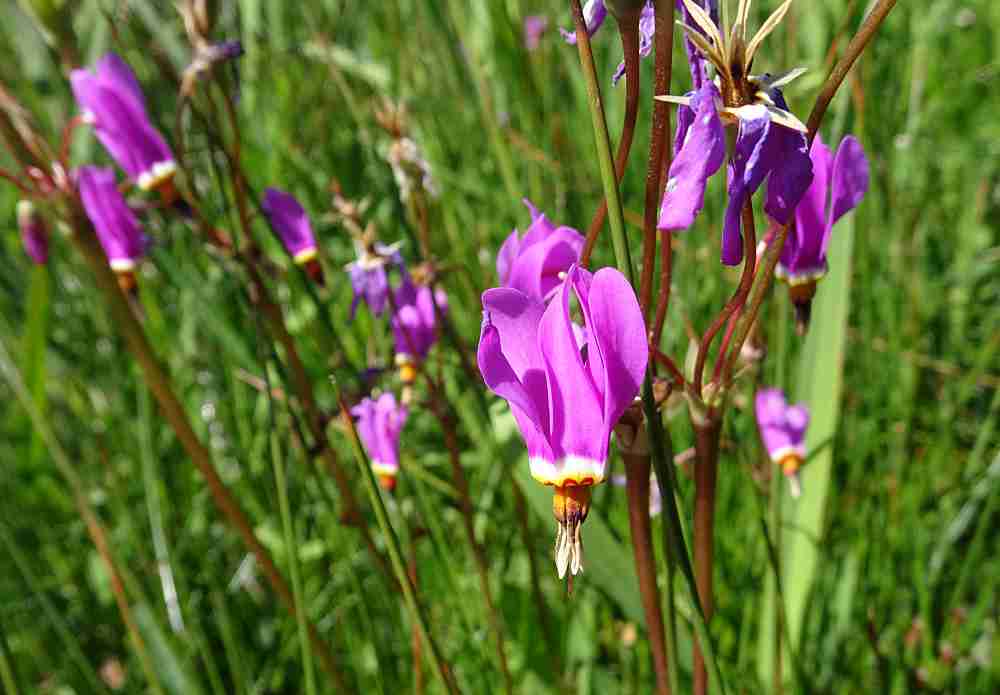
Jeffrey’s shootingstar
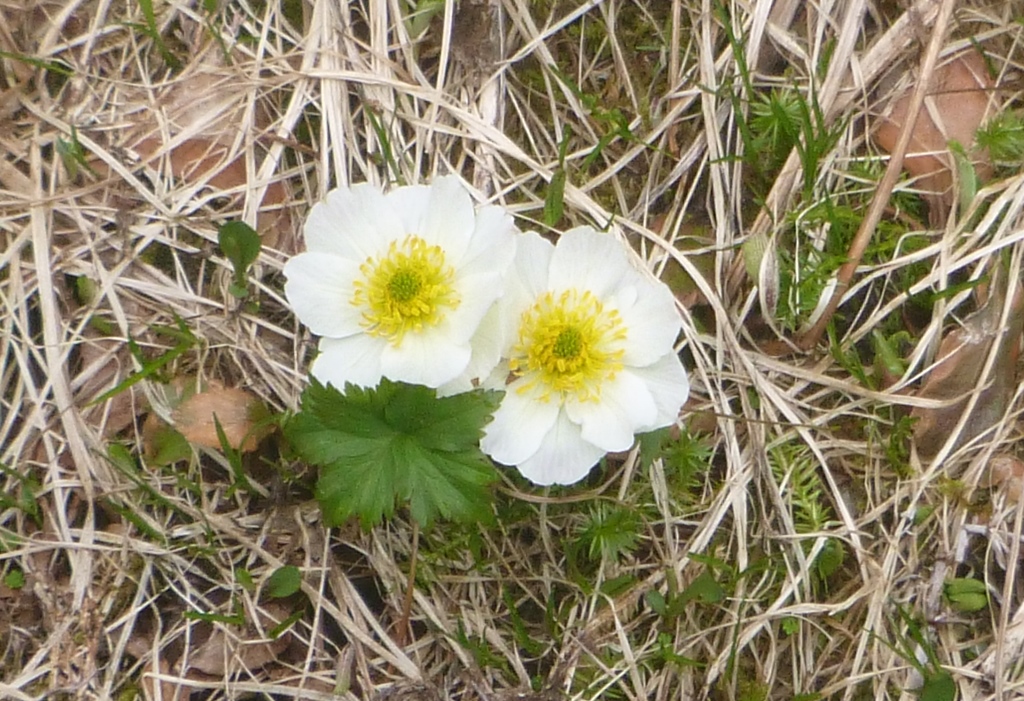
The Caltha leptosepala (alpine white marsh-marigold) starts to open as soon as the snowbanks recede and is still the predominant flower in the meadows. Kalmia microphylla (western bog-laurel) provides the first splashes of pink , with just a few Dodecatheon jeffreyi (Jeffrey’s shootingstar) in among the marsh-marigolds. It won’t be long before the shootingstars take over.
The two yellow violas, as well as the pale blue Viola palustris are out, as is Trollius laxus (globeflower).
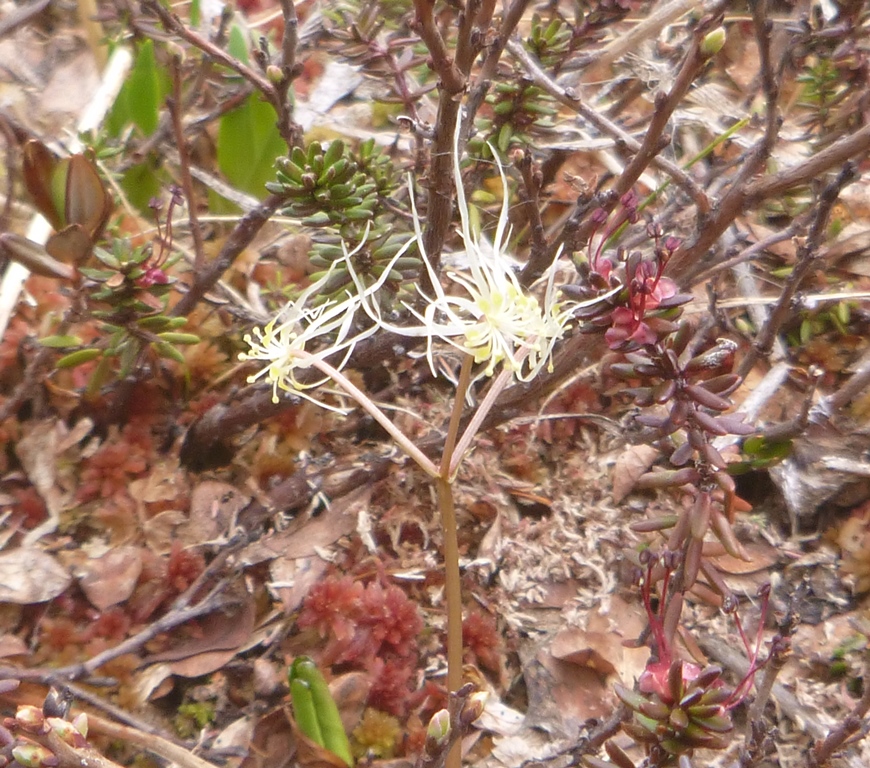
Always a challenge to find is the Coptis asplenifolia (fern-leaved goldthread); there is a large patch on the north side of the boardwalk on the path heading to Helen MacKenzie trail junction, just past the gravel section. They are hard to pick out as the delicate strands of the flower blend in amongst the sphagnum and the crowberry, plus the dull browns and yellows of last year’s dead vegetation. The fern-like green leaves of the species name will appear later.
Globeflower
Fern-leafed goldthread
Posted inPlants and fungi|Comments Off on Paradise Meadows is clear
From an email by Jocie Brooks to members of the Botany Group on May 26.
This week, I’d like to draw attention to our amazing estuary, which is full of fascinating plants, many of which are now in bloom.
Estuary view with sedge-protection fencing (Photo: Gordon Olsen)
Experience the K’ómoks Estuary
We live right beside it, but we often forget about it in our pursuit of other places and interests. It becomes just a passing glance, a “pretty view” while driving the Dyke Road from Courtenay to Comox. To really experience it, one has to step out of the car. Last week I pulled over at the Rotary viewing stand, a place I haven’t stopped at for years. In minutes, you find yourself waist deep in sedges, smelling sweetgrass, listening to the piercing song of a warbler, and peering into a hot pink shooting star or a brilliant yellow buttercup. The place is wild and interesting, beautiful, historic, with an abundance and diversity of birds, plants, fish, insects and animals that could keep an expert busy for a lifetime. This special place, the K’ómoks estuary, deserves our full attention and appreciation.
Why are estuaries important?
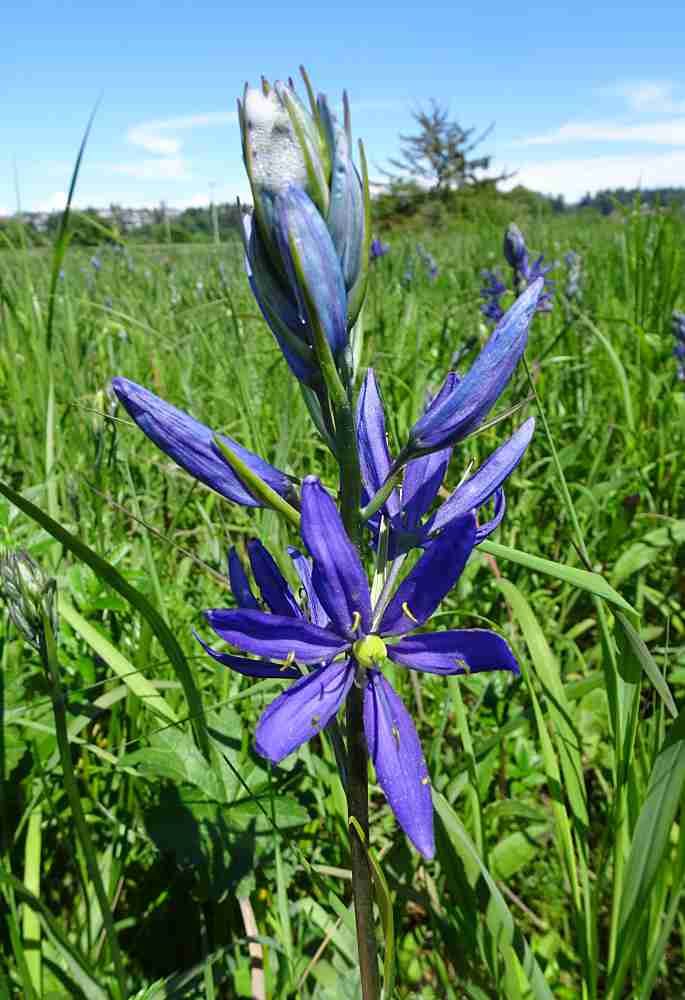
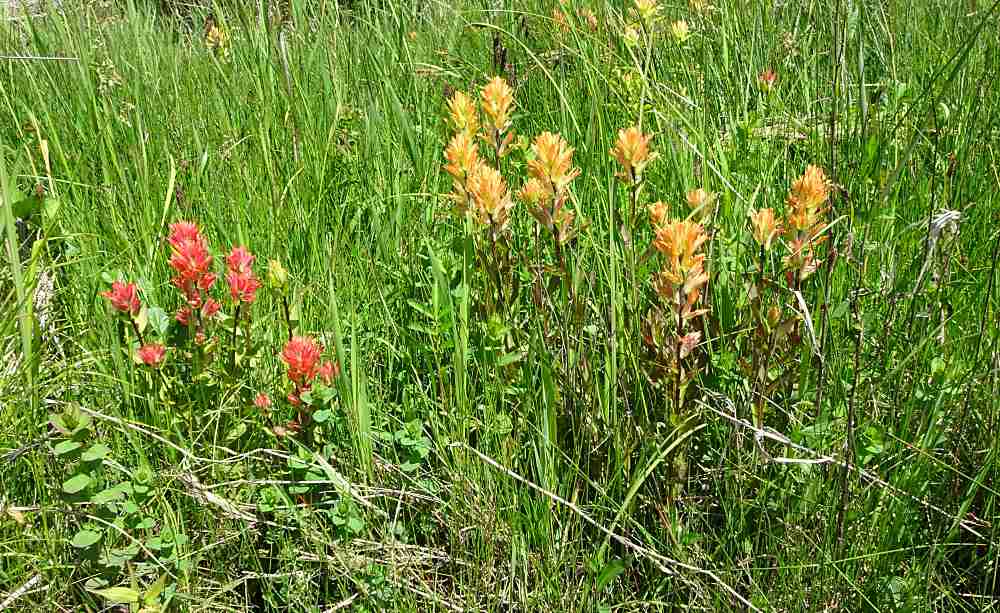
Estuaries, where rivers meet the sea, are among the most productive ecosystems on earth. In BC, only 3% of our shoreline is made up of estuaries, yet 80% of all wildlife either live in, or spend part of their lifecycle in estuaries. Rivers deposit rich, fertilized sediments, and tides carry oxygen and nutrients into the estuary and flush out its wastes. Estuaries encompass a variety of habitats. There are lush meadows of sedges, with swathes of pink, blue and red in the spring from the blooms of shooting star, camas and paintbrush. Salt marsh plants such as silverweed, seaside arrow-grass and maritime plantain thrive in a brackish mix of salt and fresh water. Exposed mudflats are colonized by small, tough plants like pickleweed and sea milk-wort, and at lower tide levels there are extensive “forests” of eelgrass. Huge amounts of carbon are stored in estuary sediments, making estuary conservation even more critical in the face of climate change.
Pretty shootingstar (Primula pauciflora)
Common camas (Camassia quamash)
Paintbrush (Castilleja spp.)
A brief history
First Nations peoples lived on the shores of the K’ómoks estuary for millennia, and the remnants of their fish weirs for harvesting salmon can still be seen in patterns of wooden pegs that protrude from the mudflats. Since the coming of the pioneers in the mid to late 19th century, the estuary has been profoundly altered and abused. Logging and coal mining had the biggest impact, with railway lines built right along the shoreline, and jetties built for dumping logs and transporting coal. The courses of our rivers were altered, and no longer fanned out into the estuary as they had done. A sewage lagoon was made (where the airpark is now) and old cars and refuse were dumped for fill (old Field Sawmill site). Much of the shoreline has been lost to housing developments. Sadly, we will never really know what the estuary was like in its pristine state, but despite all of the changes it is remarkable just how much diversity still exists.
Protection and restoration
Many local organizations work to protect and preserve our estuary. K’ómoks First Nation patrols the estuary with their Guardian program, and are involved in restoration by planting native sedges and erecting fencing to keep Canada Geese from grazing.
Project Watershed is also at the forefront of efforts to protect, restore and educate the public about the estuary. Project Watershed, KFN, the City of Courtenay, and many other organizations are working to “unpave paradise” by re-wilding the old Field Sawmill site (Kus-Kus-Sum) by the 17th Street bridge. Native plants will be restored, and side channels created for salmon habitat.
Comox Valley Nature has a long history of removing invasive plants from the estuary and planting native vegetation. The Comox Valley Land Trust is involved in efforts to protect the estuary’s watershed. Many more groups care for the rivers and streams that feed into the estuary.
What you can do
Go out and experience what’s right here before us, our amazing estuary, and do what you can to support the many organizations that work tirelessly to protect it!
From an email by Jocie Brooks to members of the Botany Group on May 18.
Backyard micro-botany
Staying closer to home this spring, I am noticing just how many plants, wanted and unwanted, are in my backyard. This year, I have three tiny species of Veronica (speedwell) blooming in my small, urban lot. Though diminutive, their purple-blue flowers have a certain charm. Due to their micro size, they are often overlooked, stepped on and mowed over. There’s a good chance that if you look for them, you will find one or more of these species in your backyard also.
More about the genus Veronica
Flowers in the genus Veronica have 4 purple/blue petals, and usually only 2 stamens. Leaves are opposite each other on the stem. Veronicas typically grow in damp, muddy habitats.
The origin of the name Veronica may be a reference to St. Veronica, whose handkerchief had markings that resembled the flower. St.Veronica used the handkerchief to wipe the face of Christ as he carried the cross (the vera-iconica, meaning ‘true likeness’).
The common name “speedwell” comes from the parting words “God be with you” or “go on well,” referring to the healing powers of some species. The petals of Veronica fall off quickly after picking, which is also why it may be called “speedwell.” Another common name for veronicas is “brooklime,” an old English word meaning: “brook” – the stream-side muddy habitats where the plants are often found, and “to lime,” an old verb for trapping birds with sticky materials.
Veronica used to be in the figwort family, or Scrophulariaceae, but has recently been moved to the plantain family, or Plantaginaceae.
There are some larger, native species of Veronica that will be coming into bloom in late spring and summer, so we might revisit this lovely genus later on!
Has upright stems with multiple flowers, often whitish and streaked with dark blue.
It likes to grow in garden pots in my yard, but it is also found in a variety of habitats: moist places as well as disturbed sites. There are two varieties, one native (var. humifusa) and one introduced (var. serypllifolia) with subtle differences between them.
2. Slender speedwell (Veronica filiformis)
Introduced from Asia, this is one of the prettiest of small veronicas, typically growing mixed with lawn grass. The flowers are quite big and showy relative to the small size of the plant. The leaves are kidney-shaped with blunt teeth.
3. Wall speedwell (Veronica arvensis)
This tiny but aggressive Veronica has taken over whole sections of my lawn this spring, colonizing patches where the grass died from the drought last summer.
The leaves are hairy, and the tiny blue flowers are just a few millimetres across. You need a hand lens for this one!
Posted inPlants and fungi|Comments Off on Featured plant: Tiny veronicas (speedwells)
From an email by Randal Mindel to members of the Shoreline Group on May 13.
Last weekend saw the passing of a strong tide cycle that took the group out to lots of nearby beaches. Below are some photos and associated comments from observations made by group members.
We are now up to more than 290 species and 1220 observations in our iNaturalist project page. If for example you wanted to see all the nudibranchs our group has uncovered, you can search our project page and enter “nudibranchs” in the species field.
The next good tide cycle runs from May 22nd to 27th, so hopefully some of these observations will inspire you to get out for a walk in the open and uncrowded environments of our local shorelines.
Not from Russia, with nacre
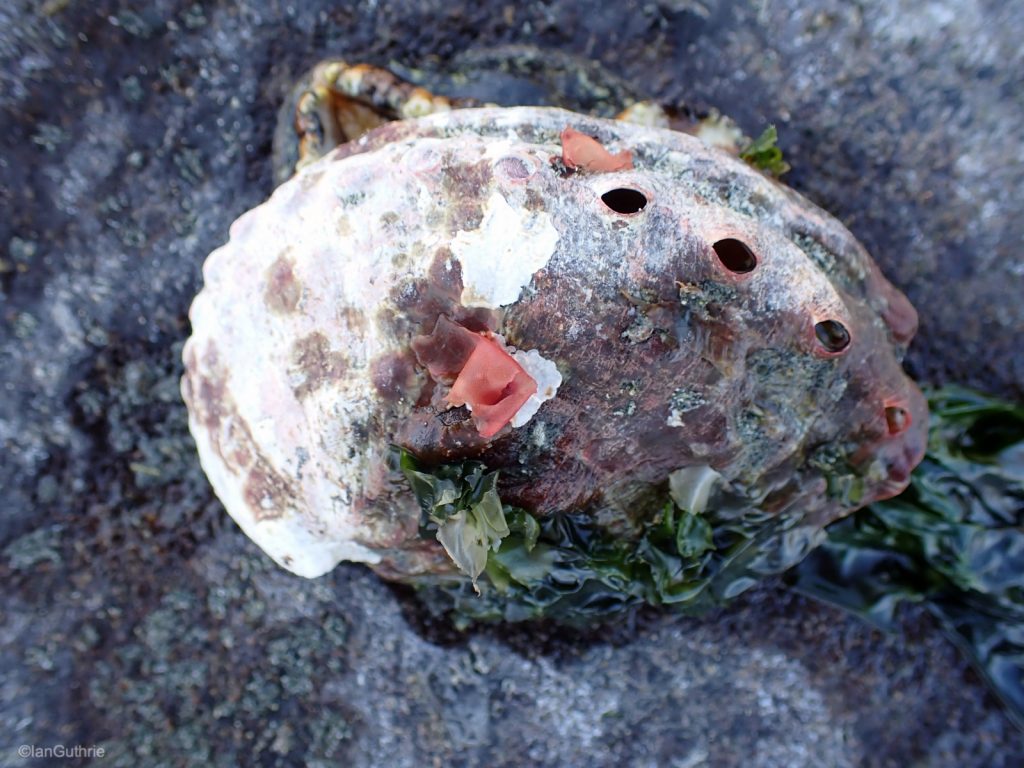
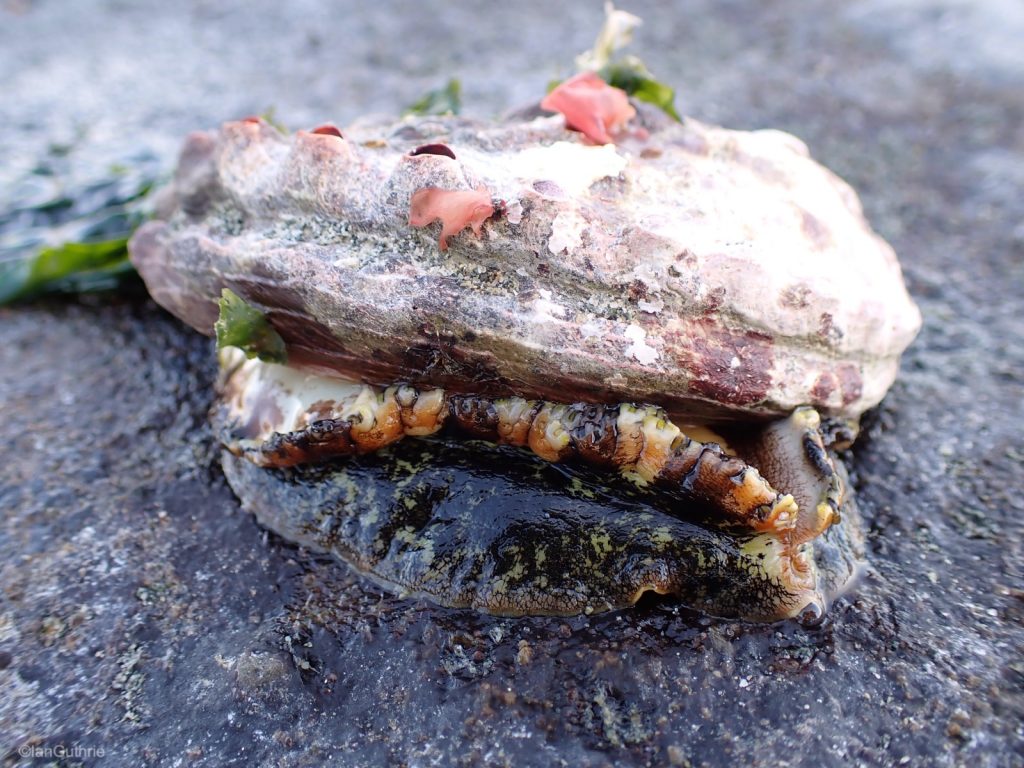
Group member Ian managed to catch sight of the red-listed Haliotis kamtschatkana, the northern abalone up by Willow Point Reef in Campbell River. Despite what the specific epithet suggests, this species ranges over the northeastern Pacific Ocean. It was named after a colloquial seaway east of the Kamchatka Peninsula around the Aleutian Islands of Alaska, where, at least in 1865, this spectacular marine gastropod flourished. Today, on account of its edibility and beautiful shell, with its characteristic perforations and deep, nacreous lining, it is overexploited and endangered through much of its range. Ian’s photos above show a live northern abalone creeping along bedrock in the low intertidal. This species is red-listed in British Columbia, meaning it is functionally at serious risk of extirpation.
The following is from the provincial government’s description of red-listed species:
Red: Includes any native species or subspecies that have, or are candidates for, Extirpated, Endangered, or Threatened status in British Columbia. Extirpated taxa no longer exist in the wild in British Columbia, but do occur elsewhere. Endangered taxa are facing imminent extirpation or extinction. Threatened taxa are likely to become endangered if limiting factors are not reversed. Not all Red-listed taxa will necessarily become formally designated. Placing taxa on these lists flags them as being at risk and requiring investigation.”
All harvesting has been prohibited in the province since 1990. If you are interested in the conservation status, biology, traditional and commercial uses of this species, there is a fairly comprehensive COSEWIC report from 2009 available online here.
Mystery of the flaccid anenome
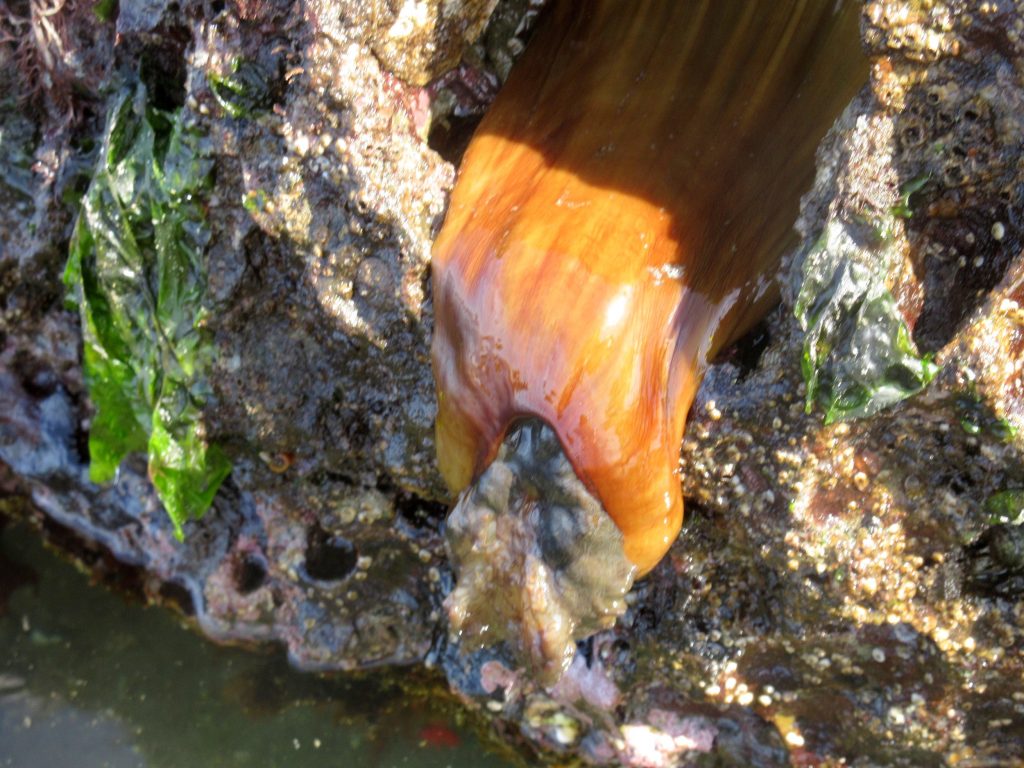
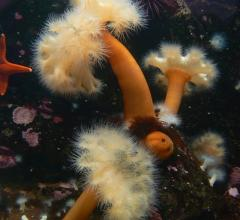
Group member Christine recently passed along a photo of a creature that has puzzled many of us in the shoreline group over time. I think Robin and Jennifer have commented on it and many of our outings include discussion of its enigmatic form. Metridium farcinatum, the giant plumose anenome is spectacular in water, where you can see its branched tentacles in a cauliflower-like mass that actively stings, paralyzes and consumes small creatures unfortunate enough to fall into its arms. Out of water, it looks completely deflated and defeated as it tries to retain water and avoid fatal dessication. Below you can see Christine’s observed specimen out of the water, with the tentacles retracted and the body tube just hanging at the mercy of gravity.
Another anenome that does this is Urticina, which has simple, unbranched tentacles. Adjacent to the first photo, you can see Metridium in its happy state, indiscriminately killing and eating everything that the current brings it.
Our biggest intertidal flatworm
As Canadians, we are used to seeing a lot of the world’s biggest things. Usually, these show up in far-flung locations in range of the Trans-Canada or Yellowhead highways. Whether this is a giant hockey stick in Duncan or a giant nickel in Sudbury, they tend to draw people on novelty and a lack of competition. The same cannot be said for the giant flatworm. It lives right alongside giant sea cucumber and giant sea stars and giant sea urchins. How can it attract attention?
Kaburakia excelsa, about the size of a sand dollar, turned up on the underside of a sandstone slab recently. It is thought to feed on limpets (how?) as it walks slowly over its substrate using a dense array of tiny cilia. Unlike most marine worms, this flatworm does not have a fully developed digestive tract, so it passes food out through the same mouth that it takes it in with. You can see the entire tract in the second photo with a human hand for scale.
While this is large for the intertidal area in our region, it is certainly not the largest flatworm. You’ll be horrified to learn (or recall) that the honour goes to a species of tapeworm that is 90 ft long! That group of flatworms inhabits the intestinal tract of large mammals, including humans. They are considered parasites and have very detrimental effects on human health in many parts of the world.
The savage sea star strikes again
Group member Mary M. sent along a picture that ties together themes from the last two email updates, wherein we considered the plainfin midshipman fish and the feeding habits of the purple sea star. I think the photo speaks for itself. We can add the midshipman to the list of unlikely items that the purple starfish eats. It should be noted that Pisaster ochraceus is considered a keystone species in our region. As a ravenous predator, it controls populations of prey species. This site from HHMI provides a visual demonstration of what happens to our intertidal flora and fauna absent the purple sea star.
This post is by Jocie Brooks, leader of the Botany Group, adapted from her email to members of the group on May 12.
General notes
Horsetail and scouring rush are distinctive plants, with bamboo-like jointed stems and a strange rough-to-touch texture. They are also ancient, living fossils that transport us back to prehistoric times when they flourished 300 million years ago in the swampy landscape of the Carboniferous period. Artists’ re-creations of that period often depict tree-sized horsetails, the Calamites, with dinosaurs roaming through them. These are fascinating plants, true survivors of the trials of time.
Description
Horsetails are in the Phylum Sphenophyta, of which there is only one living Genus today, Equisetum, which means “horse bristle.” There are 15 species of horsetail in the world and they are among the oldest surviving vascular plants on earth. Horsetails grow from perennial rhizomes that can grow a metre deep. In the spring, annual shoots arise that are hollow, ribbed and jointed. Whorled branches fan out from the joints and inconspicuous leaves form a sheath with pointed teeth. The whole plant has a coarse texture due to the presence of silica dioxide. Scouring rush differs in that it has no branches, and the shoots are perennial.
The three most common species in our area are:
Giant horsetail (Equisetum telmateia) this is the largest horsetail in our area, common in wet places such as swamps, marshes, ditches and stream sides. It is not found east of the coast mountains. The species name telmateia means “of muddy water or swamps.”
Common horsetail (Equisetum arvense)is a smaller species that is circumpolar. It grows in a variety of habitats, and can tolerate sun exposure and poor soils, often colonizing roadsides and disturbed places. It is notoriously hard to remove from the garden!
Scouring rush (Equisetum hyemale) has no branches, and has darker, blue-green stems. All of the stems look alike and are evergreen.
Giant horsetail shoots
How do horsetails reproduce?
Many species of horsetail produce green vegetative shoots that are sterile, as well as ghostly, colourless fertile shoots with a cone-like structure, or strobilus at the tip. The strobilus is packed with small, plate-like sporangiophores that are ringed with spore-producing sporangia. A spring-like elater is coiled around each spore, and when conditions are right, the spores are shot into the air. Spores grow into the beginnings of a new plant, the gametophyte, which is either male or bisexual. Male gametophytes (like mosses and ferns) have sperm with flagella that require water to swim to female plants. The fertilized plant, now called the sporophyte begins to grow and eventually detaches from the gametophyte and develops to maturity.
Strobilus of giant horsetail (left), scouring rush (right)
First Nations/Traditional use
Fertile shoots of horsetail were traditionally harvested by many coastal groups. The new spring shoots were eaten fresh or boiled after the tough outer fibers were removed. Saanich people thought the shoots were good for the blood. Squamish people used to drink water from the hollow stem segments of giant horsetail.
Horsetail, especially the green shoots, can be extremely toxic to livestock and humans, causing weakness and trembling and in some cases coma and death. It is recommended that the green shoots are never eaten, and fertile shoots should only be consumed “in small quantities and with extreme caution.”
Scouring rush was used as an abrasive, a bit like sandpaper, for polishing a variety of wooden implements. In colonial times it was used as a pot-scrubber.
Fun facts
The tallest horsetail in the world is the Mexican giant horsetail (Equisetum myriochaetum) which grows in wet, fertile soils in Mexico and Central/South America and reaches heights of 15 feet.
Horsetail is a very tough plant, that can tolerate disturbance and poor soils with metals and/or salinity. Its ability to form colonies and spread by deep rhizomes and tubers is also key to its success. After the eruption of Mt. St. Helens, horsetail was the first vascular plant to grow.
Sources
Plants of Coastal BC (Pojar & MacKinnon), Illustrated Flora of British Columbia (Douglas, Meidinger & Pojar), Biology of Plants (Raven, Evert, Eichhorn), Food Plants of Coastal First Peoples (Nancy Turner), Encyclopedia of Life (eol.org)
Posted inPlants and fungi|Comments Off on Featured plant: Horsetail and scouring rush
Join the Comox Valley Conservation Community for a day long celebration of the watersheds and waterways that connect us all in the Comox Valley!Learn about restoration and habitat enhancement projects, salmon cycles, drinking water, forests, creeks, wetlands and estuaries – and so much more. Art projects, kids activities, volunteer engagement opportunities, hands on learning and guided walks – all looking out over the beautiful Puntledge River.Comox Valley Nature will be there with our new outreach tent. Come by and say hello, and try our bird identification game. We can also show you why native plants are best for your garden, and how to spot invasive species.Pack a picnic and stay for the day! Saturday Sept 19th from 9 am – 3 pmin Puntledge Park 1111 1st , Courtenay ...
In her memoir, Pacific Northwest author Caroll Simpson recounts the highs and lows of running a remote fishing lodge on her own following the untimely death of her husband, and of falling in love with the natural world. Simpson tells stories of living in the remote wilderness and managing the lodge, becoming an accidental environmental activist, fending off wild animals, working as an angling guide and finally, fighting off a proposed mining operation and participating in the development of a government land management plan as a spokesperson for the wilderness tourism industry.While Simpson welcomed paying guests at Ookpik Lodge, unwanted house guests included a woodchuck, a pack rat, and martens. Simpson constantly had to watch out for grizzlies, moose, and cougars. Storms and extreme weather also provided fodder for hair-raising tales. All this makes for wonderful storytelling.Caroll’s story is essentially a love story. In an essay for Sierra Club, Simpson wrote: “I developed an immense passion for flora and fauna. Just walking back and forth on the 300’ dock several times a day, I was exposed to the unbelievable beauty of the northern spectrum of water life: the golden eagle soaring above, the osprey and kingfisher diving and coming up with fish for their hatchlings, the muskrats and otters looking for an easy meal, the tireless beaver working into the late evening sunsets. All of these creatures and more expressed their generational ownership of this small piece of the world. In return each was given my utmost respect and admiration…As I listened to the loons at the end of each day and the owl and the wolf in the night, I felt blessed to be witnessing such beauty. “On September 20th, join Comox Valley Nature and Save Our Forests Team for an afternoon of storytelling about this remarkable time spent living on a remote British Columbia lake.The event is being held at the Comox United Church Hall. (250 Beach Drive, Comox) Admission is by donation. Doors open at 2:30; the event begins at 3:00 p.m. There will be time for Q&A after the presentation, as well as books available for purchase. Tea/coffee and cookies - including forest-themed cupcakes - will be available for a donation.Join us, and prepare to fall in love. ...
🎟️ Get your tickets to the Project Watershed 2026 Keeping It Living Dinner today! projectwatershed.ca/2026-keeping-it-living-dinner/Every ticket holder makes a difference. 💙 🎟️ Get your tickets to our 2026 Keeping It Living Dinner today! projectwatershed.ca/2026-keeping-it-living-dinner/When community and local businesses invest in conservation, our entire ecosystem benefits. Ticket sales directly support habitat restoration, scientific research, and environmental education, while the generosity of our sponsors helps offset event costs, ensuring that more of the funds raised can go directly toward this important work. Thank you to our incredible sponsors and dinner attendees for believing in the power of community-led conservation. Odlum Brown Community and Northwest Hydraulic Consultants, 40 Knots Winery, CNB Together, we're keeping our watersheds living. 🌿 Hope to see you September 12, 5 - 8 pm at 40 KNOTS Winery #KeepingItLiving #ProjectWatershed #CommunitySupport #Conservation #ComoxValley ...
The City of Courtenay is developing a long-term vision for Bill Moore Park and Dogwood Park to guide future improvements. To help guide these decisions, three initial concepts have been developed, and there is an opportunity for you to offer your input.The latest survey on the City website engagecomoxvalley.ca/bill-moore-and-dogwood-park asks for feedback on three concept plans and specifically which concept you prefer. The three concepts present a range of recreation possibilities and there is room on the survey for your comments.Dogwood Park is a 2.32‑hectare nature park featuring mature forested areas, natural habitat and a small wetland. Only Concept A will maintain the intact forest areas in Dogwood Park. Concepts B and C propose increased recreation in the park including an off leash dog park, disc golf course, pump track (a purpose built track for children’s cycling) and nature play areas. While the planners may say that no trees or few trees will be taken down to accommodate this, the under-story will not survive this level of trampling and fragmentation. The trees as well as all the wildlife who now call that area home will disappear over time. For those of us who value this forest, Concept A is the only option that makes sense.Dogwood Park is one of the few islands of green for many, many blocks. It provides habitat for wildlife, shade, retains water and acts as a carbon sink. On the architect's base plan of current conditions it is now characterized as an "underutilized space". The City has heard from sports enthusiasts but not nature lovers. Let them know why you value an intact forest and your connection to it. The survey is open until Sept 15. ...
The Canadian Coalition for Invasive Plant Regulation (CCIPR) wants the federal government to establish a regulatory body for the horticultural industry and create a national database identifying invasive plants and their risks in different regions. "Even if we don't prohibit them, we need to let the public know when there is potential harm," said CCIPR co-founder Cathy Kavassalis. "We do this on other products, and we should do it on plants too. It's just common sense."In July, Nanaimo council passed a motion to pursue a bylaw amendment restricting the sale of plants on a list maintained by the Invasive Species Council of B.C. A week later, Surrey moved to ban sales by businesses including nurseries, large retail chains and florists. Kavassalis said a problem that could be addressed at higher levels of government is being pushed down to municipalities."These are all patchwork solutions that, in some ways, just waste a lot of resources," she said. The CCIPR says a national database could give provinces, territories, retailers and gardeners a shared source of information about which plants pose risks in different regions. Kavassalis also wants invasive plants removed from shelves or clearly labelled.For more on this story visit www.cbc.ca/news/science/invasive-plants-sale-federal-regulation-9.7312362 or see our link in bio ...