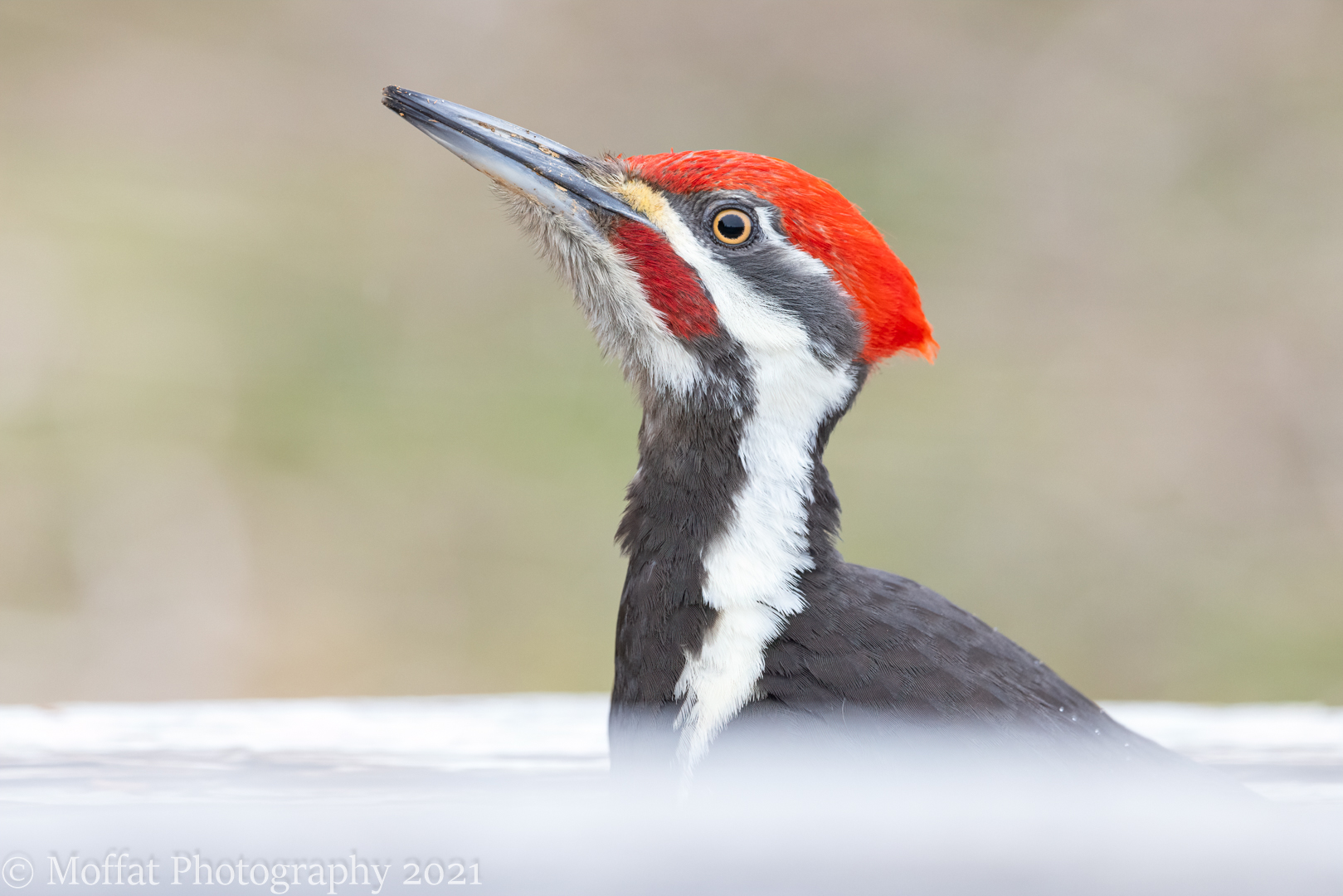
Bruce Moffat sent these great shots to the Birding Group on April 7.
“Shot these today at Rathtrevor Beach.” [Click a photo to enlarge it.]
Bruce Moffat sent these great shots to the Birding Group on April 7.
“Shot these today at Rathtrevor Beach.” [Click a photo to enlarge it.]


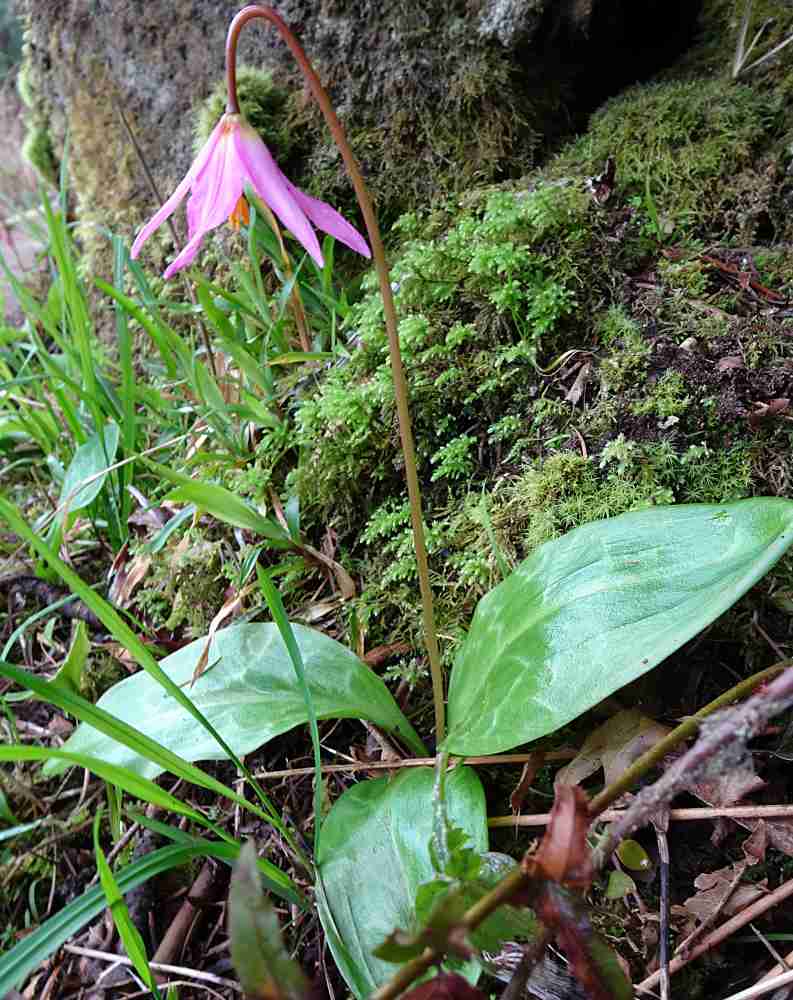
From an email by Jocie to the Botany Group on March 30.
I’m sure you are all as glad as I am to see the first wildflowers of spring! Here are some highlights from a walk along Campbell River’s scenic Canyon Trail. [Click a photo to enlarge it.]



The Canadian Society of Environmental Biologists is hosting a free online lecture as follows:
Title: Impacts of Forest Harvesting on the Supply of Bear Dens in Coastal BC
Speaker: Helen Davis
Date: Tuesday, April 6, 2021
Time: 10:00 a.m. PDT
This talk is open to CVN members and the public (see the registration link below).
Coastal bears need large old-growth structures such as hollow trees for winter dens. In most of coastal BC these structures are not protected and are disappearing due to forest harvesting. The implications of this will be discussed.

Helen Davis is a Registered Professional Biologist who has developed and implemented conservation programs for a wide variety of wildlife, including research and conservation of black bears, grizzly bears, and species at risk.
“Seating capacity” is limited, and you will need to register in advance for this talk. You can check the computer requirements for attendees here.
After registering, you will receive a confirmation email with instructions for joining the webinar.
The Strathcona Wilderness Institute hosted an online talk on March 24 by Dr. Jasmine Janes and Genevieve van der Voort whose topic was “Orchid pollinators of Strathcona Park“.
If you missed this event or would like to see it again, the recording is now available here. To access it you will need to provide your name and email address.
For more information about this talk, see the announcement on SWI’s website.
CVN’s guest speaker on March 21 via webinar was Dr. Eric Hertz whose topic was The Pacific Salmon Explorer: A novel tool for mobilizing data on salmon and their habitats risks of hatchery enhancement for Pacific salmon. The talk was well-attended and stimulated a variety of questions from the audience.
If you missed this event or would like to see it again, the recording is now available here. To access it you will need to provide your name and email address.
For more information about this talk, see the announcement in our earlier post.

The Strathcona Wilderness Institute, in conjunction with the Canadian Society of Environmental Biologists, is offering a free online lecture titled “Orchid pollinators of Strathcona Park” on Wednesday, March 24 at 7:00 pm PDT. The presenters are Dr. Jasmine Janes and Genevieve van der Voort. You will need to register in advance on the SWI website or using the link below.
The public is also invited to stay for SWI’s Annual General Meeting which follows the lecture.
For a full description of this talk and the presenters, see this SWI web page.
You can check the computer requirements for attendees here.
After registering, you will receive a confirmation email containing information about joining the webinar.
This report was prepared by Royann Petrell and Kelly Kline.
In 2020, the CVN Birders Group established a partnership with the Mountainaire Avian Rescue Society (MARS) to enhance the bird displays at their visitor centre. Last spring, Art Martell gave two presentations on the topic of the Trumpeter Swans to packed audiences at the visitor centre. Bruce Moffat was to give a photo essay on the story of a baby Loon. This will be rescheduled when the pandemic is over.
Royann Petrell provides an update in the photos below on a landscaping project at MARS to establish bird-friendly plants [click a photo to enlarge it]. She began planning a year ago and now is having weekly work parties with Karen Cummins and Jan Smith. More volunteers are needed for planting. Royann will provide training and education.


We would like weekly bird observations at MARS as we will compare species abundance before and after replanting. Linda, Gord, Kathyrn, and Krista have been doing this, but they will need more birders to have weekly reports. To date, 73 species have been recorded on eBird, and approximately half that on iNaturalist.
If you would like to help with either the planting or bird counting, please contact Royann, or email Kelly at cvnbirds [at] gmail [dot] com and he will put you in touch.
From an email by Jocie to the Botany Group on March 1.
While going through some books I came across a copy of Randy Stoltman’s classic Hiking Guide to the Big Trees of Southwestern British Columbia from the early 1990s. Stoltman was an advocate for BC’s forests and the protection of old growth, and he started BC’s big tree registry, which is now managed by UBC. Tragically, Stoltman lost his life while on a ski trip in 1994.
The current registry includes a list of “champion trees,” which are the largest trees of each species determined by a score based on height, diameter and crown. The registry also has listings of many additional big trees, and anyone can nominate a tree. Unfortunately, the registry does not mean that any of these trees are protected. You can check out the registry here.

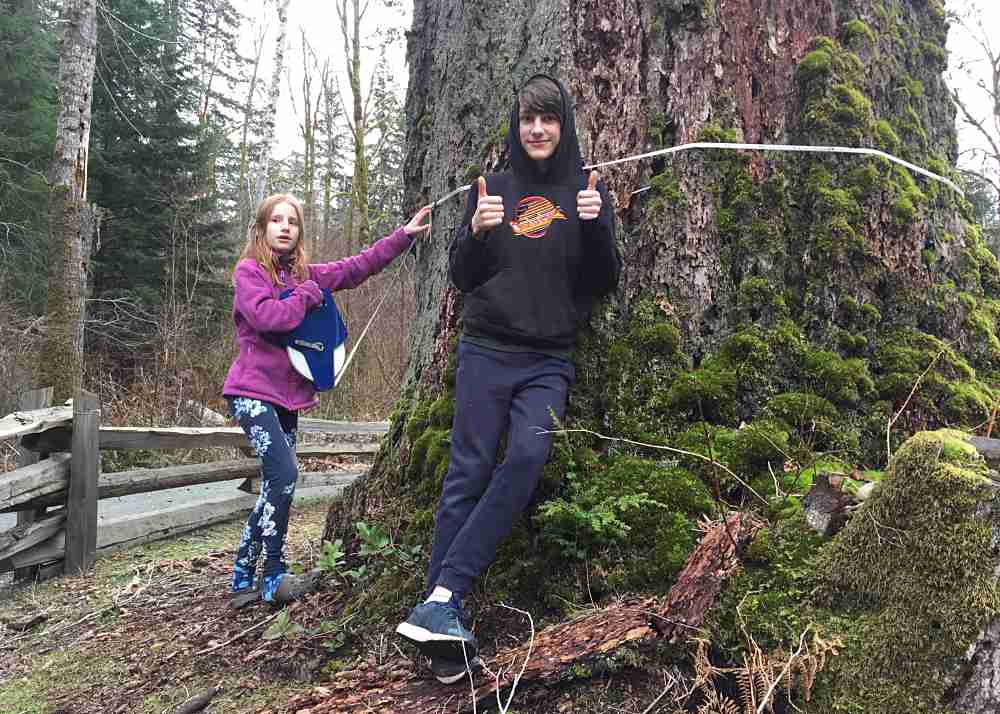
I had big trees on my mind while taking a walk in Miracle Beach Provincial Park on the weekend. I got the kids involved, and we identified the 5 largest Douglas-firs in the park. Some of these rare old growth firs escaped logging, and also the devastating fire of 1938 which swept through much of the Black Creek and Merville area. [See photos at right and below.]
Just for fun, we measured the DBH (diameter breast height) of each of these top 5 and the winner was the large fir that stands right at the campground entrance, at 2.06 metres. Interestingly, there is a fir in Kitty Coleman Provincial Park in the big tree registry that is 2.75 metres. The largest Douglas fir in BC is the Red Creek fir in the Port Renfrew area, with a whopping DBH of 4.23 metres.
Looking at things from an arboreal perspective, it hits home just how much old growth forest we have lost and continue to lose on Vancouver Island. Photographer TJ Watt captured some before and after images of logging in the Caycuse watershed in 2020 which have received international attention. Here is an article about it in the Narwahl, This is just one example of what is happening to the last remnants of old growth forest. Around 9000-10,000 hectares of old growth forest continue to be logged each year on Vancouver Island, and many of the big trees chronicled in Stoltman’s book are long gone.
The Ancient Forest Alliance and Western Wilderness Committee are good sources of information on what’s really going on in the woods, and how one can take action. The AFA also has some inspiring short videos here.
Here are a few more photos of the big trees of Miracle Beach Park. Though they aren’t going to be contenders as “champions” they are certainly impressive in their own right! [Click a photo to enlarge it.]


From an email by Jocie to the Botany Group on March 6.
Well, it is only early March, but a few tiny (and mostly weedy) species are already in bloom, shivering in the cold wind.
Here are a few things from Kin Beach Park in Comox [click a photo to enlarge it]. There should be some more early bloomers (blue-eyed Mary and such) coming along soon.
Helen reports that there are no gold stars (Crocidium multicaule) in bloom at Point Holmes yet, where they usually appear. The earliest blooming gold stars that Helen has on record are from February 22.


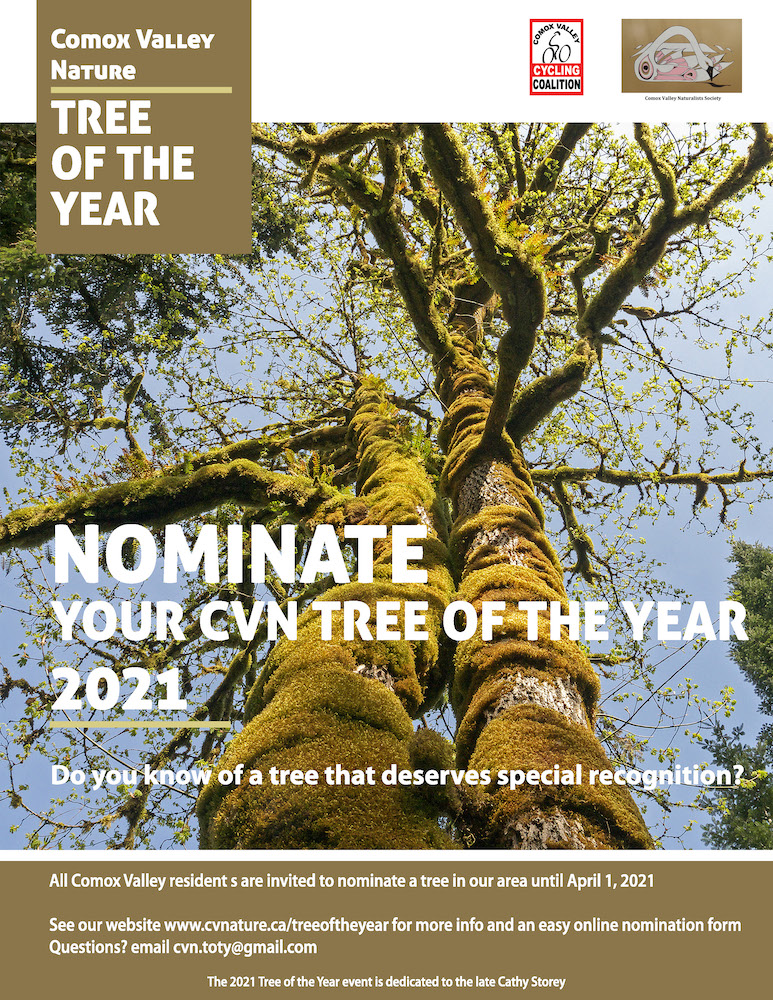
This year, CVN’s Tree of the Year contest is being held in honour of Cathy Storey, the member whose initiative founded this activity. Cathy passed away in December 2020.
In this fourth year of the contest, we have made several improvements:
You can nominate a tree any time between now and April 1. Visit our Tree of the Year page to learn more about the contest and to access the nomination form.
After nominations close, we will prepare cycling and walking guides to suggest routes by which you can visit these trees, and make the guides available on this website.
Voting will open April 16 and run until June 1. Watch for additional details at that time.