Toothed fungi, part 2

From an email from Jocie to the Botany Group on December 7.

Here is Alison’s 2nd instalment of the toothed fungi. [See this post for the first instalment.]

Alison’s notes

[Click a photo to enlarge it.]

Next on the list is in the Sarcodon genus, the dark brown cap with scales  of Sarcodon imbricatus looking not unlike an aging Hydnellum aurantiacum. The photos #1 & 2, showing cap and underside, were taken by Jocie in the Merville Woods at Williams Beach Road. It can also be found up in the Park (e.g. Divers Lake area). There is another similar species found locally – S. scabrosus distinguished  by darker underside and dark bluish coloration at the base of the stipe. A third species – Sarcodon fuscoindicus – is a stunning purple/dark blue, which could have been included in the “Blues and Greens” note. I found it in 2016 in the forest at Nymph Falls, but at the moment my photo is MIA, so here is a link to an image by Michael Beug in E-Flora.

Another toothed fungus that has sometimes been confused with the hydnella is the Phellodon genus which is common in the valley and up to the subalpine. Photo #3 from the Comox Lake Bluffs Ecological Reserve is Phellodon tomentosuswhich has a beige to brown centre and off-white margin on the cap, and beige on the underside. Phellodon atratus is also found here – with a dark centre and lighter margins on the cap and greyish/purplish teeth on the underside.  

Phellodon tomentosus

A quite different fungus in the tooth category is Hericium abietis (commonly known as bear’s head). It is usually found on dead conifer trunks, sometimes still standing, more often horizontal (photo #4). Its species name suggests that it is specific to true firs (Abies genus) but it can also be found on Douglas Fir – as in the photo. The cross-section on my kitchen table (photo #5) shows the spiny “teeth” more clearly – it is a choice edible (sautéed to a crisp and mixed into a garlicy hummus is my favourite.). 

One of the most intriguing fungi in the forest falls into this category, namely Auriscalpium vulgare or earpick fungus (photos #6 & 7).  Far from “common” (= vulgare) in its appearance, this tiny (5 cm high / 2 cm across the cap) fungus is often hard to find in the late fall, growing on its fir-cone on the forest floor – it blends in perfectly with the browns of dead leaves and fallen cones.

Finally a PS on the weather. It has been so mild this fall, apart from one short spell of sub-zero temps, that many shrooms are continuing to appear.   There has been a second flush of large Lobsters on our property and on December 2nd I picked some rather large, perfect chanterelles  – 15 cm in length and 12 across the cap.  This is the latest I have ever picked chanterelles in good condition, not softened by frost. This Fall has produced bumper crops of chanterelles, hedgehogs and many other species edible and otherwise. After three seasons where conditions were far from ideal (long hot summers lasting into October), this year has been optimal in terms of temperature and moisture at the right times. Fungi are highly sensitive to their environment!!!  It is a pity that this year we have not been able to conduct fungus ID sessions in the field and forest – photos are a poor second best.  Next year we hope….

Posted in Plants and fungi | Comments Off on Toothed fungi, part 2

Courtenay River Airpark 2020 Report

This years 2020 Restoration Report for the Courtenay River Airpark has been posted on the Comox Valley Nature Website. It is under publications on the top bar of the page. Click on this and go to Wetland Restoration. I wish to thank all the volunteers who helped keep the project going for its 26th year.
A limited number of hard copies are also available.
Thanks once again.
Frank Hovenden

Restoration Project 2020  Courtenay River Airpark


Posted in Wetland Restoration | Comments Off on Courtenay River Airpark 2020 Report

Botany quiz #2: Shrubs

From an email by Jocie to the Botany Group on December 5.

Here is quiz #2, featuring all native shrubs in autumn. [Click a photo to enlarge it.]

You can download the answers here.

Posted in Plants and fungi | Comments Off on Botany quiz #2: Shrubs

Botany quiz #1: Trees

From emails by Jocie to the Botany Group on December 1 and 5.

To keep you on your toes, here is a short quiz featuring deciduous trees in autumn (large and small, and a few that may be classified as shrubs) that are common in our area (all of these are native). I’m realizing that I didn’t include anything that would give a sense of scale…so this might not be as easy as intended! Next up will a more challenging quiz with shrubs and smaller plants in various states of decay.

The quiz is “open book” so look things up if you need to. Have fun! [Click a photo to enlarge it.]

You can download the answers here.

Posted in Plants and fungi | Comments Off on Botany quiz #1: Trees

Sunday pancakes?

From an email by Jocie to the Botany Group on November 29.

My family enjoys pancakes on a Sunday morning, but I didn’t expect to find pancakes in the woods. Wandering about in the Miracle Beach Park campground, I came across a cluster of large, rather plain looking brown shrooms and wondered what they could be. Flipping through my books didn’t help much, until I read this description: “the mature caps look remarkably like pancakes” which clinched it for me.

Reading on… “white gills, and a stout white stipe attached to a mat of pale mycelium” fit the bill also. Though I will now always recognize this as the “pancake” its official name is the brown leucopax (Leucopaxillus gentianeus). They look like they might taste good with butter and maple syrup…but this is not the case. They are in fact “inedible and extremely bitter.”

[Click a photo to enlarge it.]

Nearby, there were some dinner-plate sized white shrooms with decurrent gills (gills extending down the stipe) and broad white caps. These are another member of this genus: the large white leucopax (Leucopaxillus albissimus). Though I’ve spent considerable time in Miracle Beach Park over the years, this is the first year I have seen either of these in the park. This little park is always yielding new and unexpected things!

Posted in Plants and fungi | Comments Off on Sunday pancakes?

Herring conservation report

CVN members will be interested in Dr. John Neilson’s report to Conservancy Hornby Island on the need to protect herring in our area. The report is titled “The Science Case for a Marine Protected Area in Lambert Channel: Conservation Benefits for Pacific Herring,” and you can download it here.

CTV Vancouver Island reported on this. You can see their video here.

An online article by mycomoxvalleynow.com also covers this story in more detail. See it here.

The TV story gives equal time to the fishing industry which, of course, disputes the call for more protection. Read John’s report and the media coverage and judge for yourself.

Posted in Conservation and Restoration, News | Comments Off on Herring conservation report

eDNA sampling project completed

From an email by Kelly to the Birding Group on November 23.

Today the last sample was taken from Courtenay Airpark Lagoon. All 17 weekly samples were shipped today to Guelph University for analysis.

The sampling team consisted of myself, Shirley C., Rick H., Gael A., Linda G. and Gordon S.. Well done team!

Some photos are attached. The last photo shows the filter disks. [Click a photo to enlarge it.]

For those hearing this for the first time, the samples are to assist Bettina Thalinger (University of Guelph) with her research for a method to identify bird species at remote sites.

Posted in Birds | Comments Off on eDNA sampling project completed

Toothed fungi, part 1

From an email by Jocie to the Botany Group on November 22.

Alison M. has put together an informative overview of some of the toothed fungi: hydnums and hydnellums.

[Click a photo to enlarge it.]

Alison’s notes

Well into November there are still gilled mushrooms popping up in the valley – species of the Inocybe genus and Stropharia tend to be among the later fungi in the sequence. I still have chanterelles appearing. This however is the time when some of the toothed fungi come into their own, fungi that have little spines (rather than gills) as the spore-bearing part of the mushroom.

So first the Hydnum genus – commonly known as the hedgehog. Hydnum is the Latinized from of Greek hudnon,   a word Theophrastus appears to use for “truffle”, so I am not entirely sure why it was chosen for the genus name. In the valley the smaller Hydnum umbilicatum  is common (photo #1 from Tsolum River Road) and also in the lower elevation areas over at Buttle Lake. Its name comes from  its depressed cap like a belly-button. Hydnum repandum (#s  2,3) has a paler, less regular cap, and is larger, growing up to 25 cm in diameter ( 3 times the size of  H. umbilicatum). It tends to grow at higher elevations. Photo #3 illustrates the spines. The dense flesh will tolerate several degrees of frost, and it is an  excellent edible (the little spines tend to come off in the cooking, and can be rubbed off in advance if you are concerned about aesthetics).

Next the Hydnellum genus – the formation of the name suggests a diminutive form of Hydnum (but as with the name hydnum itself the formation doesn’t entirely make sense to me). Jocie has already illustrated the best known Hydnellum peckii in its attractive early stage (#4), which  is often called strawberries and cream, cranberry scone or …, but although it looks inviting, it is extremely acrid. As it grows the coloured droplets disappear, the cap becoming wrinkled and folded, sometimes covered in a whitish hypomyces, sometimes with darker droplets merging to give the impression of a jam tart, and the spines on the underside develop (#s 5- 7). Eventually the cap becomes a dark brown, and it becomes like other members of the genus as they age. Other species include Hydnellum aurantiacum (orange- #s 8-9) , which also shows droplets, this time golden orange in its early stages, and H. careruleum (blue- #10), though in the latter case the blue/grey cap does not have obvious droplets. There are three further members of the genus noted in the SVIMS list which I have not yet found.

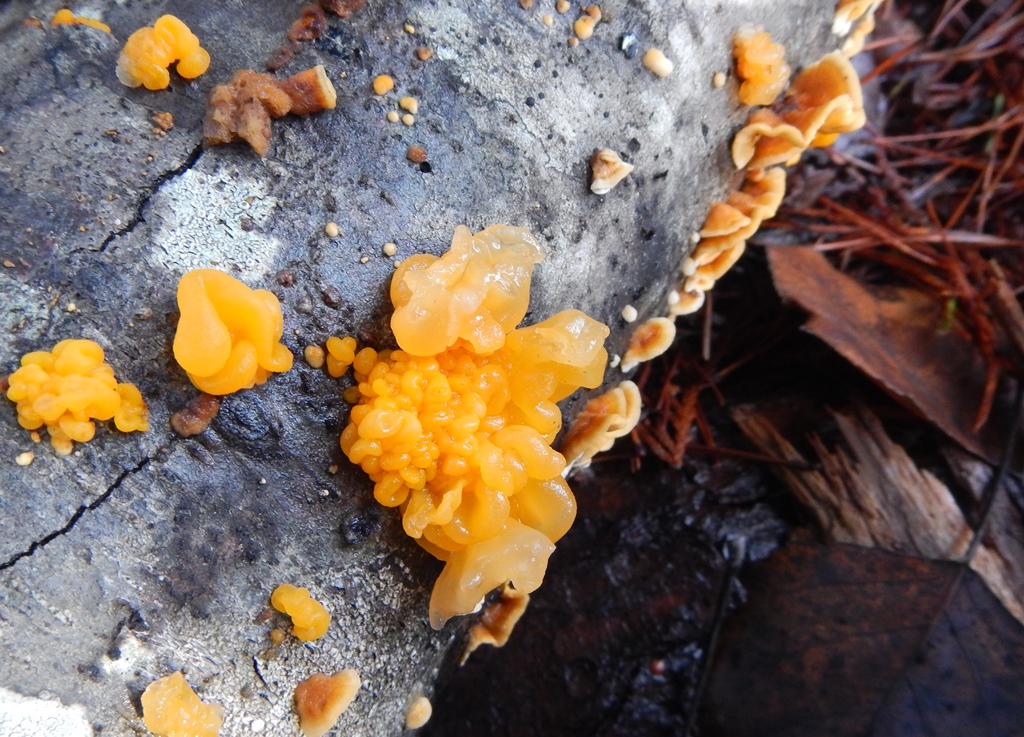
Finally, Pseudohydnum gelatinosum  = “jelly-like false hydnum”,  better known as cat’s tongue, or spirit gummy bear (#11). In the jelly fungi category, its teeth or spines make the naming obvious. You will find it commonly on dead logs or branches on the ground from late fall into winter in most of our forested areas in the valley.

Posted in Plants and fungi | Comments Off on Toothed fungi, part 1

Winter chanterelles and blue-turning coral

From an email by Jocie to the Botany Group on November 21.

Photo 1 shows a harvest of winter chanterelles or yellow foot (Craterellus tubaeformis) from Kate. This is a smaller, more delicate species of chanterelle that often has a dimple in the middle of the cap. It is a good edible, if you can find it!

(1) Winter chanterelles

Photo 2 is a coral fungus (possibly one of the crested corals in the genus Clavulina) taken by Kyle from the Beaver Lodge lands. Note the strange blue-grey colour taking over the base. In one of my books (Mushrooms of the Redwood Coast) it says that Clavulina can be parasitized by a fungus called Helminthosphaeria clavariarum (isn’t that a mouthful?) which “distorts the fruiting body to a bluish gray to dark gray color.” That is my guess on what might be going on there, but if any of you have thoughts/suggestions on this let us know!

(2) Parasitized Clavulina ?
Posted in Plants and fungi | Comments Off on Winter chanterelles and blue-turning coral

Late bloomers, etc.

From an email by Jocie to the Botany Group on November 18.

Here’s a note from Sharon that will be of interest, along with a lovely photo of gumweed, a “late bloomer” [click the photo to enlarge it]:

The Kamloops Wildflower Project and especially Clapperton Ranch have some interesting winter/fall photographs on their Facebook page.  I shared one of their posts on the Comox Valley Nature Facebook page also.

I walked through Kin Beach Park a few days ago and was struck by the winter colours and how striking the silvers and rusts were against the green of the mosses. 

Grindelia with its last bloom of autumn at Kin Beach
Posted in Plants and fungi | Comments Off on Late bloomers, etc.