Notes and photos from Alison M. on some of the first flowers blooming in the subalpine and other observations, distributed to the Botany Group on June 13. Click a photo to enlarge it.
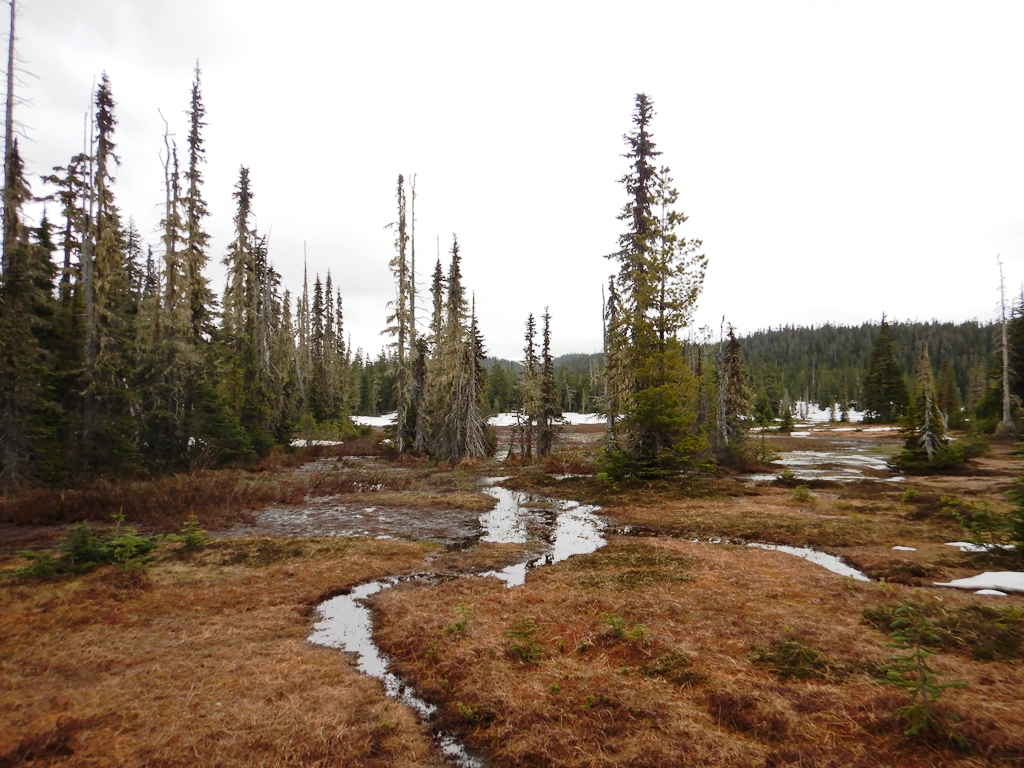
We were up at Paradise Meadows last Friday (June 4th) on an overcast cool day, and while the Meadows were open (photo #1), about half of the boardwalk still had crusty old snow that softens during the day, especially when it rains (photo #2) This wet weather may help to clear away the snow – so perhaps by the end of next week.
(1) Paradise Meadows on June 4
(2) Paradise Meadows boardwalk on June 4
The most exciting thing was the eerie “winnowing” of several Wilson’s snipe, around the ponds and in the area of Paradise Creek.
On the floral front, there were lots of Caltha leptosepala (white marsh-marigold) in bloom amid the streams of snow melt-water (photos #3 and #4) .
(3) White marsh-marigold
(4) Whte marsh-marigold flowers
In sheltered south-facing spots the Kalmia microphylla (western bog-laurel) was not quite open (photo #5).
(5) Western bog-laurel
Finally, to my embarrassment, a lonely sign [a plant identification sign placed by Alison in her work for the Strathcona Wilderness Institute], quite near the trail-head, had survived the heavy snow-pack!
Posted inPlants and fungi|Comments Off on Paradise Meadows not yet clear
From an email by Jocie to the Botany Group on June 9.
A few notes from our [Botany Group] members [click a photo to enlarge it]:
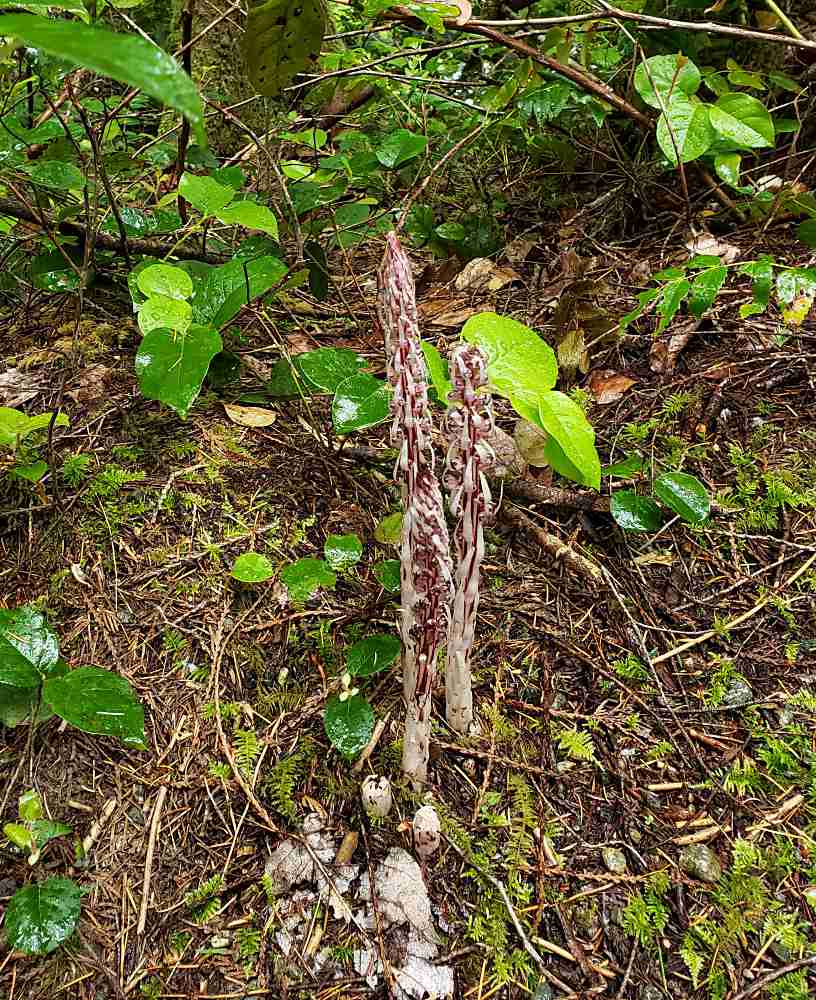
Kate reported that there is some nice candystick (Allotropa virgata) emerging at Nymph Falls Park.
Some notes from Joy about the camas bloom visible from the Dyke Road (with a close-up photo of camas from the estuary taken last year):
“A most wondrous sight greeted me this afternoon whilst driving along the Dyke Road.
In the mid-distance, between the river and the road, I spotted a large spread of beautiful blue that could have been low areas of water. I parked my vehicle, and with my binoculars I was thrilled to see that it was a largish display of camas (Camassia quamash) happily and generously blooming like a grand dame staging a comeback. Oh, so beautiful! There were the usual suspects in amongst the camas and more so in the perimeter. The only one I can remember offhand is the orange of the castilleja, but there were more.
It was thrilling to see it bloom in such abundance after the heartbreak of losing the Kye Bay Road displays. It would be wonderful to be able to see it from much closer, but my guess is that it is in some very boggy ground.
Too exciting! I hope others can stop by for a ‘gander’. I parked safely at the wide pavement by the Kus Kus Sum fence.”
From an email by Jocie to the Botany Group on June 6.
Last weekend (also showering, like this one) I did some wandering around Miracle Beach Provincial Park looking at all the nice blooms this time of year has to offer. You are probably thinking that beer and roses don’t exactly go together, but this gets to the truth of what we often see in the natural world…beauty side by side with human detritus.
Here are a few highlights [click a photo to enlarge it]:
June is the month for roses! The lovely Nootka rose (Rosa nutkana).
June also means that summer is coming, and with it more Lucky cans, garbage and beach fires!
Beach pea (Lathyrus japonicus). A plant that likes to lean out onto the beach, climbing over logs, rock and sand.
Dune grass (Elymus mollis). The strappy, blue-green leaves and giant spiky flowers are a showstopper. It is also a great shore stabilizer.
Maple erineum mite (Aceria calaceris). You may notice these bright strawberry-red patches on the leaves of Douglas maple (and possibly other maples…but I always seem to see it just on the Douglas maple).
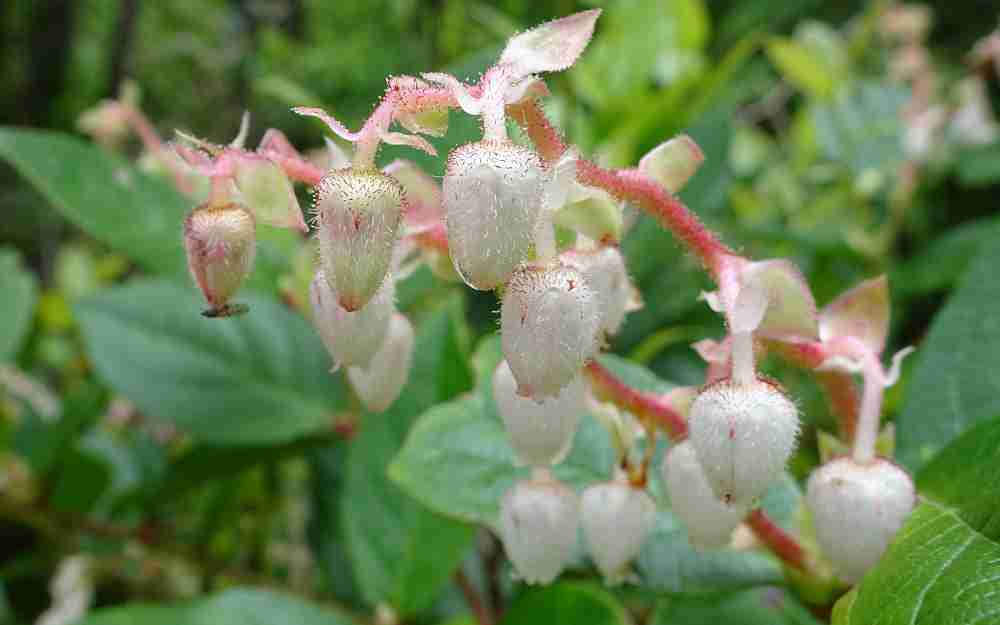
Salal flowers (Gaultheria shallon). Look again at these common, but enchanting bell-like flowers covered in sticky hairs.
Vanilla leaf (Achlys triphylla), are always attractively beaded with water droplets after the rain.
A peaceful view of Black Creek.
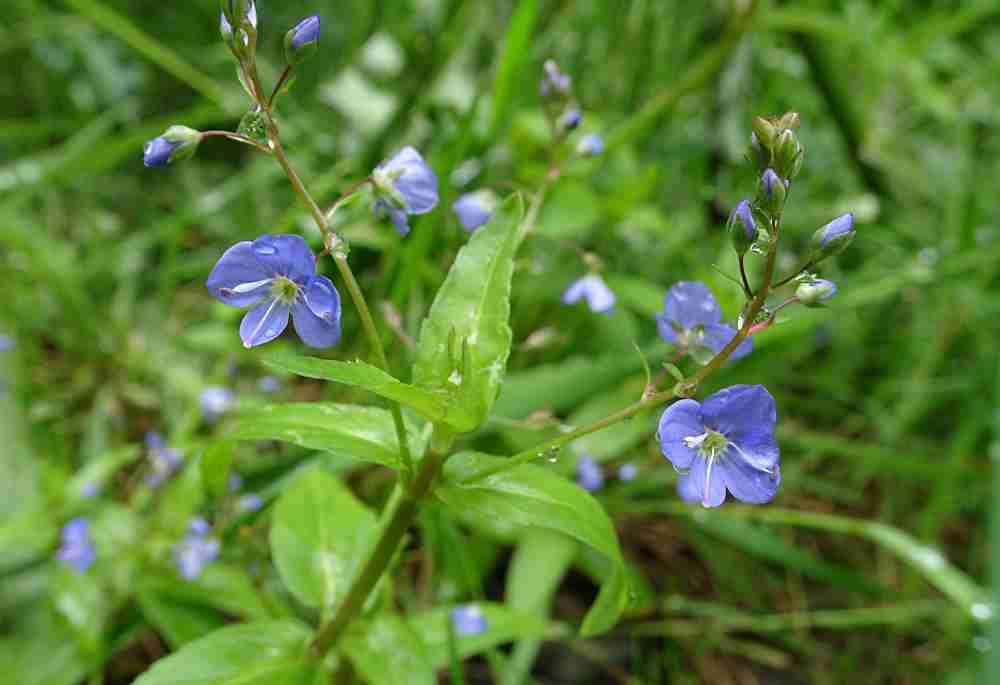
American brooklime (Veronica americana). This veronica likes ditches, stream sides and wet places.
Damp weather brings out the gastropods! Here is a banana slug (Ariolimax columibanus) out for a stroll on a sword fern frond.
The previously unidentified maple tree (#13) on Willemar Ave. has now been identified as a Norway maple (Acer platanoides).
One intrepid group of cyclists has visited almost all of the nominated trees and sent us these photos of some of them (all photos by Angela Dawson). Click a photo to enlarge it.
Here are a note and photos from Alison M., distributed to the Botany Group on May 19.
These photos of three exquisite flowers are from the lower elevations of Strathcona Provincial Park in the Buttle Lake area taken at the very end of April. [Click a photo to enlarge it.]
The Asarum caudatum (wild ginger) and the Calypso bulbosa (ladyslipper) can be found in woodlands around the Comox Valley, although where there used to be lots of the latter at the entrance to the Comox Bluffs Ecological Reserve they are sadly not visible this year.
Wild ginger
Ladyslipper
Ladyslipper
The Coptis aspleniifolia (spleenwort-leaved goldthread) will be visible up in Paradise Meadows along the boardwalk as the snow recedes (not yet).
Spleenwort-leaved goldthread
Spleenwort-leaved goldthread
Posted inPlants and fungi|Comments Off on Early blooms from the Elk River trail
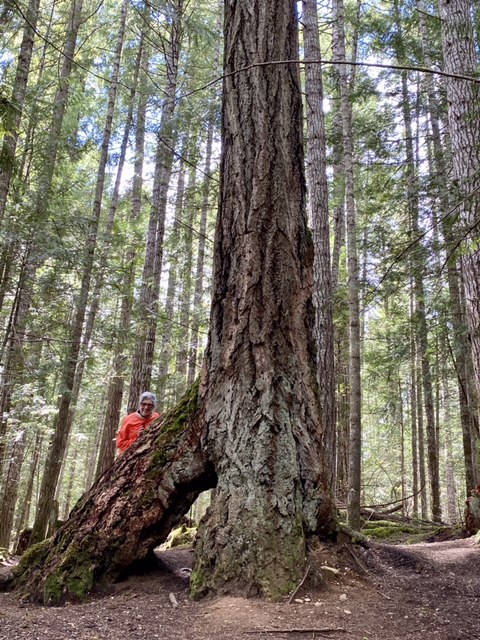
This group of local cyclists (click the photo to enlarge it) was out last week touring the trees nominated for the Comox Valley Nature Tree of the Year 2021. Circling the massive Douglas fir nominated at Kitty Coleman Park are, left to right, Marg Harris, Barb Fudge, Angela Dawson and Sue Fabrizio. Their quest continues to other trees this week.
The Canadian Society of Environmental Biologists recently hosted the following webinar, to which CVN members and the general public were invited:
Title: Citizen Science Engagement in Surveys of Bryophytes and Lichens in Strathcona Provincial Park Speaker: Daniel Tucker Date: Sunday, May 9, 2021
A major part of Dan’s talk focused on his use of the iNaturalist website, and the pros and cons of using that platform for research projects such as his.
If you missed this event or would like to see it again, the recording is now available here. To access it you will need to provide your name and email address.
Note: The recording started early. Please skip to the 8:00 minute mark for the actual start of the presentation.
For more information about this talk, see the announcement in our earlier post.
The Canadian Society of Environmental Biologists is hosting a free online lecture as follows:
Title: Citizen Science Engagement in Surveys of Bryophytes and Lichens in Strathcona Provincial Park Speaker: Daniel Tucker Date: Sunday, May 9, 2021 Time: 7:00 p.m. PDT
This talk is open to CVN members and the public (see the registration link below).
Strathcona Provincial Park is the largest wilderness area on Vancouver Island, It spans more than 250,000 hectares of the rugged snow-capped mountains, sub-alpine, and coastal temperate rainforest. Although the wilderness of Strathcona Park has been the subject of many botanical surveys since the 1880s the level of scrutiny has been inadequate considering the heterogeneity and inaccessibility of the landscape.
Bryophytes and lichens are among the most neglected due to their cryptic nature, taxonomic difficulty, and the research bias towards vascular plants. App-based citizen science programs such as iNaturalist are effective tools to enhance awareness of biodiversity, address gaps in floristic data, and monitor rare plant populations. We used iNaturalist as a repository for tracking the Strathcona Wilderness Institute’s bryological and lichenological surveys of Strathcona Park during July-August 2019 and 2020.
We found 186 bryophyte species, and 165 lichens. These surveys increased the known lists by 61 species of bryophytes (total 304), and 140 species (total 170) of lichens. These curated projects used in conjunction with surveys conducted by the Strathcona Wilderness Institute establish a functional floristic baseline essential for species conservation and increase public awareness of these marginalized groups of organisms.
Daniel is an Honours Ecology and Evolutionary Biology student finishing up his last undergraduate semester at the University of Alberta. He is an aspiring botanist interested in understanding the mechanisms behind plant-plant interactions, community assembly, and the biogeographical distributions of “lower” plants (bryophytes) and lichens. His work thus far has focused on montane areas and threatened Garry oak ecosystems of the Pacific Northwest as well as neotropical cloud forests. He has been a summer student with the Strathcona Wilderness Institute for the past three summers.
“Seating capacity” for this webinar is limited, and you will need to register in advance. You can check the computer requirements for attendees here.
From an email by Jocie to the Botany Group on April 20.
Here are a few things from a walk at Roy Morrison Nature Park last week [click a photo to enlarge it]:
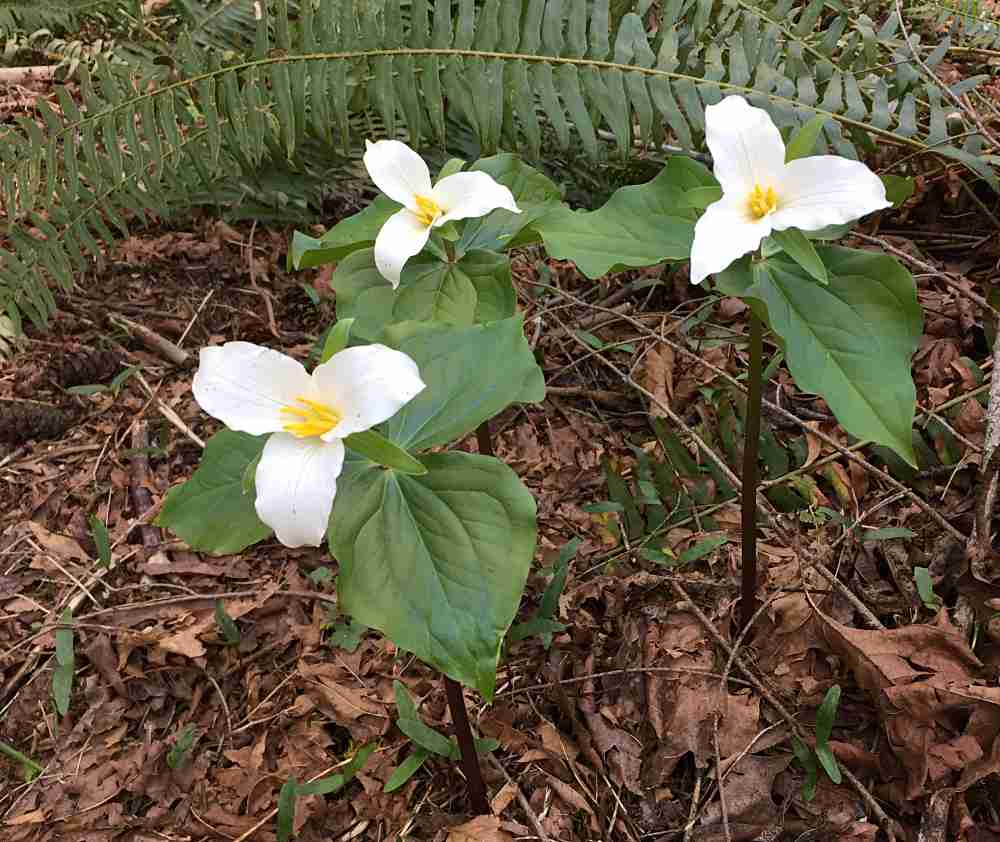
A trio of trilliums, Trillium ovatum. I was shocked to see some children clutching a bouquet of these and other flowers. We need to get the word out that these aren’t for picking, and are supposed to be protected by law in BC!!
Rusty, hairy fiddleheads of sword fern, Polystichum munitum.
The complexity of alder bark: old sapsucker drilling holes, black bear claw marks, layered over the squiggly lines of the lichen Graphis stricta. And more lichens, with intriguing boundaries that look like countries on a map.
This one is from my backyard: our showiest native shrub, red-flowering currant, Ribes sanguineum. A great plant to have in the garden, and it’s a win-win because hummingbirds love these flowers also.
Join the Comox Valley Conservation Community for a day long celebration of the watersheds and waterways that connect us all in the Comox Valley!Learn about restoration and habitat enhancement projects, salmon cycles, drinking water, forests, creeks, wetlands and estuaries – and so much more. Art projects, kids activities, volunteer engagement opportunities, hands on learning and guided walks – all looking out over the beautiful Puntledge River.Comox Valley Nature will be there with our new outreach tent. Come by and say hello, and try our bird identification game. We can also show you why native plants are best for your garden, and how to spot invasive species.Pack a picnic and stay for the day! Saturday Sept 19th from 9 am – 3 pmin Puntledge Park 1111 1st , Courtenay ...
In her memoir, Pacific Northwest author Caroll Simpson recounts the highs and lows of running a remote fishing lodge on her own following the untimely death of her husband, and of falling in love with the natural world. Simpson tells stories of living in the remote wilderness and managing the lodge, becoming an accidental environmental activist, fending off wild animals, working as an angling guide and finally, fighting off a proposed mining operation and participating in the development of a government land management plan as a spokesperson for the wilderness tourism industry.While Simpson welcomed paying guests at Ookpik Lodge, unwanted house guests included a woodchuck, a pack rat, and martens. Simpson constantly had to watch out for grizzlies, moose, and cougars. Storms and extreme weather also provided fodder for hair-raising tales. All this makes for wonderful storytelling.Caroll’s story is essentially a love story. In an essay for Sierra Club, Simpson wrote: “I developed an immense passion for flora and fauna. Just walking back and forth on the 300’ dock several times a day, I was exposed to the unbelievable beauty of the northern spectrum of water life: the golden eagle soaring above, the osprey and kingfisher diving and coming up with fish for their hatchlings, the muskrats and otters looking for an easy meal, the tireless beaver working into the late evening sunsets. All of these creatures and more expressed their generational ownership of this small piece of the world. In return each was given my utmost respect and admiration…As I listened to the loons at the end of each day and the owl and the wolf in the night, I felt blessed to be witnessing such beauty. “On September 20th, join Comox Valley Nature and Save Our Forests Team for an afternoon of storytelling about this remarkable time spent living on a remote British Columbia lake.The event is being held at the Comox United Church Hall. (250 Beach Drive, Comox) Admission is by donation. Doors open at 2:30; the event begins at 3:00 p.m. There will be time for Q&A after the presentation, as well as books available for purchase. Tea/coffee and cookies - including forest-themed cupcakes - will be available for a donation.Join us, and prepare to fall in love. ...
🎟️ Get your tickets to the Project Watershed 2026 Keeping It Living Dinner today! projectwatershed.ca/2026-keeping-it-living-dinner/Every ticket holder makes a difference. 💙 🎟️ Get your tickets to our 2026 Keeping It Living Dinner today! projectwatershed.ca/2026-keeping-it-living-dinner/When community and local businesses invest in conservation, our entire ecosystem benefits. Ticket sales directly support habitat restoration, scientific research, and environmental education, while the generosity of our sponsors helps offset event costs, ensuring that more of the funds raised can go directly toward this important work. Thank you to our incredible sponsors and dinner attendees for believing in the power of community-led conservation. Odlum Brown Community and Northwest Hydraulic Consultants, 40 Knots Winery, CNB Together, we're keeping our watersheds living. 🌿 Hope to see you September 12, 5 - 8 pm at 40 KNOTS Winery #KeepingItLiving #ProjectWatershed #CommunitySupport #Conservation #ComoxValley ...
The City of Courtenay is developing a long-term vision for Bill Moore Park and Dogwood Park to guide future improvements. To help guide these decisions, three initial concepts have been developed, and there is an opportunity for you to offer your input.The latest survey on the City website engagecomoxvalley.ca/bill-moore-and-dogwood-park asks for feedback on three concept plans and specifically which concept you prefer. The three concepts present a range of recreation possibilities and there is room on the survey for your comments.Dogwood Park is a 2.32‑hectare nature park featuring mature forested areas, natural habitat and a small wetland. Only Concept A will maintain the intact forest areas in Dogwood Park. Concepts B and C propose increased recreation in the park including an off leash dog park, disc golf course, pump track (a purpose built track for children’s cycling) and nature play areas. While the planners may say that no trees or few trees will be taken down to accommodate this, the under-story will not survive this level of trampling and fragmentation. The trees as well as all the wildlife who now call that area home will disappear over time. For those of us who value this forest, Concept A is the only option that makes sense.Dogwood Park is one of the few islands of green for many, many blocks. It provides habitat for wildlife, shade, retains water and acts as a carbon sink. On the architect's base plan of current conditions it is now characterized as an "underutilized space". The City has heard from sports enthusiasts but not nature lovers. Let them know why you value an intact forest and your connection to it. The survey is open until Sept 15. ...
The Canadian Coalition for Invasive Plant Regulation (CCIPR) wants the federal government to establish a regulatory body for the horticultural industry and create a national database identifying invasive plants and their risks in different regions. "Even if we don't prohibit them, we need to let the public know when there is potential harm," said CCIPR co-founder Cathy Kavassalis. "We do this on other products, and we should do it on plants too. It's just common sense."In July, Nanaimo council passed a motion to pursue a bylaw amendment restricting the sale of plants on a list maintained by the Invasive Species Council of B.C. A week later, Surrey moved to ban sales by businesses including nurseries, large retail chains and florists. Kavassalis said a problem that could be addressed at higher levels of government is being pushed down to municipalities."These are all patchwork solutions that, in some ways, just waste a lot of resources," she said. The CCIPR says a national database could give provinces, territories, retailers and gardeners a shared source of information about which plants pose risks in different regions. Kavassalis also wants invasive plants removed from shelves or clearly labelled.For more on this story visit www.cbc.ca/news/science/invasive-plants-sale-federal-regulation-9.7312362 or see our link in bio ...