Comox Valley Nature, in conjunction with the Canadian Society of Environmental Biologists, is pleased to host the following free online lecture:
Title: The State of Canada’s Fisheries: Oceana Canada’s 2021 Fishery Audit Speaker: Isabelle Jubinville Date: Thursday March 17, 2022 Time: 10:00 a.m. PDT
This webinar is facilitated by the CSEB and is open to the public (see the registration link below).
Rebuilding depleted fisheries and preventing healthy fish populations from declining requires good science, monitoring and management. Oceana Canada’s fifth annual Fishery Audit assesses the current state of Canada’s fisheries, tracks progress in key science and management indicators from 2017 to 2021, and provides recommendations to meet federal policy commitments to return wild fish populations to abundance in Canada’s oceans.
About the speaker
Isabelle Jubinville is a Marine Scientist with Oceana Canada. She has a BSc. in Marine Biology and an MSc. in Biology from Dalhousie University and has conducted research in seabird physiology, marine plastic pollution, and fisheries bycatch mitigation. She works in Halifax, Nova Scotia and provides research support to Oceana Canada’s campaigns to rebuild wild fish stocks and protect marine wildlife and habitat.
Comox Valley Nature, in conjunction with the Canadian Society of Environmental Biologists, recently presented the following webinar:
Title: Garry Oak Ecosystems – Benefits to Urban Areas Speaker: Thomas Munson Date: Sunday, February 20, 2022
If you missed this event or would like to see it again, CSEB has made the recording available here. To access it you will need to provide your name and email address.
For more information about this talk, see the announcement in our earlier post.
Comox Valley Nature is pleased to host the following free online lecture:
Title: Garry Oak Ecosystems – Benefits to Urban Areas Speaker: Thomas Munson Date: Sunday, February 20, 2022 Time: 7:00 p.m. PST
This webinar is facilitated by the Canadian Society of Environmental Biologists and is open to the public (see the registration link below).
Less than 5% of the rare Garry oak ecosystems exist in their natural form on Vancouver Island. Despite their rarity, they perform valuable ecological, cultural and economic functions in our urban areas. Protecting and managing Garry oak ecosystems in these urban areas is a challenge, for many reasons. Examples of successful management will be discussed from urban areas in Victoria and Saanich. These examples could be beneficial if applied to the northern range of Garry oak ecosystems in the Comox Valley.
About the speaker
Thomas Munson holds a Bachelor of Environmental Studies degree from University of Waterloo, and a Restoration of Natural Systems Diploma and Masters of Science degree from the University of Victoria. He has worked with First Nations in Yukon Territory, British Columbia, and Colombia, South America for much of the past 20 years. Thomas worked as Environmental Technician for City of Victoria Parks, in restoration, and management of Garry oak ecosystems. Now, as Senior Environmental Planner for District of Saanich, he works to protect these same ecosystems from development activities.
From an email by Jocie to the Botany Group on January 30.
Fanciful-looking Cooley spruce galls add a splash of colour to these grey, dreary days. Many have funky shades of purple, red and yellow. They vary depending on what stage they are at— older galls are dull brown.
I’ve been noticing just how abundant these galls are on the branch tips of local Sitka spruce wherever I go. I’ve also seen plenty up the mountain on the Engelmann spruce that’s been planted along the Jutland ski trail. See some photos below (click a photo to enlarge it).
The galls are caused by a tiny aphid, Adelgid cooleyi, with a complex life history (6 generations! – see the diagram below). Interestingly, the aphid requires more than one conifer species to complete its life cycle. For this species, the alternative host is usually Douglas fir (it’s called the Douglas-fir adelgid on iNaturalist). The adults look like tiny dots of white wool (see the reference below for photos). I haven’t seen these on Douglas fir needles before but it’s something to look out for!
I confess that I know nothing about spruce galls, but they are interesting to look at on a dull winter day! To learn everything you might ever want to know about them, you can download this document from the Forest Genetics Council of B.C. It’s worth looking at just to see all the great photos of different stages.
If any of you are spruce gall experts, or have anything to add to this discussion let me know.
Cooley’s spruce gall on Sitka spruce: Little River Nature Park (1).
Cooley’s spruce gall on Sitka spruce: Little River Nature Park (2).
Cooley’s spruce gall on a snowy Sitka spruce (Union Bay).
Cooley’s spruce gall on Engelmann spruce (Jutland ski trail, Mt Washington).
From an email by Jocie to the Botany Group on January 29.
An article from the Guardian, here, tells how gorse and broom could potentially be used as a source of protein. Maybe we should be using more invasives as a food source! Thanks to Mandy for sending this. [But note the caution about toxicity below the photos.]
These invasive shrubs (I’m sure you are all well familiar with them) are both in the pea family. Here are a few photos of local examples [click a photo to enlarge it].
Scotch broom (Cytisus scoparius): leaf and seed pod detail (from Piercy Rd. wasteland near the inland highway).
Gorse (Ulex europaeus): in bloom last December at Woodhus Slough.
Notes on the toxicity of these plants from a follow-up email by Jocie:
Please don’t go out and eat these plants, as they can be toxic to humans and livestock! The article mentioned “isolating the protein to make it safe for consumption” which must involve removing the toxic alkaloids.
Gary S. sent me an email which raises some good points about this:
“I was surprised that the article does not deal with the known toxicity of Scotch broom to humans and livestock. There is a documented history of poisoning in British Columbia beginning with the use of broom for brewing tea by Chinese labourers building the railroad.”
Posted inPlants and fungi|Comments Off on Gorse and broom a source of protein?
In this fifth year of our Tree of the Year contest, we continue with the improvements made last year, including:
Any resident of the Comox Valley can nominate a tree, not just CVN members.
We have an online nomination form to make nominating easier.
The winner will be decided by public vote. All residents of the Comox Valley can vote for their choice among the nominated trees using online voting.
You can nominate a tree any time between February 1 and April 1. Visit our Tree of the Year page to learn more about the contest and to access the nomination form. There you will also find some clarifications of the nomination rules.
After nominations close, we will publish an illustrated list of the nominees on this website, along with maps of their locations. We encourage you to visit as many as you can, preferably by cycling or walking, before you vote.
Voting will open in late April and run until the end of May. Watch for additional details at that time.
Posted inTree(s) of the Year|Comments Off on Nominate a tree for the 2022 CVN Tree of the Year
From an email by Jocie to the Botany Group on January 22.
Here are a few more trees from the subalpine (photos from the Jutland nordic ski trail).
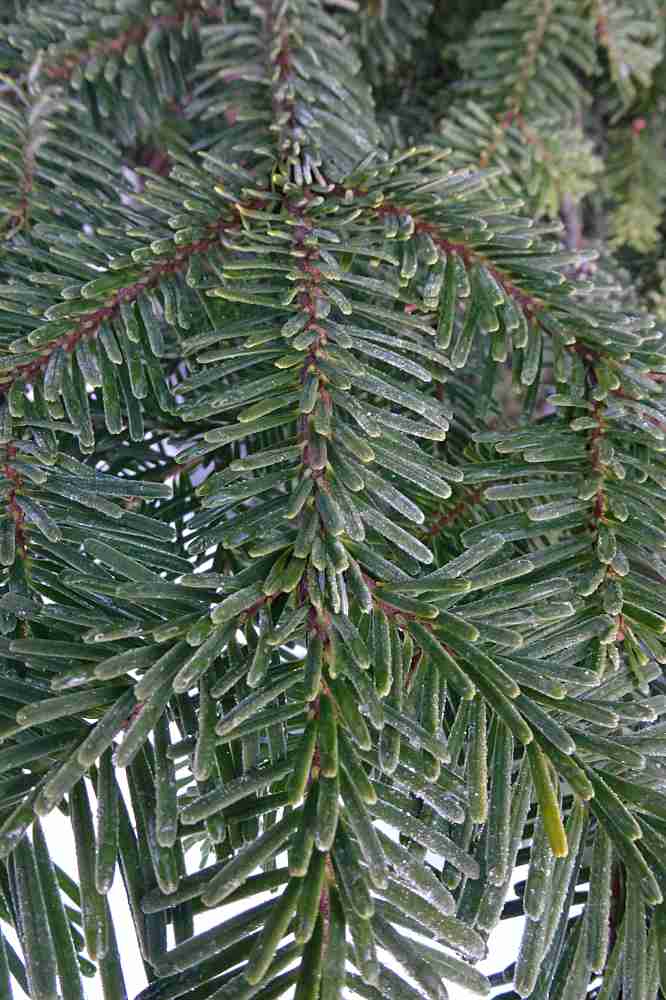
One of my favourite trees is the amabilis fir (Abies amabilis). The silvery bark, dark green needles, and spicy fragrance are emblematic of the mountain wilderness. They evoke the deep forests of the past that covered much of Vancouver Island just a few centuries ago.
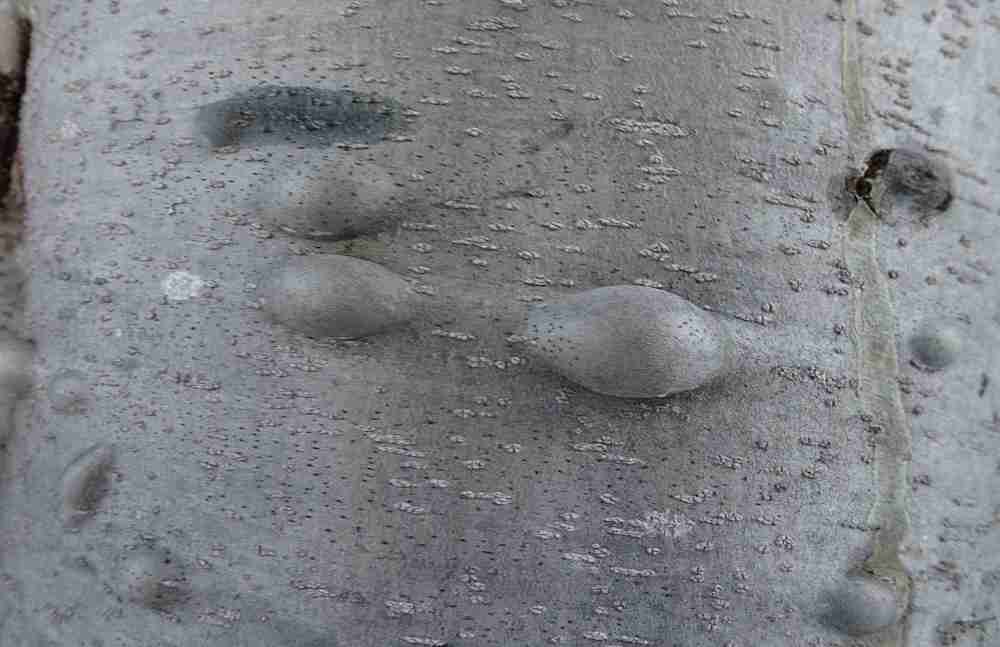
Amabilis usually has somewhat flattened needles, a bit like a grand fir, but it has a double row of needles along the center. Like all “true firs,” amabilis has smooth bark (when young) and bumpy resin blisters.
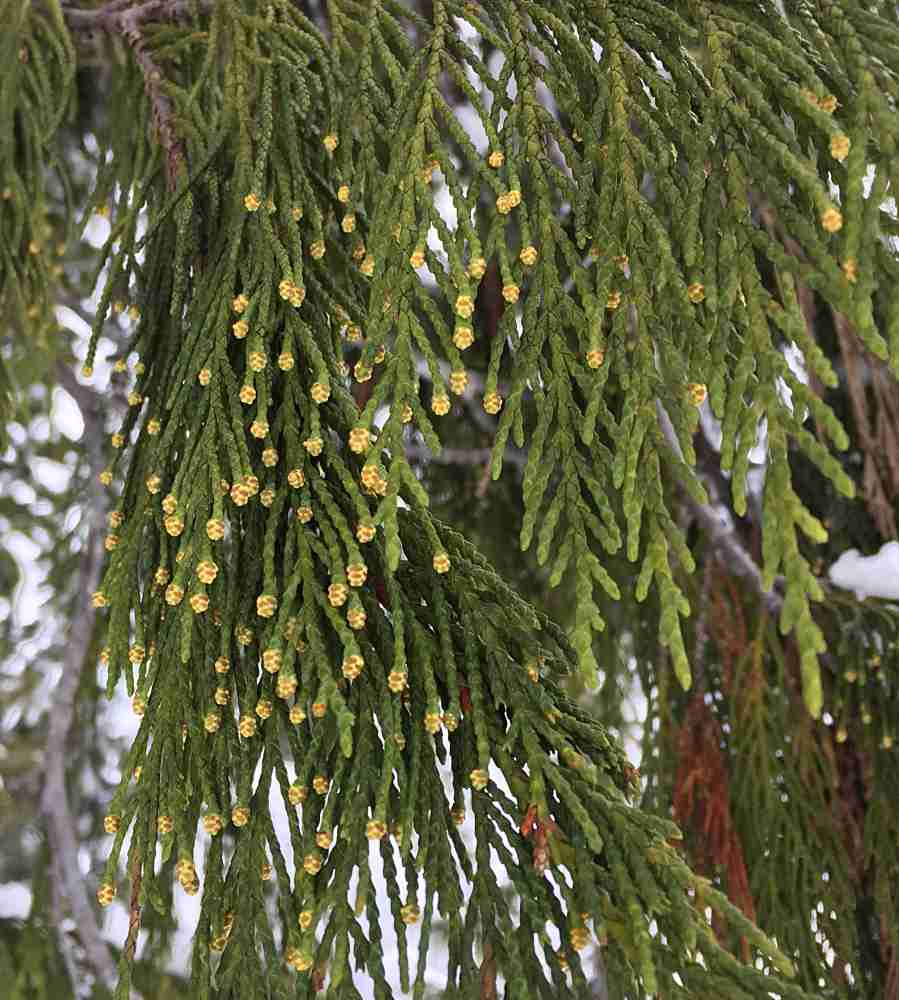
Another common tree of the subalpine in our area is the yellow cedar, Callitropsis nootkatensis (formerly: Cupressus nootkatensis). The seed cones look like little round berries, and are light green when young and chestnut brown when mature. Tiny male pollen cones dot the tips of the branches.
Branches of yellow cedar tend to hang straight down like a curtain, unlike the fanning branches of red cedar. Yellow cedar is also found at sea level and becomes more common along the coast as one heads north.
Have a closer look at these wonderful trees the next time you are up the mountain! [Click a photo to enlarge it.]
Amabilis fir needles: note the double row along the centre, and the notched needle tips.
Close-up of the smooth bark and bumpy resin blisters of amabilis fir.
Yellow cedar: new green “berry-like” seed cones.
Mature yellow cedar seed cones.
Tiny male pollen cones dot the tips of yellow cedar branches.
Yellow cedar branches hang straight down like a curtain.
From an email by Jocie to the Botany Group on January 17.
I was up the mountain on Saturday, x-country skiing on the upper west-Jutland loop. The conditions weren’t great…it had rained heavily up there a week or so ago. Most of the nordic skiers seem driven to get from A to B as fast as possible. I like to putter along and look at things, take pictures, ponder ancient trees etc. Those hurried skiers don’t know what they are missing!
Anyway, here are a few highlights. [Click a photo to enlarge it.]
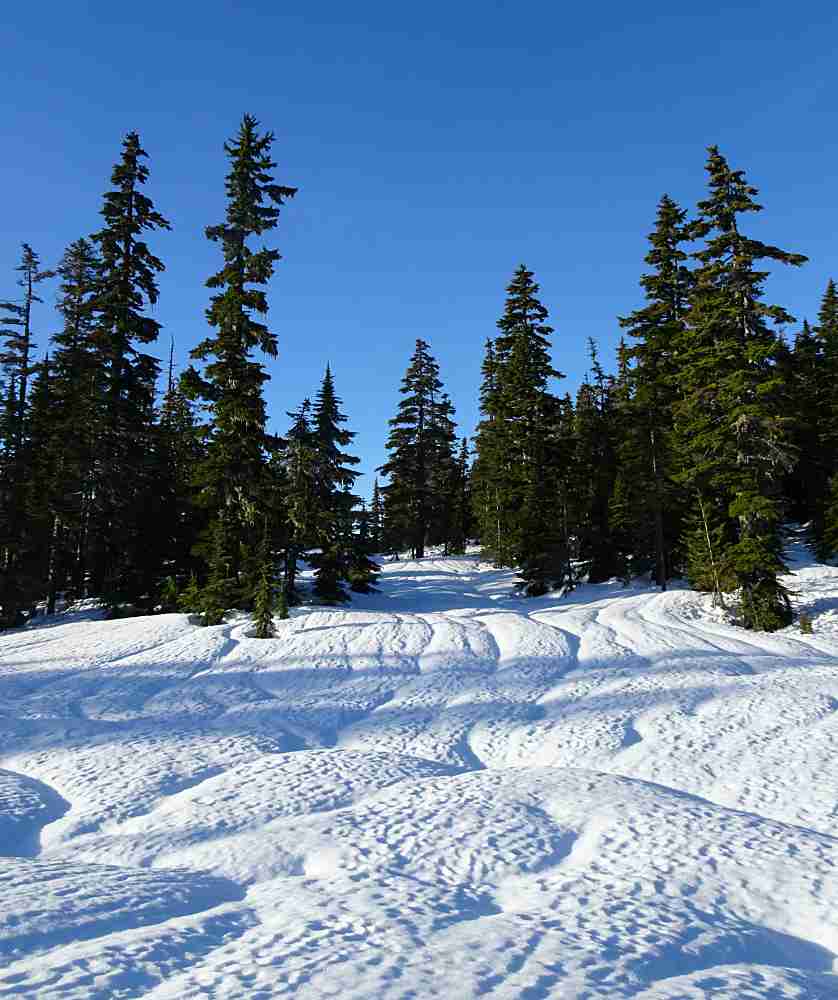
Snow pitted with rain.
Frosted subalpine fir: note the upswept bushy needles.
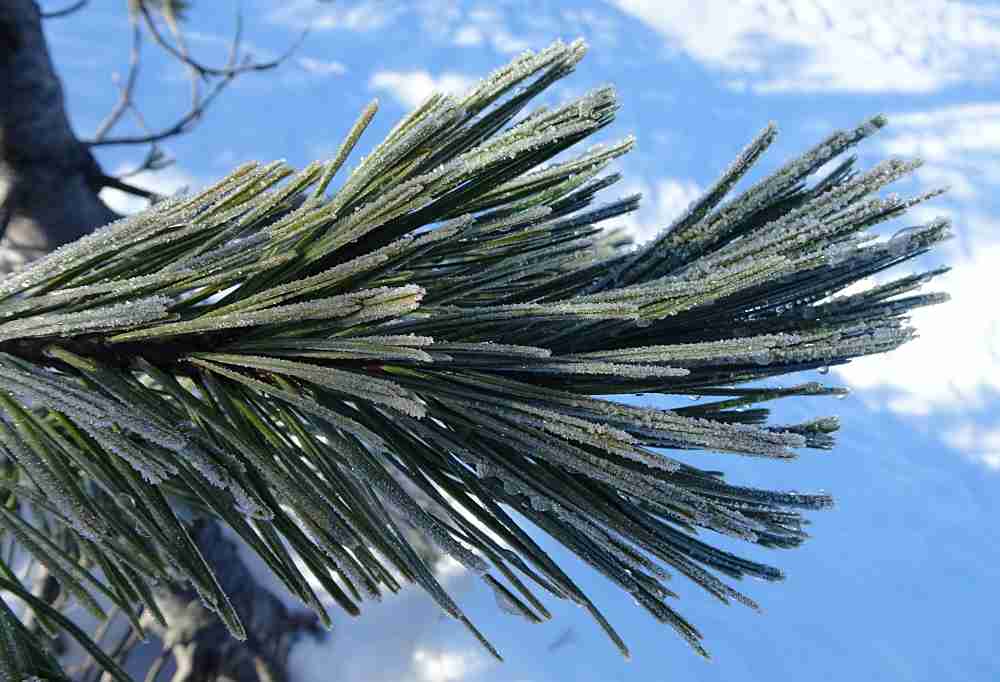
Frosted white pine needles.
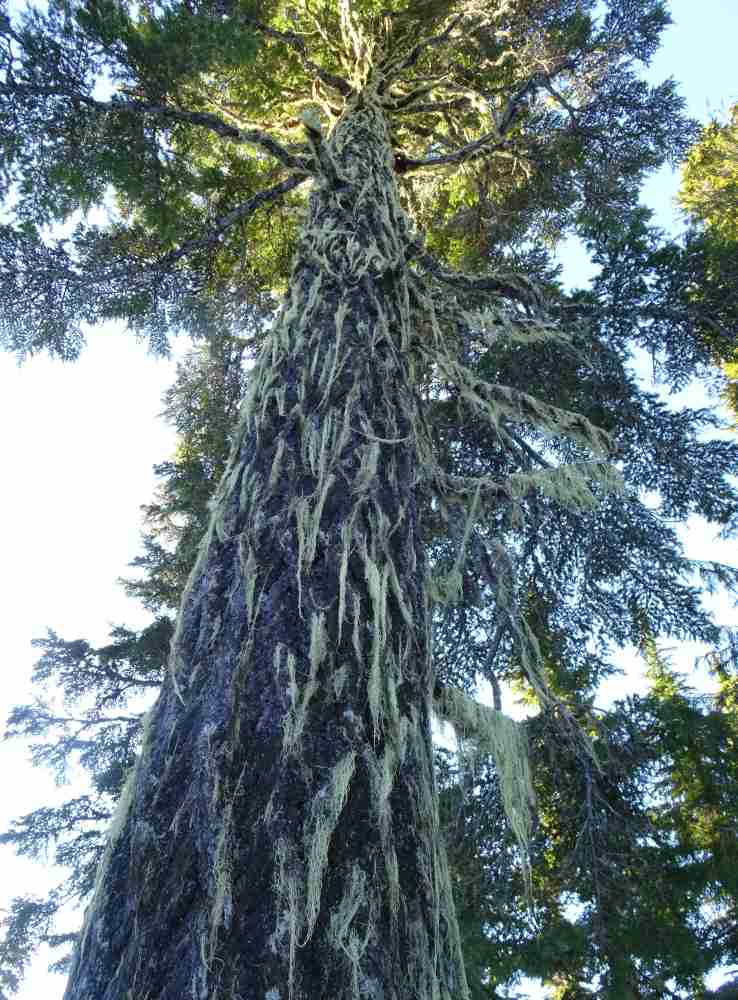
Mountain hemlock with garlands of hair lichen (Alectoria, Bryoria, etc).
Wolf lichen – I think, (Letharia vulpina): the bright yellow patch on the right of the snag.
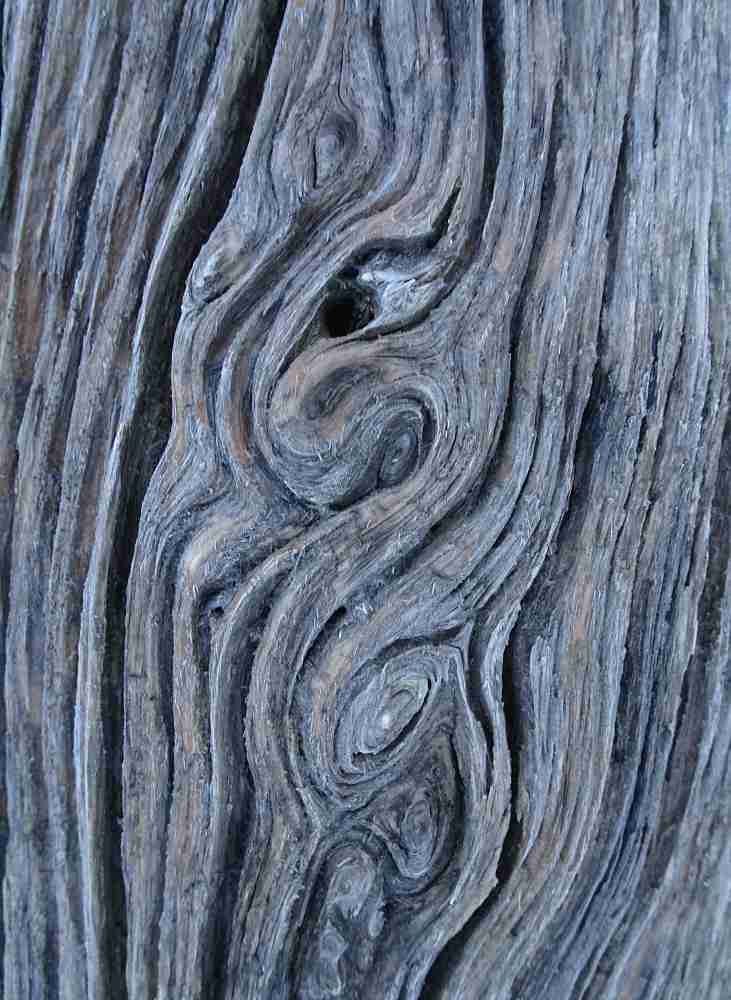
Ancient yellow cedar snag detail.
View of Albert Edward & Divers/Rossiter lakes.
View of Alexandra Peak (the “thumbs up” mountain): Sadly, this range of mountains is not in Strathcona Park.
Comox Valley Nature, in conjunction with the Canadian Society of Environmental Biologists, recently presented the following webinar:
Title: Using iNaturalist to document biodiversity patterns in BC Parks Speaker: Dr. Brian Starzomski and Kate McKeown Date: Sunday, January 16, 2022
If you missed this event or would like to see it again, CSEB has made the recordingavailable here. To access it you will need to provide your name and email address.
For more information about this talk, see the announcement in our earlier post.
Posted inEcology, Guest Speakers|Comments Off on Recording available for talk on BC Parks iNaturalist project
Comox Valley Nature is pleased to host the following free online lecture:
Title: Using iNaturalist to document biodiversity patterns in BC Parks Speakers: Dr. Brian Starzomski and Kate McKeown Date: Sunday, January 16, 2022 Time: 7:00 p.m. PST
This webinar is facilitated by the Canadian Society of Environmental Biologists and is open to the public (see the registration link below).
In Sugarbowl Grizzly Den Provincial Park (photo by Jason Headley)
iNaturalist is a biodiversity database and social media platform. It has revolutionized community science by making it easy and fun for anyone to contribute to the collection of biodiversity data, any time they’re out enjoying nature. A dedicated community of identifiers helps to refine the accuracy of the species IDs.
iNaturalist is a wonderful addition to biodiversity inventory in British Columbia where the species diversity is greater than anywhere else in Canada. BC is vast, and traditional data collection methods alone cannot survey all corners of the province. To fill in some of these gaps and provide opportunities for anyone to collect biodiversity observations and hone their natural history skills, Dr. Brian Starzomski (UVic) and Dr. John Reynolds (SFU) teamed up with BC Parks and the BC Parks Foundation to create the BC Parks iNaturalist Project. BC Parks iNaturalist data are fast becoming a large and valuable source of biodiversity information in BC, and it is all due to the great work of more than 6,000 keen citizen scientists.
To date, the BC Parks iNaturalist dataset consists of almost 500,000 observations and more than 9100 species! The dataset keeps growing, and observations are routinely used in threatened and endangered species assessments by the federal Committee on the Status of Endangered Wildlife in Canada (COSEWIC).
So far, the top three parks for observations are Strathcona Provincial Park, South Okanagan Grasslands Protected Area, and E. C. Manning Provincial Park. All 1035 BC provincial protected areas (including parks, conservancies, and ecological reserves) are listed in the BC Parks iNaturalist project, but 400 have fewer than 10 observations: there is much more work to do!
This is an excellent opportunity for you to learn more about the value of iNaturalist and citizen science for describing patterns of biodiversity in BC Parks.
About the speakers
Brian Starzomski is the Ian McTaggart Cowan Professor and Director in the School of Environmental Studies at the University of Victoria. He loves to work in a variety of systems to study biodiversity questions, and is broadly trained as a community ecologist and conservation biologist. His research focuses on biodiversity structure and dynamics, and seeks to link theory and empirical approaches. Brian works across the taxonomic spectrum, from insects to plants to birds. He encourages nature lovers to add biodiversity observations to iNaturalist.ca.
Kate McKeown joined the BC Parks iNaturalist Project shortly after graduating with a BSc in Forest Biology from the University of Victoria. Starting on the field team in May 2020, she has since become the project manager. Some of her BC Parks project highlights include finding a brown wasp mantidfly in Skihist Ecological Reserve, photographing Arctic terns in Boya Lake Provincial Park, and seeing peoples’ faces light up when they learn that their passion for wildlife photography can also generate valuable biodiversity data!
Registration
“Seating capacity” for the talk is limited, and you will need to register in advance. You can check the computer requirements for attendees here.
Join the Comox Valley Conservation Community for a day long celebration of the watersheds and waterways that connect us all in the Comox Valley!Learn about restoration and habitat enhancement projects, salmon cycles, drinking water, forests, creeks, wetlands and estuaries – and so much more. Art projects, kids activities, volunteer engagement opportunities, hands on learning and guided walks – all looking out over the beautiful Puntledge River.Comox Valley Nature will be there with our new outreach tent. Come by and say hello, and try our bird identification game. We can also show you why native plants are best for your garden, and how to spot invasive species.Pack a picnic and stay for the day! Saturday Sept 19th from 9 am – 3 pmin Puntledge Park 1111 1st , Courtenay ...
In her memoir, Pacific Northwest author Caroll Simpson recounts the highs and lows of running a remote fishing lodge on her own following the untimely death of her husband, and of falling in love with the natural world. Simpson tells stories of living in the remote wilderness and managing the lodge, becoming an accidental environmental activist, fending off wild animals, working as an angling guide and finally, fighting off a proposed mining operation and participating in the development of a government land management plan as a spokesperson for the wilderness tourism industry.While Simpson welcomed paying guests at Ookpik Lodge, unwanted house guests included a woodchuck, a pack rat, and martens. Simpson constantly had to watch out for grizzlies, moose, and cougars. Storms and extreme weather also provided fodder for hair-raising tales. All this makes for wonderful storytelling.Caroll’s story is essentially a love story. In an essay for Sierra Club, Simpson wrote: “I developed an immense passion for flora and fauna. Just walking back and forth on the 300’ dock several times a day, I was exposed to the unbelievable beauty of the northern spectrum of water life: the golden eagle soaring above, the osprey and kingfisher diving and coming up with fish for their hatchlings, the muskrats and otters looking for an easy meal, the tireless beaver working into the late evening sunsets. All of these creatures and more expressed their generational ownership of this small piece of the world. In return each was given my utmost respect and admiration…As I listened to the loons at the end of each day and the owl and the wolf in the night, I felt blessed to be witnessing such beauty. “On September 20th, join Comox Valley Nature and Save Our Forests Team for an afternoon of storytelling about this remarkable time spent living on a remote British Columbia lake.The event is being held at the Comox United Church Hall. (250 Beach Drive, Comox) Admission is by donation. Doors open at 2:30; the event begins at 3:00 p.m. There will be time for Q&A after the presentation, as well as books available for purchase. Tea/coffee and cookies - including forest-themed cupcakes - will be available for a donation.Join us, and prepare to fall in love. ...
🎟️ Get your tickets to the Project Watershed 2026 Keeping It Living Dinner today! projectwatershed.ca/2026-keeping-it-living-dinner/Every ticket holder makes a difference. 💙 🎟️ Get your tickets to our 2026 Keeping It Living Dinner today! projectwatershed.ca/2026-keeping-it-living-dinner/When community and local businesses invest in conservation, our entire ecosystem benefits. Ticket sales directly support habitat restoration, scientific research, and environmental education, while the generosity of our sponsors helps offset event costs, ensuring that more of the funds raised can go directly toward this important work. Thank you to our incredible sponsors and dinner attendees for believing in the power of community-led conservation. Odlum Brown Community and Northwest Hydraulic Consultants, 40 Knots Winery, CNB Together, we're keeping our watersheds living. 🌿 Hope to see you September 12, 5 - 8 pm at 40 KNOTS Winery #KeepingItLiving #ProjectWatershed #CommunitySupport #Conservation #ComoxValley ...
The City of Courtenay is developing a long-term vision for Bill Moore Park and Dogwood Park to guide future improvements. To help guide these decisions, three initial concepts have been developed, and there is an opportunity for you to offer your input.The latest survey on the City website engagecomoxvalley.ca/bill-moore-and-dogwood-park asks for feedback on three concept plans and specifically which concept you prefer. The three concepts present a range of recreation possibilities and there is room on the survey for your comments.Dogwood Park is a 2.32‑hectare nature park featuring mature forested areas, natural habitat and a small wetland. Only Concept A will maintain the intact forest areas in Dogwood Park. Concepts B and C propose increased recreation in the park including an off leash dog park, disc golf course, pump track (a purpose built track for children’s cycling) and nature play areas. While the planners may say that no trees or few trees will be taken down to accommodate this, the under-story will not survive this level of trampling and fragmentation. The trees as well as all the wildlife who now call that area home will disappear over time. For those of us who value this forest, Concept A is the only option that makes sense.Dogwood Park is one of the few islands of green for many, many blocks. It provides habitat for wildlife, shade, retains water and acts as a carbon sink. On the architect's base plan of current conditions it is now characterized as an "underutilized space". The City has heard from sports enthusiasts but not nature lovers. Let them know why you value an intact forest and your connection to it. The survey is open until Sept 15. ...
The Canadian Coalition for Invasive Plant Regulation (CCIPR) wants the federal government to establish a regulatory body for the horticultural industry and create a national database identifying invasive plants and their risks in different regions. "Even if we don't prohibit them, we need to let the public know when there is potential harm," said CCIPR co-founder Cathy Kavassalis. "We do this on other products, and we should do it on plants too. It's just common sense."In July, Nanaimo council passed a motion to pursue a bylaw amendment restricting the sale of plants on a list maintained by the Invasive Species Council of B.C. A week later, Surrey moved to ban sales by businesses including nurseries, large retail chains and florists. Kavassalis said a problem that could be addressed at higher levels of government is being pushed down to municipalities."These are all patchwork solutions that, in some ways, just waste a lot of resources," she said. The CCIPR says a national database could give provinces, territories, retailers and gardeners a shared source of information about which plants pose risks in different regions. Kavassalis also wants invasive plants removed from shelves or clearly labelled.For more on this story visit www.cbc.ca/news/science/invasive-plants-sale-federal-regulation-9.7312362 or see our link in bio ...