Although there will be only one winner of the Tree of the Year contest, all the 36 nominated trees have interest and value. We invite everybody to go out and enjoy these trees as part of their nature activities this season (while adhering to public health guidelines). Please respect private property boundaries as well as owner privacy by viewing the trees from public land unless otherwise invited in.
Watch for subsequent posts here that will provide a location map with touring suggestions and a link to the online voting page. Be sure to come back to vote for your favourite after you’ve visited the trees. If you’re ready to vote now, you can go straight to the voting page.
The trees are numbered here in the order in which the nominations were received. Quoted text was supplied by the nominators, and some details were added by the TOTY Committee. Photos were supplied by the nominators except as noted. Diameter at breast height (meaning at 1.2 m above ground level) is denoted by DBH. Click a photo to enlarge it.
Index
- Douglas fir – Millard Nature Park
- Dawn redwood – Pritchard Rd.
- Douglas fir – Cumberland Forest
- Pacific dogwood – North Island College
- Douglas fir – Kin Beach
- Chestnut – Urquhart Ave.
- Garry oak – Vanier Nature Park
- Monkey puzzle tree – Beaton Ave.
- Garry oak – Grieve Rd.
- Apple – 3rd St.
- Western white pine – near McDonald Rd. and Inverclyde Way
- Douglas fir – Piercy Rd.
- Garry oak – Glacier Rd.
- Sitka spruce – Headquarters Rd.
- Douglas fir – MacDonald Wood Park
- Red oak – Filberg Park
- Garry oak – Ship’s Point Park
- Douglas fir – Buena Vista Ave.
- Ponderosa pine – Buena Vista Ave.
- Douglas fir – Connemara Rd.
- Garry oak – Sandwick Cemetery
- Grand fir – Waterloo Creek area
- Arbutus – Bolt Ave.
- Garry oak – Huband Rd.
- Pear – Ensign St.
- Garry oak – Vanier Nature Park
- Garry oak – near RCMP station
- Cascara – Tsolum River Commons
- English oak – Filberg Park
- Garry oak – base of cliff below Pioneer Memorial Park
- Black cottonwood – Cousins Park
- Garry oak – 506 Lazo Rd.
- Western hemlock – Dog Leg Trail in Cumberland Forest (wildlife tree)’
- Sitka spruce – Ships Point Rd.
- Douglas fir – Ruth Masters Greenway
- Garry oak – Cheetah Court
1. Douglas fir (Pseudotsuga menziesii)

Location: Anfield Rd. entrance to Millard Nature Park, Courtenay. GPS: 49.66605, -124.97962
This is a City of Courtenay park and cycling is not permitted within the park.
Find the sign that explains the process of forest succession about ½ way up Anfield Rd. (across from the first access into the shopping centre). Very near the sign on the right side of the trail is what looks to be a stump 1 m high and 81 cm DBH. Note, however, that the cut top has been completely enclosed by bark. This tree without branches is being kept alive by trees nearby feeding it the nutrients it needs through their root systems with the help of mycorrhizae. There is an enormous Douglas fir behind the sign. Could this be the mother tree that produced the seed for this tree and now keeps it alive?
Submitted by Jim Boulter.
2. Dawn redwood (Metasequoia glyptostroboides)

Location: 215A Pritchard Rd. Comox. GPS: 49.674475, -124.917478
This tree is in the back yard in the corner closest to the sidewalk along Balmoral and adjacent to 1567 Balmoral. It is an elegant, deciduous conifer that is about 24m tall and a fat 96 cm DBH.
“Scientists have found fossils of this tree dating back millions of years, but none after the time the dinosaurs disappeared. It was thought to have become extinct. About 1936 some specimens were found in China, but a war was raging at that time. By 1938 things had settled down and intrepid explorers ventured forth to bring back samples. This tree is thought to have come to the valley about that time. It is in what used to be the beautiful garden of Mrs. Radford. There are (were?) three much smaller dawn redwoods in Butchart Gardens near Victoria. There is a fellow in New York City who is recording all known dawn redwoods worldwide – he is aware of this one! In the photo the 12 inch steel ruler gives a comparison of size.”
The owners of the property designed and built the house ten years ago around the goal of saving as many of the existing unique trees as possible.
Submitted by Peter Brice.
3. Douglas fir (Pseudotsuga menziesii)

Location: In Cumberland Forest on UROC trail Monday’s Child, the tree is about 1 km from the start of the Monday’s Child trail sign off the access road. GPS: 49.61825, -125.009833. (The closest parking may be the Coal Hills BMX at 2815 Dunsmuir Ave, Cumberland.)
“Monday’s Child trail is in the east block of the Cumberland Forest Trails which has public access though privately owned. The tree has a small protection “fence” around the trunk – and it’s a place where people have stopped to stand in awe of a trunk that is so wide that three people with outstretched arms barely touch fingers around its girth.” Our nominator believes it is the biggest old growth tree in the Cumberland Forest. It is approximately 44 m tall and 190 cm DBH and is 200 years or older.
Submitted by Marie Maccagno.
4. Pacific dogwood (Cornus nuttallii)
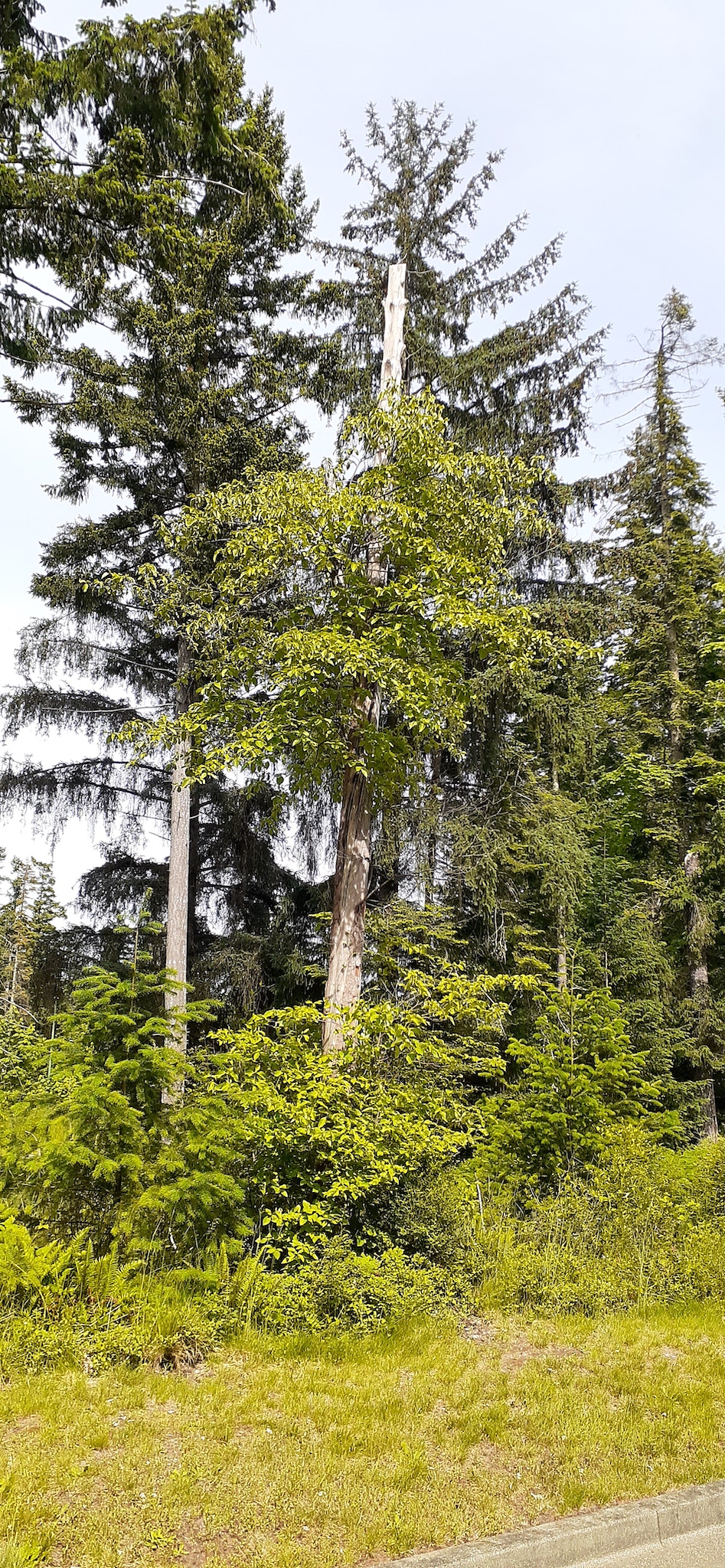
Location: North Island College, 2300 Ryan Rd, Courtenay. GPS: 49.708809, -125.973278
Go in the Ryan Rd. entrance, turn left and find the tree at the junction between Lot A and the Trades Building. It is about 8 m high and 35 cm DBH and estimated to be 40 years old.
“This is a survivor. It was damaged when development took place, and has been through some very rough times – however, it has taken the attitude of “the little train that could”. It is carrying on…. Despite setbacks which would have eliminated other trees, it perseveres, and in spring it had a great show of blossoms on the few branches left. It is being surrounded and supported by several native shrubs, which encourage it on. And it has produced a host of shoots to take over in future years, when the mother tree is no longer able to thrive and blossom.”
Submitted by Murray Little.
5. Douglas fir (Pseudotsuga menziesii)

Location: This tree is at Kin Beach Provincial Park at 1712 Astra Rd, Comox. GPS: 49.7290572, -124.897817
Find it near the parking right off Astra Rd. at the north end of the park (across from 1749 Astra Rd.). The tree is at the edge of the park and looks down on the BBQ shelter, out to the meadow and the ocean view of Powell River and the mountains. It is about 25 m tall and 107 cm DBH.
“This Douglas fir has guarded the community entrance for many years. It was originally part of a large group of firs when the area had a dirt one lane road and scattered summer cottages. Located nearby are groups of coastal Douglas firs. This tree has lost its top numerous times due to many storms. The lateral branches have taken over the top and this is what makes it look so “wolfy”. Something caused the sweep on the shorter stem and instead of dying it righted itself. It is features such as this on old veteran trees that make them very valuable as wildlife trees.
This friendly tree welcomes everyone who comes through the path: children, visitors and dog walkers who gather under the branches to chat.
The tree watches over the BBQ hut activities and enjoys the picnics, birthday parties, weddings and people relaxing. Young boys have climbed to the crux of the tree and then slid along the branch.
A musician sitting beside the tree, playing his guitar, wrote a song called “These Trees”. Seven years ago Michael Enright on the CBC Sunday edition spoke about the cutting down of urban trees. He used this song to close his show. TREES ARE PRECIOUS TO ALL OF US.”
This tree is protected by the Provincial Park rules. The guardians of the tree are the visitors, park attendant and the people who live on Astra Rd who love and admire this tree.
Submitted by Bev Wolsey.
6. Chestnut (Castanea sp.)

Note: This could be either American chestnut (Castanea dentata) or Chinese chestnut (Castanea mollisima), and we will be able to identify it when the leaves and flowers are out later in the spring.
Location: 1170 Urquhart Ave. Courtenay. GPS: 49.681117, -125.00598
One can easily spot this tree in the front yard as it is at least 20 m tall and the multi-stemmed trunk is massive at 165 cm DBH.
“This tree is special because it is unique. You do not come across a mature chestnut in the Comox Valley every day. I walk to visit this tree frequently, and have a friend who has planted seeds of this tree. It produces copious amounts of edible nuts, and is truly a stately tree.”
The owners of the property are accustomed to the curiosity of folks passing by this tree. In their opinion the nuts are very small and inedible as there is not another variety of this species of chestnut to reliably pollinate it. The research on this chestnut continues!
Submitted by Lana.
7. Garry oak (Quercus garryana)
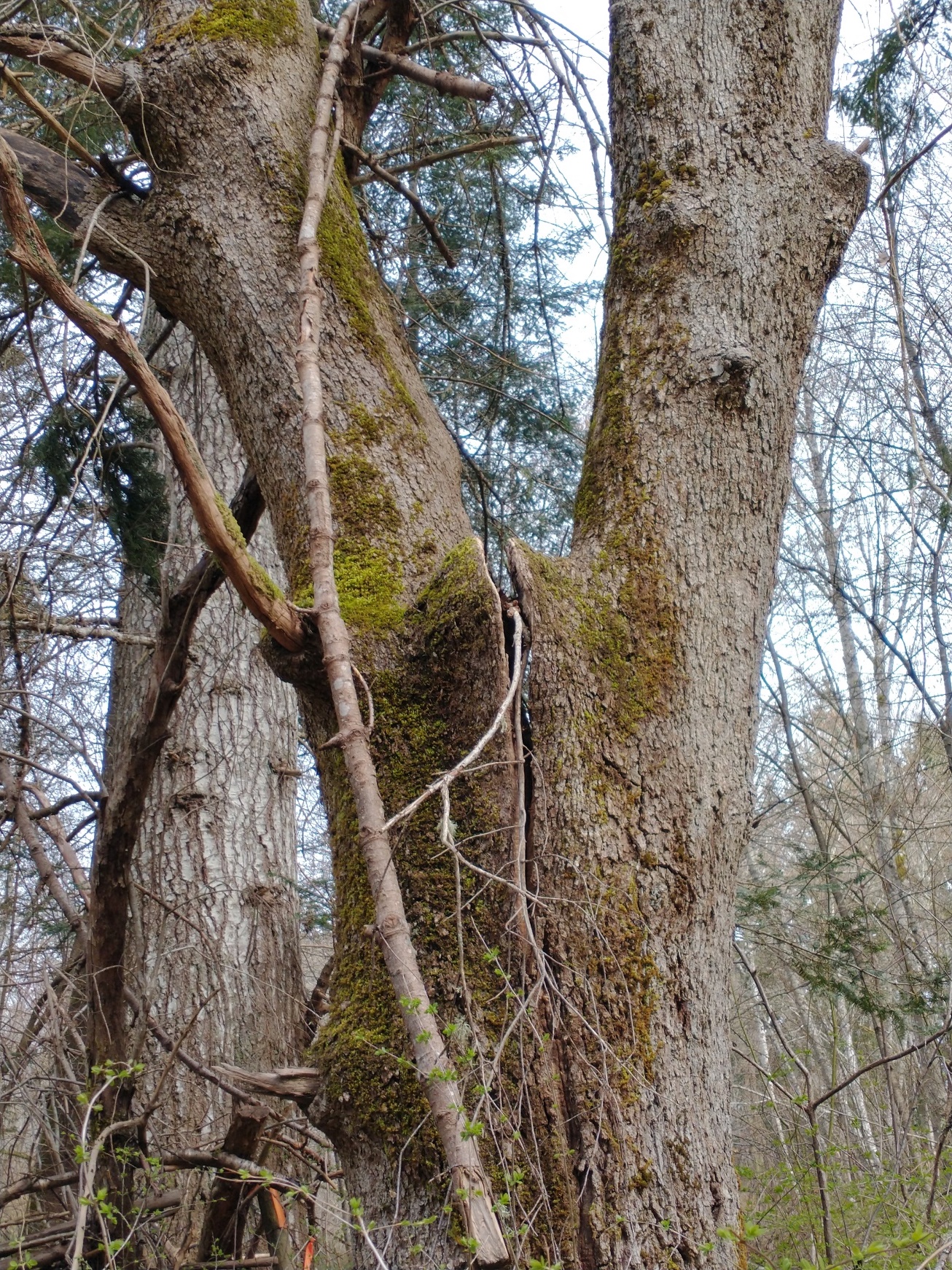
Location: City of Courtenay Vanier Nature Park, Vanier Dr., Courtenay (just uphill of the SD71 Operations and Facilities Yard, 2963 Vanier Dr.) Closest parking is down the hill at the Sports Centre.
Find the closest trail entrance (GPS: 49.712520, -124.999132) just beyond the driveway into the SD71 Operations Yard, along the chain link fence and into the forest and up the hill approximately 50 m to the bend in the path to the right at the top of the hill. This majestic Garry Oak is to the left of the path and has a pink ribbon on it (GPS of tree: 49.712525, -124.997168). It is about 26 m tall with a DBH of 91 cm and a crown spread of about 24 m. Some years ago the double or co-dominant trunk of this tree split slightly at the junction of these two branches. The risk of this trunk failing could be drastically reduced by the installation of a support system.
‘’Garry oak ecosystems are dwindling, and this grove in particular is at the far northern reaches of their range. Many mature Garry oaks are in this stand. I know of the effort of Comox Valley Nature to restore this grove.” (CVN has presented the Vanier Forest Garry Oaks Restoration and Stewardship Pilot Project proposal to the City of Courtenay and it is still under consideration.)
Submitted by Lana.
8. Monkey puzzle (Araucaria araucana)

Location: 2040 Beaton Ave (on the corner of Beach and Beaton Ave), Comox. GPS: 49.673260 -124.937171
The monkey puzzle tree is clearly visible in the front yard close to the street corner. It is about 7 m tall.
“I know this is an introduced species but I have recently moved to the island and when visitors come from Ontario I always take them to see this tree to illustrate the unique climate of this area.” The owner of this property who has lived there 22 years says “I don’t know much about it but it was big when we moved here”.
Submitted by Mark Bonneville.
9. Garry oak (Quercus garryana)

Location: Grieve Rd, opposite 2610 Grieve Rd, in the middle of the field at the foot of the hill. GPS of tree (approx): 49.733414, -124.993877.
Cyclists can pull off the road just past the end of the wire fence to view the tree on a flat area off the side of the road. Cars should park on the shoulder near the mail boxes at the bottom of the hill.
“The area around this Garry oak has been a pioneer picnic site on the old farm since the Grieve family bought the property in the 1880s. This tree, that has a diameter of 137 cm DBH and is about 20 m tall, could be well over 100 years old. Ken Grieve, owner of the property now, is 3rd generation on the farm. His grandfather built the barn still standing across the highway from this property.”
This is a stunning, open grown Garry oak.
Submitted by Jim Whyte.
10. Apple (Malus ‘Gravenstein’)

Location: 560 3rd St. Courtenay. GPS: 49.69065, -125.004147
This tree may be viewed by entering the lane just past this address and peaking at this majestic specimen from over the fence there. “It is approximately 100 years old and part of the original orchard in the old orchard area of Courtenay.”
The owners of the property, Eve and Pete, have resided here for 20 years and believe that the previous 3 owners each stayed on the property for nearly that long as well. This tree has been carefully tended for many years above and below ground. Note the impeccable pruning it has benefitted from. Two of the main limbs that have some decay have been propped with wood to ensure the limb remains intact. Many buckets of apples are enjoyed and shared throughout the neighbourhood. Eve says “It is so beautiful viewed from every angle; you could just live under this tree.” The bare branches create fractals Eve never tires of observing.
Submitted by Suzanne Gravelle.
11. Western white pine (Pinus monticola)

Location: Park at the corner of Inverclyde and McDonald in Comox. GPS of start of trail: 49.692083, -124.9465. This tree is about 180 m along on the City of Courtenay paved walking trail that starts here. GPS of tree: 49.693222, -124.944667. It is about 60 cm DBH and 30 m tall and estimated to be about 50 years old.
‘’White Pine Blister Rust is a fungus that kills most young white pine trees. There is a white pine seedling to the right of this tree.”
We noted that this white pine is very robust and there is no sign of blister rust so it would seem it has a long life ahead of it. Good candidate for resistance to the rust. BC used to have a high proportion of white pine in the landscape. It’s more resistant to shade than Douglas fir and is more resistant to root rot, making it a good choice for mixed species planting. The tree breeders have developed resistant seed orchards and more white pine is included in the planting program.
When you are viewing this tree, note that it has 5 soft needles in each bundle of needles. In comparison the Ponderosa pine in Comox is a 3-needle pine.
Submitted by Shirley Krotz.
12. Douglas fir (Pseudotsuga menziesii)
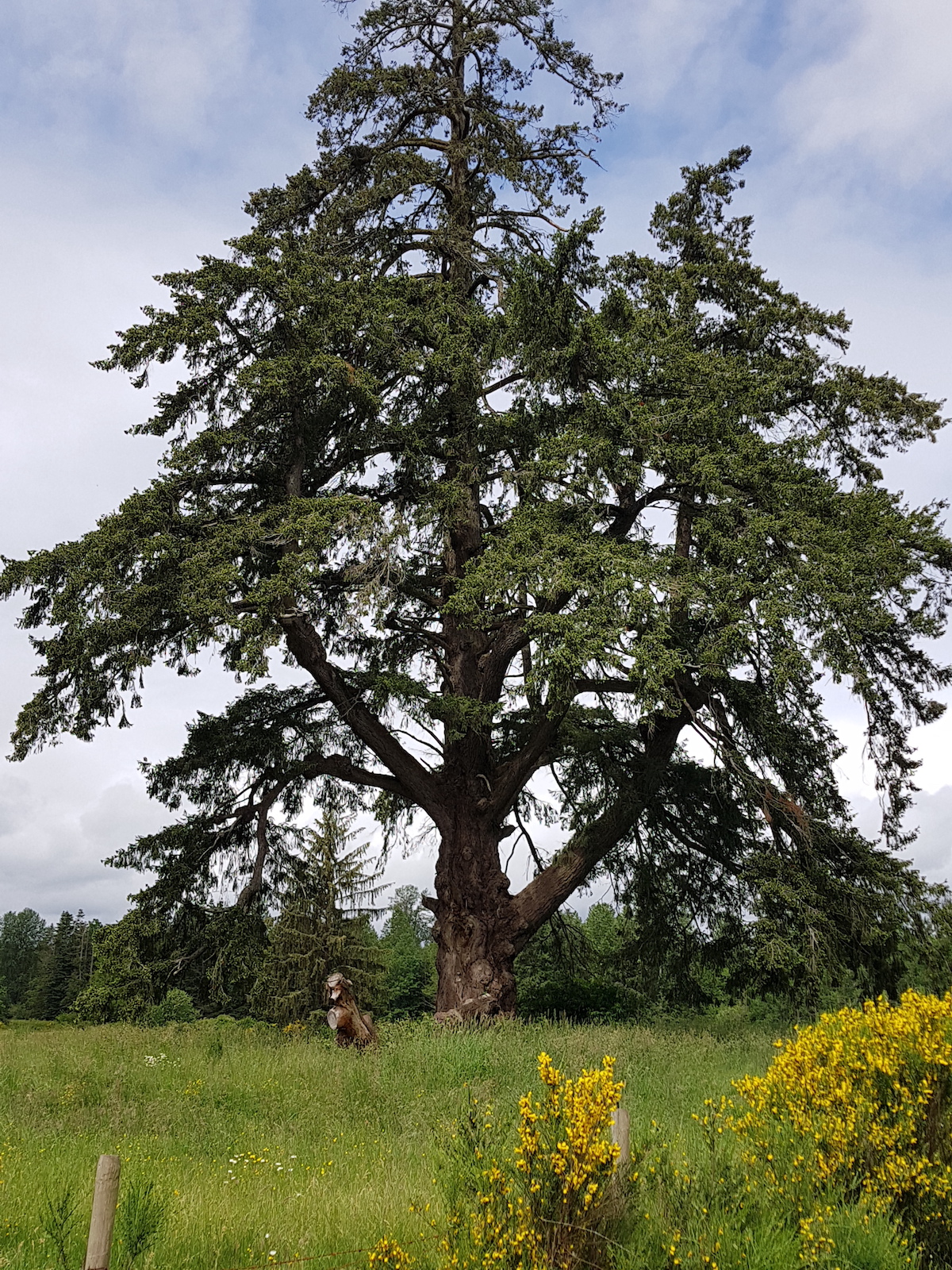
This tree is on private property just to the north of Piercy Rd. between Condensory Rd. and Dove Creek Rd. (in the field west of 3220 Piercy). GPS location of tree: 49.709505, -125.020477
‘’It is huge: 35 m tall and 150 cm DBH. The size of this tree is spectacular and the branching on it is quite unusual. It would be the perfect tree to see on Halloween night during a full moon. I sometimes drive that way to Courtenay just to look at it.”
If you are in a vehicle, there isn’t much room to pull off the road so please consider parking on either Condensory or Dove Creek Rd. and walking to view this tree. This tree deserves special consideration as this is the 3rd year in a row that it has been nominated for CVN Tree of the Year by different individuals. There is no trouble finding this tree on an aerial map!
Submitted by Stan Geeroms.
13. Garry oak (Quercus garryana)

Location: 3015 Glacier Rd., Courtenay (first house on the right as you turn off Headquarters Rd. onto Glacier Rd.) GPS location of tree: 49.70545, -124.99526
‘’This amazing tree is visible walking or driving up Glacier Road (off Headquarters Road) on your right. It stands in front of the corner property at 3015 Glacier Road – often to be seen with a neighbouring nesting eagle eating a rabbit or seagull, scattering feathers and fur below, or a little black squirrel running up the rope. This is apparently arguably the largest northern-most Garry oak on Vancouver Island! It is significant to us because we bought this property because of this tree and designed the house around it – the house foundations start only beyond the root system, and the windows were designed to capture views of the foliage to create the feeling of being in its branches.
Unusually, metal bands were attached many years ago by Hydro to preserve the main trunks and prevent them from touching the Glacier Road power lines. The tree has incorporated them into its growth. I have a thick rope attached to climb up regularly into the crux of this Being to feel the power of its presence and energy while gaining an unparalleled view of the Comox Glacier and Mount Washington in the distance.
My Mum, Denise Nadler (deceased in April 2020), who had severe dementia, tripped and fell while walking beneath it in 2019, and lay there gazing smilingly up into its branches for an hour refusing to move, while I lay beside her and told her made-up stories of the Faraway Tree, inspired by Enid Blyton! This tree will always have a special place in my heart – even as the property is now for sale, and we plan to move to the UK.’’
This Garry oak is approximately 120 cm DBH and 21 m tall. The owner has been told it could be 400 years old. Ruth says “this magnificent oak is guarded by the spirit of the eagle.”
Submitted by Ruth Barry.
14. Sitka spruce (Picea sitchensis)

Location: 7124 Headquarters Rd, Courtenay. GPS of tree: 49.76478, -125.113472
The property is located adjacent to the Headquarters townsite and the recently developed Headquarters Townsite Park and nature trail, 1/2 block from the Tsolum River. The nearest cross road is Railway Ave.
“The tree is unique, and while there are a few other similar trees in the area, this is the grandfather. Not sure if it was affected by copper leaching from the copper mine which fed into the river? The top has broken off in wind storms a few times in our 30 years here. Some of the “weeping” branches reach up to 6’ long. Our sheep trim the lower branches which would otherwise reach the ground. It protects a large patch of stinging nettle at the base in the spring. Numerous people have stopped to inquire and admire the tree.”
This Sitka spruce is open grown with broken tops over its 80-90 year life, limiting the height to 35 metres. The DBH is about 180 cm. The tree is well fertilized by a small flock of sheep and the ground cover at the base is covered in stinging nettles.
View the tree from the fence line on Headquarters road at the end of Headquarters townsite trail. Look for pink ribbon on the fence.
Submitted by Denise Kussauer.
15. Douglas fir (Pseudotsuga menziesii)

Location: Big Beautiful Doug is located in MacDonald Wood Park which is at 128 Croteau Rd. in Comox. Follow Croteau Rd. to the parking area at the end of the road and walk into the path on the right side heading west. Follow the path until it takes a turn north. Doug is located at the junction of the paths. GPS of tree: 49.671028, -124.910139.

“Doug” is about 37 m tall and 60 cm DBH. It looks as if the top was broken at some time.
“I first noticed “Doug” while out on a walk through the forest and saw that someone had labelled “Doug” with a red heart that stated, “I love you Big Beautiful Doug”. I thought that was awesome and “Doug” deserved more recognition for being Big and Beautiful. I hope others will feel the same.”
Submitted by Mark Salter.
16. Red oak (Quercus rubra)

Location: Filberg Park, which is at 61 Filberg Rd. in Comox. Enter the park through the gate on Comox Ave. and head immediately east towards the flower bed in the top corner of the meadow. The red oak is the large tree directly in front of the flower bed. GPS of the tree: 49.671611, -124.916389.
It is about 26 m tall and 109 cm DBH and could be about 90 years old.
“This tree had some surgery a few years ago. It was beginning to split apart and had rods and bolts inserted to hold it together, earning it the affectionate nickname of “Frankie” by the Town of Comox Parks Dept. Local history claims that Robert Filberg was responsible for planting many of the older specimens at the Filberg Park .”
Submitted by Tryna McLean.
17. Garry oak (Quercus garryana)

Location: Ships Point Park (CVRD Regional Park), 7956 Park Rd, Ships Point. Drive or ride into the park. This tree is found on the west side of the small parking area. GPS of tree: 49.49206, -124.79144.
The tree is about 9 m tall and 40 cm DBH.
“This tree represents the meaning of ‘Survivor’. It completely changed direction, probably having grown up to an overbearing limb by another tree, perhaps a Douglas fir, that is no longer there, and kept growing out at a 90 degree angle. Since then, no longer having the competition, it has grown many limbs vertically, the one closest to the trunk resembling a lovely oak tree. I admire it often as the rising sun reaches the park. I wonder if my story is correct, or if its original top was broken off in a storm and an already formed limb then became the main trunk.
The park has many story-telling oaks, but this one has always caught my attention. It is on the west side of the small park and very easy to spot. My love of Garry oaks started early in life. I grew up in Victoria in the 50s. We had two grand Gary oaks in our front yard. Before my Dad cut the lawn he’d have my brothers and me collect all the acorns for 5 cents a bucket! I now am very happy to have some Garry oaks in my own yard on Ships Point. The Steller’s Jays feast on the acorns each fall, and right now there is a bed of fawn lilies under the trees. The Anna’s hummingbirds use the crooked branches for perching and soon the foliage will provide our yard with summer shade. I love our oaks!”
Submitted by Jill Chudleigh.
18. Douglas fir (Pseudotsuga menziesii)

Location: This tree is found on the former Evergreen Auto Court property in Comox and since it is in the NW corner of the property along Buena Vista is most easily found by looking across the street from 1944 Buena Vista Ave. Since it is on private property, please view only from the street. GPS of tree: 49.675047, -124.927506.
“This is the largest of the Douglas firs on this private property that runs a block to Comox Avenue. This nomination is certainly not the largest fir in the Valley. It is 118 cm in diameter and 32 metres tall, and I estimate it to be 235 years old. It’s significant as part of a small “forest” that provides shade and contributes to the health of the Valley’s fast-changing, urban-like environment. Over at least a couple of decades the residents of the small cottages have received notices of impending development that has not yet materialized. However, last year a professional arborist appraised these firs that mingle among the cottages. In the 1950s this property was known as the Evergreen Auto Court.”
The Comox Museum stores a 1930s aerial photograph of what is now the Town of Comox. Much of the area is stumps at that time. However, the neighbourhood surrounding the “auto court” shows small trees.
Submitted by Shirley Dumas.
19. Ponderosa pine (Pinus ponderosa)
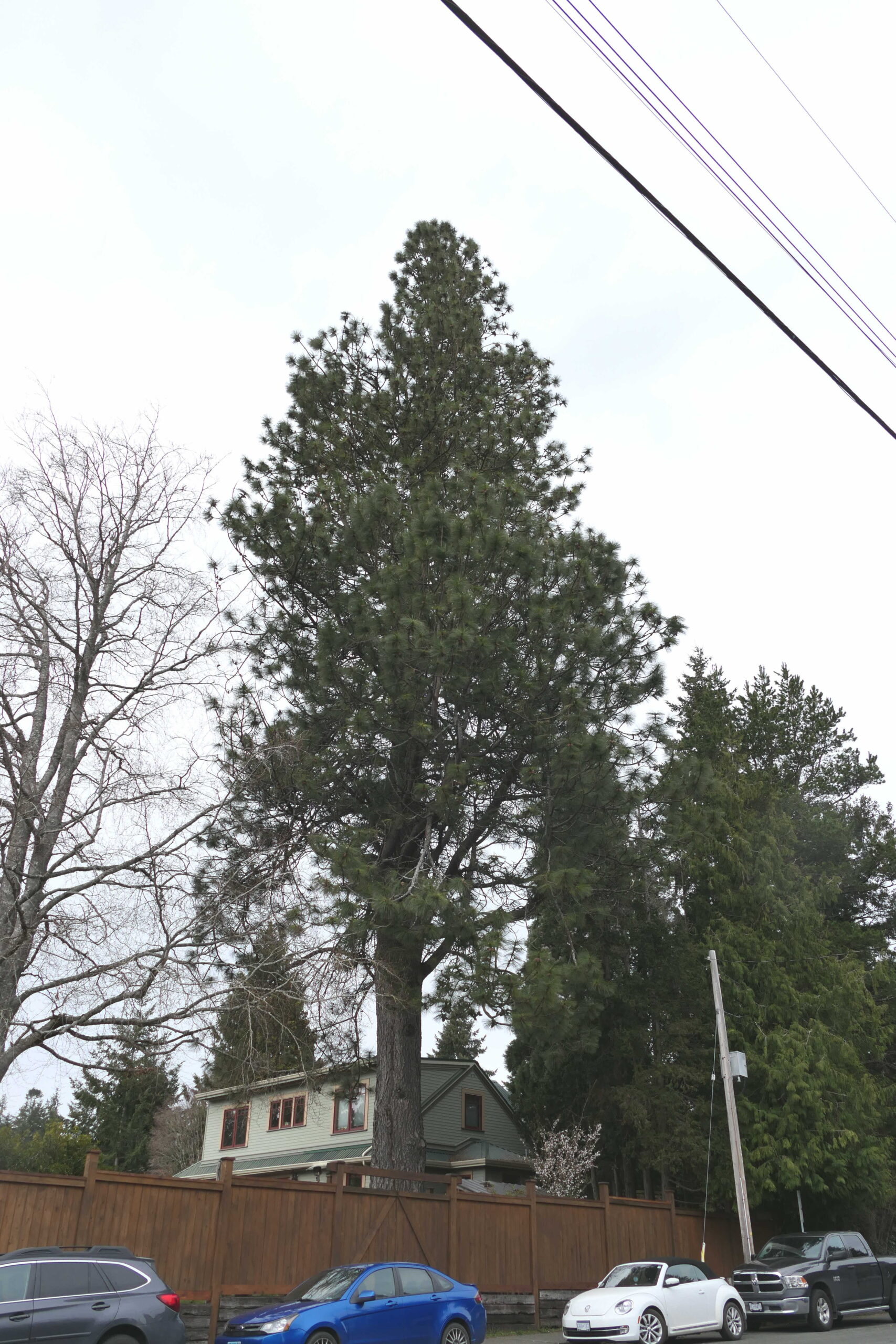
Location: 1809 Buena Vista Ave, Comox GPS: 49.676678, -124.9333292.
The tree is so tall (about 40 m and 141 cm DBH), it can be viewed before reaching this address and from across Church Street in front of St Peter’s Anglican Church.
“A booklet that Rev. Milne created in 2021 explains that the original small St. Peter’s Church was pulled down in 1939. Once again, the photographs indicate there are very few trees in the neighbourhood at that time. However, at the edge of the newspaper picture of the demolition there is a partial tree showing that appears to be on this Buena Vista property.
Both this tree and Tree #18, a Douglas fir further east on Buena Vista, are evidence of the resilience of trees. This is less about the specifics of the nominated trees. It’s more about how the Town of Comox was logged by the early settlers in the late 1800s and the current evidence of regeneration.”
We might also add that these and many large trees on this street remain and share their benefits today because of the stewardship of current and previous property owners.
Submitted by Shirley Dumas.
20. Douglas fir (Pseudotsuga menziesii)

Location: From Kye Bay Rd. turn right onto Simon Crescent, turn right onto Tara Rd., turn right onto Connemara Rd., drive to the empty field on the left (adjacent to 210 Connemara). Look across the empty field to the cliff edge. GPS of tree: 49.703758, -124.990051.
This tree is estimated to be 110 cm DBH and 12 m tall.
“The stunted growth of this tree, growing in this exposed location, makes it difficult to determine its age. This tree is actually two trees growing tightly together. It stands alone on the edge of the cliff in what appears to be public land.”
Submitted by Ted Grainger, who nominated the 2021 Tree of the Year winning tree, #10 Western yew (Taxus brevifolia), in Cumberland Forest. Photo credit: Debbie Colby.
21. Garry oak (Quercus garryana)

Location: Sandwick Cemetery, behind St. Andrews Church, 4634 N. Island Hwy, Courtenay. Turn right onto Dingwall off N. Island Hwy northbound, left off Dingwall Rd. onto McQuillan where you can park. GPS of tree: 49.703758, -124.990051.
“Enter the gate on the NE corner of the cemetery and go straight ahead to near the far northwest corner. Here you will find these two Garry oaks (largest oak is 105 cm DBH and 22 m tall), seemingly embracing. We discovered that a distant cousin rests, nestled under them in this peaceful setting.
Recent genealogy found our coincidental connection. We discovered that our cousin F. George Barcham was a music teacher, choir master and organist. He was born in Norfolk, England in 1870 around the time St Andrews Church was established. How remarkable to think that we were not the only ones in our family to come from England and to choose this lovely valley as our home. Gillian and Murray’s home is a kilometre from his gravestone.
There are approximately 13 very old oaks in this cemetery. Each one has a unique character, and they are in various states of living and dying. The meadow surrounding them is filled with flowers. Another ancient oak in this grove was featured in TOTY 2021. It’s humbling to think of all the people, animals, plants and other living things who have passed through this area reaching back to the First Nations People and to time immemorial.
To us, these two trees signify the love, caring and appreciation we need to extend to one another, to our neighbourhood, our people and our planet. Embracing our ancestors!”
Submitted by two sisters: Angela Dawson and Gillian Little.
22. Grand fir (Abies grandis)

Location: At the intersection of Highway 19A and Hastings Road follow Hastings (Main) Rd. to top of hill, stay left (becomes Rosewall Main 01). Turn off to the Grove after approximately 2.6 km, just past the bridge. The Grand Mamma is approximately 50 m in and to the left. The Grand Grove is another 260 m further and to the right. Follow the orange flagging tape for 65 m. Please note the access to the Grand Grove is a rough “trail.”
“Grand Mamma” GPS: 49.4716, -124.809933; start to Grand Grove GPS: 49.4716, -124.8069333; “Grand Grove” GPS: 49.47115, -124.8069333.
The Waterloo Creek area, in Fanny Bay, is host to a stand of trees that covers 24 hectares of Crown Land currently managed by the K’omox First Nation. In the 30s and 40s it was selectively logged for Douglas fir and redcedar leaving the unfavoured grand firs. In the early 40s the owner defaulted on the taxes for the land, and post-WWII, the land reverted to the Crown. Today, it is a marvellous mixed forest of very old and large conifers and deciduous trees, accented by the very large grand firs in the richer ecosystems. Of these, “Grand Mamma” stands out at a height of 68 m (223 ft or a 22-storey building) and a diameter of 120 cm (4 ft). Interestingly, the largest grand fir of record measuring 75 m is in the Chilliwack Valley. Could it be that the second largest is right here in Fanny Bay? There is a large stand, the “Grand Grove” which has eight large grand fir trees in an unusual linear pattern – can you spot them? The largest in the stand is 63 m high but only (!) 110 cm in diameter.

This entire area is currently unprotected. However, together, Provincial tree gene conservation scientists and local residents have highlighted to the government, for the last twenty years, that this stand is the last remaining “large group” of grand fir left unlogged on the east side of Vancouver Island and should therefore have a formal protected status. Currently there is a verbal agreement between the K’omox First Nation and the Province to not log the area and they are working to making this an official Old Growth Management Area (OGMA).
Submitted by Roger Chayer.
23. Arbutus (Arbutus menziesii)

Location: 1950 Bolt Ave, Comox GPS: 49.68468, -124.93293. This beautiful specimen is easily seen from the street by looking to the end and the right of the driveway.
This tree is approximately 12 m tall and 70 cm DBH.
“This is one of the biggest arbutus in the valley”.
Submitted by Doug Stauber.
24. Garry oak (Quercus garryana)

Location: In a hay field on the north side of Huband Rd., approx. 475 metres from the intersection of Huband Rd. and HWY 19A. (The field is beside the property at 2646 Huband but is not owned by them). I would recommend parking on Mottishaw, no houses on that road, and then walking down Huband to view the tree, about 400 metres. Parking is also available at Huband School on Mottishaw during non-school hours (about 500 metres from the tree). Bikes are best! GPS of tree: 49.728397, -124.989768.
“A lone and aged oak tree in a meadow is an evocative sight; a witness to history that physically connects our present to the past in a very tangible way while also providing hope and optimism for existence far beyond our own. Garry oaks are unique to the southeast of Vancouver Island, the Gulf Islands, two spots in the Fraser Valley, Washington, Oregon and California, and their ecosystems are under continued threat, due primarily to development. While most of the Garry oak meadows, long nurtured by First Nations, are gone, or overgrown by competing vegetation, we are fortunate to have many impressive specimens still visible in fields, cemeteries, and roadsides throughout the Comox Valley that predate the first settlers.
This gorgeous specimen (110 cm DBH and 21 m tall with a canopy spread of 24 m) has both an aesthetic appeal and historical importance to our community. This particular Garry oak has a large, symmetrical canopy, with long branches reaching almost to the ground. It is visually stunning when fully leafed out in summer, and no less beautiful in winter, when the “ bones “ of the tree are clearly visible. These fields once formed part of the pioneer John Grieve’s farm in Sandwick, Courtenay. In April, 1917, (Isaac ) Victor Shopland married Elizabeth “Lila” Jeanette Grieve, and the land along Huband Rd. became part the Shopland farm, and continues to be farmed by that family. Victor and Lila lived in the farmhouse on Hwy 19A, where Devonshire farm is today. There are between eight and ten of these old Garry oak trees between Huband and Grieve Rds. Some are clearly visible, others along fence lines or at the edge of the woods.
The genus Quercus thrives throughout the temperate zone around the globe, and settlers would have known oak trees in their homelands. The form of the canopy, the broad strong trunk, and gnarled limbs, and distinctively lobed leaves would have been a recognizable and perhaps comfortable sight for those settlers new to the dark forests on the west coast. So many Garry oaks have survived on these pioneer farmlands, possibly because of a connection to a common past, reminding early settlers of home, or maybe just because of the shelter and shade they provided for grazing livestock. Whatever the reason, we are truly thankful that these rugged beauties remain. (If you want to know more about oak trees I recommend the book, Oak, The Frame of Civilization, by William Bryant Logan. A great resource for nurturing native plant habitats in Garry oak communities is The Garry Oak Handbook. Developed by the Garry Oak Ecosystems Recovery Team, it is available as a free download at www.goert.ca/gardeners.)”
Submitted by Carol L. White. Photo credit: Jim Whyte.
25. Pear (Pyrus communis)

Location: 406 Ensign St., Comox. This tree is in the centre of the front yard with another pear. GPS: 49.68018, -124.90293.
“This is a heritage tree that was part of an orchard prior to this area being developed and is estimated to be over 60 years old. It has provided Lush Valley over the last few years with many, many pounds of pears. In addition to what Lush Valley is able to pick each year the tree provides pears to neighbours, friends and our family. It is a tree that has withstood the test of time, each year providing flowers for bees to pollinate, fruit for many and a beautiful visual to all as it changes throughout the seasons.”
The pear has a covenant on it by the Town of Comox which reads: The trees must be protected, preserved, maintained and restored in accordance with the terms of the covenant.
Submitted by Mary Bogue.
26. Garry oak (Quercus garryana)

Location: City of Courtenay Vanier Nature Park, Vanier Dr. (just uphill of the SD71 Operations and Facilities Yard, 2963 Vanier Dr.)
Find the closest trail entrance (GPS: 49.712623, -124.999218) just beyond the driveway into the SD71 Operations Yard, along the chain link fence and up into the forest. Follow the path into the park and up the hill. This Garry oak is on the right hand side of the path with a blue ribbon and just before tree #7 with the pink ribbon.
It is 20 m tall and 73.2 cm DBH and is approximately 190 years old.
“One of the largest oaks in Vanier Forest and has a nice shape”.
Submitted by Bob Hauser.
27. Garry oak (Quercus garryana)

Location: In the field east of the RCMP station, 800 Ryan Rd. Courtenay. GPS: 49.6996796, -124.9865726. It is 19 m tall and 127 cm DBH.
“This tree is special because it is a reminder of the Garry oak meadows that were maintained by the K’omoks first nations. It is a link to the past that carries forward hope for the future. It has a strikingly beautiful crown that rises up beside a busy developed commercial paved landscape. I had never visited it, and was taken with the wide tall straight bole. There are other Garry oaks in this area in the vacant lot and beside the parking lots of the apartment buildings along Braidwood. I imagine that these oaks were part of a ridge of oaks that ran from Goose Spit and on up Headquarters Road. I fancy what it might be like to have the vacant lot transformed in the spring with blooming camas providing green space for the many people living in this urban space wedged between the old highway and Ryan Rd., and this tree with more Garry oaks to keep this tree company. My nickname for it is Big Bobbi, being next to the RCMP station.”
Submitted by Janet Gemmell.
28. Cascara (Rhamnus purshiana)

Location: Tsolum River Commons, CVRD Regional Park, near the end of River Ave. N, in North Merville. Directions and description from the CVRD website: This pocket park, used primarily by the local community, has a small loop trail and provides access to the Tsolum River and a little sandy beach. The park also has an open, grassy section with a variety of grasses and historical fruit trees. Two vehicle parking spaces and park entrance sign are located 100 metres north of the park entrance on River Avenue North (parking location due to insufficient width of road along frontage of park). GPS of park: 49.769000, -125.119000. Look for the park sign at the end of the road from the parking, follow the path into the forest. After crossing 3 boardwalks go straight into the meadow, past the maypole to the sign “Park Boundary” and look right along the path where the cascara nestles at the edge of the thicket. GPS of tree: 49.768693, -125.11986. It is about 9 m tall and 45 cm DBH.

‘’It is just so round, full, sturdy and elegant for a cascara, who usually reaches up through the forest or leans out into the sun. It is a happy tree. And happy birds who like cascara fruit. First Nations carefully collected and used the bark as a laxative and settlers collected and sold the bark, causing depletion of the cascara south of the border. Fortunately BC set some regulation for cascara bark collection. (Source J. Brooks, Island Nature, Sept 2011)”
Submitted by Janet Gemmell.
29. English oak (Quercus robur)
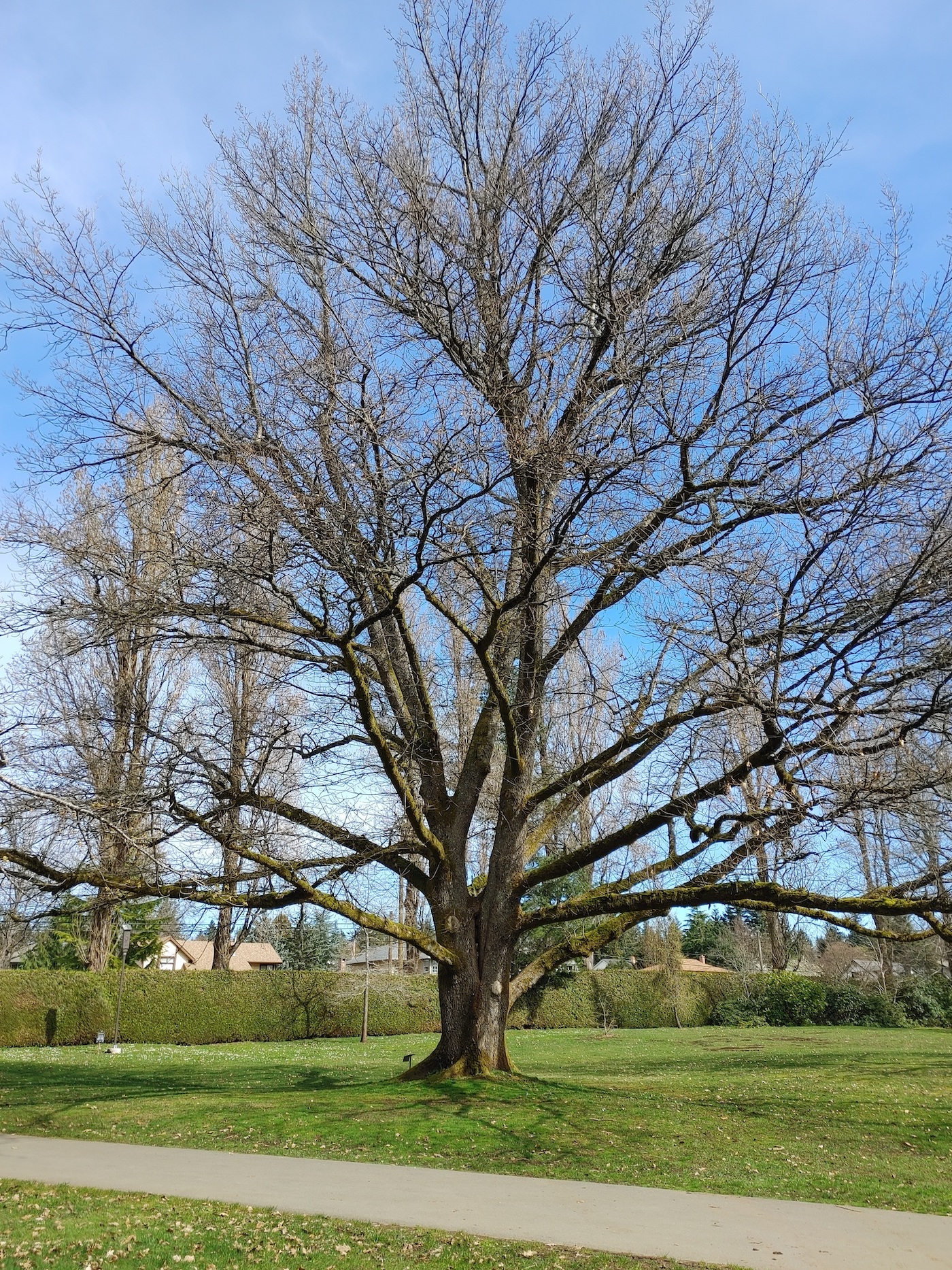
Location: Filberg Park, 61 Filberg Rd., Comox. Enter the park through the gate on Comox Ave. Follow the path and this is the first tree on the left. GPS of tree: 49.671667, -124.917222.
“There is a collection of stately oaks that are a significantly attractive aspect of Filberg Park. The ruling majesty of the woods, the wise old English oak holds a special place in the culture, history and hearts of my homeland – the UK. It supports more life than any other native species in the UK. It grows 20-40 m tall. The personal significance to me is threefold. First, are the childhood memories of lying under the canopy of a spreading oak tree reading for hours in the summer. Second, are several enjoyable days parking bikes at the Filberg Festival with the Cycling Coalition in the heat of the summer all the while protected by the canopy of this particular tree. Third, is my enjoyment of weekly meetings with my French conversation group sitting on the grass in the dappled light and shade of this magnificent tree.”
This oak is about 28 m tall with a DBH of 132 cm.
Submitted by Margaret Harris.
30. Garry oak (Quercus garryana)

Location: Grows in a grove of Garry oak at the base of the cliff below Pioneer Memorial Park on Manor Dr. in Comox. It can be viewed by traveling to the end of Beach Dr. and then walking west along the beach. The walk will take about 20 minutes. GPS of tree: 49.672501, -124.947502.
The tree is 12 m tall and 47 cm DBH.
“This endangered tree is special because it’s the only specimen of a dozen Garry Oaks in this location that is not being strangled by English ivy, because the meadow is covered with this invasive plant. Most of the trees growing on the cliff are being killed by English ivy thus contributing to the erosion of the cliff, and putting the buildings, and its occupants, at risk.”
There are several other beautiful Garry oaks, mostly covered in ivy, near this one along the beach to the east.
Our nominator also noted that several of the Garry oaks on the hillside had been topped and others cut down and asked the questions: “Doesn’t the Town of Comox have a policy to protect trees? If so, I wonder why the trees growing on the cliff haven’t been protected, specifically from the English ivy and ‘development’? Earlier this week I noticed quite a number of trees had been cut down, when it’s really the ivy that should be cut back!”
These are excellent observations and questions. In 2016 the property owner above this tree illegally removed, topped or pruned 18 of the trees. This escarpment is protected due to the threat of erosion and the removal of trees without a permit is illegal. The property owner was fined $10,000 by the Town of Comox and a restoration plan proposed that “includes planting five new young Garry oak trees on 147 Manor Place and slope stability, as well as a three-year monitoring plan to ensure no overall long term degradation of Garry oak ecosystem.’’
Do look at these Garry oaks and this slope yourself and you may be interested to read the report and letters that followed the 2016 illegal tree removals:
https://www.comoxvalleyrecord.com/news/10k-bill-for-garry-oak-pruner/
https://decafnation.net/2016/12/11/readers-write-about-garry-oaks/
Submitted by Alora Griffen.
31. Black cottonwood (Populus balsamifera ssp. trichocarpa)

Location: In City of Courtenay Cousins Park: just beside the Courtenay Greenway trail – SW of the trail entrance at Tater Place just across bridge that crosses Piercy Creek and to the left of the path. It is approximately behind the Progressive Growth Garden Centre at 2459 Cousins Ave. GPS of tree: 49.668530, -124.997059.
This is the largest cottonwood in this grove (and at the very edge of the path) at about 36 m tall and 120 cm DBH.
“Having recently moved to the Comox Valley I have certainly seen some large trees in the Valley, but this Cottonwood (in fact there are five similar sized trees in close proximity) is one of the largest trees I’ve seen to date. When I first saw it and its companions I was absolutely entranced by its size and grandeur and frequently visit the location and experience the same feeling of awe and amazement. While I understand this species can be much larger (it is the tallest and fastest growing deciduous tree in the Pacific NW) I am still very impressed with this one and thought others would appreciate viewing it as well.”
Submitted by Glenn Gustafsen.
32. Garry oak (Quercus garryana)

Location: 506 Lazo Rd. at the front of the property easily seen from the road. GPS: 49.69053, -124.87311.
The size of one of the largest trees in this Mothering system is 4 m tall and 24 cm DBH. The grove on this property may originate from just two trees.
“Moving to the Valley in 2002 and while exploring my new area I found myself on Lazo Road at Point Holmes where ocean, wind, sun and sand met up with the Garry oak stand in the front yard of Judy Morrison at 506 Lazo Road. Trees have always inspired an immense happiness in me. It’s fascinating how over the years these Garry oaks have come to symbolize so much to me with their very presence. Their strength in how year and after year they endure the Point Holmes winter winds managing to bend without breaking. They are resilient and hearty in their resolute stance to environmental conditions intensified by climate change that’s more extreme each year.
Adaptable, the Lazo oak are their own genotype and it’s awesome how perfectly suited they are to their location – once established they are naturally drought tolerant, preferring sunny locations not shaded by other trees. Their extensive root system making them very wind firm. They have become emblematic of this ecosystem with their shear-line or wind-blown canopy gently easing away from predominate heavy winds. Yes, this is one tree! The sandy ground is too harsh to support the growth of the oak from an acorn – not enough moisture held in the sandy soil to do so. Instead, the root system of the ‘mother’ tree spreads horizontally from the taproot to support the nutrient requirement and eventual growth of a new family member. A symbol of patience, this Comox Garry oak’s “Mothering System” expanse is close to 300 years old according to Judy Morrison who refers to herself as steward of the property and these magnificent, historical trees.
The wintertime (a favourite) highlights the Garry oak’s unique branching system. Over time I’ve watched the branches as they naturally take sharp twists and corkscrew-like turns as the tree grows. This delightful growing characteristic with the strikingly gnarly shape and twisting formations gives the Garry oaks their contorted look that becomes more noticeable as the tree gracefully ages. Crooked, gnarly, bending, twisting trunks and limbs – each Lazo Garry oak a character, each a unique work of art and nature! Trees, just like the Lazo Road Garry oak, are the life from the past, the life that sustains the present, and the life, with stewardship that will survive to see the future.”
Submitted by Sue Smith.
33. Western hemlock (Tsuga heterophylla), which is now dead and hence a wildlife tree

Location: in Cumberland Forest, on Dog Leg Trail. The closest parking is at the Coal Hills BMX at 2815 Dunsmuir Ave, Cumberland. On foot or cycle, follow the main trail from the parking area past the red washroom building to the end of the chain-link fence and turn left to follow the trail to the UROC kiosk. Dog Leg Trail is a narrow trail just a few paces beyond the kiosk and to the right into the forest. The trail borders a marsh and the tree is about 150 m along, on the left side of the path between the path and the marsh, growing out of an old stump with red huckleberry, salal and young western hemlocks. Look up to see life!
GPS of the tree: 49.616858, -125.019447 .
This tree is about 10 m tall and 43 cm DBH.
“It is host to an array of other creatures. Many different lichens, mosses, fungi, insects and birds, maybe even salamanders or bats. Dead trees are very much alive!”
This “tree” continues to function ecologically even though it is dead. In addition to offering food and shelter, the decaying wood is critical for soil health and provides nutrients for waterways.
Submitted by Alisha Cole.
34. Sitka spruce (Picea sitchensis)

Location: Fanny Bay; Ships Point Rd., 900 metres east from Highway 19A – south side of the road. GPS: 49.49285, -124.8014666.
The tree is approximately 25 m tall and 140 cm DBH.
‘’This tree is one of a number of mature Sitka spruce trees that make up a grove at ocean’s edge, in a Fanny Bay wetland area. This grove escaped the widespread logging of the 1930s so is now considered an unusual occurrence on the east coast of Vancouver Island. So much so that a tree genetic specialist recognized this grove for its unique Vancouver Island east coast genetics. Overlooking the estuary of Bob Springs Creek on the edge of Little Bay, this tree is a magnet for Red-tailed hawks, a resting place for eagles and of course a perch for the territorial Kingfisher! It is appreciated for its wide distinctive branches by all who pass by it transiting to and from Ships Point. However, when viewed on an overcast and foggy winter’s day this tree evokes a sense of eeriness.”
Submitted by Pam Lengyel.
35. Douglas fir (Pseudotsuga menziesii)
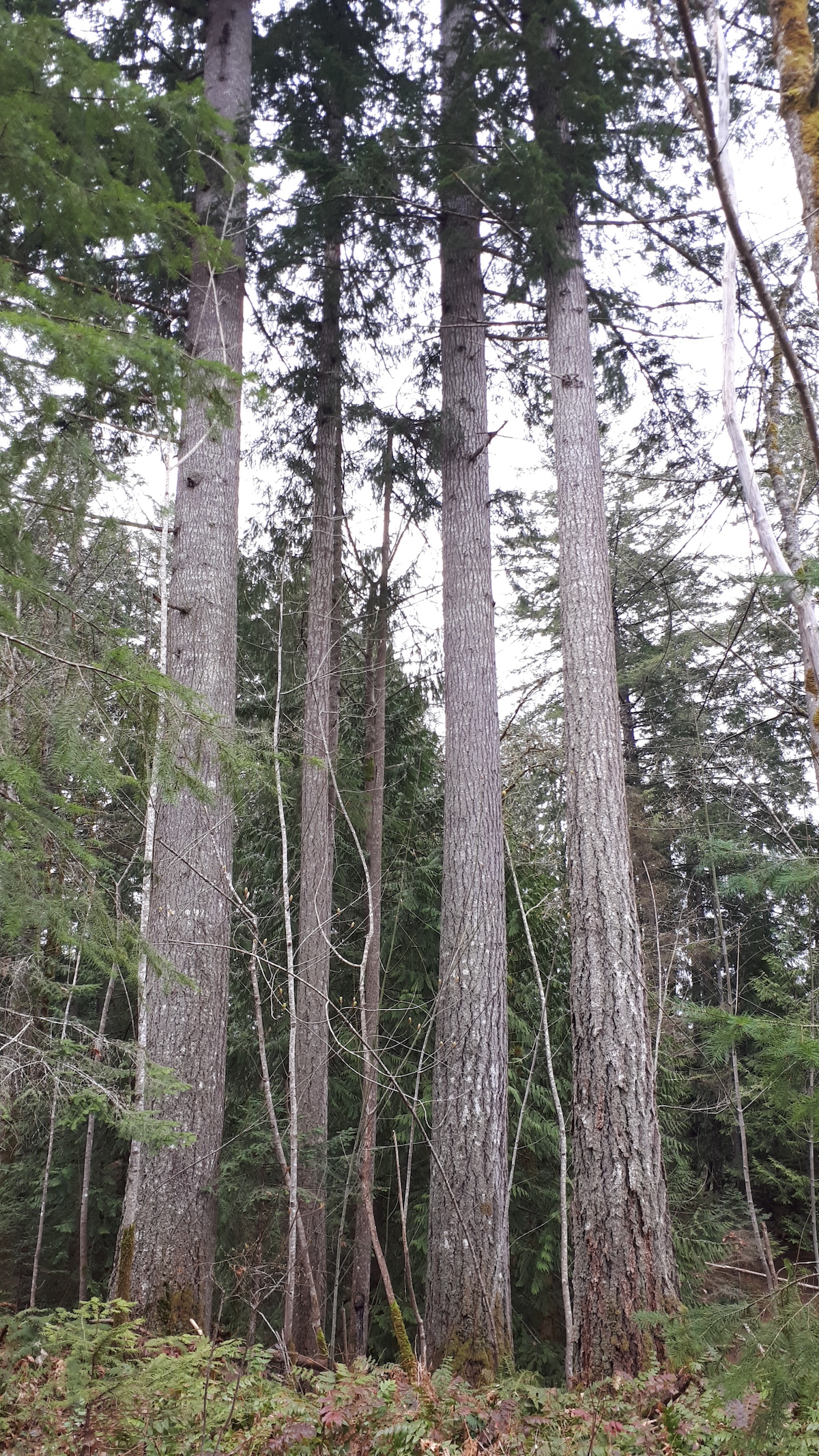
Location: Ruth Masters Greenway, 68 Powerhouse Rd., Courtenay. GPS of park at Powerhouse entrance: 49.68242, -125.03274, or enter off 1st St. access. Note: there is no cycling allowed in the Masters Greenway park so the 1st St. access (next to 2425 1st St., GPS: 49.682119, -125.025395) which is close to the tree location may be the best entrance for cyclists.
The tree is on Turkey Vulture trail in the northeast corner of the park on the creek and near the river. GPS of tree: 49.684453, -125.028991. It is a very short walk of about 50 m from the north end of the 1st St. trail onto Turkey Vulture and to the trees.
“There are 3 firs of good size within metres of each other right beside the trail as you walk down to the bridge. I believe Ruth Masters referred to these firs as the three sisters.” Our nominator estimates that these trees are 65-75 years old.
The largest of these trees is 119 cm DBH and about 35 m tall. It is a stunning grouping of trees.
The CVRD website gives this history of the Masters Greenway: “To help preserve the environment near her home, Ruth Masters donated 7.3 hectares (18 acres) of land to create the Masters Greenway and Wildlife Corridor.
Ruth arranged for to the Comox Valley Regional District, the Comox Valley Land Trust and The Land Conservency of BC to cooperatively manage the donation. As part of this arrangement, Ruth had a covenant registered on the land. The covenant prohibits the placement of any buildings, toilets, picnic tables, parking lots or garbage bins on the greenway. Ruth helped nature reclaim the old fields, orchards and gardens on the property by planting ferns and trees rescued from construction sites such as the Courtenay Walmart development.
The Masters Greenway (also referred to as the Ruth Masters Greenway) is part of an extensive trail network along the south shore of the Puntledge River. The park includes high-bank river frontage and a creek running through the park.
The greenway features both red-listed and blue-listed (threatened and endangered) species while containing quality habitat for a wide range of wildlife. As part of a larger undeveloped corridor along the south side of the Puntledge River, the Masters Greenway allows larger species, such as bears, to move through the area.”
Ruth Masters was a long-time member of Comox Valley Nature and you can read more about her story here.
Submitted by Brian Allaert.
36. Garry oak (Quercus garryana)
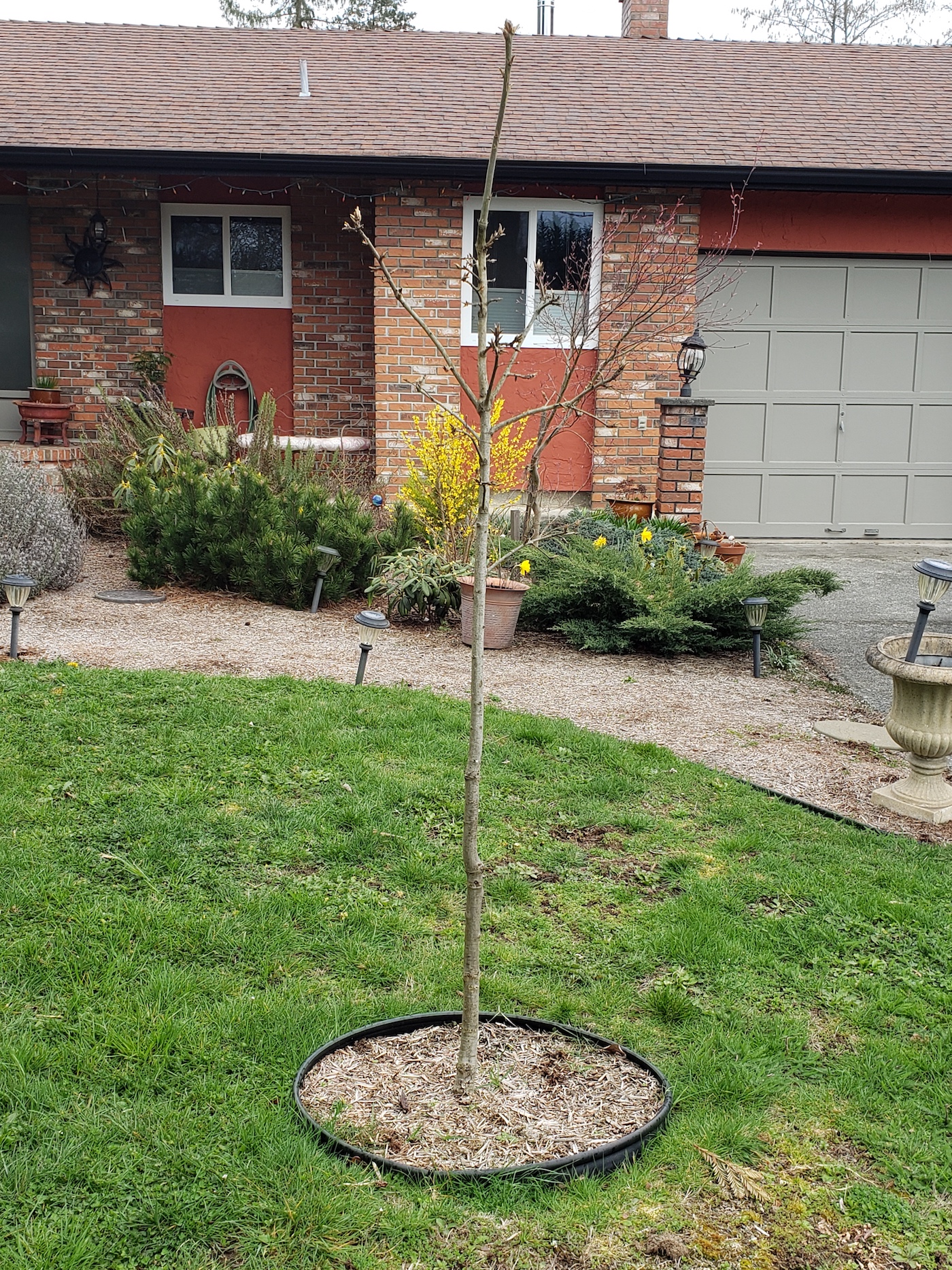
Location: 546 Cheetah Court, Comox, in the front yard. GPS: 49.68386, -124.93116.
“Why nominate this not so impressive (for now) 7’ tall tree?
This is the “baby” of several generations of Garry oaks which formed the cityscape of our homes since we moved to BC in 1992 from Ottawa. At that time we were not even aware of the existence of these magnificent giants…but here it is:
1. Oak Bay, 1330 Mitchel Street: We were surrounded with 3 gorgeous centenarians. We were told that one may be 700 years old, one 400, another about 200…one gnarled, one entwined with an Arbutus tree and the youngest in a perfect vase shape. We fell in awe…and my husband Gary adopted them as his namesake.
2. When we purchased our woodland, halfway up Forbidden Plateau road in 1997, we knew we were pushing the limits for a Garry oak, but all considerations aside we purchased a 3 ft one from the nursery at Swan Lake and planted it in an open, south-facing location. It is a thriving individual, snow and drought be damned. 25 years later it stands about 30 ft tall, cradled by its fir buddies and unperturbed by my son building his garage workshop right in front, blocking the southern sun. However by now it is over 10 ft above the garage roof. This perhaps is an extreme…for now.
3. We also had purchased in 2008 a family property in Courtenay, 425 Back Rd., now sold. One attraction was that it had a beautiful urban vase shaped Garry Oak worthy of note and nomination on its own. Its lower branches have been pruned so its shape crowns the surrounding landscape, a designer’s urban tree for sure.
Well, by the time we got our recent bungalow for our “old age” we had to plant this “baby Garry oak” tree. Loys was kind enough to give us one from his nursery. It was planted some 4 years ago and is happy where it is. Of course we will not see it come to full maturity…whatever this means for these centenarian giants?
One thing is for sure, Garry oaks seem to thrive in the meadows, they thrive in the urban settings near busyness of roads and pollution, they thrive in the small quiet neighbourhoods, they even thrive on the mountain.
So if we all planted one baby Garry Oak tree in our Comox Valley, especially where their original ecosystem has been, maybe in few hundred years there will be a forest of them.”
Submitted by Kate Panayotof and Gary Schaan.