Early blooms and plants from Yellow Point

From an email by Jocie to the Botany Group on March 22.

I was down at Yellow Point Lodge (a bit south of Nanaimo) with my mother for a weekend in late February and found some interesting plants there and some early bloomers! Blue-eyed Mary should be making an appearance here soon, but of course it is much earlier down-island.

Here are a few notes & highlights. [Click a photo to enlarge it.]

  1. Blue-eyed Mary (in the genus Collinsia). My photo isn’t diagnostic enough to tell the difference between the similar looking parviflora and grandiflora.
  1. Common whitlow-grass (Draba verna). This is not a native plant, but it is one of our earliest blooms in the mustard family.
  1. Macoun’s meadowfoam (Limnanthes macounii). This is a rare, red-listed plant. I knew of its presence at Yellow Point from an old plant list. Glad to find it!
  1. Dwarf owl-clover (Triphysaria pusilla). The deep purple colour and strange growth form of this tiny plant are distinctive.
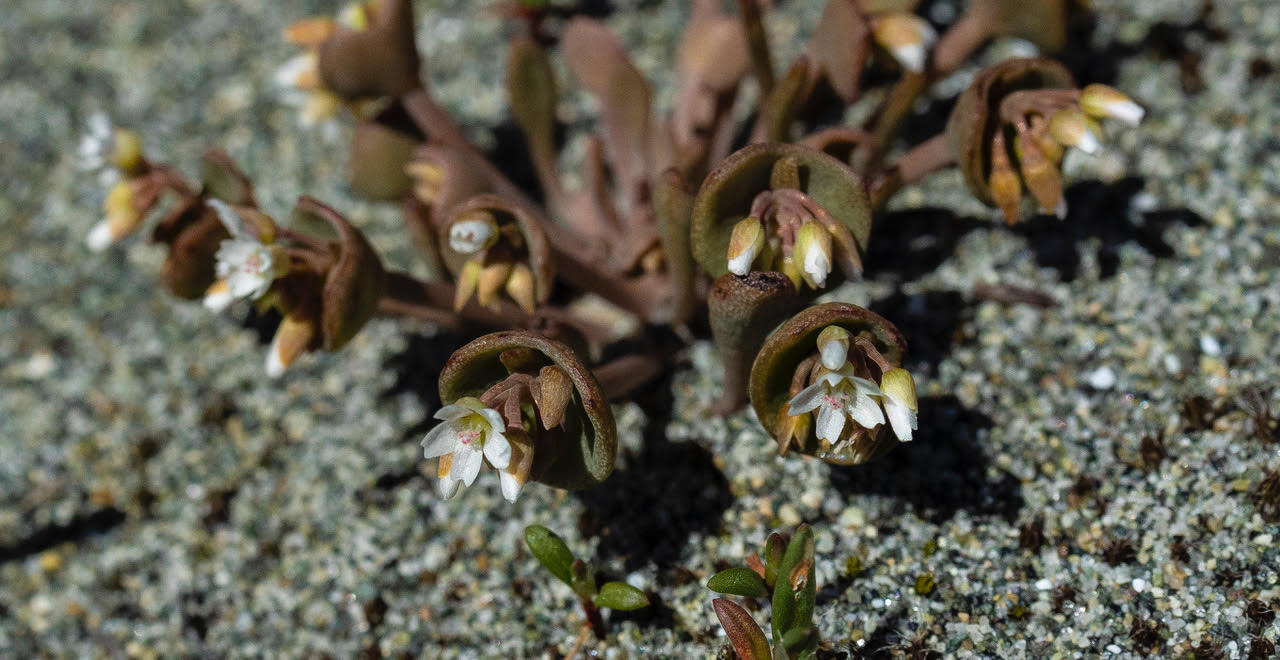
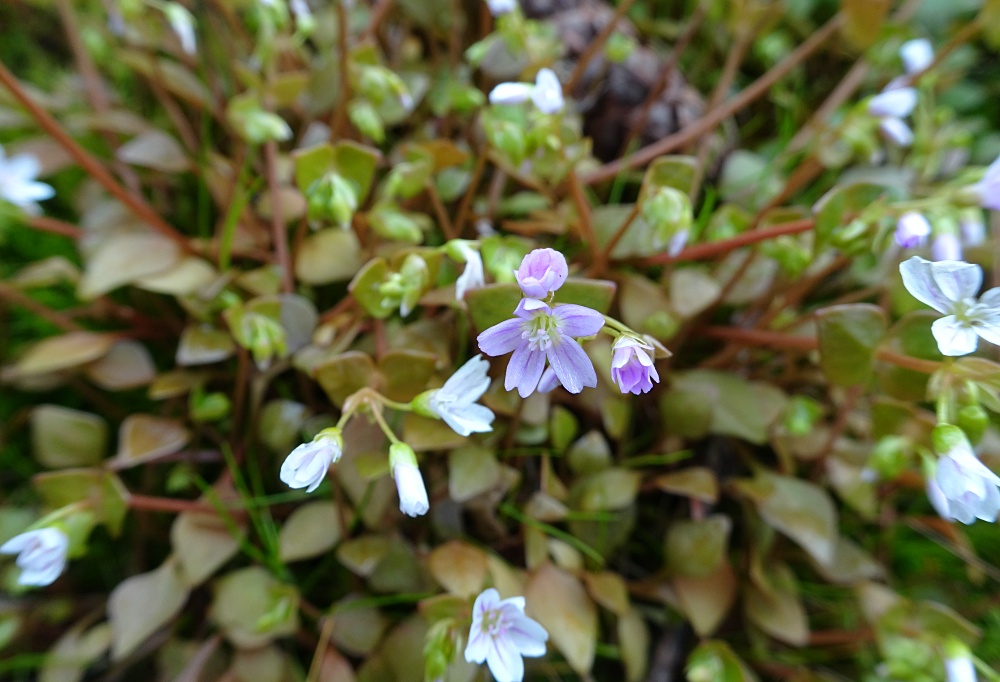
  1. Blinks (Montia fontana). This is a small and nondescript montia…blink and you miss it! It has some tiny early-blooming white flowers.
  1. Field madder (Sherardia arvensis). Another tiny plant, does it madder? Small and non-native, with a whorled leaf arrangement that is similar to cleavers.
  1. Hairy/purple honeysuckle (Lonicera hispidula). Common on the drier gulf islands. Note the hairy leaf edges that are different from orange honeysuckle.
  1. Yerba buena (Clinopodium douglasii). A fragrant, trailing plant that is often found growing in the same habitats as the purple honeysuckle.
  1. Small-flowered nemophila (Nemophila parviflora). This lovely, albeit overlooked, native plant can be found around the Comox Valley and will be in bloom soon…look out for it!
  1. Maritime juniper (Juniperus maritima). There are some ancient maritime juniper in this area. It was neat to see the purple-blue juniper berries.
Posted in Plants and fungi | Comments Off on Early blooms and plants from Yellow Point

Recording available for talk on Canada’s fisheries

Comox Valley Nature, in conjunction with the Canadian Society of Environmental Biologists, recently presented the following webinar:
Title: The State of Canada’s Fisheries: Oceana Canada’s 2021 Fishery Audit
Speaker: Isabelle Jubinville
Date: Thursday March 17, 2022

If you missed this event or would like to see it again, CSEB has made the recording available here. To access it you will need to provide your name and email address.

For more information about this talk, see the announcement in our earlier post.

Posted in Conservation and Restoration, Guest Speakers, Shoreline and Marine | Comments Off on Recording available for talk on Canada’s fisheries

Learn about the status of data-poor fish stocks

Comox Valley Nature, in conjunction with the Canadian Society of Environmental Biologists, is pleased to host the following free online lecture:

Title: The State of Canada’s Fisheries: Status of Data-poor Stocks
Speaker: Rebecca Schijns
Date: Thursday March 24, 2022
Time: 10:00 a.m. PDT

This webinar is facilitated by the CSEB and is open to the public (see the registration link below).

The status of a third of Canada’s fisheries is uncertain, which limits policy actions and informed management necessary to sustain healthy populations. Oceana Canada has conducted new assessments using a data-limited tool to estimate the status of “Uncertain” fisheries to help Canada’s progress towards rebuilding fisheries and sustaining marine biodiversity.

About the speaker

Rebecca Schijns is a Canadian marine fisheries scientist with a B.Sc. in Biology from Queens University and an M.Sc. degree in Oceans and Fisheries from the University of British Columbia, where she worked with the Sea Around Us initiative to reconstruct historical catches and analyze global marine fishing impacts. She has produced research articles on northern cod and shifting fisheries baselines and is fluent in data-limited stock assessment methodology. Based in Vancouver, she provides research on fisheries and marine conservation issues to inform and support the goals of Oceana Canada’s campaigns.

Registration

“Seating capacity” for the talk is limited, and you need to register in advance. You can check the computer requirements for attendees here.

Register here

After registering, you will receive a confirmation email with instructions for joining the webinar.

If you are new to Comox Valley Nature, find out more about us here.

Although CVN lectures are free, donations of any size from non-members who attend are always appreciated ($4.00 is suggested).

Posted in Guest Speakers, Shoreline and Marine | Comments Off on Learn about the status of data-poor fish stocks

Learn about the state of the Salish Sea

Comox Valley Nature, in conjunction with the Canadian Society of Environmental Biologists, is pleased to host the following free online lecture:

Title: The State of the Salish Sea
Speaker: Dr. Ian Perry
Date: Sunday March 20, 2022
Time: 7:00 p.m. PDT

This webinar is facilitated by the CSEB and is open to the public (see the registration link below).

How much do you know about the Salish Sea? What is the Salish Sea? Is the Salish Sea
warming? What is the current condition of the Salish Sea ecosystem? Join Dr. Perry as he
discusses these questions and more in his presentation.

About the speaker

Dr. Ian Perry is an Emeritus Scientist with the Pacific Biological Station of Fisheries & Oceans
Canada. His research expertise includes the effects of the environment on larval, juvenile and
adult stages of finfish and invertebrates; the structure and function of marine ecosystems;
ecosystem-based approaches to the management of marine resources; the human dimensions of
marine ecosystem changes; methods for providing scientific advice for new and developing
fisheries; and scientific leadership of international and inter-governmental programs on marine ecosystems and global change.

Registration

“Seating capacity” for the talk is limited, and you need to register in advance. You can check the computer requirements for attendees here.

Register here

After registering, you will receive a confirmation email with instructions for joining the webinar.

If you are new to Comox Valley Nature, find out more about us here.

Although CVN lectures are free, donations of any size from non-members who attend are always appreciated ($4.00 is suggested).

Posted in Guest Speakers, Shoreline and Marine | Comments Off on Learn about the state of the Salish Sea

Hip to be a botanist!

From an email by Jocie to the Botany group on March 6.

Before the spring growing season explodes, take a moment to check out some colourful rose hips! [Click a photo to enlarge it.]

Nootka rose hips

Our native Nootka rose (Rosa nutkana) has nice round red hips all through the winter months. These are a high source of vitamin C, so it’s OK to nibble the hips. However, beware of the large, coarsely hairy seeds that aren’t very palatable.

Dog rose hips

The dog rose (Rosa canina complex), is a similar looking, pink-blooming rose from Europe, with oval-shaped hips that typically taper at each end.

Mossy rose gall (winter)
Mossy rose gall (spring)

Dog roses often have golf-ball-sized galls known as the mossy rose gall or “robin’s pincushion,” caused by the larvae of a certain gall wasp. Here’s a bit of information that I found about mossy rose galls on the website of The Wildlife Trusts in the UK:

The Robin’s pincushion (also known as the ‘Bedeguar Gall’) is a gall caused by the larvae of a tiny gall wasp, Diplolepis rosae. The gall is widespread and common, and can be found developing on the stems of Dog-roses during late summer; it acquires its reddish colour as it matures in autumn. Each gall holds many grubs, which feed on the gall tissues throughout the winter and emerge in spring as adults. Only a tiny number of adults are male.

Curved spines of dog rose and sweetbriar

Dog rose and another European species, sweetbriar (Rosa rubiginosa), are tricky to tell apart without examining leaf details. Both of these species have curved, downward pointing spines.

Posted in Insects and spiders, Plants and fungi | Comments Off on Hip to be a botanist!

Learn about the state of Canada’s fisheries

Comox Valley Nature, in conjunction with the Canadian Society of Environmental Biologists, is pleased to host the following free online lecture:

Title: The State of Canada’s Fisheries: Oceana Canada’s 2021 Fishery Audit
Speaker: Isabelle Jubinville
Date: Thursday March 17, 2022
Time: 10:00 a.m. PDT

This webinar is facilitated by the CSEB and is open to the public (see the registration link below).

Rebuilding depleted fisheries and preventing healthy fish populations from declining requires good science, monitoring and management. Oceana Canada’s fifth annual Fishery Audit assesses the current state of Canada’s fisheries, tracks progress in key science and management indicators from 2017 to 2021, and provides recommendations to meet federal policy commitments to return wild fish populations to abundance in Canada’s oceans.

About the speaker

Isabelle Jubinville is a Marine Scientist with Oceana Canada. She has a BSc. in Marine Biology and an MSc. in Biology from Dalhousie University and has conducted research in seabird physiology, marine plastic pollution, and fisheries bycatch mitigation. She works in Halifax, Nova Scotia and provides research support to Oceana Canada’s campaigns to rebuild wild fish stocks and protect marine wildlife and habitat.

Registration

“Seating capacity” for the talk is limited, and you need to register in advance. You can check the computer requirements for attendees here.

Register here

After registering, you will receive a confirmation email with instructions for joining the webinar.

If you are new to Comox Valley Nature, find out more about us here.

Although CVN lectures are free, donations of any size from non-members who attend are always appreciated ($4.00 is suggested).

Posted in Conservation and Restoration, Guest Speakers, Shoreline and Marine | Comments Off on Learn about the state of Canada’s fisheries

Recording available for talk on Garry oak benefits

Comox Valley Nature, in conjunction with the Canadian Society of Environmental Biologists, recently presented the following webinar:

Title: Garry Oak Ecosystems – Benefits to Urban Areas
Speaker: Thomas Munson
Date: Sunday, February 20, 2022

If you missed this event or would like to see it again, CSEB has made the recording available here. To access it you will need to provide your name and email address.

For more information about this talk, see the announcement in our earlier post.

Posted in Conservation and Restoration, Ecology, Guest Speakers | Comments Off on Recording available for talk on Garry oak benefits

Learn about the benefits of Garry oak ecosystems

Comox Valley Nature is pleased to host the following free online lecture:

Title: Garry Oak Ecosystems – Benefits to Urban Areas
Speaker: Thomas Munson
Date: Sunday, February 20, 2022
Time: 7:00 p.m. PST

This webinar is facilitated by the Canadian Society of Environmental Biologists and is open to the public (see the registration link below).

Less than 5% of the rare Garry oak ecosystems exist in their natural form on Vancouver Island. Despite their rarity, they perform valuable ecological, cultural and economic functions in our urban areas. Protecting and managing Garry oak ecosystems in these urban areas is a challenge, for many reasons. Examples of successful management will be discussed from urban areas in Victoria and Saanich. These examples could be beneficial if applied to the northern range of Garry oak ecosystems in the Comox Valley.

About the speaker

Thomas Munson holds a Bachelor of Environmental Studies degree from University of Waterloo, and a Restoration of Natural Systems Diploma and Masters of Science degree from the University of Victoria. He has worked with First Nations in Yukon Territory, British Columbia, and Colombia, South America for much of the past 20 years. Thomas worked as Environmental Technician for City of Victoria Parks, in restoration, and management of Garry oak ecosystems. Now, as Senior Environmental Planner for District of Saanich, he works to protect these same ecosystems from development activities.

Registration

“Seating capacity” for the talk is limited, and you need to register in advance. You can check the computer requirements for attendees here.

Register here

After registering, you will receive a confirmation email with instructions for joining the webinar.

If you are new to Comox Valley Nature, find out more about us here.

Although CVN lectures are free, donations of any size from non-members who attend are always appreciated ($4.00 is suggested).

Posted in Conservation and Restoration, Ecology, Guest Speakers | Comments Off on Learn about the benefits of Garry oak ecosystems

Cooley spruce gall

From an email by Jocie to the Botany Group on January 30.

Fanciful-looking Cooley spruce galls add a splash of colour to these grey, dreary days. Many have funky shades of purple, red and yellow. They vary depending on what stage they are at— older galls are dull brown.

I’ve been noticing just how abundant these galls are on the branch tips of local Sitka spruce wherever I go. I’ve also seen plenty up the mountain on the Engelmann spruce that’s been planted along the Jutland ski trail. See some photos below (click a photo to enlarge it).

The galls are caused by a tiny aphid, Adelgid cooleyi, with a complex life history (6 generations! – see the diagram below). Interestingly, the aphid requires more than one conifer species to complete its life cycle. For this species, the alternative host is usually Douglas fir (it’s called the Douglas-fir adelgid on iNaturalist). The adults look like tiny dots of white wool (see the reference below for photos). I haven’t seen these on Douglas fir needles before but it’s something to look out for!

I confess that I know nothing about spruce galls, but they are interesting to look at on a dull winter day! To learn everything you might ever want to know about them, you can download this document from the Forest Genetics Council of B.C. It’s worth looking at just to see all the great photos of different stages.

If any of you are spruce gall experts, or have anything to add to this discussion let me know.

  1. Cooley’s spruce gall on Sitka spruce: Little River Nature Park (1).
  1. Cooley’s spruce gall on Sitka spruce: Little River Nature Park (2).
  1. Cooley’s spruce gall on a snowy Sitka spruce (Union Bay).
  1. Cooley’s spruce gall on Engelmann spruce (Jutland ski trail, Mt Washington).
  1. Cooley spruce gall life cycle.
Posted in Ecology, Insects and spiders, Plants and fungi | Comments Off on Cooley spruce gall

Gorse and broom a source of protein?

From an email by Jocie to the Botany Group on January 29.

An article from the Guardian, here, tells how gorse and broom could potentially be used as a source of protein. Maybe we should be using more invasives as a food source! Thanks to Mandy for sending this. [But note the caution about toxicity below the photos.]

These invasive shrubs (I’m sure you are all well familiar with them) are both in the pea family. Here are a few photos of local examples [click a photo to enlarge it].

  1. Scotch broom (Cytisus scoparius): leaf and seed pod detail (from Piercy Rd. wasteland near the inland highway).
  1. Gorse (Ulex europaeus): in bloom last December at Woodhus Slough.

Notes on the toxicity of these plants from a follow-up email by Jocie:

Please don’t go out and eat these plants, as they can be toxic to humans and livestock! The article mentioned “isolating the protein to make it safe for consumption” which must involve removing the toxic alkaloids.

Gary S. sent me an email which raises some good points about this:

“I was surprised that the article does not deal with the known toxicity of Scotch broom to humans and livestock. There is a documented history of poisoning in British Columbia beginning with the use of broom for brewing tea by Chinese labourers building the railroad.”

Posted in Plants and fungi | Comments Off on Gorse and broom a source of protein?