CVN has a new and improved online method for new members to join and existing members to renew. With this new method you can provide your contact information, affirm the waiver, optionally make a donation, and pay with a credit or debit card, all together through our payment processor Square.
If you have not already joined or renewed, try it out! Start at our updated Membership page.
Even if you prefer to pay by e-transfer, cheque or cash, you can still use the new method to send us your membership information and affirm the waiver. However, if you would like to use the traditional paper form instead, it is still available on our Membership page.
Donations
We have similarly improved the process of making a donation separately from membership to let you specify your donation intentions more clearly and pay with a credit or debit card online. You can even make multiple donations to different CVN interest groups or activities with one payment while itemizing your intended amounts.
To try out the new donation process (apart from the membership process), start at our updated Donate page.
Posted inMiscellaneous, News|Comments Off on New online membership renewal and donations
Contributed by Karen Cummins, leader of the Tree of the Year team. Click a photo to enlarge it.
Meet the tree-checking crew for Tree of the Year 2023
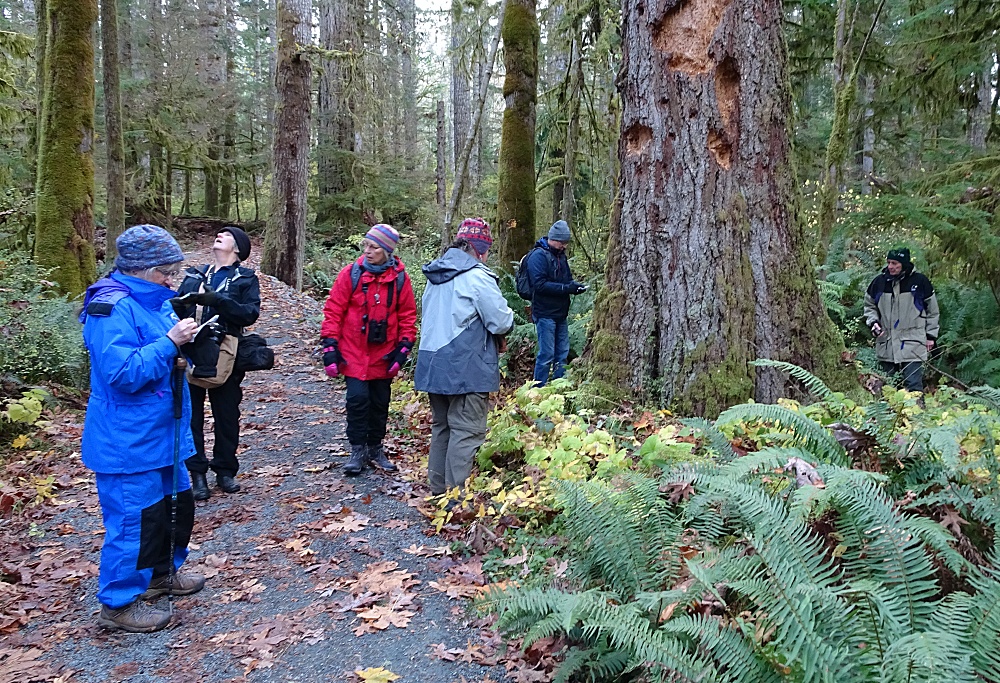
Left to right: Isabella, Barbara, Kathie, Katrice, Carol, Tryna and Fred
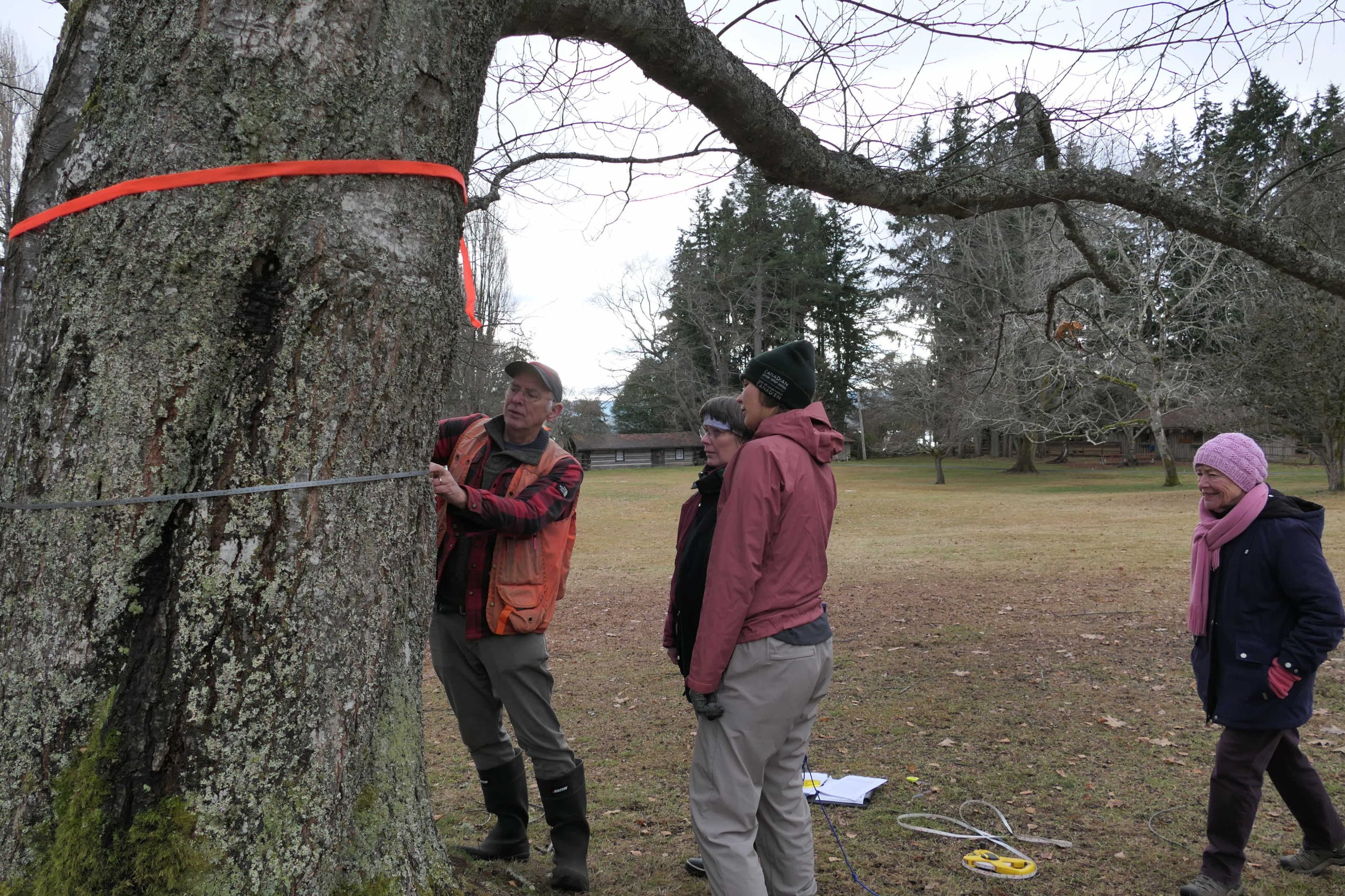
We had our first workshop for CVN members who will help check the trees nominated for the upcoming Tree of the Year event. We met on a beautiful mid-December afternoon in Filberg Park in Comox to learn how to measure tree height and diameter, consider tree identification, and describe the location including the GPS coordinates.
This was a first CVN outing for Katrice Baur who is the Comox Valley Youth Coordinator for the Invasive Species Council of BC. We are looking forward to Katrice and her youth helping us with Tree of the Year as well as engaging in birding, botany and wetland group outings.
We were also very fortunate to be joined in our workshop by Tryna McLean, the charge-hand for Filberg Park. Serendipitously, we had already decided to use “Frankie,” the red oak in Filberg Park that Tryna nominated for Tree of the Year in 2022, as a tree to illustrate measuring techniques. Tryna shared more of “Frankie’s” history and was able to identify and tell stories of many of the park trees.
Frankie’s diameter being measured by Fred while Isabella, Katrice and Kathie watch.
We are really pleased that at least three of our group are also interested in testing and helping Roger Chayer to create the cycle maps for 2023.
Nominations for the 2023 Tree of the Year event will be open from January 15 to March 15. Watch for further blog posts as the event progresses.
Look up, look way up and find your favourite tree to honour.
Posted inTree(s) of the Year|Comments Off on Tree of the Year 2023 is coming
This year’s 2022 Restoration Report for the Courtenay River Airpark has been posted on the Comox Valley Nature Website. It is under publications on the top bar of the page. Click on this and go to Wetland Restoration.
I wish to thank all the volunteers who showed up in record numbers helping the project for its 28th year. We are looking forward to 2023 and some new initiatives that we have planned. A limited number of hard copies of the report are also available from myself or Karen Cummins.
Comox Valley Nature, facilitated by the Canadian Society of Environmental Biologists, recently presented the following webinar:
Title:Biodiversity of the Morrison Creek Headwaters Speakers: David Stapley, Joy Wade and Chanchal Cabrera Date: Sunday, December 11, 2022
If you missed this event or would like to see it again, CSEB has made the recording available here. To access it you will need to provide your name and email address.
For more information about this talk, see the announcement in our earlier post.
From an email by Jocie to the Botany Group on December 4. Click a photo to enlarge it.
We snuck in a walk at Bear Creek Regional Park last week (Nov. 26) just before the recent snowfall. It was a cold frosty day, but we saw lots of interesting things!
Here are a few notes and highlights. Photos are mine and Veronique’s. If any IDs are incorrect let me know.
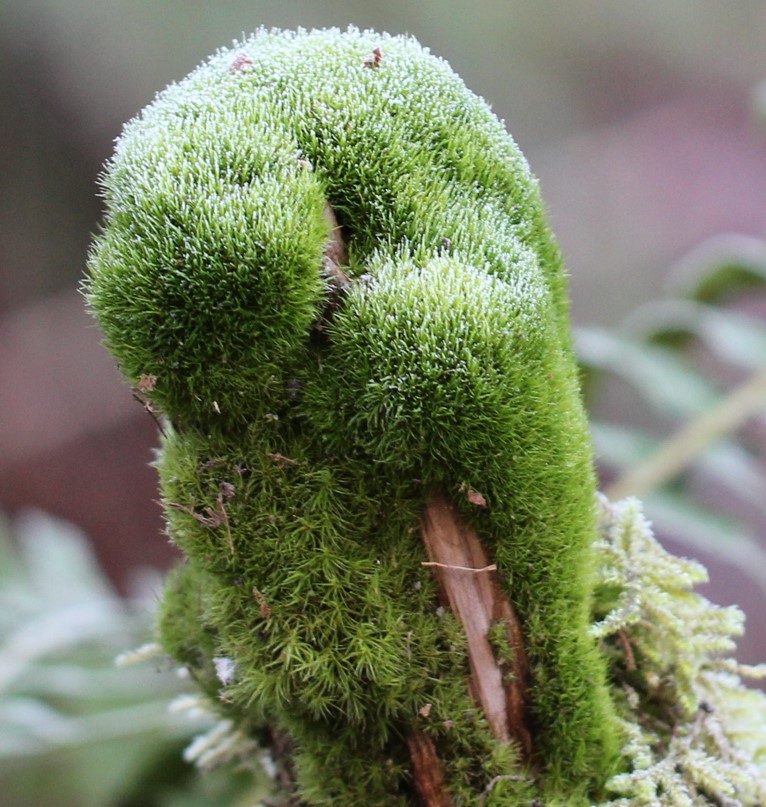
Fragile fork moss (Dicranum tauricum). The fragile tips break off on your finger!
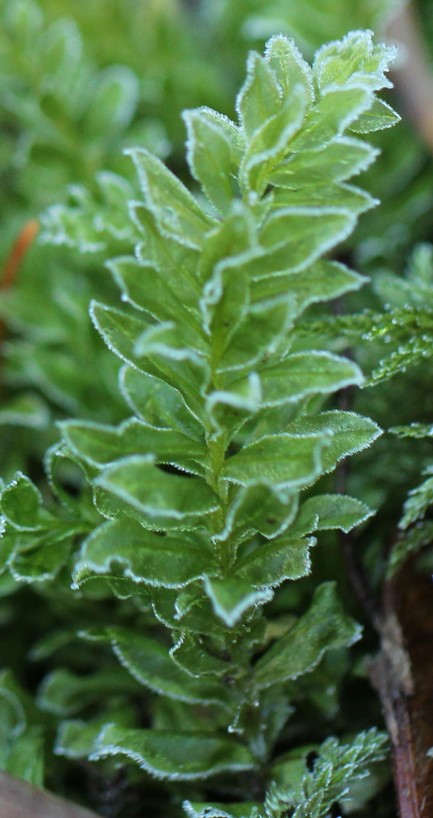
Badge moss / coastal leafy moss (Plagiomnium insigne). One of our largest mosses.
Tree ruffle liverwort (Porella navicularis). A common epiphyte on maple and alder.
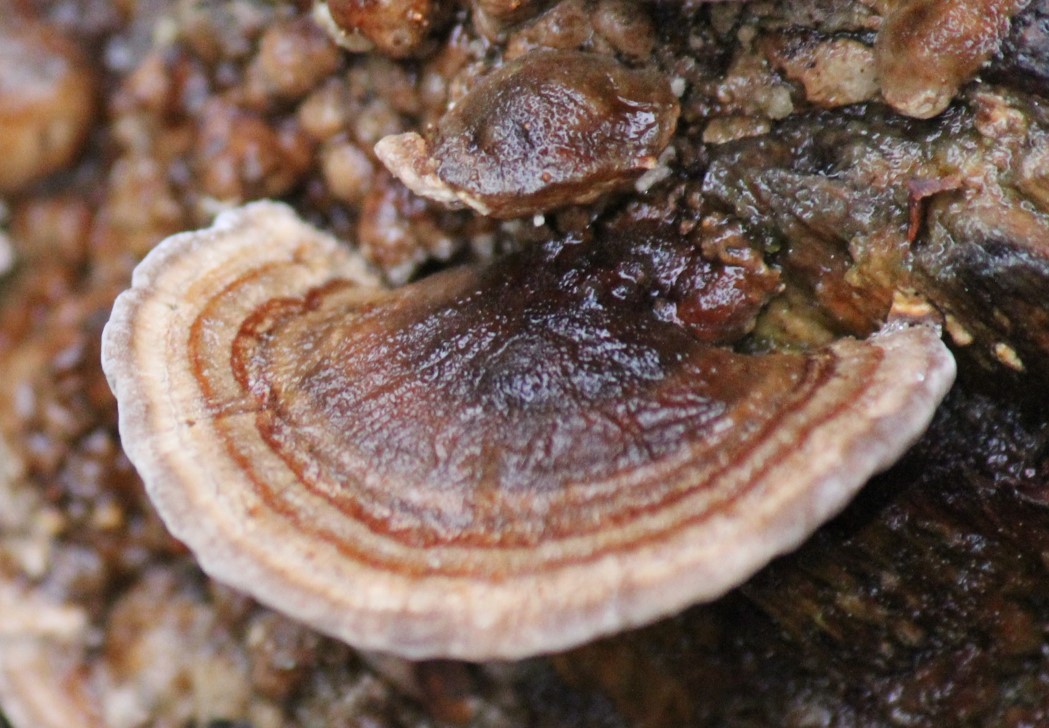
Purplepore bracket fungus (Trichaptum abietinum). A common fungus on conifers, with shades of green and purple.
Same as above, showing the purplish, ragged pores on the underside.
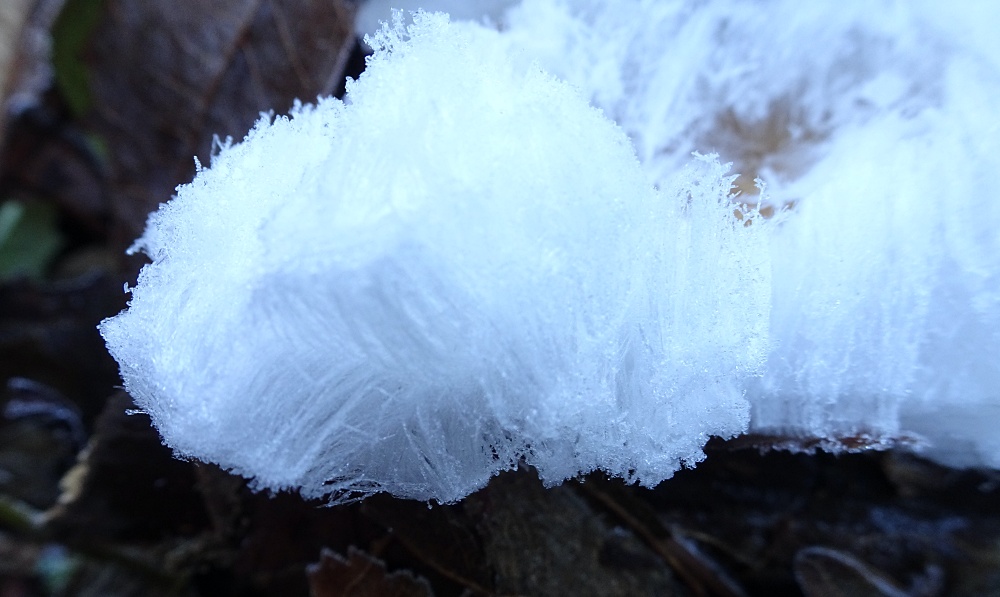
Hair ice / frost flowers are associated with the fungus Exidiopsis effusa, on hardwoods.
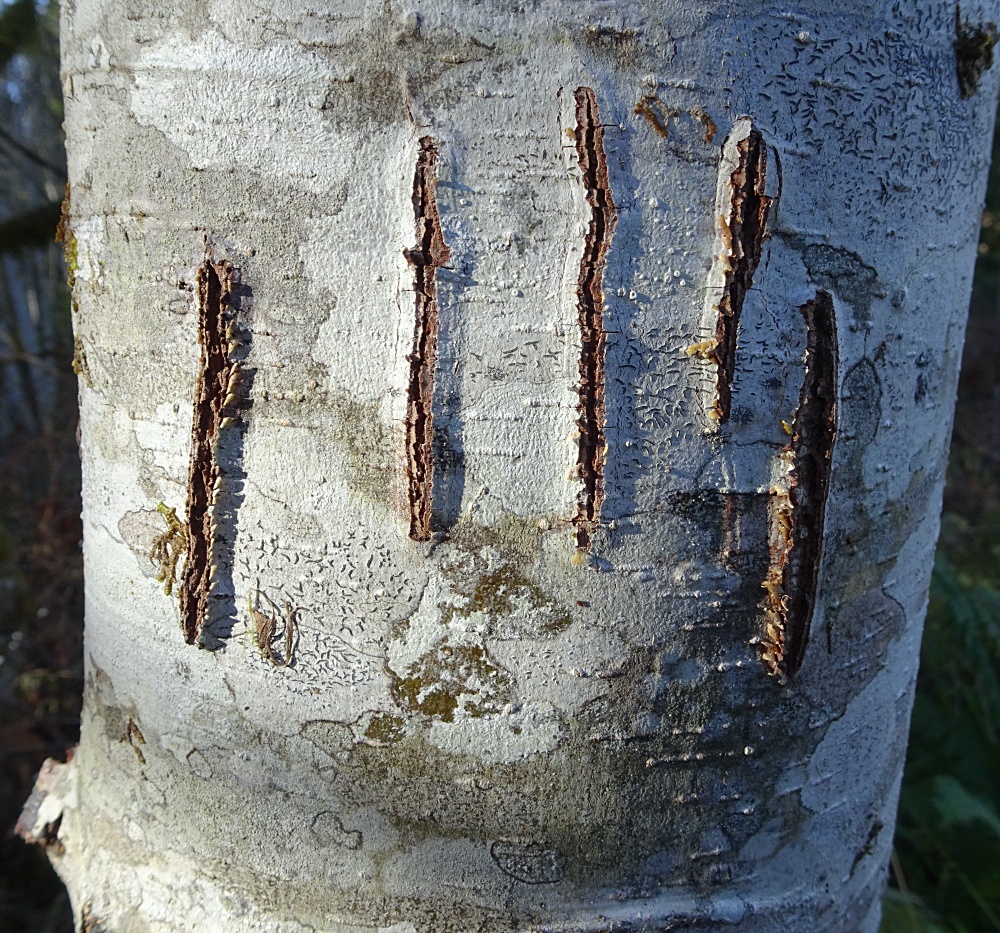
They don’t call it “Bear Creek Park” for nothing! Lots of bear sign…scratch marks on trees, and scat with lots of crabapples in it.
Netted crust (Byssormerulius corium). This fungus was quite abundant on our walk. A striking pure white with soft, marshmallowy edges and a wrinkled surface. Some ochre tints. It is called Meruliopsis corium in some books. On hardwoods.
Same as above, showing variation of growth form.
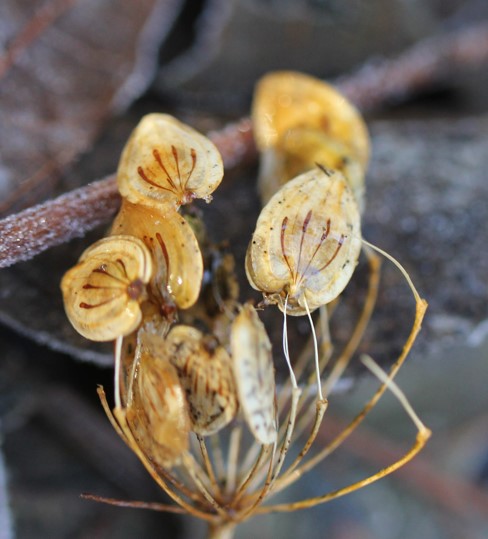
Cow parsnip seeds (Heracleum maximum), formerly H. lanatum. Has delicate brown lines that look painted on.
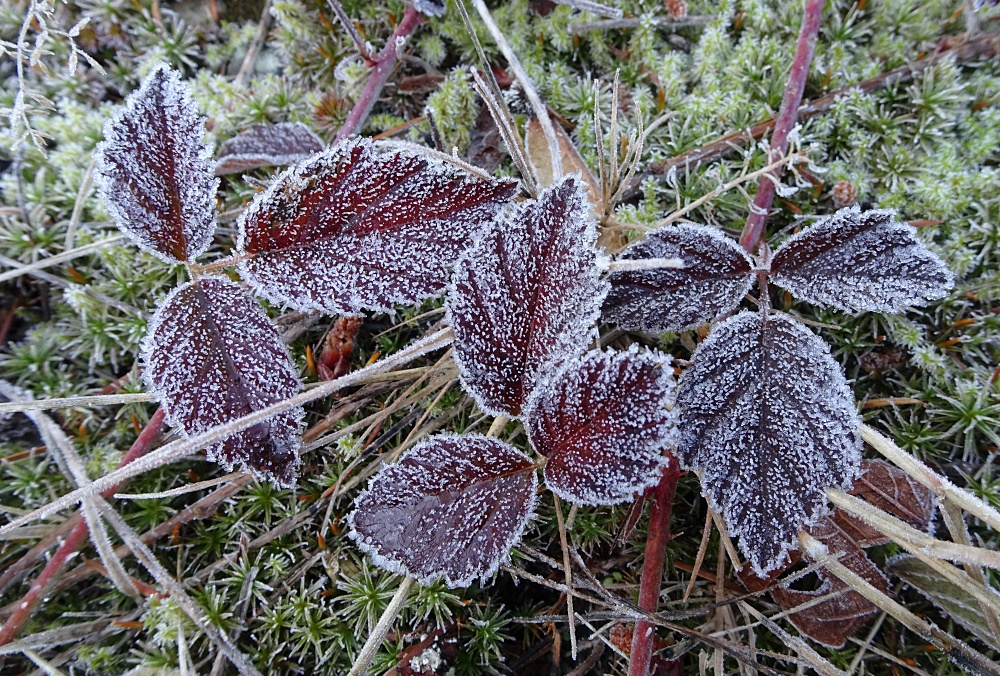
Trailing blackberry leaves (Rubus ursinus). “Frosty botany” is always fun to photograph.
Comox Valley Nature is pleased to host the following free lecture at our December online meeting:
Title: Biodiversity of the Morrison Creek Headwaters Speakers: David Stapley, Joy Wade and Chanchal Cabrera Date: Sunday, December 11, 2022 Time: 7:00 p.m. PT
The unique environmental features of the Morrison Creek headwaters have resulted in a biologically rich ecosystem, home to many endangered and threatened species including the one-of-a-kind Morrison Creek lamprey. Volunteers with the Morrison Creek Streamkeepers and with the Comox Valley Land Trust are trying to preserve a forested area around the Morrison Creek headwaters. The presenters will share their knowledge of the habitat and species of the headwaters and of the Comox Valley Land Trust project to protect them.
About the speakers
David Stapley was program manager for the Comox Valley Land Trust (CVLT) Conservation Partnership program for ten years and is currently a CVLT director. David has been a strong advocate for improved environmental policies and practices and played a key role in the Conservation Partnership’s notable conservation successes between local governments and the ENGO sector.
Joy Wade is a research biologist who works to address questions concerning the conservation of (what some may call) uncharismatic species at risk and their habitat. Most of that work focuses on scientific activities to help manage the species to minimize harm and ensure the environment is suitable to help them survive. She has worked on issues for Cowichan Lake lamprey and Morrison Creek lamprey for more than ten years, and more recently on species like Rocky Mountain ridged mussel, speckled dace and Pacific lamprey.
Chanchal Cabrera is a medical herbalist with 35 years of clinical practice. She runs a private herbal medicine clinic with a specialty in holistic oncology, and is also a certified Shinrin Yoku (forest bathing) practitioner, a certified Master Gardener and a certified Horticulture Therapist. Chanchal lives on Vancouver Island, British Columbia where she and her husband manage Innisfree Farm and Botanic Garden, a 7 acre internationally registered botanic garden. Chanchal is a former CVLT director.
From an email by Jocie to the Botany Group on November 24. Click a photo to enlarge it.
Here are photos of a lovely red/pink coral fungus that I think you will all enjoy. The below message and photos are from Sandra P.
I am a volunteer and key contact for the Roy Creek Salmonid Enhancement Society. I came across this fungus this morning while at our fish hatchery for Roy Creek. This fungus was near the water source by the spring. Can you tell me what it is — very pretty. First I thought it was a pom pom on the ground but with a stick I poked gently and broke 2 pieces, realizing that it’s a fungus. Is it rare? poisonous?
This is a coral fungus in the genus Ramaria. There are a few species it could be…hard to determine without microscopic work and chemical tests according to Alison M. Could be R. araiospora or R. stunzii. Not toxic, but not a desired edible. Less common than the beige and yellow ramarias.
Posted inPlants and fungi|Comments Off on Colourful coral fungus!
Comox Valley Nature, facilitated by the Canadian Society of Environmental Biologists, recently presented the following webinar:
Title:What we need to do to rescue wild salmon from further decline Speaker: Alexandra Morton Date: Sunday, November 20, 2022
If you missed this event or would like to see it again, CSEB has made the recording available here. To access it you will need to provide your name and email address.
For more information about this talk, see the announcement in our earlier post.
From an email by Jocie to the Botany Group on November 13. Click a photo to enlarge it.
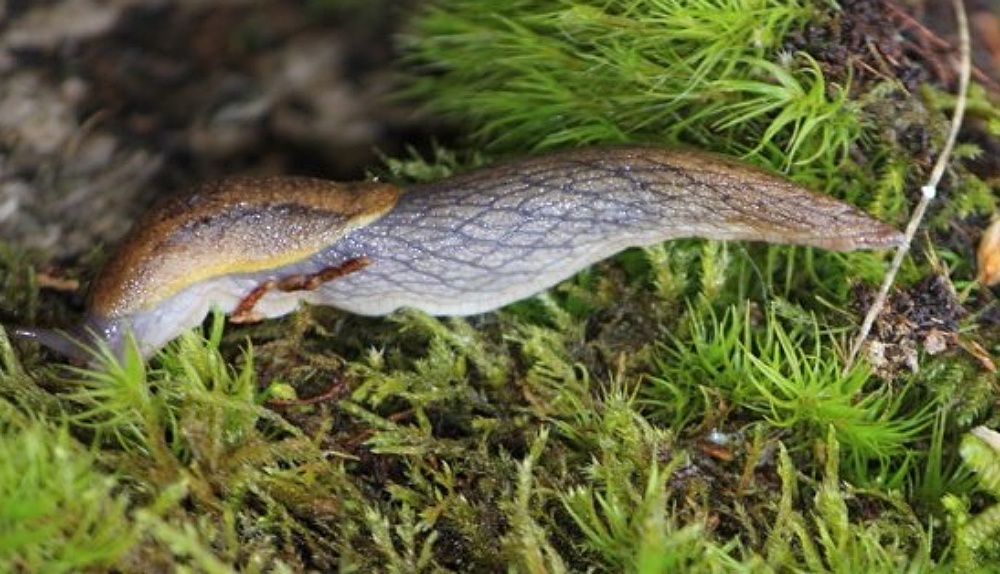
Here is part 2 from our Miracle Beach outing on November 7: mosses and a taildropper slug. Thanks Veronique, Alison and Karen for submitting so many wonderful photos. I’ve decided to leave out the lichens for now, but we’ll revisit these on another winter walk, and I will keep the lichen photos on file.
From an email by Jocie to the Botany Group on November 13. Click a photo to enlarge it.
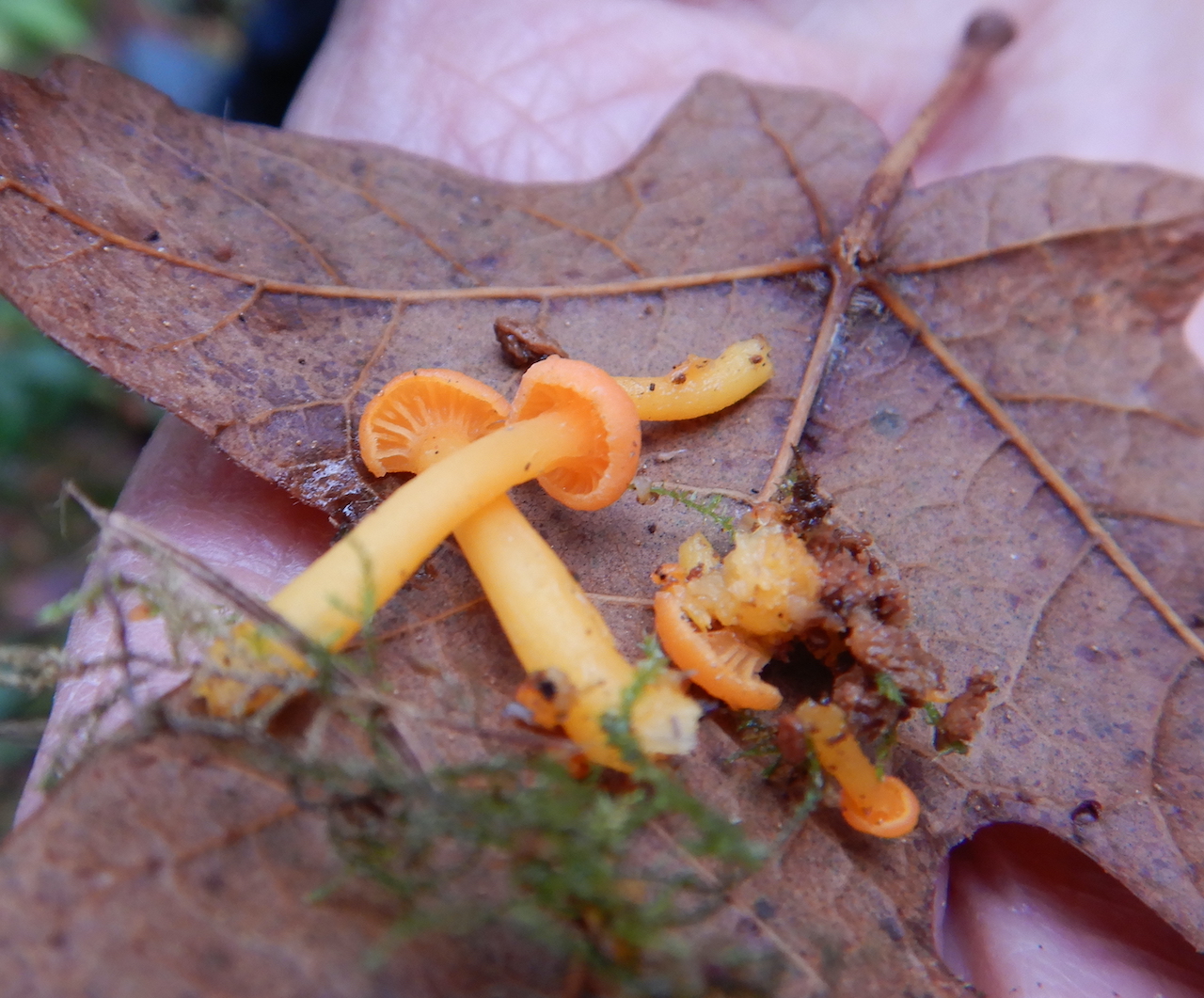
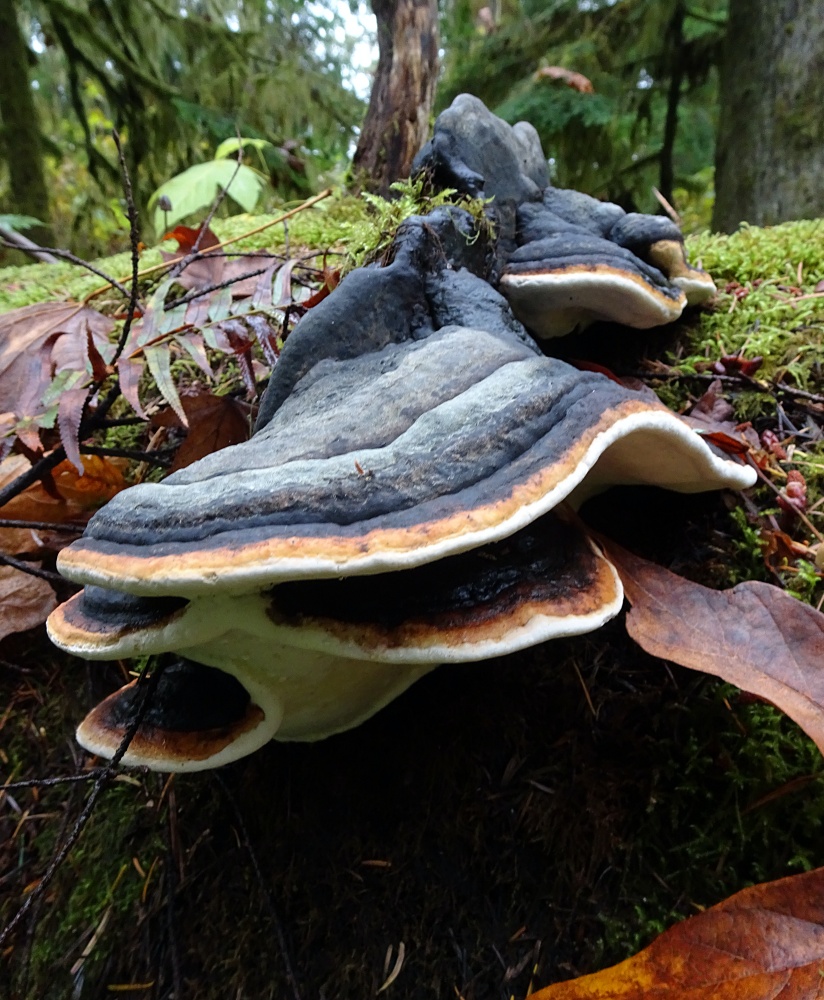
We saw a wealth of things at Miracle Beach Park on November 7. Here’s Part 1, the fungi (mosses are coming up later). One of the most fun was Bondarzew’s polypore—as we circled an old snag they progressed from small to large! Thankfully, Alison & Loys were along to help out with identification.
Join the Comox Valley Conservation Community for a day long celebration of the watersheds and waterways that connect us all in the Comox Valley!Learn about restoration and habitat enhancement projects, salmon cycles, drinking water, forests, creeks, wetlands and estuaries – and so much more. Art projects, kids activities, volunteer engagement opportunities, hands on learning and guided walks – all looking out over the beautiful Puntledge River.Comox Valley Nature will be there with our new outreach tent. Come by and say hello, and try our bird identification game. We can also show you why native plants are best for your garden, and how to spot invasive species.Pack a picnic and stay for the day! Saturday Sept 19th from 9 am – 3 pmin Puntledge Park 1111 1st , Courtenay ...
In her memoir, Pacific Northwest author Caroll Simpson recounts the highs and lows of running a remote fishing lodge on her own following the untimely death of her husband, and of falling in love with the natural world. Simpson tells stories of living in the remote wilderness and managing the lodge, becoming an accidental environmental activist, fending off wild animals, working as an angling guide and finally, fighting off a proposed mining operation and participating in the development of a government land management plan as a spokesperson for the wilderness tourism industry.While Simpson welcomed paying guests at Ookpik Lodge, unwanted house guests included a woodchuck, a pack rat, and martens. Simpson constantly had to watch out for grizzlies, moose, and cougars. Storms and extreme weather also provided fodder for hair-raising tales. All this makes for wonderful storytelling.Caroll’s story is essentially a love story. In an essay for Sierra Club, Simpson wrote: “I developed an immense passion for flora and fauna. Just walking back and forth on the 300’ dock several times a day, I was exposed to the unbelievable beauty of the northern spectrum of water life: the golden eagle soaring above, the osprey and kingfisher diving and coming up with fish for their hatchlings, the muskrats and otters looking for an easy meal, the tireless beaver working into the late evening sunsets. All of these creatures and more expressed their generational ownership of this small piece of the world. In return each was given my utmost respect and admiration…As I listened to the loons at the end of each day and the owl and the wolf in the night, I felt blessed to be witnessing such beauty. “On September 20th, join Comox Valley Nature and Save Our Forests Team for an afternoon of storytelling about this remarkable time spent living on a remote British Columbia lake.The event is being held at the Comox United Church Hall. (250 Beach Drive, Comox) Admission is by donation. Doors open at 2:30; the event begins at 3:00 p.m. There will be time for Q&A after the presentation, as well as books available for purchase. Tea/coffee and cookies - including forest-themed cupcakes - will be available for a donation.Join us, and prepare to fall in love. ...
🎟️ Get your tickets to the Project Watershed 2026 Keeping It Living Dinner today! projectwatershed.ca/2026-keeping-it-living-dinner/Every ticket holder makes a difference. 💙 🎟️ Get your tickets to our 2026 Keeping It Living Dinner today! projectwatershed.ca/2026-keeping-it-living-dinner/When community and local businesses invest in conservation, our entire ecosystem benefits. Ticket sales directly support habitat restoration, scientific research, and environmental education, while the generosity of our sponsors helps offset event costs, ensuring that more of the funds raised can go directly toward this important work. Thank you to our incredible sponsors and dinner attendees for believing in the power of community-led conservation. Odlum Brown Community and Northwest Hydraulic Consultants, 40 Knots Winery, CNB Together, we're keeping our watersheds living. 🌿 Hope to see you September 12, 5 - 8 pm at 40 KNOTS Winery #KeepingItLiving #ProjectWatershed #CommunitySupport #Conservation #ComoxValley ...
The City of Courtenay is developing a long-term vision for Bill Moore Park and Dogwood Park to guide future improvements. To help guide these decisions, three initial concepts have been developed, and there is an opportunity for you to offer your input.The latest survey on the City website engagecomoxvalley.ca/bill-moore-and-dogwood-park asks for feedback on three concept plans and specifically which concept you prefer. The three concepts present a range of recreation possibilities and there is room on the survey for your comments.Dogwood Park is a 2.32‑hectare nature park featuring mature forested areas, natural habitat and a small wetland. Only Concept A will maintain the intact forest areas in Dogwood Park. Concepts B and C propose increased recreation in the park including an off leash dog park, disc golf course, pump track (a purpose built track for children’s cycling) and nature play areas. While the planners may say that no trees or few trees will be taken down to accommodate this, the under-story will not survive this level of trampling and fragmentation. The trees as well as all the wildlife who now call that area home will disappear over time. For those of us who value this forest, Concept A is the only option that makes sense.Dogwood Park is one of the few islands of green for many, many blocks. It provides habitat for wildlife, shade, retains water and acts as a carbon sink. On the architect's base plan of current conditions it is now characterized as an "underutilized space". The City has heard from sports enthusiasts but not nature lovers. Let them know why you value an intact forest and your connection to it. The survey is open until Sept 15. ...
The Canadian Coalition for Invasive Plant Regulation (CCIPR) wants the federal government to establish a regulatory body for the horticultural industry and create a national database identifying invasive plants and their risks in different regions. "Even if we don't prohibit them, we need to let the public know when there is potential harm," said CCIPR co-founder Cathy Kavassalis. "We do this on other products, and we should do it on plants too. It's just common sense."In July, Nanaimo council passed a motion to pursue a bylaw amendment restricting the sale of plants on a list maintained by the Invasive Species Council of B.C. A week later, Surrey moved to ban sales by businesses including nurseries, large retail chains and florists. Kavassalis said a problem that could be addressed at higher levels of government is being pushed down to municipalities."These are all patchwork solutions that, in some ways, just waste a lot of resources," she said. The CCIPR says a national database could give provinces, territories, retailers and gardeners a shared source of information about which plants pose risks in different regions. Kavassalis also wants invasive plants removed from shelves or clearly labelled.For more on this story visit www.cbc.ca/news/science/invasive-plants-sale-federal-regulation-9.7312362 or see our link in bio ...