Title:To Reduce the Social and Economic Damage from High Severity Wildfires, We Must Transform our Landscapes Speaker: Bob Gray (R.W. Gray Consulting Ltd.) Date: Thursday, January 25, 2024
If you missed this event or would like to see it again, CSEB has made the recording available here. To access it you will need to provide your name and email address.
For more information about this talk, see the announcement in our earlier post.
Posted inEcology, Guest Speakers|Comments Off on Recording for talk on reducing wildfire harms
The nomination period for Comox Valley Nature’s Trees of the Year event for 2024 opens on February 1. Some key features of the event:
Any resident of the Comox Valley can nominate one or more trees, not just CVN members.
We have an online nomination form to make nominating easy.
Starting this year, we are promoting appreciation of all the nominated trees rather than having a vote for a single winner.
Tour routes will be published for the nomination phase to help you find interesting trees to consider (in addition to routes to find the nominated trees later).
You can nominate a tree any time between February 1 and March 31. Visit our Trees of the Year page to learn more about the event and to access the nomination form. There you will also find some details of the nomination rules. Or, on February 1 and after, go directly to the nomination form here:
After nominations close, we will publish an illustrated list of the nominees on this website, along with maps of their locations. We encourage you to visit as many as you can, preferably by cycling or walking.
We welcome your feedback on this year’s event. You can use the comment link below.
The nomination period for CVN’s Trees of the Year 2024 runs from February 1 to March 31. If you do not already have a tree in mind, we have suggestions for where you can look for one (or more). This year we have prepared suggested tour routes to lead you to some of the prime spots in the Valley where you can find interesting and special trees.
Browse through the maps of five such areas (and one combined map) listed in the table below. Then go out and find a tree to nominate. At the same time you might discover some natural areas that you didn’t previously know. We encourage travel by cycle or walking to visit these areas.
Please respect private property boundaries and owner privacy by viewing the trees from public land.
The maps
We have three ways for you to access the route maps using the links in the table below:
The route maps (with written directions) were implemented on the PlotARoute website (plotaroute.com) which has multiple viewing options. See some tips below the table.
If you would like to have printable information, you can download a PDF version of the plotaroute map and directions.
If you like Google maps, the five routes are shown on one here.
The five routes constitute a plotaroute collection and appear together on the combined map. Select the one you want to see in the table below the map.
Expand a map to full screen using the crossed arrows at the top right of the map.
Play an animation using the play icon at the bottom left of the map.
Zoom in or out using the + and – icons at the top left of the map.
Use the menu at the top right of the map to access various types of information. The Directions option includes notes that describe tree-centric points of interest along the route.
The length of the route is given in the bottom margin of the map.
We are grateful to TOTY team members Roger Chayer, Fred Newhouse and others for all their work preparing these maps.
We welcome feedback on your experience with the touring routes and related information. You can use the comment link below.
Posted inTree(s) of the Year|Comments Off on Find trees to nominate for Trees of the Year 2024
Comox Valley Nature members and the general public are invited to the following free online lecture presented by CVN and facilitated by the Canadian Society of Environmental Biologists:
Title: Seed-based Restoration for Urban Settings on Vancouver Island Speakers: Kristen Miskelly (Satinflower Nurseries) Date: Sunday, February 18, 2024 Time: 7:00 p.m. PT
See the registration link below.
Reducing barriers to restoration is one of the goals of Satinflower Nurseries. Over the last ten years, the nursery has produced native seeds and worked to encourage their use on southern Vancouver Island, including in urban areas! Kristen will discuss how native seeds can be used to enhance biodiversity and create drought-tolerant spaces in our neighbourhoods and cities. She will share project examples like green roof, septic fields, and urban meadows. The talk will also highlight aspects of small-scale native seed production.
About the speaker
Kristen Miskelly (MSc) is a biologist who specializes in the flora, ecology, and restoration of ecosystems of southern Vancouver Island and Gulf Islands. Kristen owns and operates Satinflower Nurseries, a native plant nursery and consulting business that provides native plants, seeds, biological consulting, and public education/outreach. She provides ecological consultation, project planning, and implementation of various native plantings projects and is a sessional lecturer at the University of Victoria in the schools of Ecological Restoration, Biology, and Environmental Studies.
Title:Conserving and Restoring a Legacy: Vanier Forest Garry Oak Restoration Project Speakers: Jim Boulter, Karen Cummins, Eloise Holland Date: Sunday, January 21, 2024
If you missed this event or would like to see it again, CSEB has made the recording available here. To access it you will need to provide your name and email address.
For more information about this talk, see the announcement in our earlier post.
Comox Valley Nature members and the general public are invited to the following free online lecture presented by CVN and facilitated by the Canadian Society of Environmental Biologists:
Title: Conserving and Restoring a Legacy: Vanier Forest Garry Oak Restoration Project Speakers: Jim Boulter, Karen Cummins, Eloise Holland Date: Sunday, January 21, 2024 Time: 7:00 p.m. PT
See the registration link below.
Garry oak ecosystems are the richest land-based ecosystems in coastal British Columbia. They include open forests dominated by oak groves of soaring sculptural Garry oak trees (as in the photo above) and the less common oak communities found in wetter areas like Vanier Forest. The understory is typically composed of shrubs and grassy meadows of wildflowers that carpet the ground in the spring.
The Vanier forest Garry oaks are a unique part of several remaining groves that once covered 160 square kilometres and stretched from the Comox estuary to present-day Smith Road.
This presentation will review the work that CVN has carried out so far on our restoration project and outline the methodology proposed to provide a viable growing environment for this rare and at-risk habitat.
About the speakers
Jim Boulter (behind the camera), Karen Cummins (2nd from right), and Eloise Holland (3rd from right) are CVN members on the Vanier Garry Oaks Restoration Team. The others in this photo are also CVN members who contribute to this work.
Title:Beyond Climate Change: the nuts and bolts of adaptation at the local scale Speaker: Dr. Ruth Waldick Date: Sunday, December 10, 2023
If you missed this event or would like to see it again, CSEB has made the recording available here. To access it you will need to provide your name and email address.
For more information about this talk, see the announcement in our earlier post.
Title: To Reduce the Social and Economic Damage from High Severity Wildfires, We Must Transform our Landscapes Speaker: Bob Gray (R.W. Gray Consulting Ltd.) Date: Thursday, January 25, 2024 Time: 12:00 p.m. (noon) PT
See the registration link below.
The Good Creek wildfire in Okanagan Mountain Park, approaching Lakeshore Rd, near Kelowna, BC, Canada on July 19, 2018. (Credit: Pinderphoto https://pics.uvic.ca/projects/wildfire-and-carbon)
As of June 28, over 8 million ha of forest had burned in high severity fires from Nova Scotia to British Columbia with another three months of fire season still to go. These fires are resulting in significant social, ecological and economic impacts. Transformational change in landscape-scale forest and fire management is key to reducing area burned at high severity.
About the speaker
Bob Gray is a highly reputed AFE Certified Wildland Fire Ecocologist whose clients include: US Forest Service, Parks Canada, The World Bank, State of Oregon, State of Washington, ?aq’am and Tsilhqot’in First Nation, B.C. Ministry of Forests, Lands and Natural Resource Operations, B.C. Ministry of Environment, University of Washington, University of Idaho, and University of British Columbia, several rural BC communities (Cranbrook, Kimberley, Vernon), the BC forest industry, and many others.
From an email by Jocie to the Botany/Mycology Group on November 22. Click a photo to enlarge it.
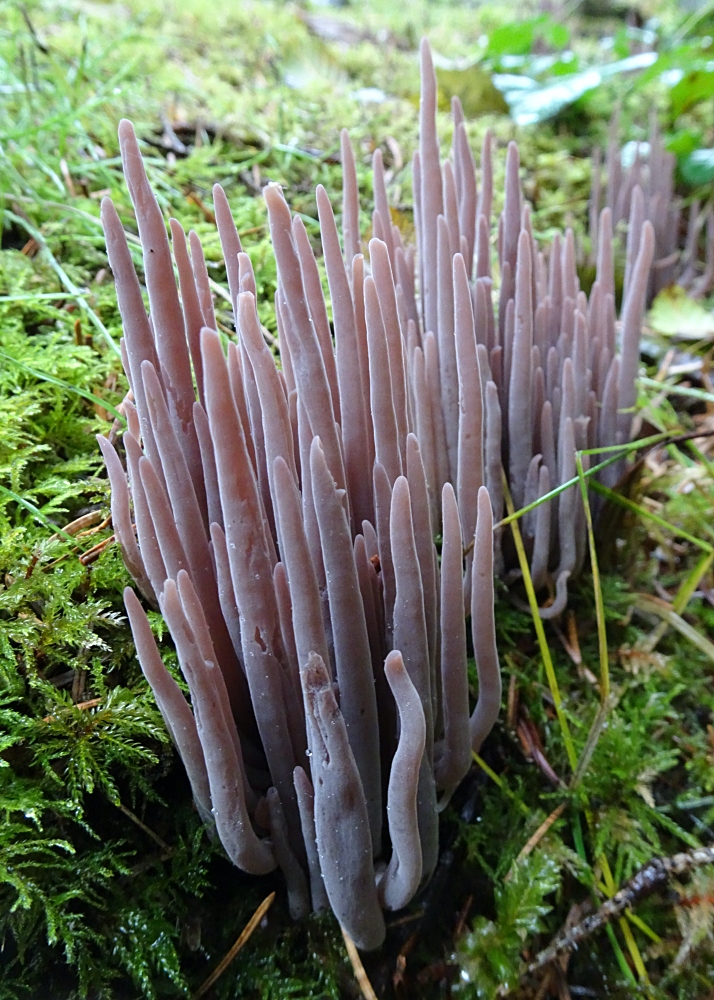
Here are a few examples of colourful purple-tinged fungi recently seen:
Thanks to Ann B. for sending in this photo of a blewit (Lepista nuda) with the following note: “This photo was taken a couple of days ago under the lilac bushes along my driveway on Fraser Rd. Blewits were one of the first mushrooms that Dulcie Hamilton identified for me some 50 years ago when I lived next to her on the Back Road.” (Dulcie was a long-time member of CVN and the botany group.)
and 3. Purple spindles (Alloclavaria purpurea) from the edge of a mossy ditch in the upper campsites of Miracle Beach Park.
Amethyst laccaria (Laccaria amethysteo-occidentalis) also from the campsites of Miracle Beach Park. Gills have a lovely lilac-tone.
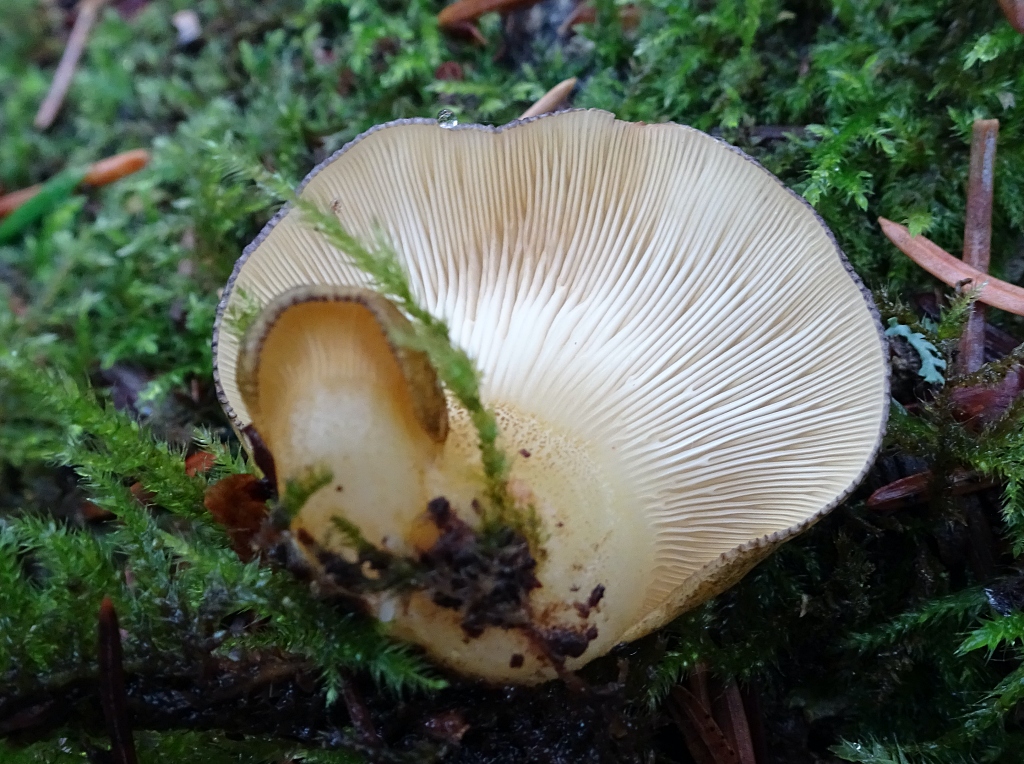
Late oyster/green oyster (Sarcomyxa serotina). This later season shroom has shades of grey/green and purple.
Gills of the late oyster, a creamy pale orange colour.
In the latest in our occasional series of long-form articles, Véronique McIntyre dug deep into the life histories and origins of the herbaceous members of the dogwood genus (Cornus) to find some lessons in anatomy, ecology and evolution. Learn all about the lives and history of the Alaskan bunchberry and just plain bunchberry in her article: “Some call us pop flowers, others, bunchberries.”
You can always find this and other long-form articles via the Articles category in the sidebar.
Join the Comox Valley Conservation Community for a day long celebration of the watersheds and waterways that connect us all in the Comox Valley!Learn about restoration and habitat enhancement projects, salmon cycles, drinking water, forests, creeks, wetlands and estuaries – and so much more. Art projects, kids activities, volunteer engagement opportunities, hands on learning and guided walks – all looking out over the beautiful Puntledge River.Comox Valley Nature will be there with our new outreach tent. Come by and say hello, and try our bird identification game. We can also show you why native plants are best for your garden, and how to spot invasive species.Pack a picnic and stay for the day! Saturday Sept 19th from 9 am – 3 pmin Puntledge Park 1111 1st , Courtenay ...
In her memoir, Pacific Northwest author Caroll Simpson recounts the highs and lows of running a remote fishing lodge on her own following the untimely death of her husband, and of falling in love with the natural world. Simpson tells stories of living in the remote wilderness and managing the lodge, becoming an accidental environmental activist, fending off wild animals, working as an angling guide and finally, fighting off a proposed mining operation and participating in the development of a government land management plan as a spokesperson for the wilderness tourism industry.While Simpson welcomed paying guests at Ookpik Lodge, unwanted house guests included a woodchuck, a pack rat, and martens. Simpson constantly had to watch out for grizzlies, moose, and cougars. Storms and extreme weather also provided fodder for hair-raising tales. All this makes for wonderful storytelling.Caroll’s story is essentially a love story. In an essay for Sierra Club, Simpson wrote: “I developed an immense passion for flora and fauna. Just walking back and forth on the 300’ dock several times a day, I was exposed to the unbelievable beauty of the northern spectrum of water life: the golden eagle soaring above, the osprey and kingfisher diving and coming up with fish for their hatchlings, the muskrats and otters looking for an easy meal, the tireless beaver working into the late evening sunsets. All of these creatures and more expressed their generational ownership of this small piece of the world. In return each was given my utmost respect and admiration…As I listened to the loons at the end of each day and the owl and the wolf in the night, I felt blessed to be witnessing such beauty. “On September 20th, join Comox Valley Nature and Save Our Forests Team for an afternoon of storytelling about this remarkable time spent living on a remote British Columbia lake.The event is being held at the Comox United Church Hall. (250 Beach Drive, Comox) Admission is by donation. Doors open at 2:30; the event begins at 3:00 p.m. There will be time for Q&A after the presentation, as well as books available for purchase. Tea/coffee and cookies - including forest-themed cupcakes - will be available for a donation.Join us, and prepare to fall in love. ...
🎟️ Get your tickets to the Project Watershed 2026 Keeping It Living Dinner today! projectwatershed.ca/2026-keeping-it-living-dinner/Every ticket holder makes a difference. 💙 🎟️ Get your tickets to our 2026 Keeping It Living Dinner today! projectwatershed.ca/2026-keeping-it-living-dinner/When community and local businesses invest in conservation, our entire ecosystem benefits. Ticket sales directly support habitat restoration, scientific research, and environmental education, while the generosity of our sponsors helps offset event costs, ensuring that more of the funds raised can go directly toward this important work. Thank you to our incredible sponsors and dinner attendees for believing in the power of community-led conservation. Odlum Brown Community and Northwest Hydraulic Consultants, 40 Knots Winery, CNB Together, we're keeping our watersheds living. 🌿 Hope to see you September 12, 5 - 8 pm at 40 KNOTS Winery #KeepingItLiving #ProjectWatershed #CommunitySupport #Conservation #ComoxValley ...
The City of Courtenay is developing a long-term vision for Bill Moore Park and Dogwood Park to guide future improvements. To help guide these decisions, three initial concepts have been developed, and there is an opportunity for you to offer your input.The latest survey on the City website engagecomoxvalley.ca/bill-moore-and-dogwood-park asks for feedback on three concept plans and specifically which concept you prefer. The three concepts present a range of recreation possibilities and there is room on the survey for your comments.Dogwood Park is a 2.32‑hectare nature park featuring mature forested areas, natural habitat and a small wetland. Only Concept A will maintain the intact forest areas in Dogwood Park. Concepts B and C propose increased recreation in the park including an off leash dog park, disc golf course, pump track (a purpose built track for children’s cycling) and nature play areas. While the planners may say that no trees or few trees will be taken down to accommodate this, the under-story will not survive this level of trampling and fragmentation. The trees as well as all the wildlife who now call that area home will disappear over time. For those of us who value this forest, Concept A is the only option that makes sense.Dogwood Park is one of the few islands of green for many, many blocks. It provides habitat for wildlife, shade, retains water and acts as a carbon sink. On the architect's base plan of current conditions it is now characterized as an "underutilized space". The City has heard from sports enthusiasts but not nature lovers. Let them know why you value an intact forest and your connection to it. The survey is open until Sept 15. ...
The Canadian Coalition for Invasive Plant Regulation (CCIPR) wants the federal government to establish a regulatory body for the horticultural industry and create a national database identifying invasive plants and their risks in different regions. "Even if we don't prohibit them, we need to let the public know when there is potential harm," said CCIPR co-founder Cathy Kavassalis. "We do this on other products, and we should do it on plants too. It's just common sense."In July, Nanaimo council passed a motion to pursue a bylaw amendment restricting the sale of plants on a list maintained by the Invasive Species Council of B.C. A week later, Surrey moved to ban sales by businesses including nurseries, large retail chains and florists. Kavassalis said a problem that could be addressed at higher levels of government is being pushed down to municipalities."These are all patchwork solutions that, in some ways, just waste a lot of resources," she said. The CCIPR says a national database could give provinces, territories, retailers and gardeners a shared source of information about which plants pose risks in different regions. Kavassalis also wants invasive plants removed from shelves or clearly labelled.For more on this story visit www.cbc.ca/news/science/invasive-plants-sale-federal-regulation-9.7312362 or see our link in bio ...