Guide to lichens of Strathcona Park published

Loys Maingon’s lichen field guide for Strathcona Park is now available! Loys is a Registered Professional Biologist (retired) and the research director of Strathcona Wilderness Institute (SWI). He is also a former president of Comox Valley Nature.


Field Guide to Basic Lichens of Strathcona Provincial Park
by Loys Maingon

Year: 2023
Format: paperback, 132 pages, full colour on 100 lb gloss paper
Dimensions: 8.25 x 4.5 inches
Price: $30

To order a copy, contact SWI by email:


This is the second in SWI’s series of Naturalist Field Guides to Strathcona Provincial Park. It is intended to help all levels of user to identify over a third of the lichens currently catalogued in Strathcona Provincial Park. 101 lichens are illustrated through high quality photographs together with indication of size, shape, environment and other distinctive features for easy identification. Similar looking species are also noted. The text also includes a list of the 274 taxa of lichens confirmed to date for Strathcona Provincial Park.

Here are two sample pages and the back cover:

Posted in News, Plants and fungi | Comments Off on Guide to lichens of Strathcona Park published

Learn about Marine Protected Area targets

CVN members and the general public are invited to attend the following free online lecture hosted by the Canadian Society of Environmental Biologists:

Title: Canada’s Approach to Achieving Marine Protected Area Targets
Speaker: Isabelle Jubinville (Oceana Canada)
Date: Tuesday, April 11, 2023
Time: 11:00 a.m. PT

See the registration link below.

The past year has seen Canada reaffirm commitments to protect 25% of our oceans by 2025 (and 30% by 2030) and showcase national marine conservation efforts on the world stage. With new perspectives and standards for marine protected areas and ‘what counts’ towards these targets, it raises the question—are we meeting our commitments? Recent developments in Canada’s push to meeting our 25% target will be discussed alongside how Canada’s national approach fits in with internationally championed best practices.

About the speaker

Isabelle Jubinville is a Marine Scientist with Oceana Canada. She has a BSc. in Marine Biology and an MSc. in Biology from Dalhousie University and has conducted research in seabird physiology, marine plastic pollution, fisheries bycatch mitigation and habitat protection. She is based in Halifax, Nova Scotia and works to advance marine habitat conservation in Canada’s oceans.

Isabelle is a return guest to CSEB and CVN, having presented in March 2022 on “The State of Canada’s Fisheries: Oceana Canada’s 2021 Fishery Audit.”

Registration

“Seating capacity” for the talk is limited, and you need to register in advance. You can check the computer requirements for attendees here.

Register here

After registering, you will receive a confirmation email with instructions for joining the webinar.

Posted in Conservation and Restoration, Guest Speakers, Shoreline and Marine | Comments Off on Learn about Marine Protected Area targets

Learn about Oceana’s 2022 fisheries audit

CVN members and the general public are invited to attend the following free online lecture hosted by the Canadian Society of Environmental Biologists:

Title: The State of Canada’s Fisheries: Fishery Audit 2022
Speaker: Rebecca Schijns (Oceana Canada)
Date: Tuesday, March 21, 2023
Time: 11:00 a.m. PT

See the registration link below.

Oceana Canada’s annual Fishery Audit reports on the state of fish stocks and tracks progress on how well the government is meeting its policy and management commitments. This year’s audit reveals that Canada’s fisheries are continuing to decline despite significant commitments, investments, new policies and updated laws from the federal government in efforts to rebuild them.

About the speaker

Rebecca Schijns is a Canadian marine fisheries scientist with a B.Sc. in Biology from Queens University and M.Sc. degree in Oceans and Fisheries from the University of British Columbia, where she worked with and the Sea Around Us initiative to reconstruct historical catches and analyze global marine fishing impacts. She has produced research articles on northern cod and shifting fisheries baselines and is fluent in data-limited stock assessment methodology.

Based in Vancouver, she provides research on fisheries and marine conservation issues to inform and support the goals of Oceana Canada’s campaigns.

Rebecca is a return guest to CSEB and CVN, having presented in March 2022 on the “Status of Data-Poor Stocks.”

Registration

“Seating capacity” for the talk is limited, and you need to register in advance. You can check the computer requirements for attendees here.

Register here

After registering, you will receive a confirmation email with instructions for joining the webinar.

Posted in Conservation and Restoration, Guest Speakers, Shoreline and Marine | Comments Off on Learn about Oceana’s 2022 fisheries audit

Upper Puntledge botany and fungi notes

This report by Alison M. was distributed to the Botany Group by Jocie on March 4. Click a photo to enlarge it.

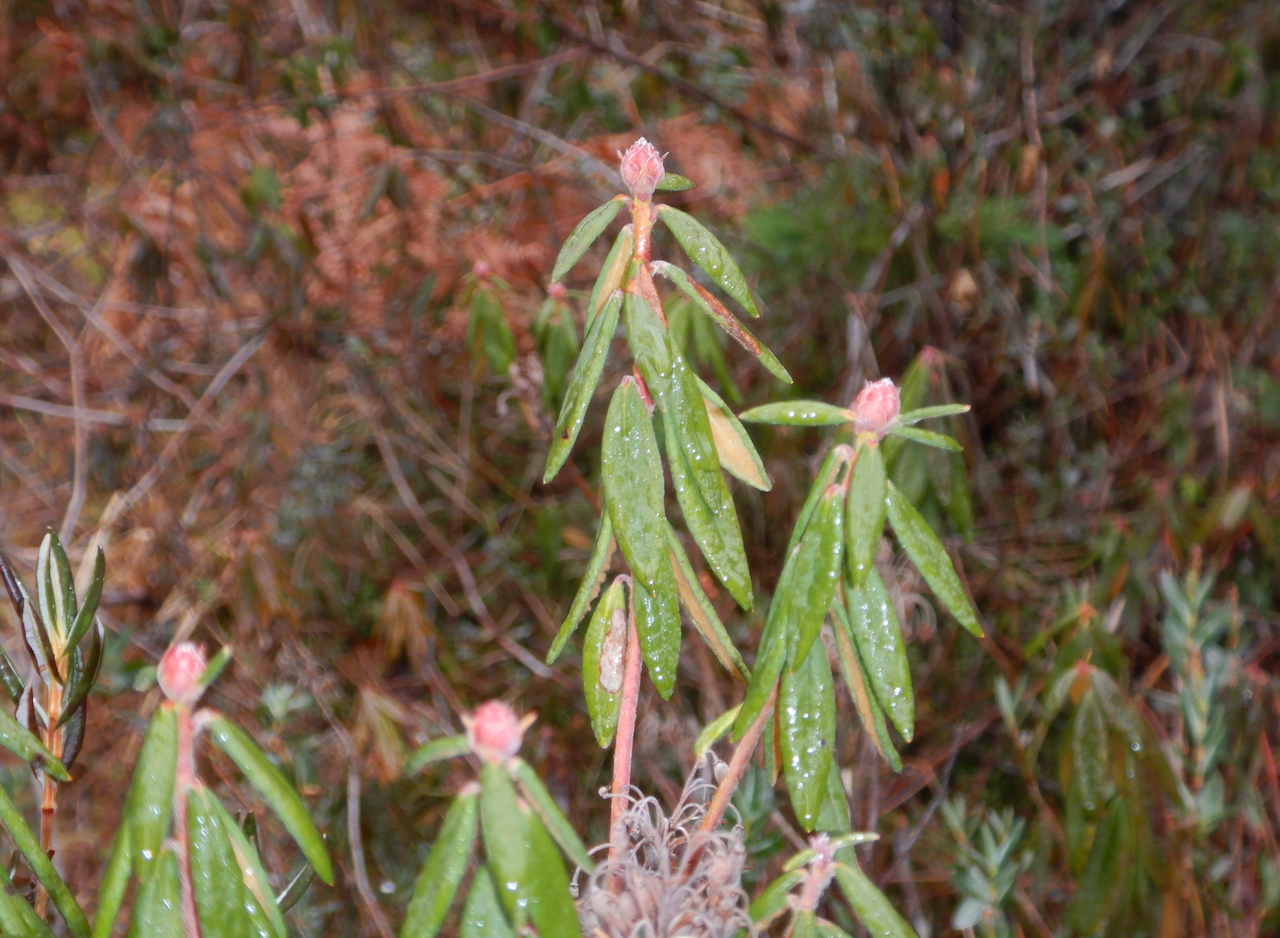
On February 11 we walked down the south side of the Puntledge River from the dam. Too early yet for the sweet gale (Myrica gale), though it is in bud. The evergreen Rhododendron groenlandicum (photo 1) and Kalmia microphylla both had buds, but the rhododendron leaves were still firmly pointing downwards in the cold – perhaps expecting the snow we have just received!

(1) Rhododendron groenlandicum

Of fungi there were quite a few of those you [the Botany Group] have already found in other locations (the little pink Scytinotus longinquus on dead alder seems to be everywhere!). Photo 2 shows the cut end of a dead conifer trunk with a little garden of fresh Dacrymyces chrysospermus (witch’s butter), plus old Trichaptum abietinum, its usual pink cap well covered in green algae and a couple of Fomitopsis mounceae.

(2) Dacrymyces chrysospermus, Trichaptum abietinum, and Fomitopsis mounceae

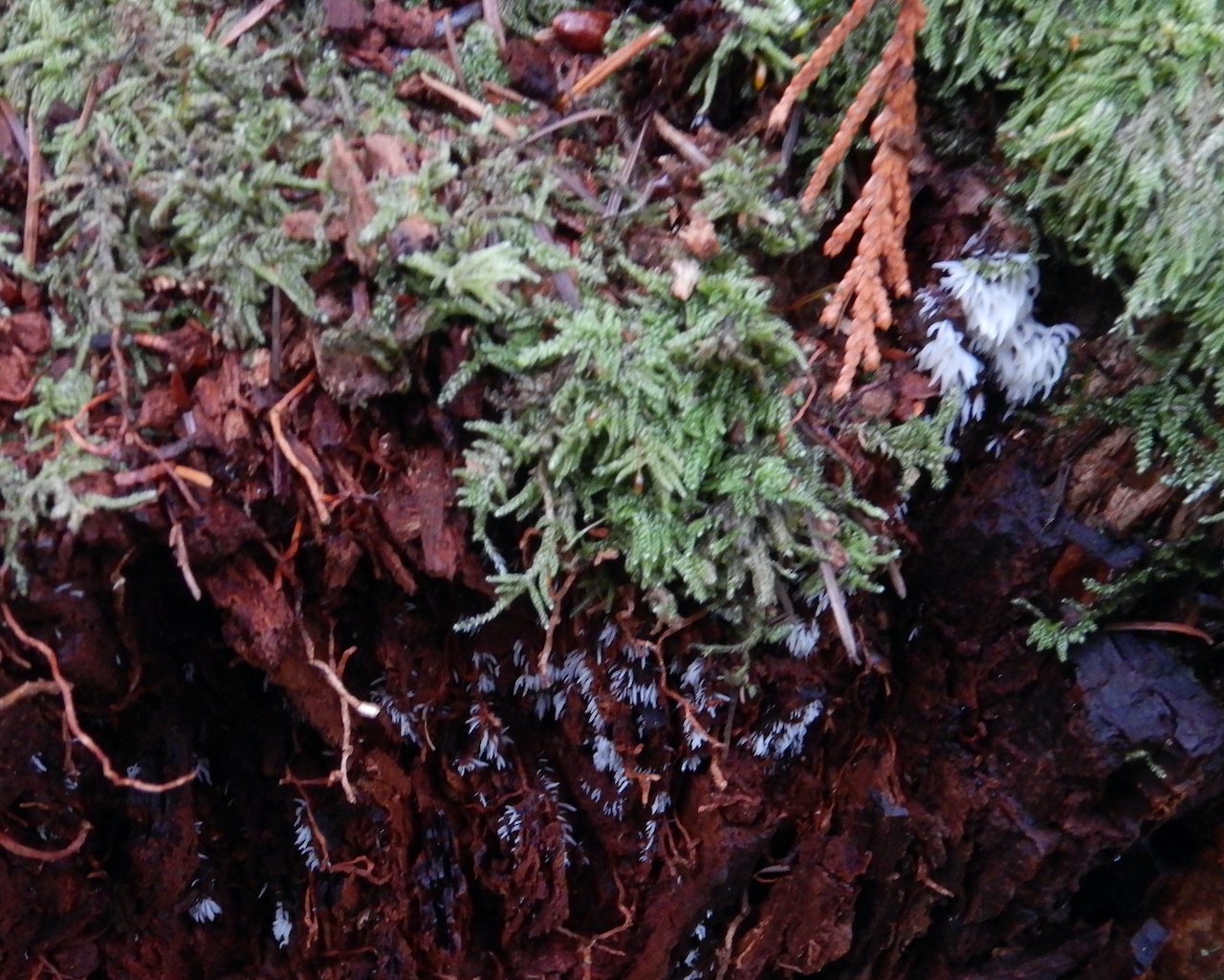
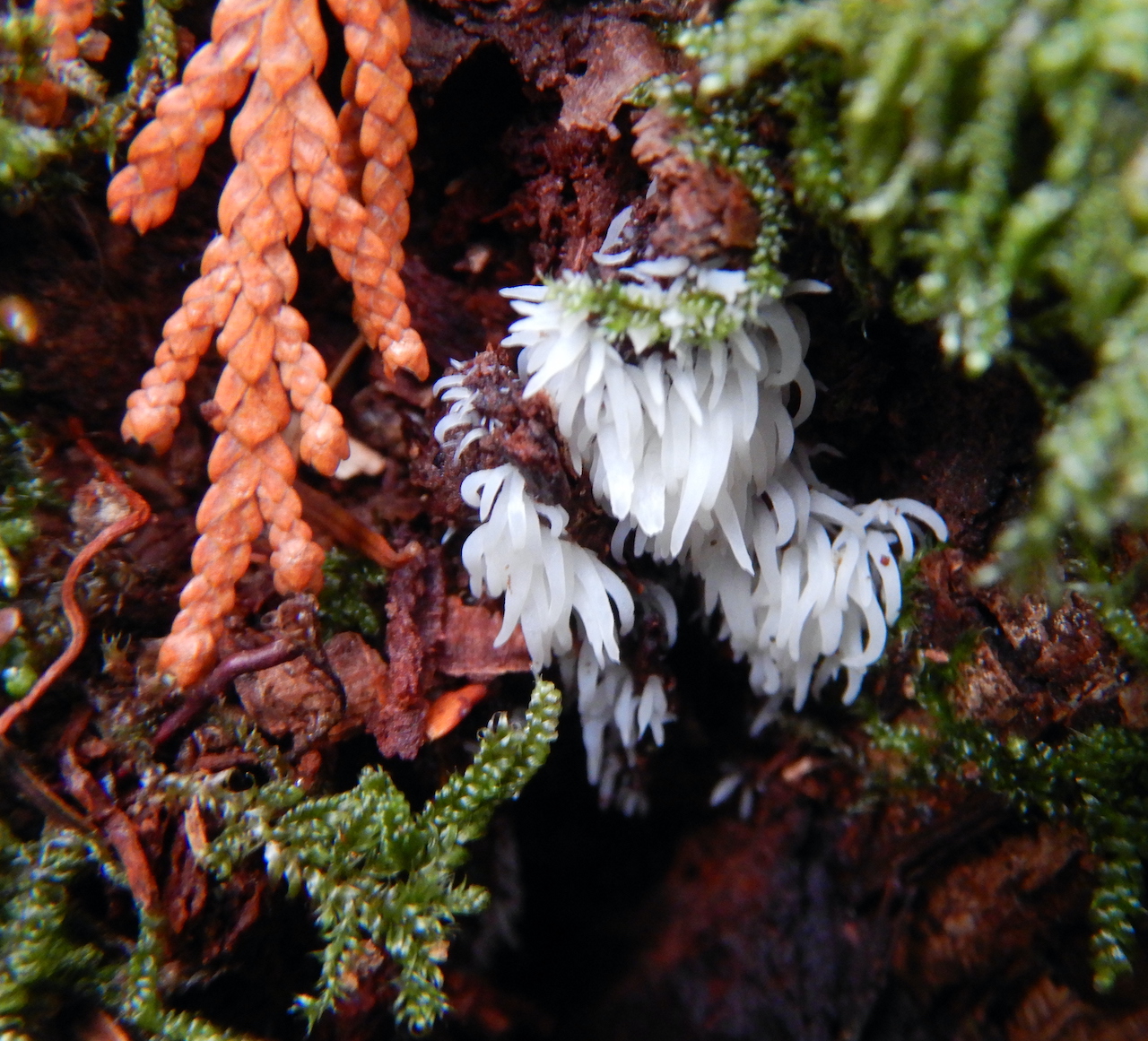
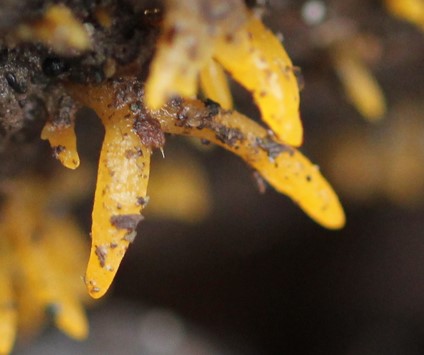
More unusual was the splendid example of Mucronella pendula (photos 3 & 4), sometimes called white icicle. The dead red cedar leaflet gives a sense of how small it is.

(3) Mucronella pendula
(4) Mucronella pendula

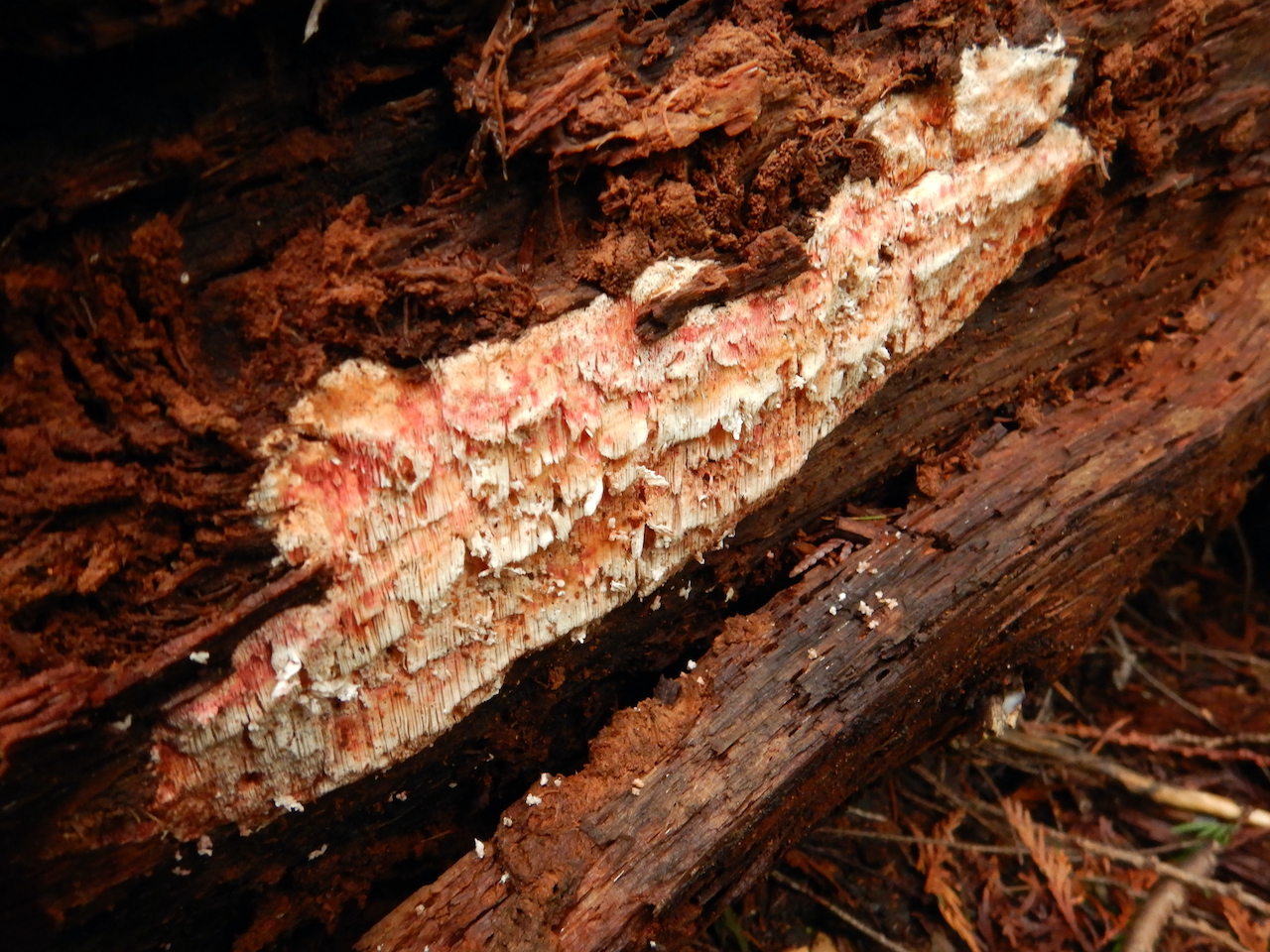
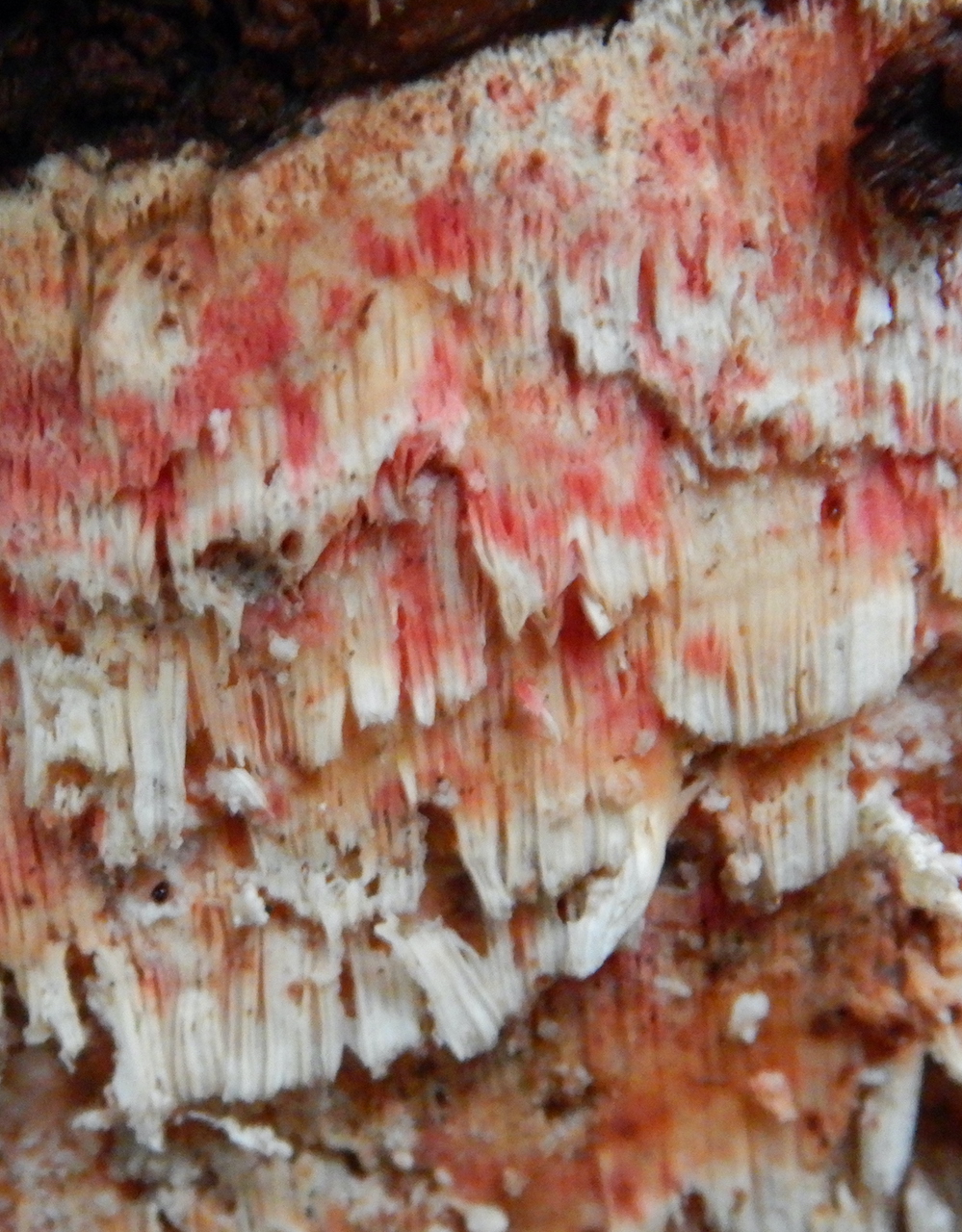
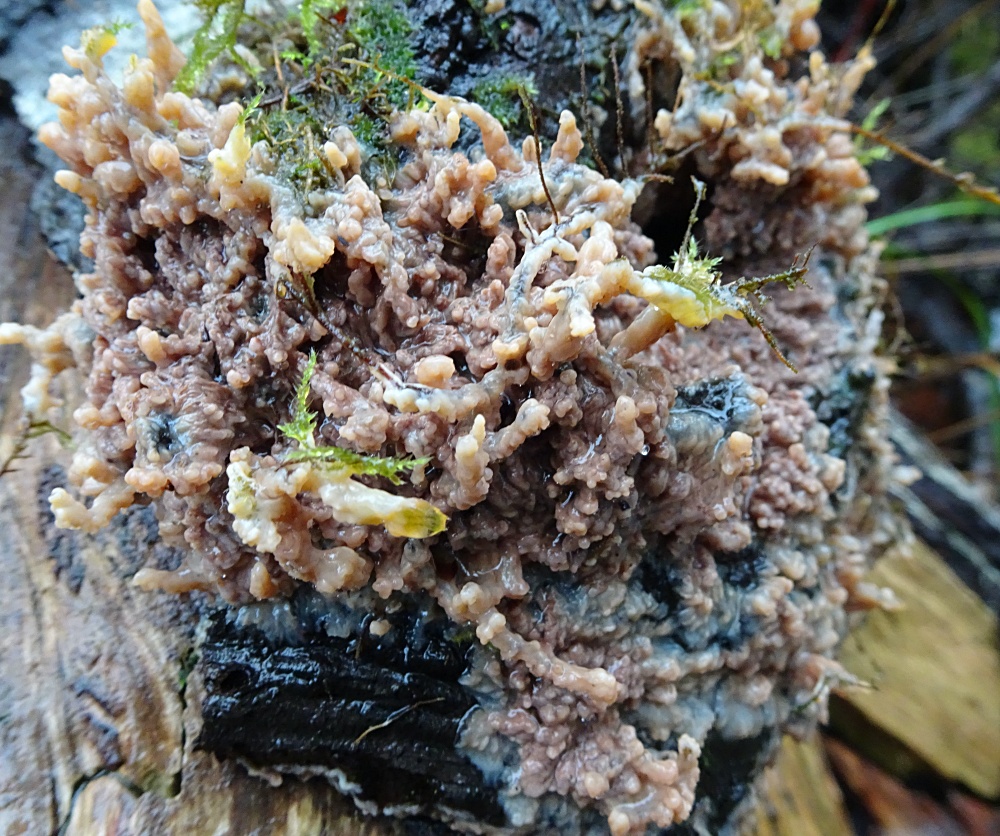
Along the side of another dead conifer we found a large specimen of not quite fully developed Pycnoporellus alboluteus, which is a spongy polypore and can look like a clump of stalactites when older (photos 5 and not well-focussed 6). This specimen had a fair amount of red – it is often more of a dingy orange and beige. It tends to be found underneath logs, in spring as the snow recedes.

(5) Pycnoporellus alboluteus
(6) Pycnoporellus alboluteus
Posted in Field Trips, Plants and fungi | Comments Off on Upper Puntledge botany and fungi notes

Botany walk at Roy Morrison Nature Park

From an email by Jocie to the Botany Group on February 19. Click a photo to enlarge it.

We had a good walk around Roy Morrison Nature Park on February 13, seeing many wonderful things. We focused mainly on winter fungi, but we took a look at a few mosses and other things. We even saw a wooly bear caterpillar!

We saw most of the fungi from my last posts “Winter fungi review, part 1” and “Winter fungi (and a slime mould), part 2” so I won’t repeat those here.

Here are a few highlights. Thanks to Véronique and Shirley for submitting photos.

  1. Botanists on a bridge!
  1. Western wild ginger (Asarum caudatum). The evergreen heart-shaped leaves are distinctive.
  1. Siberian miner’s lettuce (Claytonia sibirica). Lots of leaves showing in crevices at the base of trees.
  1. A lovely vase-shaped Clitocybe of some sort, growing on a decaying fallen tree (a cottonwood, we think).
  1. Orange jelly (Dacrymyces chrysospermus). Common on conifers.
  1. Artist conk (Ganoderma applanatum).
  1. Small staghorn (Calocera cornea).
  1. Plume moss (Dendroalsia abietina).
  1. Hanging moss (Antitrichia curtipendula).
  1. Magnificent moss (Plagiomnium venustum). On bigleaf maple trunks; multiple sporophytes.
  1. Banded wooly bear – larval form of Isabella tiger moth (Pyrrharctia isabella).
Posted in Field Trips, Insects and arachnids, Plants and fungi | Comments Off on Botany walk at Roy Morrison Nature Park

Learn about the strategy to address wrecked and abandoned vessels

Comox Valley Nature is pleased to host the following free online lecture:

Title: Update on the National Strategy to address Canada’s wrecked and abandoned vessels
Speaker: Donavan Jacobsen (Transport Canada)
Date: Sunday, March 19, 2023
Time: 7:00 p.m. PT

This webinar is facilitated by the Canadian Society of Environmental Biologists and is open to the public (see the registration link below).

The Government of Canada recognizes that wrecked and abandoned vessels can pose hazards to the environment, public health and safety, and local economies such as fishing and tourism industries.

Most owners are responsible and maintain and dispose of their vessels properly. However, the small percentage that are not responsible can create significant impacts on our coastal communities, with the burden for costly clean-up often falling on Canadian taxpayers.

In November 2016, the Government of Canada launched the $1.5 billion Oceans Protection Plan, to improve marine safety and responsible shipping, protect Canada’s marine environment and help advance Indigenous reconciliation.

A key element of the 2016 Oceans Protection Plan was the commitment to develop a National Strategy to address Canada’s wrecked and abandoned vessels. This comprehensive strategy focused on prevention and removal of problem vessels.

This webinar will outline the strategy and provide an update on progress, as well as provide information on ways the public can report vessels to responsible authorities.

About the speaker

Donavan Jacobsen has been a manager for Transport Canada for six years in the area of Environmental Policy. This includes managing the teams responsible for work in support of the Vessels of Concern file. Prior to working with Transport Canada, Donavan worked at Indigenous Services Canada in the areas of community infrastructure and economic development, and at Industry Canada on renewable energy industries.

Donavan has Master’s and Undergraduate degrees in Political Science with specializations in comparative politics and international relations.

Although Donavan technically works out of Ottawa, he proudly calls the Comox Valley home, having worked remotely here since 2020.

Registration

“Seating capacity” for the talk is limited, and you need to register in advance. You can check the computer requirements for attendees here.

Register here

After registering, you will receive a confirmation email with instructions for joining the webinar.

If you are new to Comox Valley Nature, find out more about us here.

Although CVN lectures are free, donations of any size from non-members who attend are always appreciated ($4.00 is suggested).
Posted in Guest Speakers, Shoreline and Marine | Comments Off on Learn about the strategy to address wrecked and abandoned vessels

Recording for talk on the Rights of Nature movement

Comox Valley Nature, facilitated by the Canadian Society of Environmental Biologists, recently presented the following webinar:

Title: What is the Rights of Nature Movement and How Might We Engage It?
Speakers: Kai Sanburn (Community Rights San Juan Islands) and Robin Reid (Colorado State University)
Date: Sunday, February 19, 2023

If you missed this event or would like to see it again, CSEB has made the recording available here. To access it you will need to provide your name and email address.

The speakers have also kindly made available (as a downloadable PDF) the list of references cited in the talk. They particularly recommend reading the paper by Garrett and Wood.

For more information about this talk, see the announcement in our earlier post.

Posted in Conservation and Restoration, Guest Speakers | Comments Off on Recording for talk on the Rights of Nature movement

AGM recording

On February 15, Comox Valley Nature conducted its Annual General Meeting for 2023 as a videoconference, enabled by the online meeting capabilities of the Canadian Society of Environmental Biologists. See the announcement in this earlier post.

If you missed the meeting, you can watch a recording which CSEB has made available here. To access it you will need to provide your name and email address.

Posted in General Meetings | Comments Off on AGM recording

Recording for talk on tidal marsh plant communities and goose grazing

Comox Valley Nature, facilitated by the Canadian Society of Environmental Biologists, recently presented the following webinar:

Title: Changes in Salish Sea tidal marsh plant communities, with or without grazing by Canada geese
Speaker: Stefanie Lane
Date: Sunday, February 12, 2023

If you missed this event or would like to see it again, CSEB has made the recording available here. To access it you will need to provide your name and email address.

For more information about this talk, see the announcement in our earlier post.

Posted in Ecology, Guest Speakers, Plants and fungi, Shoreline and Marine | Comments Off on Recording for talk on tidal marsh plant communities and goose grazing

Winter fungi (and a slime mould), part 2

From an email by Jocie to the Botany Group on February 4. Click a photo to enlarge it.

Here is “Part 2” of winter fungi. Some of these are a review of those that we saw on the January walk (so there’s a few photos you may have already seen). I thought I’d put them all together here for the benefit of those who have recently joined our group. 
Most of these photos are from Miracle Beach Park, and a few from the One-Spot trail. Again, thanks to Alison for some help with ID, especially of the Aleurodiscus. 

Mandy sent me this article a while back from the Guardian about things like fungi and slime mould that we tend to overlook in the drab winter months, which I think ties in well with the photos here.

  1. Marasmiellus candidusFairy parachutes. This pure-white fungus often grows in clusters on stems or branches. Growing here on thimbleberry canes. Has short, curved stipes (stalks) that are dark at the base.
  1. Marasmiellus candidus gills. Wide-spaced gills with radiating veins between. Stipes are dark at the base, but I didn’t cut it off low enough to see for this photo.
  1. Scytinotus longinquus also known as Panellus longinquus. Look for the pinkish colour and striate, viscid cap.
  1. Scytinotus longinquus gills. Note the pinkish colour.
  1. Phlebia radiata. “Wrinkled crust”.
  1. Phlebia radiata growing over and engulfing some moss on an alder log. This creates some neat texture!
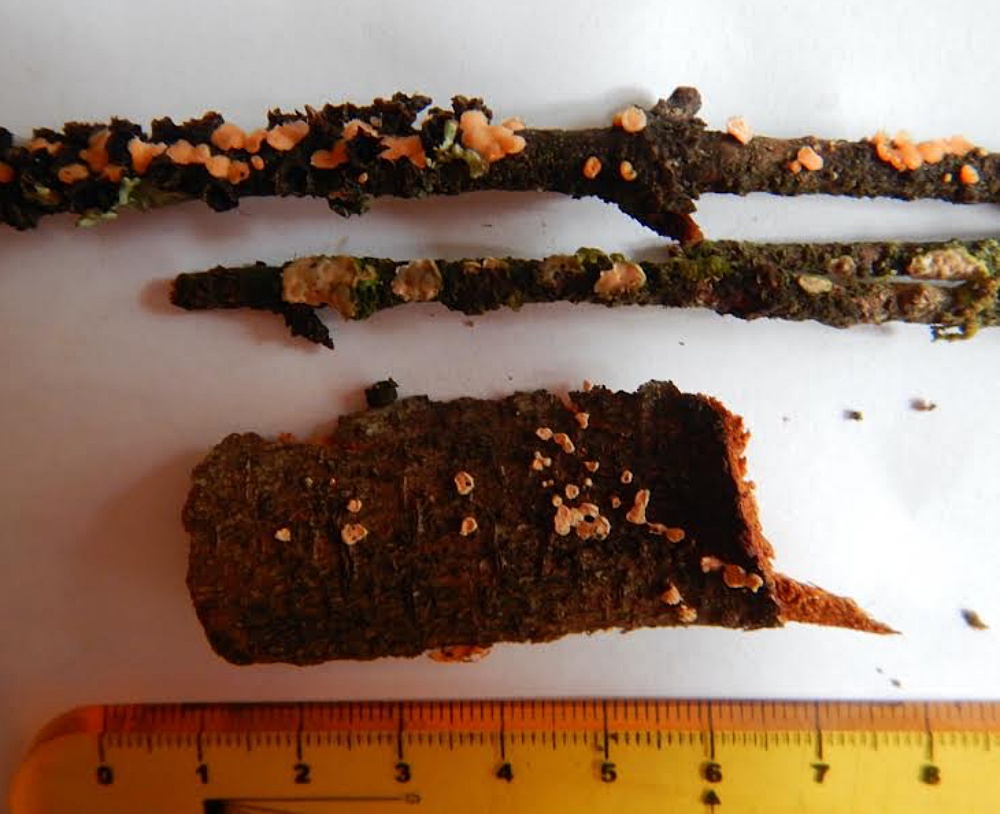
  1. Aleurodiscus grantii. This was the mystery crust fungus from our January walk on the One Spot trail. Thanks to Alison for getting to the bottom of the ID for us. Tiny, salmon-pink discs on conifer branches.
  1. Aleurodiscus grantiiAlison’s photo of some she found on her property along the Tsolum River.
  1. Microscope view of Aleurodiscus showing the white hairy edges of the discs. Photo: Loys Maingon.
  1. An orange slime mould on conifer bark. I don’t know which species…haven’t investigated yet. If anyone knows what it is let me know!
Posted in Plants and fungi | Comments Off on Winter fungi (and a slime mould), part 2