AGM – Hosted by Central Okanagan Naturalists – May 10 – 13, 2012. Details will be available in the Winter Magazine. Not to be missed – if Delta and Williams Lake (FGM/AGM respectively) are any indications of what to expect, Kelowna will be a “DO NOT MISS” event! The speakers will be fabulous and the outings, very informative! Mark this on your calendar and get your registration forms in early!
FGM – 2012 FGM is being co-hosted by Nanoose Naturalists and Arrowsmith Naturalists. Dates are September 27-30th, 2012. This event also should be circled as a no miss event. More info available in the Spring Magazine.
Club Deadlines
Club Grants from the Foundation – due into office by Jan 31, 2012
Deadline for resolutions for the AGM February 28, 2012
BC Nature Awards – nominations accepted up until February 28, 2012 – for both AGM & FGM
Rene Savenye Scholarship – Please apply by April 4, 2012
Camps & Bird Blitz’s Skagit Bird Blitz: May 4 through 6th – 2012 Saltspring Camp – June 4-8, 2012 Robson Bird Blitz – June 9 & 10, 2012 Manning Bird Blitz – June 15 – 17th, 2012 Lillooet Camp – Oct. 1-6th, 2012
Issue 18
Date November 2011
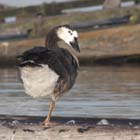
Hybrid Canada Goose
Are you Opposed to the Northern Pipeline and Tanker Traffic
BC Fossils presentation by Author
Interested in Fossils? This presentation is for you: Sidetracked: The Struggle for BC’s Fossils
December 6th, 7:00 pm at the Vancouver Public Library in the Alice Mackay room.
The accidental discovery of a huge dinosaur trackway in northeastern BC reveals far more than ancient footprints. Join writer Vivien Lougheed, author of Sidetracked: The Struggle for BC’s Fossils, as she takes us on a journey into the science, political intrigue and turf wars that characterize the world of paleontology. From the Rockies to BC’s coast, north to the Yukon border and beyond, Lougheed uses several beautiful slides to uncover the landscapes, personalities, politics and creatures behind some of BC’s most important fossil finds. And in the telling she argues for cooperation, not competition, in the quest to unravel our geological past.
Comox Valley Naturalists present…..
The CVNS has developed a nature guide of their neck in the woods and it is accessible via their website We thought this may interest you. If you plan to be the Comox/Courteney/Cumberland area, consulting this guide is a start to get more out of your visit. Funding for this project was through the “New Horizons” grant which unfortunately is now closed for next years grants. Keep this link in your favourites for applications for next year! Link
Register Now for IPCBC’s 2012 Forum – “Shutting Out Invaders”
The IPCBC (Invasive Plant Council of BC) is hosting its annual public forum on January 24th to 25th, 2012.
Date: January 24th & 25th, 2012
Workshop: January 26th, 2012
Theme: Prevention – Early Detection Rapid Response, and Changing Behavior
Venue: Delta Vancouver Airport Hotel, Richmond BC Call 1-888-WEEDSBC or (250) 392-1400 for more information. YOU ARE INVITED!
Government restores land reserve funding
Article – Vancouver Sun – By Randy Shore
The provincial government has restored funding to the Agricultural Land Commission and introduced new rules intended to relieve development pressure on B. C.’ s farm land. The Commission will implement a five- year moratorium on repeat applications to remove land from the Agricultural Land Reserve for development or industrial uses, Agriculture Minister Don Mcrae told a news conference. The commission fields 600 to 1,000 exclusion applications a year and sees applications to remove the same piece of land five or six times, something that he expects to slow with the new rules, he said. The belief of many real- estate developers that land can be removed from the ALR for urban development has flooded the commission with exclusion applications. “This puts a nail in that,” ALC chairman Richard Bullock said. “I hope people hear that message, and hear it loud and clear, and we can begin to build.” “We are sending a message to farmers and the population of British Columbia that we value the Agricultural Land Reserve and the ALC … and we have backed it up with action and with money,” said Mcrae. About 95 per cent of British Columbians support the ALR and its goals, he said. The province has also released a new model bylaw that municipalities can use to curb the spread of monster homes on agricultural land, a problem that Metro Vancouver had sought help with as early as 2009. After nearly 10 years of erosion, the ALC’S budget will increase by $ 600,000 for the balance of this fiscal year and $ 1 million in 2012- 13.
Humpback Whale – Listing of Special Concern”
Fisheries and Oceans Canada (DFO) is seeking your input on the potential listing of the Humpback Whale (North Pacific population) as “Special Concern” under the Species at Risk Act (SARA). Automatic prohibitions would not apply if listed as “Special Concern” under SARA. The Humpback Whale (Megaptera novaeangliae) is currently “Threatened” under the Species at Risk Act (SARA). This species has been recently re-assessed by the Committee on the Status of Endangered Wildlife in Canada (COSEWIC) as being of “Special Concern”. Current abundance estimates suggest that the population is recovering at an annual rate of increase ranging from 4.9 to 6.8 percent. Humpback Whales may be sighted throughout the year off the coast of British Columbia; however, the greatest numbers are found between May and October. Humpbacks enter temperate and polar waters to engage in feeding, foraging, resting and socializing. General threats to this species include vessel strikes, entanglement, toxic spills, prey reduction and acoustic disturbance. If you would like to know more about the Humpback Whale or would like to submit comments on its potential SARA listing as “Special Concern,” please go to: this link. We are seeking comments from November 10, 2011 to January 4, 2012. Your input is important and will be considered by the Minister of Environment, in consultation with the Minister of Fisheries and Oceans, in making a listing decision. If you have any questions, please call Kendra Hagerman at (604) 666-1331 or email email Species at Risk
Read all about the Cosmetice use of Pesticides and how you can assist in making this legislation happen. You are invited to participate in the consultation by completing an on-line questionnaire or by sending a written submission to the Committee. Following the consultation, the Committee will issue a report to the Legislative Assembly recommending possible changes to provincial laws concerning the use and sale of cosmetic pesticides. The deadline for submissions is Friday, December 16, 2011. Please review and submit your recommondations to this site
“Site C” – Funding Opportunies extended
The Site C hydro project will be assessed by a Joint Review Panel which has not yet been established. The public originally had 30 days to comment on the draft agreement between the Canadian Environmental Assessment Agency and the BC Environmental Assessment Office for the harmonized environmental assessment. That period ended on November 7, 2011, and it has not been extended. All comments received during the comment period will be considered. However:$140,000 Available for Public Participation – Deadline Extended The CEA Agency is making available $140,000 under its participant funding program to assist individuals and groups to participate in the environmental assessment process for this project. The deadline to submit a funding application has been extended and is now December 7, 2011. Funding applications received by the CEA Agency by this date will be considered.
To submit an application or to obtain additional information on the program, contact:
Participant Funding Program -Canadian Environmental Assessment Agency (CEAA)
Maurenia Lynds
160 Elgin Street, 22nd Floor
Ottawa ON K1A 0H3
Telephone: 1-866-582-1884 or 613-948-1761
Fax: 613-948-9172
Information on the Participant Funding Program, including a guide and the application form, is available at this site
It's that time of year! A couple of off leash dogs have been seen romping at the confluence of Morrison Creek and the Puntledge River. Dogs get quite excited to see those big chum. The chum do spawn right at the mouth of the creek, salmon eggs are very sensitive to disturbance so paws, or feet, in the creek kill eggs. Keep your dog on a leash, especially if you do not want a smelly dog! Dogs like to roll in dead fish. Salmon spook, be a quiet calm wildlife paparazzi. ...
Fish Walk!!! ( Well, not really...but don't miss this chance to follow their journey!)Join the Morrison Creek Streamkeepers for a walk along Morrison Creek, starting at its confluence with the Puntledge River in Puntledge Park, to watch salmon spawning after their remarkable journey back from the ocean. Register here: form.jotform.com/262924316992264...
Thanks to community support, a property in Deep Bay is now protected, safeguarding its mature forests, salmon streams and diverse shoreline.Now, we’re helping restore this land so it can regenerate into a healthy forest.Join the Comox Valley land Trust and WolfTree for a hands-on day to rehabilitate the former homestead by planting trees and shrubsIf you'd like to volunteer your time, the work party is Sunday, October 25th, from 10:00 am to 3:00 pm.Meet at Rosewall creek Provincial Park parking lot at 9:50 to carpool to the deep bay restoration site.See this link or link in bio to register and for more information: www.jotform.com/form/262826298698277...
Comox Valley Nature’s Wetlands restoration group has been working on the Courtenay Rotary Trail removing invasive plants.Removing invasive plants ensures that native plants can thrive. A vigorous native plant population also provides food for insects and birds.Join us in liberating native plants from invasive thugs such as ivy.We meet at the end of 21st street in Courtenay, where it meets the Courtenay Rotary Trail near Dogwood Park. You’ll find us there every Sunday starting Oct 18 to mid-Dec, mid-Jan to March 14, from 1:00 to 3:30 Bring gloves and water, dress for the weather and wear sturdy shoes.For more information contact ...
Many people fear trees, especially big trees, and old trees. Join us on this guided walk and overcome those fears. Verna Mumby (ISA certified arborist), will take us through the basics of tree bio-mechanics; how trees dance and move, how they withstand wind loads, and the importance of tree roots. Understand how trees help each other during storms and how they communicate. This walk will take place in Filberg Park, Comox, on October 17th, from 11 a.m. to 12:30.This walk is on flat ground, on grass and well maintained paths. Check the weather and choose appropriate outerwear. The workshop will be cancelled in the event of strongwinds and heavy rain.REGISTRATION required using the link in our bio, or visit cvnature.ca/events/This event is free. Donations welcome.For more information, to add your name to a waitlist or to cancel your reservation, mail: . Details re meeting place will be sent to registrants. ...

 It's that time of year! A couple of off leash dogs have been seen romping at the confluence of Morrison Creek and the Puntledge River. Dogs get quite excited to see those big chum. The chum do spawn right at the mouth of the creek, salmon eggs are very sensitive to disturbance so paws, or feet, in the creek kill eggs. Keep your dog on a leash, especially if you do not want a smelly dog! Dogs like to roll in dead fish. Salmon spook, be a quiet calm wildlife paparazzi.