AGM 2013 – Along the Fraser – Adapting to
Change Abbotsford-Mission Nature Club – May 2-5, 2013 – Details in Winter
Magazine and our website
April 27 – May 1, 2013 – Tofino Camp –
Registration details in Winter Magazine and our website
January 31, 2013 – Submission date close for Club
Support Grants for BC Naturalists Foundation Grants.
February 28, 2013 – Deadline for BC Nature Awards
nominations.
Skagit Valley Bird Blitz – May 10-12, 2013
Manning Park Bird Blitz – June 14-16,
2013
SEND A LETTER TO YOUR MP
BC Nature is not a political entity, but the second half of
our motto:” Know nature and keep it worth knowing” seems to be under threat.
Please respond according to your own conscience. This will be law Nov 1 unless
we speak up.
At the FGM this year (Parksville) – we were lucky to have
Elizabeth May as one of our guest speaker. Elizabeth alerted us to the fact that
she was busy trying to get a reading on a bill (Canada-China Investment
Treaty)which was quietly being pushed through by the Conservatives. The
following article was published in The Tyee and a similar article was written a few weeks ago in
the Globe & Mail.
It is an abomination that
this is being allowed to happen to us – as Canadians, British Columbians and
Naturalists. All for the greed of the oil, coal and any other natural resource
up for grabs!
We ask that you read the article in its entirety and to send
your comments to your local MP. Chairman Harper and the Chinese Sell-Out
– Who needs democracy? Secret treaty is a massive giveaway of Canadian resources
and rights with no vote in Parliament.
Link to the whole article
A follow up article to the side effects of
this type of treaty can be found here from a provincial point of view.
More Info can be
found at David Suzuki Foundation
Issue
26
Date
October 2012
The federal government’s refusal to follow our national endangered
species law, the Species at Risk Act.
Dozens
of Canada’s animals and plants – from humpback whales to woodland caribou – are
at risk. What’s one of the biggest things threatening them?
The federal
government’s refusal to follow our national endangered species law, the Species
at Risk Act. That’s why Ecojustice is taking major action to protect Canada’s
endangered wildlife. Read more link to website
Last week, Ecojustice
published a report that exposes huge problems with the way Canada’s species laws
are being enforced. And in September, we launched a lawsuit against the federal
government for failing to protect four at-risk species living along the proposed
Northern Gateway pipeline and shipping route.
But instead of taking action,
the federal government is now talking about changing the Species at Risk Act as
a way of avoiding its responsibility to fully implement it.
Don’t let
Canada’s endangered species disappear. Tell the federal government to live up to
its legal duty to implement and enforce Canada’s national endangered species
law, without weakening its requirements.
Sign the petition today. And then
share it with your friends and family. Because once Canada’s at-risk species
are gone, they’re gone for good.
On going Enbridge Information, articles,updates
Clark
meets Redford about Enbridge – Click here to read the article
The fine for the
pipeline disaster at Marshall, Michigan was only $3.7 million
PHMSA Issues
Final Order to Enbridge link to document or website
B.C.
Premier Christy Clark warns of national crisis over pipeline – Article
About Town – Upcoming Events
Saturday,
October 27 Mushroom Meander
Leader: Al Grass
Time: 10:00 amJoin Langley Field Naturalist for a Mushroom Meander at Campbell Valley
Regional Park – 10:00 am to 2:00 pm. Come join Al Grass as we will go in search
of the many different species of mushrooms that sprout up in the coastal forest
each Fall. Meet at 16th Ave parking lot. Bring a snack and refreshments. Dress
warm.
National Marine Conservation Area
You
can be a part of an important conservation effort happening right now in your
“ocean backyard.” If you love and appreciate the incredible rich ocean that
flows through the Gulf Islands in the Southern Strait of Georgia/Salish Sea,
please visit Take Action site to add your voice to those of many other
citizens, scientists, and conservation groups who wish to see this beautiful
marine ecosystem protected and sustainably managed for generations to come!What is a National Marine Conservation Area?
A National Marine
Conservation Area reserve is a type of marine protected area that is managed and
used in an ecologically sustainable manner to meet the needs of the present and
future generations. It has the same goals as a national park – conservation,
public understanding, appreciation, enjoyment – in addition to the goal of
sustainable use. A NMCA helps maintain healthy functioning ecosystems.
Activities such as commercial and recreational fishing, shipping,
transportation, tourism and recreation are allowed, but are managed in a
conservation-oriented manner. Traditional food, social and ceremonial harvesting
by First Nations peoples also continues in an NMCA reserve.
To read more
about the proposed National Marine Conservation Area reserve – see this project
update from Parks Canada or check out the info on this CPAWS webpage.
Interesting Sites and articles
Anne
Murrays Latest Article – link here.
Backyard Birdwatchers Wanted! –
Please see Bird Studies Site for more information on Project
Feeder watch.
Canada vastly extends Vancouver wetlands – Visit Here
Updates on “Jumbo Glacier Resort” –
Kootenays – link here
Chronic exposure to pesticides has a bigger
knock-on effect on bees than conventional probes suggest, according to a new
study on Sunday touching on the mysterious collapse of bee colonies. Pesticides
have knock-on effect for bees, study finds Link
Updates from BC EAO re VAFFC’s Vancouver
Airport Fuel Delivery Project Link
Draft Management Plan for the Sea Otter
Fisheries
and Oceans Canada (DFO) is pleased to inform you that the 2012 draft Management
Plan for the Sea Otter is now undergoing regional consultations. The Sea Otter
was re-assessed as a species of Special Concern by the Committee on the Status
of Endangered Wildlife in Canada (COSEWIC) in April, 2007..The Government of
Canada listed this species as Special Concern under the Species at Risk Act
(SARA) in March, 2009. In accordance with SARA, the Minister of Fisheries and
Oceans is responsible for developing a Management Plan for aquatic species
listed as Special Concern under SARA. To fulfill this obligation, DFO has
developed a draft Management Plan for this species. Management plans are
documents that describe species information, threats to the species, management
goals and objectives, and measures for the conservation of the species. Recent
population surveys (2008) indicate the Canadian Sea Otter population includes a
minimum of 4,110 animals along the west coast of Vancouver Island and 602
animals on the central B.C. coast. Sea Otters are considered a keystone species
exerting significant ecological effects on near shore marine communities and
upon the life history of their prey. The management objective for the Sea Otter
is to conserve abundance and distribution as observed in 2008, and promote the
continued population growth and expansion into formerly occupied regions such as
Haida Gwaii, Barkley Sound, and north mainland B.C. coast. More information on
the Sea Otter can be found at
http://www.dfo-mpo.gc.ca/species-especes/species-especes/seaotter-loutredemer-eng.htm.
Sea Otter. Photo credit: Margaret Butschler, Courtesy of the Vancouver Aquarium
Marine Science Centre. DFO would like to invite you to provide feedback on the
draft Management Plan via the Regional SARA Consultation – webpage where the document will be available for comment from
September 27th to October 29th, 2012. In doing so, interested parties may learn
more about the species, and provide input to DFO to aid in finalizing the
document. If you have any questions, please contact us at (604) 666-7907 or
email .
Survey Request – Bird Collisions with Buildings: A Willingness to
Pay Survey
This
survey will take only 10 minutes of your time. Please help out if you can.Eric Warren is a Master of Public Policy student at Simon Fraser University
in British Columbia, Canada. Under the supervision of Dr. Nancy Olewiler, his
thesis will examine the issue of bird collisions with commercial and residential
buildings and homes.
He has developed an online survey as one component of a
benefit-cost analysis of the bird collision issue. He is hoping that this
research can bring a new perspective to the problem, and help to enrich future
discourse. The goal of the survey is to determine the publics’ willingness to
pay to protect birds from collisions with residential structures. Questions
explore respondents’ experiences with bird collisions, attitudes towards birds
(ex: what about birds they value), and measure support for various potential
solutions to the problem. If you are willing, please consider doing the survey
yourself (will take about 10 minutes) and/or distribute the survey as you see
fit to colleagues, friends and family. It will be very important to capture a
wide cross-section of the public. Link: SFU
Websurvey
BirdLife International Launches Marine Conservation e-Atlas
The
e-Atlas of Marine Important Bird Areas was launched by BirdLife International
today at the Eleventh Conference of the Parties to the Convention on Biological
Diversity in Hyderabad, India. The e-Atlas covers 3000 Important Bird Areas
worldwide, and comprises the first global inventory of important sites for the
conservation of migratory marine species. It will be crucial to the process of
describing ecologically or biologically significant marine areas, and will have
significant input into the siting of offshore energy infrastructure. Learn more
on the BirdLife Community website.
Follow up on Boreal Woodland Caribou
Thank
you for helping us to send a strong message to the federal government that the
future of Canada’s caribou is important. Together, more than 32,045 voices were
heard!
The government has just released its final recovery strategy for
Boreal woodland caribou. It contains notable improvements over the draft
released last year. Many critical changes that we advocated for were
incorporated, which is great news. Unfortunately, the strategy still has
weaknesses. For one, we’re concerned that it sets the bar too low for caribou
habitat protection. This recovery strategy provides a good starting point for
restoring Boreal woodland caribou populations in Canada. We’re now looking to
the provinces and territories to create strong action plans for each caribou
range across the country. Once again, thank you for helping us to give Canada’s
Boreal woodland caribou a voice. Together, we can continue to ensure that our
country’s woodland caribou will stay healthy for generations to come. Yours in
conservation, Éric Hébert-Daly P.S. Without a strong federal Species at Risk
Act, this strategy wouldn’t have been drafted and Canada’s remaining caribou
would have been left to fend for themselves. There are rumours that the
government may make changes to the Act in coming months. If you’re concerned,
please take a moment to send a note to the environment minister to let him know
that a strong federal Species at Risk Act matters to you.
Big Change for Christmas Bird Count
19
October 2012 – The Christmas Bird Count has always been an integral part of the
holiday season for birders across North America, and its huge database is one of
the most important sources of information on the populations of birds on the
continent. The Count is a project of the National Audubon Society coordinated in
Canada by Bird Studies Canada. This year there is a big change coming to the
program’s funding structure. Christmas Bird Count coordination and data analysis
have long been funded by mandatory participation fees instituted by Audubon; for
the past 25 years or more, they’ve been set at $5 per participant. Audubon
announced this fall that they would no longer be collecting this fee, and Bird
Studies Canada will follow suit. While the elimination of the fees will be
welcomed by many, it does leave a big funding gap. Bird Studies Canada hopes
that much of this gap can be made up by voluntary donations, so if you enjoy the
Christmas Bird Count and appreciate the important role it plays in North
American bird conservation, please select this link to donate. Thank you for your continued support of
this critically important program!
India- Birding, Nature & Culture Tour – Advertisement
Join
naturalist Kelly Sekhon on his 9th India nature trip to visit some of India’s
best birding hot spots, renowned National Parks and famous historic sites. The
variety of bird & animal life and the cultural highlights that you see will
truly be amazing.
The Golden Triangle of Delhi, Agra & Jaipur- Feb 3-12,
followed by Kerala & South India from Feb 12- 25, 2013
Tour itinerary,
details and pictures on: Peak Adventures Site E-mail: email
us here or Phone us @ 604 526 9091 – Booking deadline: Nov 7, 2012
Comox Valley Nature’s Wetlands restoration group has been working on the Courtenay Rotary Trail removing invasive plants.Removing invasive plants ensures that native plants can thrive. A vigorous native plant population also provides food for insects and birds.Join us in liberating native plants from invasive thugs such as ivy.We meet at the end of 21st street in Courtenay, where it meets the Courtenay Rotary Trail near Dogwood Park. You’ll find us there every Sunday starting Oct 18 to mid-Dec, mid-Jan to March 14, from 1:00 to 3:30 Bring gloves and water, dress for the weather and wear sturdy shoes.For more information contact ...
Many people fear trees, especially big trees, and old trees. Join us on this guided walk and overcome those fears. Verna Mumby (ISA certified arborist), will take us through the basics of tree bio-mechanics; how trees dance and move, how they withstand wind loads, and the importance of tree roots. Understand how trees help each other during storms and how they communicate. This walk will take place in Filberg Park, Comox, on October 17th, from 11 a.m. to 12:30.This walk is on flat ground, on grass and well maintained paths. Check the weather and choose appropriate outerwear. The workshop will be cancelled in the event of strongwinds and heavy rain.REGISTRATION required using the link in our bio, or visit cvnature.ca/events/This event is free. Donations welcome.For more information, to add your name to a waitlist or to cancel your reservation, mail: . Details re meeting place will be sent to registrants. ...
Autumn is fast upon us, and the trees in the Comox Valley are beginning their transition into the winter season. CVN’s Comox Valley Trees team (formerly Trees of the Year) is inviting you to share how your favourite trees are changing with the season and preparing for the winter ahead. It could be a brilliant display of autumn foliage, a production of fruit, nuts or berries, or as a winter haven for wildlife. As the leaves fall, do they reveal an interesting or unique tree architecture, shape or silhouette? Perhaps you have discovered trees of interest in forgotten spaces or unusual or unexpected places, or trees with fungi or lichen.Send us the story of why you selected your tree of note. Include a brief description of the tree, a photograph, and the geographical location of the best viewing spot. Ideally the tree is in a public location to facilitate viewing.Please send your story to We will share your stories on our website and on CVN’s Facebook and Instagram pages.Also, be sure to check CVN’s Events calendar regularly for other Comox Valley Trees events such as knowledge walks.#treestories #comoxvalley#comoxvalleytrees #autumn...
Join Comox Valley Nature for a walk to celebrate Comox trees on Saturday, October 3, 2026. We will meet in the parking lot of the Comox Tennis Courts at 1:00 p.m. This 1.5 to 2 hour walk will be led by tree lovers Alora Griffin and Barbara Neilson. The number of participants is limited, and registration is required. RSVP on our events page at comoxvalleynaturalist.bc.ca/events/We will walk beneath the graceful boughs of some of Comox’s glorious trees, while enjoying their surroundings and the ambience they create for us. The trees selected will include examples of all the native trees now protected by the Town of Comox, as well as some exotic trees.We will discuss their biological features and historical significance as we amble along Brooklyn Creek and through Filberg Park and other parts of Comox. The path through Brooklyn Creek is uneven and there are stairs to climb. Bring your curiosity and questions as well as a water bottle and sun or rain protection, if needed. Please wear comfortable walking shoes. Children are welcome but please leave your furry friends at home, except for service dogs.This event is free, but donations are welcome. ...
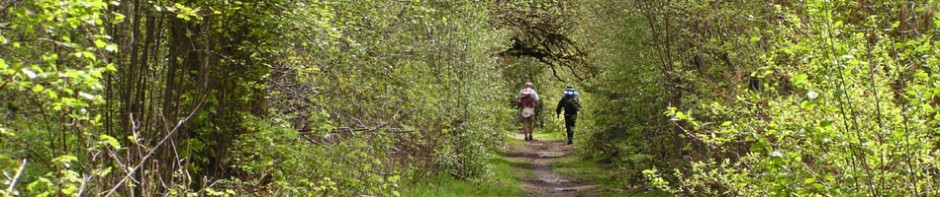
 Comox Valley Nature’s Wetlands restoration group has been working on the Courtenay Rotary Trail removing invasive plants.Removing invasive plants ensures that native plants can thrive. A vigorous native plant population also provides food for insects and birds.Join us in liberating native plants from invasive thugs such as ivy.We meet at the end of 21st street in Courtenay, where it meets the Courtenay Rotary Trail near Dogwood Park. You’ll find us there every Sunday starting Oct 18 to mid-Dec, mid-Jan to March 14, from 1:00 to 3:30 Bring gloves and water, dress for the weather and wear sturdy shoes.For more information contact