From an email by Jocie to the Botany Group on February 4. Click a photo to enlarge it.
The recent mild and wet winter weather has yielded some winter fungi (some of these aren’t exclusive to winter). Here are a few with notes (part 2 coming soon!). I’ve been back and forth with Alison M. on some of these…thanks to Alison for the ID of Plicatura nivea. All photos are from Miracle Beach Park, taken over the past few weeks.
- Plicatura nivea. This is fruiting abundantly right now, mostly on rotting red alder logs. At a glance it is a boring, ruffly white with bands of grey and beige, but sometimes there are bands of bright blue! It looks a bit similar to the blue cheese polypore (Postia caesia) but Alison notes that Postia is usually found in the fall. Also, Plicatura has a very wrinkly, convoluted underside, unlike the pores on the underside of Postia.

- Underside of Plicatura nivea.

- Crepidotus mollis. Hairy Crep, or “peeling oysterling” on iNaturalist. I found some nice examples of this growing on stems of ocean spray. Brownish and hairy on the cap and clean whitish gills beneath. No stem, attached directly to the branch like an oyster mushroom.

- Underside of Crepidotus mollis.
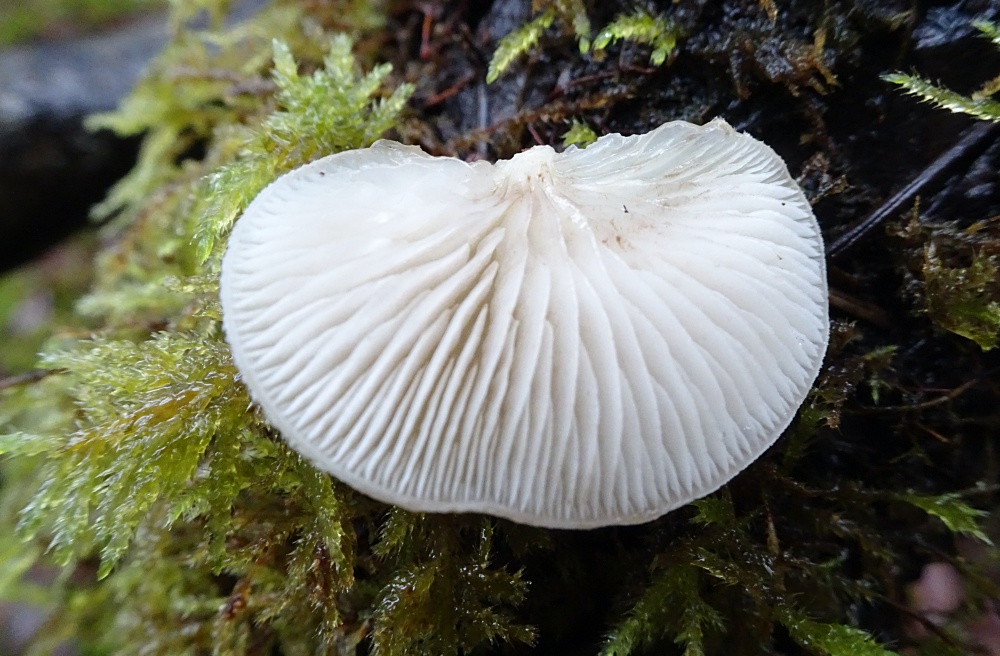
- Stereum. False turkey tail. These are common and abundant, usually shades of orange with banding on the cap. Smooth underneath and don’t have pores like the regular turkey tail. On hardwoods.

- Underside of Stereum.

- Stereum and Plicatura nivea are often found side by side on alder logs & stumps.

- Trametes versicolor. Turkey-tail. Note that the turkey tail has a light underside with tiny pores (you might need a hand lens to see them!). Cap is zoned with shades of brown, sometimes with a white leading edge.

- Underside of Trametes versicolor.