Article contributed by CVN member Véronique McIntyre.
Ah, this is so nice! Lying on my back, my tail and my pectoral fin lifted up above water, I am letting my body temperature reach the 36 degrees I love. No, I am not in distress, I am not sick, I am not injured, I am not trying to reach the shore. I am simply warming up. Or sometimes cooling down, if I just exerted myself swimming after some swift salmon.
I suppose I should introduce myself. I am a California sea lion, Zalophus californianus, a member of the Carnivora (= meat-eaters) order, the Pinnipeds (= flippered feet) suborder with my cousins the seals and the walruses, and the Otariidae (= eared seals) family.
Figure 1 is a picture that some people on the jetty at Air Force Beach took of me around mid-January, thinking at first I was a tree with branches sticking out which, frankly, is quite insulting.

Like you, I am a mammal, which means my body needs to be at a constant temperature (a bit below yours) to function. A few degrees off kills me. Trouble is, I live in cold water, and heat loss in water is much faster than in air of the same temperature (you would die here in less than forty-five minutes as your core heat would be drained off into the water and air through your skin). I solve this problem using thermoregulation, the fancy name that describes the adaptations I use to keep my body temperature constant in water that can drop to barely a few degrees above zero for months on end.
In the 24 millions of years that have passed since my ancestors (the same as for skunks, badgers, raccoons, weasels or maybe for bears) lived on land and very slowly took to living in water (fossils of flippered pinnipeds were found in layers 17 million years old), many adaptations to fight the cold and heat were selected. To give you an idea of how long 17 million years is, the common ancestor to humans and chimpanzees lived 7 million years ago. Think of all the changes that have occurred in that much shorter span of time.
The first adaptation we developed was size. We are usually big. No little mice-sized mammals living full-time in the water. Cuteness does not cut it here. We lose heat through our skin, and the smaller the surface compared to the volume of our heat-generating body, the less heat loss there is. Being bigger also means that our core takes much longer to cool down or to overheat, leaving us plenty of time to use our other adaptations to fight any drop or increase in temperature. Mammals that live full-time in the sea like whales are even bigger than us.
We are also very well insulated with a natural wetsuit: a 2 to 3 cm thick layer of blubber covered by a nice fur coat which oil glands waterproof, thus making sure that our skin sandwiched in-between stays dry even when we dive! Quite cozy, no?
Because blubber keeps us warm, we lose it in the summer and build it again each winter by doubling the number of fish we eat from 25 kg per day in the summer to 50 kg in the winter. I bet you think that blubber is a layer of fat. Wrong! Blubber is collagen and adipose tissue that can both insulate and keep us afloat. We tend not to use our layer of blubber for energy production, except if we are really starving, or during the breeding season as males don’t eat and rely on it.
Fur traps air against the skin and works like your clothes. It also traps humidity, so the skin stays dry. Humans could use hair to keep warm, but because you don’t have much, you only get goosebumps. We sea lions don’t have as much fur as seals, so we rely more than them on our blubber to stay warm. This is why our fur looks more like skin than theirs. Cetaceans, which include whales, dolphins and porpoises, completely rely on their blubber for cold protection and don’t have fur (although like all mammals they do have some hair).
The only parts of our bodies that are not covered with blubber or fur are our tail and flippers. Fur slows us down when swimming (your competitive swimmers shave before competing for that reason), and not having blubber allows us to swim faster since our flippers are lighter. Not to boast, but we sea lions are the fastest swimmers among all pinnipeds, with bursts at 40 km/h, although we usually cruise around at 18 km/h.[1] You swim usually around 3.5 km/h, even though some of your champions can reach 9 km/h, the same normal speed as seals or walruses. To be fair, seals can reach 30 km/h when motivated enough.
Our tail and flippers are highly vascularized, meaning lots of blood vessels run through them, very close to the skin. When I get cold, I simply float at the surface of the water and stick up one or both flippers in the air making sure the maximum surface faces the sun. The sun heats up my flipper, the blood vessels in the flipper dilate, the blood inside warms up, and that warm blood then reaches my veins and goes to my heart, and from there it is distributed to my organs. Measurements of our wet coats show that they absorb 92% of all types of shortwave radiation (which includes infrared, a.k.a. heat) making us very efficient at rapidly warming up by simply sunbathing.[2]
I can choose how much surface is exposed to the sun: holding one front flipper and one rear flipper in the air makes me look much like a shark with its caudal and dorsal fins above the surface; one front flipper and two rear flippers in the air gets me warm faster; if I really want to impress a crowd, I can float on my back with all four flippers in the air as well as my tail, sticking out my nose from time to time to get extra cheers. This, by the way, is how you can tell I am a sea lion: seals hold their flippers together, away from their body, resembling the handle of a jug or pitcher, hence the name of that seal posture: jughandling.
The problem with waving my flippers in cold air is that, as I said, our tail and flippers are not insulated from the cold water around us. On top of that, the flattened shape gives our flippers a very high surface area to volume ratio, which means they will shed heat to surrounding air or water at high speed. We could lose our body heat through them when we hold them in the water. Luckily, we have a marvelous adaptation that prevents that from happening.
At the level of our wrists the arteries that bring warm blood from the heart to the tip of our flippers are surrounded by up to six veins that are very close to the artery and bring blood back to the heart.[3] Thus, vessels transporting blood that moves in opposite directions are very close to each other. This allows heat to leave the arteries for the veins, thus bypassing the flipper. As a result, the blood that reaches our flippers is cold, and we don’t lose much or any of our precious core heat, keeping our brain and vital organs warm. Of course, cold flippers could mean frostbite in very cold water. Luckily, they consist mostly of bones, nerves, tendons and blood vessels. There is very little muscle there, and our skin is tough.

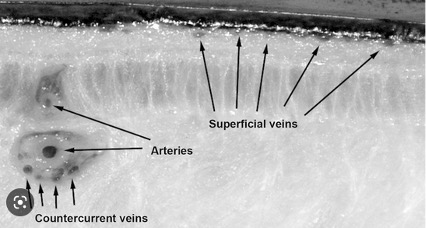
Of course, your scientists felt compelled to give fancy names to our anatomy, just so they can look clever. We did the work, they get the credit, as usual. The mess of arteries surrounded by up to six veins each is called a rete mirabile (= “wonderful network” in Latin), and the passage of heat (or ions etc.) from one vessel to another close one where blood flows in opposite direction is called a countercurrent system. The name given to the strategy in which an animal allows some parts of the body to cool down to preserve heat for the core is regional heterothermy.
You can see why I am so superior to you when it comes to living in cold water: you have almost no fat to insulate you; with your long limbs you have a very high surface-to-volume ratio, which results in high amounts of heat loss through all that skin; and you don’t have retia mirabilia where your limbs leave your core, which means that blood coming back from your limbs cools down blood from your core. In short, you are disasters in cold water.
Humans wondered if fighting heat loss, being a trait shared by all marine mammals, results from the action of genes that mutated in a terrestrial common ancestor or not.[5] By comparing the genomes of 11 cetaceans (= whales) and 6 pinnipeds (myself and my cousins) to that of the mouse they found that the gene SEMA3E (encoding semaphorin 3E) is essential to form the retia mirabilia and the heat exchange countercurrent system I am so proud of (it saves my life…).
Compared to the same gene in mice they noticed similar (but not identical) mutations at the same spot in cetaceans and pinnipeds. Thus, the evolutionary pressure resulting from trying to adapt to life in the ocean led to the independent formation of similar retia mirabilia in both groups. This is called convergent evolution, i.e., the emergence of similar traits in different groups as an answer to the same evolutionary pressure. But not identical traits, because it did not show up in a common ancestor–it appeared after our lineages had split from each other.
Those scientists suggest that mutations in four marine mammals’ genes that also exist unchanged in terrestrial mammals indicate that “the thermostatic strategy of marine mammals shifted from enhancing heat production to limiting heat loss”. This makes complete sense when you remember that heat is lost 1.5 to 4.5 times faster in water than in air, because water has 25 times greater thermal conductivity.[6]
So, if you see me lazily floating on the surface of the ocean, don’t call DFO nor MARS. If you really want to help me, please refrain from using motorized craft, as the resulting pollution makes me sick. Also, please recycle your plastic items at home, don’t leave them on the beach where they get blown into the sea and poison me or block my digestive tract, which would kill me quite painfully.
References
- Laurie J. Gage and Vaughan A. Langman (2008). “Thermoregulation in California Sea Lions.” IAAAM 2008. International Association for Aquatic Animal Medicine.
- “Figure: Countercurrent heat exchange mechanism in the flipper of porpoise“. As reproduced on the ResearchGate website.
You might also want to look at “Seal flipper heat exchange, illustration” on the Science Photo Library website.
- Paul J. Ponganis (2015). “Adaptations in cardiovascular anatomy and hemodynamics.“ Diving Physiology of Marine Mammals and Seabirds, Chapter 6, pp. 118–132. Cambridge University Press.
- Yuan Yuan, Yaolei Zhang et al. (2021). “Comparative genomics provides insights into the aquatic adaptations of mammals.” PNAS 118 (37) e2106080118.
- Allyson G. Hindle, Markus Horning and Jo-Ann E. Mellish (2015). “Estimating total body heat dissipation in air and water from skin surface heat flux telemetry in Weddell seals.” Animal Biotelemetry 3, Article 50.