From an email by Jocie to the Botany/Mycology Group on November 22. Click a photo to enlarge it.
Here are a few examples of colourful purple-tinged fungi recently seen:
Thanks to Ann B. for sending in this photo of a blewit (Lepista nuda) with the following note: “This photo was taken a couple of days ago under the lilac bushes along my driveway on Fraser Rd. Blewits were one of the first mushrooms that Dulcie Hamilton identified for me some 50 years ago when I lived next to her on the Back Road.” (Dulcie was a long-time member of CVN and the botany group.)
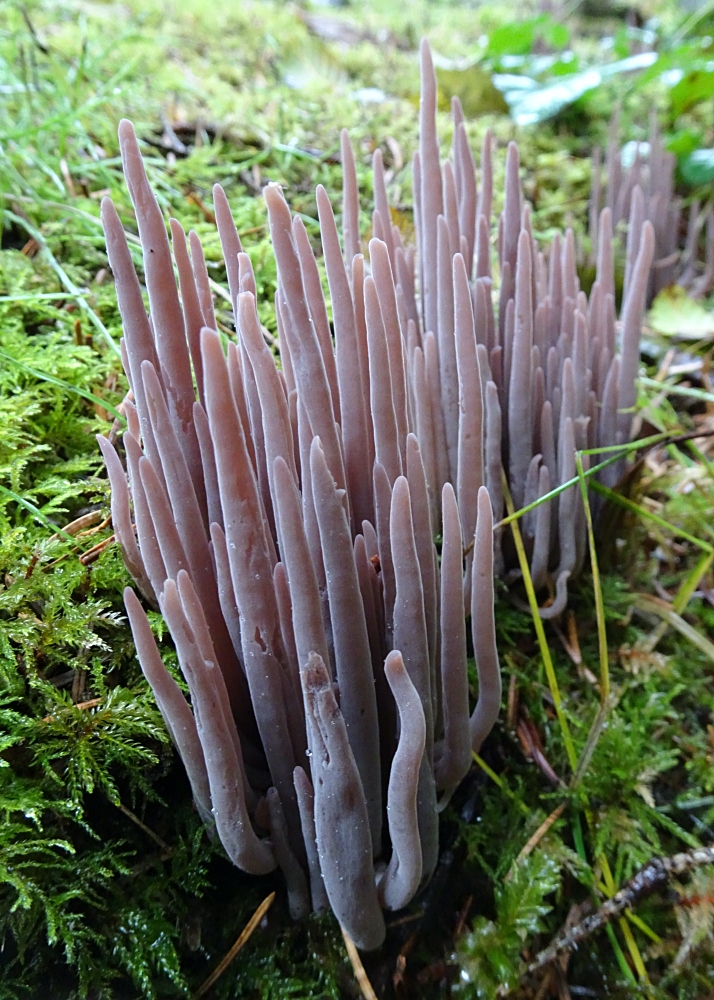
and 3. Purple spindles (Alloclavaria purpurea) from the edge of a mossy ditch in the upper campsites of Miracle Beach Park.
Amethyst laccaria (Laccaria amethysteo-occidentalis) also from the campsites of Miracle Beach Park. Gills have a lovely lilac-tone.
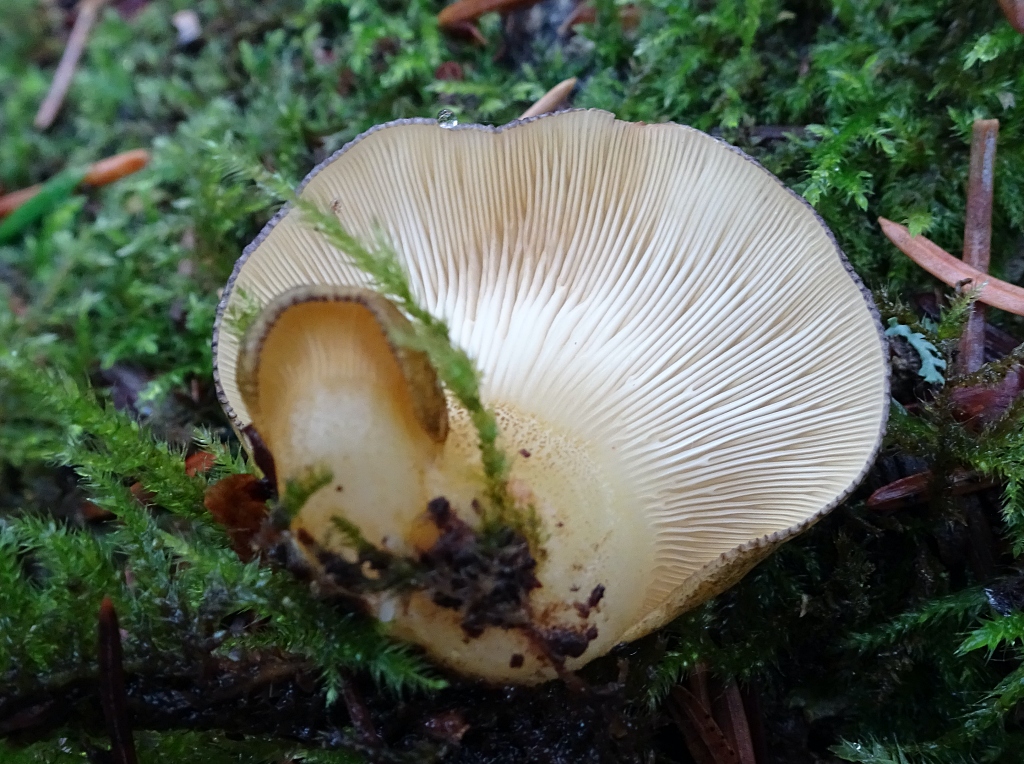
Late oyster/green oyster (Sarcomyxa serotina). This later season shroom has shades of grey/green and purple.
Gills of the late oyster, a creamy pale orange colour.
In the latest in our occasional series of long-form articles, Véronique McIntyre dug deep into the life histories and origins of the herbaceous members of the dogwood genus (Cornus) to find some lessons in anatomy, ecology and evolution. Learn all about the lives and history of the Alaskan bunchberry and just plain bunchberry in her article: “Some call us pop flowers, others, bunchberries.”
You can always find this and other long-form articles via the Articles category in the sidebar.
Notes and photos from Alison M., distributed to the Botany/Mycology Group on November 18. Click a photo to enlarge it.
Until a couple of days ago I had given up on there being anything of interest in our woodlands here on Tsolum River Road. The drought conditions that have persisted now for three summers are taking their toll. Fungi appear to be resilient to a degree, but there is clearly a limit. We have not seen chanterelles here for a couple of years now, but just today I finally found a couple. We were also delighted to find a western cauliflower fungus – an excellent edible. However, good specimens are few.
The photos start with some of the more intriguing fungi to be seen at this time of year.
and 2. Auriscalpium vulgareor ear-pick, which falls into the tooth or spine category morphologically. It appears only on Douglas-fir cones. Being tiny and with a cap colour that mimics the colour of the cone (as well as the surrounding dark browns) it tends to be hard to detect, but this fall we have found quite a few. (I placed the cone on a cottonwood leaf for contrast.)
(1) Auriscalpium vulgare
(2) Auriscalpium vulgare
and 4. Pseudohydnum gelatinosum or cat’s tongue or spirit gummy bear, which with its tiny spines falls into the same category as the Auriscalpium, but note that in texture it is gelatinous.
(3) Pseudohydnum gelatinosum
(4) Pseudohydnum gelatinosum
Xylaria hypoxylon or carbon antlers is a club or spindle type of fungus, growing amid moss on dead stumps. In the photo the black stipe shows white asexual spores, the sexually viable spores are on the black section.
(5) Xylaria hypoxylon
and 7. and 8. Sparassis radicata or western cauliflower fungus, an uncommon species, which usually appears at the base of old fir stumps, in this case what would have been a first-growth tree removed when the area was logged in the 1920s. The fungus last produced a fruiting body on the stump 5 or 6 years ago. It is usually classed with the coral-type fungi and is a choice edible, though it requires a longer cooking time than some fungi.
(6) Sparassis radicata
(7) Douglas-fir stump
(8) Sparassis radicata in the kitchen
Xercomellus zelleri ( formerly Boletus zelleri) or Zeller’s bolete – one of the later bolete types to appear, with a very distinctive dark cap above the yellow sponge and red/white stipe.
(9) Xercomellus zelleri
The rest are gilled fungi.
Lactarius substriatus (formerly Lactarius subflammeus) – no common name – is abundant in our woodland in the later fall and stands out against the green of the various mosses on the ground. It is smaller than most species of Lactarius, has white latex that is unchanging and is bitter to taste, therefore not edible.
(10) Lactarius substriatus
Hygrocybe coccineaor red waxy cap is also striking on a grey November day, far brighter than any of the fallen leaves.
(11) Hygrocybe coccinea
Russula brevipesor short-stemmed russula. This common russula is only now beginning to push through the duff in profusion though none of the examples I have seen have reached the size of dinner plates, as in some years. (This is the species that becomes the “lobster mushroom” when parasitized by Hypomyces lactiflorum.)
(12) Russula brevipes
Pseudosperma sororium (formerly Inocybe sororia) or corn-silk fibrehead. The Inocybe genus is recognizable by the conical shape and the radiating fibrils that split apart as the mushroom ages. Quite a few of the species have been assigned to new genera, including Inosperma, and this common one is now Pseudosperma. This example is one of those that can smell like green corn when young.
(13) Pseudosperma sororium
Mycena haematopus or bleeding mycena. There are hundreds of tiny mycenas decorating the forest floor at the moment with their diminutive conical caps, but many of them are very hard to identify. This one however is easy – break the stipe and it oozes red droplets – hence the name.
(14) Mycena haematopus
Posted inPlants and fungi|Comments Off on Later fall fungi in the Comox Valley
From an email by Jocie to the Botany/Mycology Group on November 16. Click a photo to enlarge it.
One of the highlights from our fungi trip to Paradise Meadows on October 20 was the handsome Admirable bolete (Aureoboletus mirabilis). The red, velvety gills of Cortinarius smithii were also spectacular!
You can download the full list of species seen. If you notice any errors or names that aren’t up to date let me know.
If you’ve ever wondered about the dwarf mistletoe that you can see parasitizing coniferous trees in our forests, you can find out all about it in the latest addition to our occasional series of long-form articles, as Véronique McIntyre listens in on a conversation between a mistletoe and its host, a fallen hemlock branch: A Dwarf Mistletoe’s Story.
Learn about the adaptations that let this flowering plant succeed as a parasite. And you might be surprised to realize that, beyond its deleterious effects on the host, it has a potential ecological benefit.
You can always find this and other long-form articles via the Articles category in the sidebar.