Hey Everyone,


We had 19 members and a little assistant show up at the very tip of the Comox peninsula. Some observations, follow ups and a species list can be found below.
A sluggish leopard

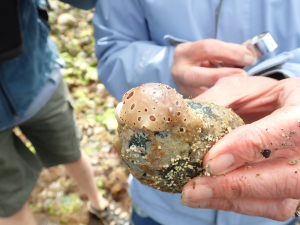
The spotted leopard dorid, Dialula odonoghuei was found affixed to the underside of a cobble. This distinctive nudibranch feeds on the sponges that encrust rocks in the middle-to-lower intertidal. How? Nudibranchs like their brethren the chitons and the gastropods have a specialized apparatus, the radula that can be used to rasp and file at their prey. In places, we saw extensive mats of a reddish-range encrusting sponge. The nudibranchs, chitons and snails are the ones hoovering up the algae and sponges that typically encrust these rocks. How can anyone determine what exactly is being eaten by the spotted leopard dorid? Patient observation by SCUBA-equipped biologists is one option, but another is to collect their fecal pellets and look at the collection of spicules, frustules, tests and the like to determine diet. This has been done for a southern relative of our local species, but never for Dialula odonoghuei. Any takers?
Chitons lined & mossy grazing with a furor that is insistent and bossy

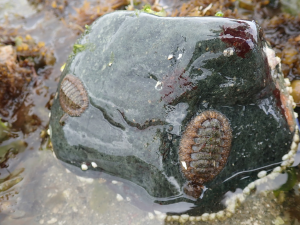
There were a number of different chitons out along the shore. A number of them were members of the genus Mopalia, the mossy chitons, which has a fleshy girdle that encases a large portion of the mineralized valves or plates that are the distinguishing feature of the order Polyplacophora (many-plate-bearer). In Mopalia, the fleshy girdle, in addition to being extensive, is ornamented with large hairs and other odd bumps and spines. Locally, there are a number of species within this genus which vary from very hairy (Mopalia muscosa, the mossy chiton) to just vaguely so (Mopalia hindsii, Hinds’ chiton). Like most chitons, these species are deathly afraid of exposure in the light, thus their daytime hiding spots under the rocks. At night, they come out to graze. Tom Carefoot has put together a wonderful summary of research on the feeding behaviour of the genus Mopalia in our region. I pasted above a pie chart taken from his website (in-turn repurposed from a paper from the 1960s) that shows the gut contents on the Mossy Chiton, Mopalia muscosa.

We saw a lovely juvenile lined chiton of the Genus Tonicella. This genus diverse in our area, but easy to recognize by its dramatic, bright colors and linear patterns. We saw an example of one of these small juvenile chiton rolling up such that its vulnerable undersides were abutting one another, with the plated surrounding the entire enrolled individual. This is presumably a protective response. The main predators of chitons in the intertidal are purple sea stars (Pisaster ochreus) and a potpouri or birds, fishes and otters. Hard to imagine this defense being of any help to the smaller individuals, though the birds might appreciate the more streamlined bolus it provides.
Northern Kelp Crab Fashion

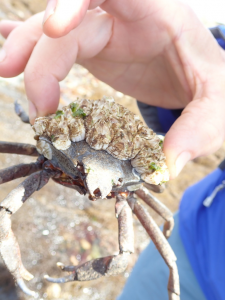
Group member Barbara could not help but marvel over the giant living kelp crab that had a significant population of living barnacles on its carapace. So symmetrical was the arrangement that it could be mistaken for a thicket of regal hair. This kelp crab, Pugettia producta, is part of a grouping of crabs that includes a bunch of species known as “decorator crabs”. These crabs have a veritable menagerie of algae and invertebrates affixed to their carapace as a means of camouflage for themselves. The kelp crab is not known to decorate itself, but perhaps tolerates this kind of taxing load for the same reasons.
A good online guide to local-ish species
Kathleen was trying to make sense of some seaweeds and asked that this Central Coast Biodiversity website be sent out. The guide is good and visual and pretty comprehensive if not entirely specific to the central island. It makes a good reference Start with the species guide if you are trying to figure out the identification or something. You can usually follow it through and learn a little about the biology, ecology and distribution.
Species List
As mentioned, observations are now being kept in iNaturalist. You can see pictures and IDs (at varying levels of confidence and resolution) here. I am also pasting a species list below, though I was not able to keep track of everything yesterday on account of so much being seen and so many people seeing it. If you have additions, corrections or deletions from the list, let me know.
|
Sarcodiotheca gaudichaudii
|
|
Homaxinella amphispicula
|
|
Ophlitaspongia pennata
|
|
Eupentacta quinquesemita
|
|
Dermasterias imbricata
|
|
Anthopleura elegantissima
|
|
Petrolisthes eriomerus
|
|
Lophopanopeus bellus
|
|
Pagarus grainosimanus
|
|
Hemigrapsus oregonensis
|
|
Oligocottus maculosus
|
|
Gobiesox maeandricus
|
|
Anoplarchus purpurescens
|
|
Ambrosia chamissonis
|
See you soon,
Randal