The coal hills walk at Union Bay drew about 45 people of all ages on a beautiful sunny Saturday morning. We had the good fortune of being joined by Juanita and her children who was able to provide us with insights into the heritage value of the site.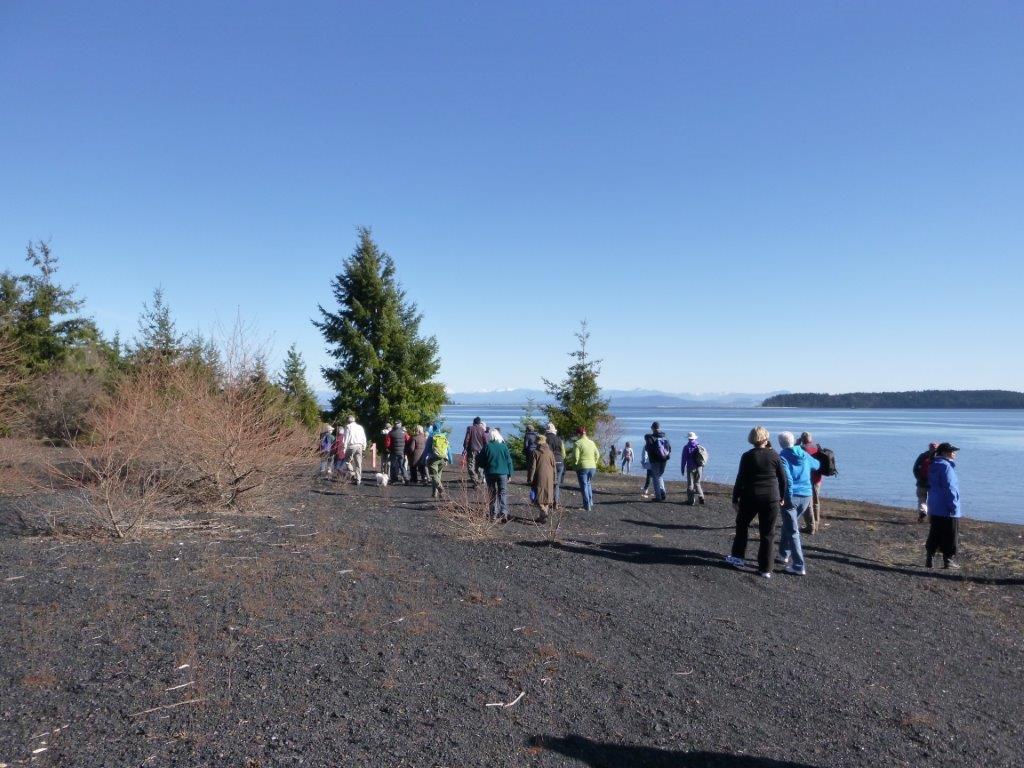
Unbeknownst to us Union Bay has been extremely pro-active in conserving its environmental history and heritage. It has not only worked to preserve not only its historic buildings, such as the Post Office, but it has also designated certain trees, such as the big Broad-leaved maple along the highway as a protected tree with heritage significance. It is near the site of one of the old hotel and was known as the place where lovers crooned!
We also had the good luck of being joined by two geologists with mining experience. In particular, Bob Hauser, who has just filed to join CVN, was able to explain the function of the remaining structures, and from a lump of processed coal that we found, gave us a good technical explanation on the production of coke.
We also were able to observe what plants have been able to colonize this extremely acid metallic site and the role that invasives play in the revegetation of Coal Hills. As usual, the estuary of Heart/Washer Creek, showed the long-term changes that the coal operation has brought to the region, with some observations on this impact on Baynes Sound.
As usual the bay was California sea-lions, abounded in the estuary together with scoters, and hundreds of mallards. A dozen killdeer also seemed to be readying to nest on the south side, and an ever-present pair of Anna’s hummingbirds were observed.
Finally, Ernie Stefanik had the good sense to bring a map of the historic lay-out of the site. Click here for a pdf of the map.