The Clayoquot River Valley, 1995 Slide Show

The regular monthly meeting of the Comox Valley Naturalists Society will be held January 16, 2011 at 7:00 pm at the Florence Filberg Centre, 411 Anderton Avenue, Courtenay. The speaker will be local environmentalist Wendy Kotilla, and consists of slides from her 1995 fisheries study of the entire length of the Clayoquot River.

Wendy Kotilla has been involved with wild Pacific salmon for over forty years through commercial fishing, salmon enhancement, fisheries research and ecological restoration.  Fisheries work has taken her to many areas of the coast including Skeena River, Queen Charlotte Islands, Tsitka River, Clayoquot River and Carnation Creek Experimental Watershed Project.  Currently, Wendy coordinates the Youth and Ecological Restoration Program in the Comox Valley to educate young people about the natural world.

In 1993, over 850 people were arrested in Clayoquot Sound to stop clear-cut logging. Clayoquot Biosphere Project began baseline data collection in the pristine Clayoquot River valley and built a cabin at Clayoquot Lake to be used as a base camp.  In 1995, Wendy initiated assessment of longitudinal distribution of fish communities in the Clayoquot River, walking most of its length to conduct the field work.  Her presentation highlights the fisheries research she was involved with during that time and contains “never before seen” slides.  Clayoquot River valley remains unlogged to this day.

Please come and join us to become better informed, and to learn how you can help CVNS provide education and protection for B.C.’s natural environment. A donation of .00 is suggested for non-members, and new memberships are always welcome.

Posted in Guest Speakers | Tagged , , , , | Comments Off on The Clayoquot River Valley, 1995 Slide Show

Protecting Vancouver Island’s Ancient Forests

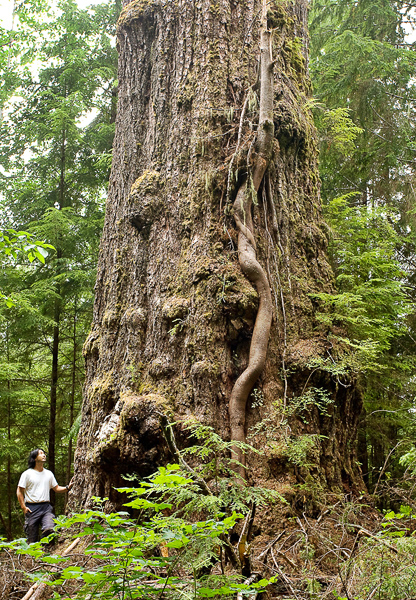
On Wednesday, December 8th the Comox Valley Naturalists are hosting a slideshow by Ken Wu and TJ Watt of the Ancient Forest Alliance (AFA) to raise awareness of  the need to protect BCs endangered old growth forests. The AFA is calling on the BC government to inventory BC’s ancient forests and protect them where they are scarce, to ban raw log exports to foreign mills, and to ensure the establishment of a sustainable second-growth forest industry in BC.

The 40-minute Power Point presentation will highlight the current status of Vancouver Island’s forests and what citizens can do to protect old-growth forests, watersheds, and related ecosystems. The presentation includes Watt’s superb photos of some of the most magnificent forests in the country, including Clayoquot Sound, the Walbran Valley, Red Creek Fir, and Avatar Grove.

“Our diminishing old-growth forests are important for wildlife, tourism, the climate, water quality, and for many First Nations cultures,” stated Wu. “How many jurisdictions on Earth still have trees that grow trunks wider than a car’s length and as tall as downtown skyscrapers? We need a plan to protect our endangered old-growth forests and to sustainably log the second-growth stands that constitute most of the landbase on Vancouver Island now.”

According to satellite photos, 75% of the original productive old growth forests of Vancouver Island have been logged. This includes 90% of the original productive old growth forests in valley-bottoms, where the largest trees grow and most biodiversity resides.

Slideshow will take place Wednesday, December 8th at the Florence Filberg Centre, 411 Anderton Avenue from 7-9pm.


Posted in Guest Speakers | Tagged , , , , , | Comments Off on Protecting Vancouver Island’s Ancient Forests

CVNS to Host BC Nature Camp

The Comox Valley Naturalists Society will be hosting a BC Nature Camp in Strathcona Park in July 2011. BC Nature is the parent provincial organization of CVNS and other natural history societies throughout the province.

Strathcona Provincial Park has a special significance as BC’s first Provincial Park, and the largest on Vancouver Island. Activities celebrating BC Parks’ 100th anniversary in 2011 began this summer & will continue into next year. 

[mappress mapid=”4″]

The Strathcona Park Nature Camp will include nature walks, hikes, and special presentations. More details will be available in the coming months.

Posted in BC Nature, News | Tagged , | Comments Off on CVNS to Host BC Nature Camp

Little River Nature Park

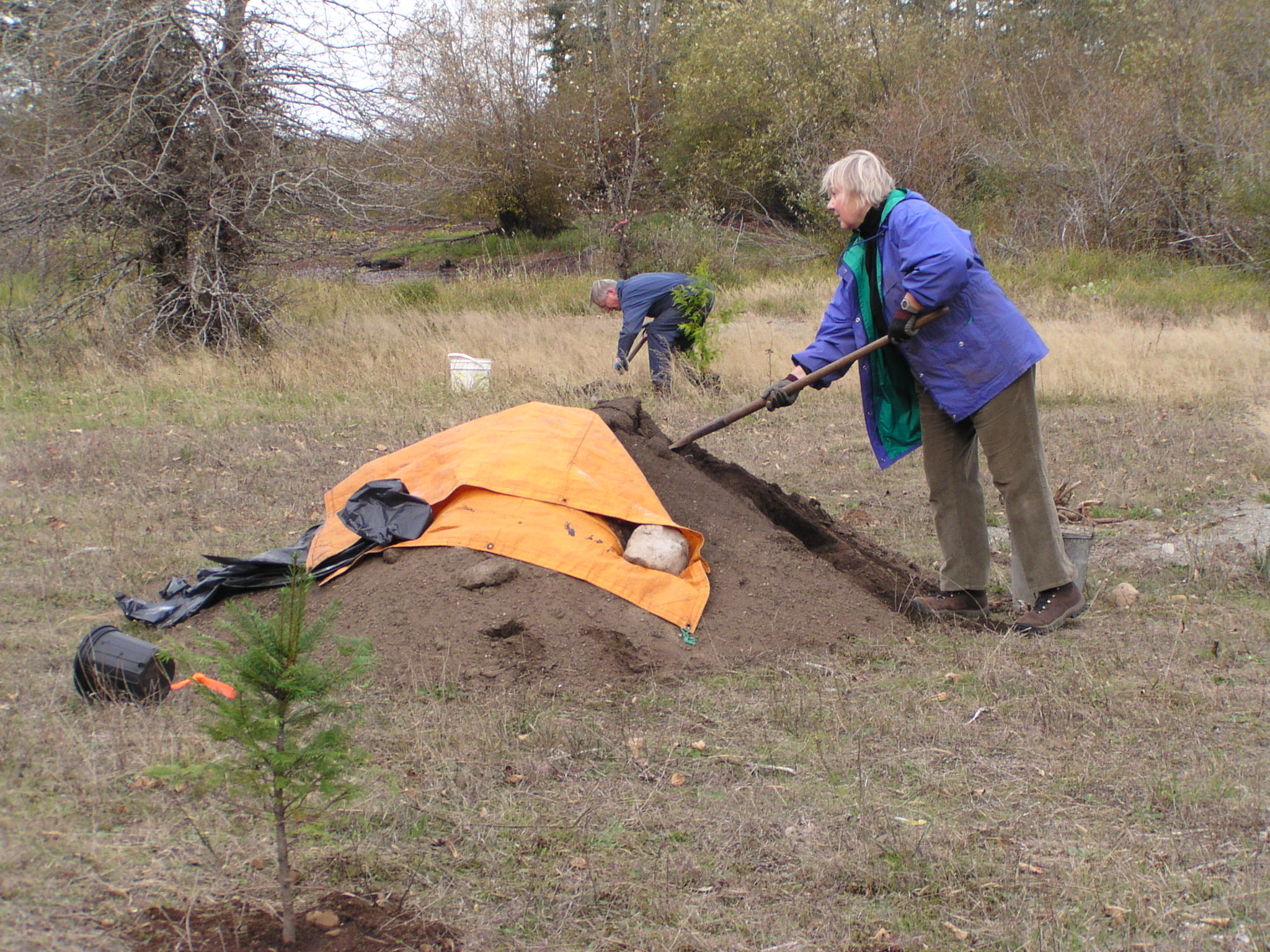
Karen Franzen and Murray Little planting native plants

Residents of the Little River area may have noticed the Comox Valley Naturalists toiling on the old McPhee property recently. This site, located on Wilkinson Road, was once an old gravel pit and is being transformed into what will become the Little River Nature Park administered by the Comox Valley Regional District.

[mappress mapid=”1″]

As a result of the beachfront development, a large portion of the property has been dedicated to parkland. However because of the old gravel extraction operation, much of the area is devoid of vegetation or else infested with invasive plants such as Scotch broom.

This year a remediation plan was developed for the site by Sellentin’s Habitat Restoration and Invasive Species Consulting. In the spring several crews began removing much of the Scotch broom and other invasive plants from the site. Now with wet fall weather upon us, the Comox Valley Naturalists have started planting native plants on the site, to help with its restoration to a more natural condition. Over 600 native plants have been placed in the ground so far. These include our native conifers like Douglas fir and Sitka spruce. Also planted are many of the smaller shrubs, forbs, and ferns one normally finds associated and growing close to these trees.

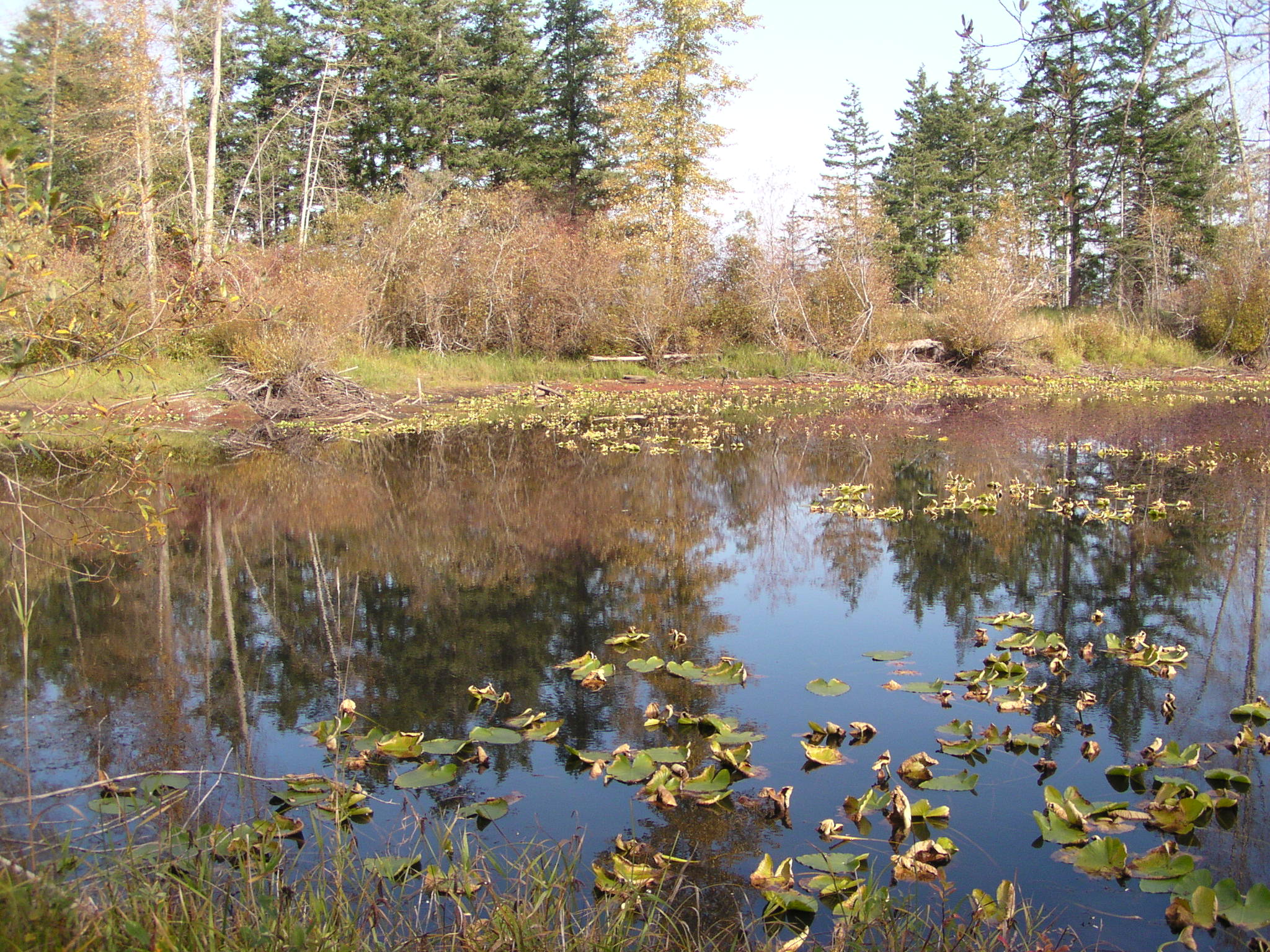
Beaver lodge in old gravel pit pond

Another local conservation group, the Little River Enhancement Society, also works on this site. Their interest is, of course, fish. For the last several years they have been stocking the ponds with native fish. To help provide shading, and thus lower the water temperature, many trees have been planted beside the pond.

Wildlife of many kinds use this property. Many of the trees have had to be fenced to protect them from browsing deer. As well, it was necessary to wrap with wire many of the existing cottonwood trees, as the local beavers are

active in the area. During the planting, adult bald eagles could be seen repairing their nests with large branches. There are two eagle nests on, or adjacent to, this site. A nature park designation is indeed a good use for this property.

The Comox Valley Regional District has plans for further work on this property, in the form of trails and fencing. In the meantime, local groups will continue to give nature a helping hand as the restoration process takes hold.

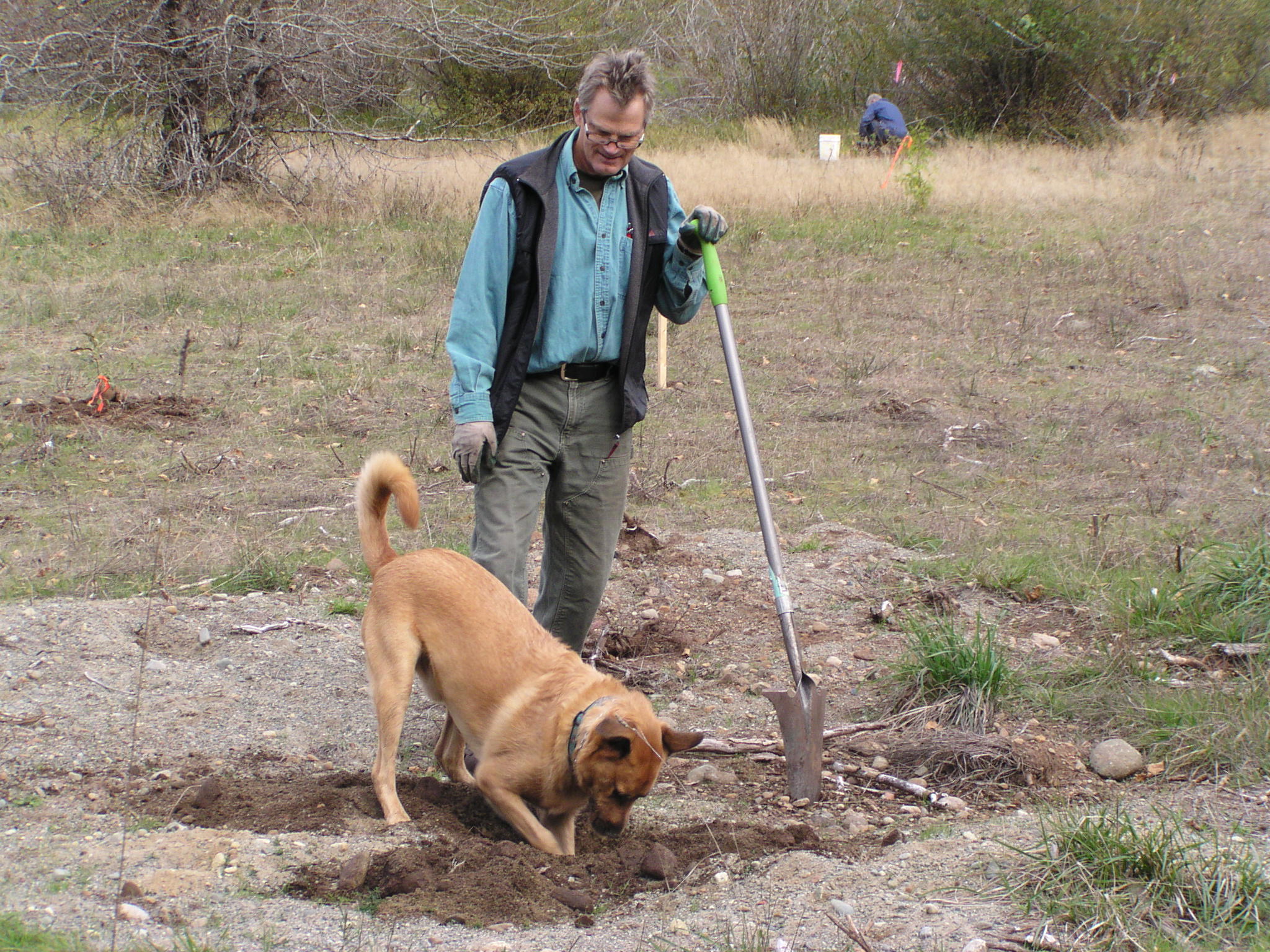
Ernie and his hole digger

Posted in Wetland Restoration | Tagged | Comments Off on Little River Nature Park

November Presentation: Author Chris Czajkowski, “A Wilderness Dweller’s Cookbook”

Chris Czajkowski: A Wilderness Dweller's Cookbook

The regular monthly meeting of the Comox Valley Naturalists Society will be held November 21, 2010, at 7:00 pm at the Florence Filberg Centre, 411 Anderton Avenue, Courtenay. The featured speaker will be noted author Chris Czajkowski, who will present on her life in remote areas of Northern British Columbia, as well as her newest book “A Wilderness Dweller’s Cookbook”.

In 1988, Chris Czajkowski walked into British Columbia’s Central Coast Mountains to build a homestead, a business, and a life. Raised in England, Chris was in her thirties when she moved to a remote location some 300 miles north of Vancouver. There, she single-handedly cleared the land and – despite a total lack of experience – built her own home. Later, she perfected her stone oven and her recipes – and word began to spread of Nuk Tessli and “The Best Bread in the World.”

This is not a ‘how-to-skin-a-moose-and-salt-it-down-and-make-the-offal-into-sausages’ kind of book. Rather it is a fascinating account of how a wilderness dweller – in a ‘none-growing climate’ 20 km from a road, 60 km from a store, and 250 km from the nearest town large enough for a supermarket – feeds herself and the visitors that come to her small ecotourism resort.

From tangy sourdough loaves of freshly-ground grain, Nuk Tessli Fruit Bread sweetened with molasses and aromatic spices, to Montreal Bagels with an alpine touch, here are hearty, adventurous recipes that bypass the bread machine. Also included are quick breads and desserts, like Trail Mix Cake – perfect for a hike – and Nuk Tessli’s enigmatic Spotted Dick, plus a few indispensable recipes for any wilderness dweller (or frugal urbanite), such as fresh yogurt and sprouts. Of particular interest to readers with their own wilderness dreams will be her descriptions of how she gets wholesome, fresh food to the table in this remote and spectacular location.

Please come and join us to become better informed, as to how you can help CVNS provide education and protection for B.C.’s natural environment.

Meetings of the Comox Valley Naturalists Society are held on the third Sunday of most months at the Florence Filberg Centre, 411 Anderton, Courtenay. Meetings are open to the public, including youth. A donation of $3.00 is suggested for non-members, and new memberships are always welcomed. Meetings are not held in December, July, and August. The CVNS January 16 presentation is by Wendy Kotilla, with a ‘never before seen’ show of an early1990’s trip up the Clayoquot Valley. On February 20 we will have a presentation by Gordon Hutchings, with a wide range of Bee topics, stories and information.

Posted in Guest Speakers | Tagged , , | 1 Comment

Henderson’s Checker-Mallow in Courtenay River Estuary

Henderson's checkermallow in Courtenay River Estuary

In late July a concerned individual contacted the Comox Valley Naturalists Society to report that purple loosestrife was running rampant in the Courtenay estuary! As the Wetland Restoration crew working on behalf of the CVNS had just finished working in the estuary I was surprised by the report. They had found and removed only a small number of the invasive purple loosestrife plants. Nevertheless I went down to check out this report. What I found was not purple loosestrife but masses of our beautiful native Henderson’s checkermallow (Sidalcea hendersonii) which is sometimes called the marsh hollyhock. From a distance it might well be mistaken for the nefarious purple loosestrife (Lythrum salicaria).

Checkermallow is readily seen growing along the Dyke road in the Courtenay River estuary. In full bloom (late July to August) it puts on a spectacular show of pink flowers. It is tolerant of the salt water and requires humus soil. The estuary provides ideal habitat where the plant can reach more than a meter in height.

We are indeed lucky to have such a beautiful plant growing in our estuary. The Checkermallow grows only in the Pacific Northwest and we are at the northern fringe of its range. It is in fact a Blue listed species, or a species of special concern in BC. This means there are relatively few populations of the plant in our province and those that exist are vulnerable to disturbance.

This beautiful plant is just one of the reasons our estuary is special and needs protection. Much of the work of the CVNS Wetland Restoration project is focused on removing invasive plants such as purple loosestrife and yellowflag iris that can overtake habitat for our native plants like the Henderson’s checkermallow. Although the initial report was mistaken it is great to see that the public is concerned about what is growing in our estuary and are keeping an eye out for non-native invaders.

The Wetland Restoration Project is managed by the Comox Valley Naturalists. Much of the work is being done by contractor Lynda Fyfe of Juniper Environmental Services and with the assistance of volunteers from the Naturalists Society. This important project is made possible through the generous grants from the Comox Valley Regional District, City of Courtenay, Ducks Unlimited Canada and BC Nature. We are truly grateful to our funders who have supported this project through the years.

[mappress mapid=”2″]

The Comox Valley Naturalists Society is an affiliated club of BC Nature, our parent provincial organization.

Posted in Wetland Restoration | Tagged , , , | Comments Off on Henderson’s Checker-Mallow in Courtenay River Estuary

Sharing Our Natural History: a new project for CVNS

Sharing Our Natural History is a new project for the Comox Valley Naturalists Society: the creation of a contemporary natural history guide to the Comox Valley & area.

The guide will have both print & on-line formats: a summary component in the form of a printed brochure distributed within the community; and an expanded, interactive on-line component available to the extended Internet network. Stay tuned for more details!

Funding for this project is made possible by the Government of Canada’s New Horizons for Seniors Program.

Posted in News | Tagged | Comments Off on Sharing Our Natural History: a new project for CVNS

October Presentation: Conservation Strategy – A Coalition for Biodiversity Protection

Comox Valley Conservation Strategy Poster

Comox Valley Conservation Strategy Poster

 The regular monthly meeting of the Comox Valley Naturalists Society will be held October 24 2010, at 7:00 pm at the Florence Filberg Centre, 411 Anderton Avenue, Courtenay. The speaker will be local teacher and environmentalist Kerry Dawson.

Kerry Dawson

Kerry Dawson holds up the Comox Valley Conservation Strategy Poster.

Kerry is the Education and Outreach Coordinator for the Comox Valley Conservation Strategy, a regional conservation plan for the protection and restoration of critical ecological areas in the Comox Valley. She is also a secondary math and science teacher.

Her talk will be about the growth of the Conservation Strategy from a project of the Comox Valley Land Trust to a broad Community Partnership of over 14 local environmental and community organizations now working together to implement the recommendations of the Nature Without Borders document. Using a dynamic visual presentation, she will explain what the Comox Valley Conservation Strategy is, and speak about working with local governments to make regional conservation planning a reality. Kerry will also outline current projects, including the postcard campaign aimed at local governments, the social media campaign, and the latest educational initiative: publication of the first-ever Comox Valley Conservation Calendar. The calendars feature photos of local sensitive ecosystems and give information on many of the CVCS’s member organizations and local conservation issues. Calendars and postcards will be available at the meeting. For more information about the CVCS visit their website.

Please come and join us to become better informed, as well as how you can help CVNS provide education and protection for B.C.’s natural environment.

Meetings of the Comox Valley Naturalists Society are held on the third Sunday of most months at the Florence Filberg Centre, 411 Anderton, Courtenay. Meetings are open to the public, including youth. A donation of $3.00 is suggested for non-members, and new memberships are always welcomed. Meetings are not held in December, July, and August. The CVNS November 21 presentation is author Chris Czajkowski who will present some of the culinary aspects (etc.) of northern solitary life. On January 16 we will have Wendy Kotilla, with a ‘never before seen’ show of an early1990’s trip up the Clayoquot Valley.

Posted in Guest Speakers | Tagged , , | Comments Off on October Presentation: Conservation Strategy – A Coalition for Biodiversity Protection

September Presentation: Hiking and Beachcombing Western Haida Gwaii

Dave Lacelle

Dave Lacelle enjoying a cup of tea (?) after a seven day hike.

The regular monthly meeting of the Comox Valley Naturalists Society will be held September 19 2010, at 7:00 pm at the Florence Filberg Centre, 411 Anderton Avenue, Courtenay. The featured speaker will be the local environmentalist Dave Lacelle.

Dave has been involved with environmental issues for most of his life, from childhood cedar lean to, BES Waterloo, 27 years with Environment Canada, and is currently President of CVNS, and also CVEC Secretary. When he wants to get away from the preceding, he goes on a (usually) solitary month long hike/camp/beach comb at a very remote area on the west coast of Haida Gwaii (Queen Charlotte Islands).

18 Glass Fish Floats

18 glass fish floats found on the west coast of Haida Gwaii.

This area does not have trails, nor even marking tape (!), Dave does not usually see anyone else. In the last 30 years of these ‘retreats’, he has made many discoveries, and had a few adventures. The presentation will include scenic pictures, old Haida sites, odd findings, five message bottles, and some comments on ocean pollution, as well as local ecology and geology.

Shaman's Burial Pole

Shaman's burial pole, circa 1790-1840 on Haida Gwaii.

Please come and join us to become better informed, as well as how you can help CVNS provide education and protection for B.C.’s natural environment.

Posted in Guest Speakers | Tagged , , , , | 1 Comment

May Presentation: Birding, Natural History and Inca Culture in Peru

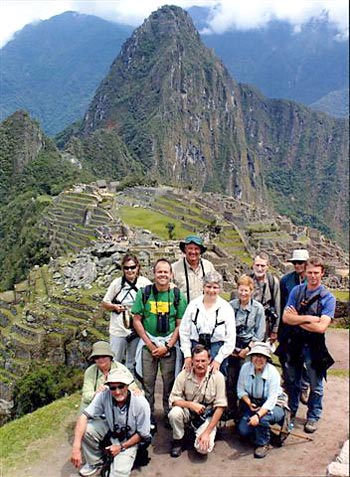
Machu Picchu

Group at Machu Picchu


The regular monthly meeting of the Comox Valley Naturalists Society will be held May 16 2010, at 7:00 pm at the Florence Filberg Centre, 411 Anderton Avenue, Courtenay. The featured speaker will be the noted birder and trip leader, Joe Crichton, who will take us on a birding and natural history photo tour of Peru.

Joe was one of the founders 15 years ago of the Wildbird Tours operations which are now active in half a dozen countries. He has great expertise in not only birding, but also natural history, and tour guiding in many different areas. For our presentation he will lead us through Peru, a country which contains examples of 87 of the 103 recognized Life Zones in the world!

We journey from the Pacific shores to the High Andes then down into the Amazon Basin by the Manu Biosphere. The beauty of this trip is the variety of habitats, ranging from orchid laden cloud forest where Spectacled Bears and Cock-of-the-Rocks still live unmolested, to untouched Amazon rainforest where 13 species of Monkey abound and Giant Otters still exist in the ox-bow lakes. A trip to Manu is a trip to one of the world’s great wilderness areas where wildlife is still plentiful and nearly 1000 species of birds have been recorded. We conclude our journey in the Sacred Valley and then the fabled cities of Machu Picchu and Cusco. This will be a spectacular and colourful presentation.

Please come and join us to become better informed, as well as how you can help CVNS provide education and protection for B.C.’s natural environment.

Posted in Guest Speakers | Comments Off on May Presentation: Birding, Natural History and Inca Culture in Peru