Today 13 birders went in search of spawning herring and, hopefully, lots of birds. We started at Nile Creek – there were many birds scattered over the waters but no concentrations. We could see several gill netters searching for herring but didn’t see any successful fishing. We could see that there were some waterbirds south of us so we then went to Qualicum Bay. There weren’t any spawning herring, but there had been some previously because the Bay was filled with huge flocks of Greater Scaup, scoters, goldeneyes and Long-tailed Duck and the shore was covered with several thousand gulls! We enjoyed great views of the spectacle, including courting goldeneyes. We then headed back north to Deep Bay, which was fairly quiet but had a few flocks of birds and many eagles. That calm was periodically interrupted by groups of sea lions that had found a small school of herring and began to churn up the waters with their feeding – which, in turn, attracted many gulls and eagles. We also saw a few of the first Brant of the season. All together we saw 33 species and had an enjoyable morning.
Brant
Mallard
Northern Pintail
Greater Scaup
Harlequin Duck
Surf Scoter
White-winged Scoter
Black Scoter
Long-tailed Duck
Bufflehead
Common Goldeneye
Barrows Goldeneye
Common Loon
Horned Grebe
Red-necked Grebe
Double-crested Cormorant
Pelagic Cormorant
Great Blue Heron
Bald Eagle
Mew Gull
Western Gull
California Gull
Herring Gull
Thayer’s Gull
Glaucous-winged Gull
Northwestern Crow
Common Raven
Chestnut-backed Chickadee
Pacific Wren
American Robin
Spotted Towhee
Song Sparrow
Dark-eyed Junco
Posted inBirds|Comments Off on Bird Outing Report: Qualicum to Deep Bay, Mar. 5,2015
John Neville, BC ornithologist well-known for his recordings of bird songs, and past-president of BC Nature will give an illustrated talk at CVN’s next lecture: Avian Carpenters : Canada’s Woodpeckers.
John Neville
John Neville is well known for his CD recordings of bird songs. Serious field recording of birds began in 1993 after studying with the MacAuley Library of Natural Sounds, Cornell University. As Neville Recording, John has produced seventeen regional sound guides to bird identification and an e-book titled “Travelling the Dempster”. He just released the 4 CD set “Bird Songs of Canada , Chants D’Oiseax du Canada”.
He regularly presents at birding festivals such as the Brant Festival, Wings over the Rockies and the Meadowlark Festival. He has published articles in Birds and Blooms and journals for the Ontario Nature (Seasons), Nature Saskatchewan, BC Field Ornithologists (BC Birds), Wildlife Sound Recording Society (Wildlife Sound), and BC Nature of which he is the Past President. He is the current recipient of the BC Nature Elton Anderson Award for outstanding achievement in public conservation.
Hairy Woodpecker
You can listen to interviews with John and sample his recordings and purchase CD’s and downloads on his web site www.nevillerecording.com. Recently John’s nature recordings have been used by the Canadian Wildlife Service for Training DVD, CBC Television , The Nature of Things and Parks Canada Interpretive Programs. His work is now being exhibited in the new Robert Bateman Center in Victoria. John records in the wild with great sensitivity and field craft awareness. His major aim is that the production of his art of nature recording will make people more aware of the feathered creatures and their need for a protected habitat.
This presentation, Avian Carpenters: Canada’s Woodpeckerswill take place at the Florence Filberg Seniors Centre at 7pm (sharp) Sunday March 15 2015.
Posted inGuest Speakers|Comments Off on Guest Speaker: John Neville, BC Ornithologist, Sun. March 15, 2015
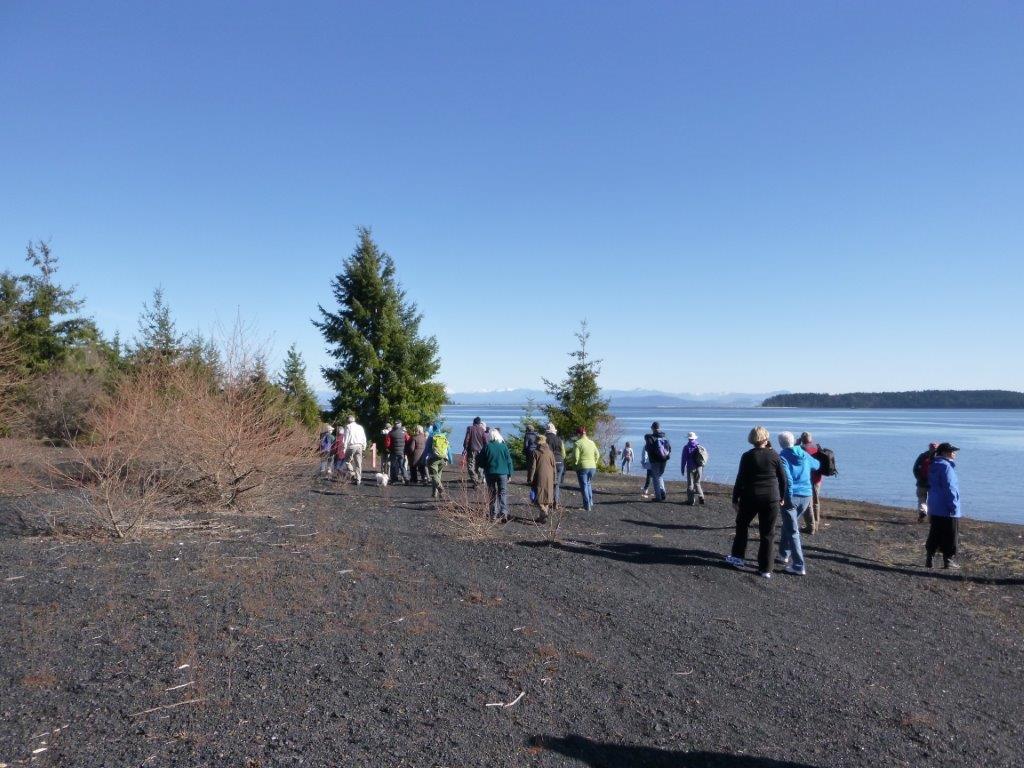
The coal hills walk at Union Bay drew about 45 people of all ages on a beautiful sunny Saturday morning. We had the good fortune of being joined by Juanita and her children who was able to provide us with insights into the heritage value of the site.
Unbeknownst to us Union Bay has been extremely pro-active in conserving its environmental history and heritage. It has not only worked to preserve not only its historic buildings, such as the Post Office, but it has also designated certain trees, such as the big Broad-leaved maple along the highway as a protected tree with heritage significance. It is near the site of one of the old hotel and was known as the place where lovers crooned!
We also had the good luck of being joined by two geologists with mining experience. In particular, Bob Hauser, who has just filed to join CVN, was able to explain the function of the remaining structures, and from a lump of processed coal that we found, gave us a good technical explanation on the production of coke.
We also were able to observe what plants have been able to colonize this extremely acid metallic site and the role that invasives play in the revegetation of Coal Hills. As usual, the estuary of Heart/Washer Creek, showed the long-term changes that the coal operation has brought to the region, with some observations on this impact on Baynes Sound.
As usual the bay was California sea-lions, abounded in the estuary together with scoters, and hundreds of mallards. A dozen killdeer also seemed to be readying to nest on the south side, and an ever-present pair of Anna’s hummingbirds were observed.
Finally, Ernie Stefanik had the good sense to bring a map of the historic lay-out of the site. Click here for a pdf of the map.
Posted inField Trips|Comments Off on Public Walk Report: Coal Hills, Feb. 28, 2015
Join the Young Naturalists down at sandy Kye Bay to explore the beach at low tide, and walk along the coastline towards Air Force Beach. We will be looking at the sand flats and tide pools, with creatures such as sand dollars, clams, small fishes, crabs and anemones. We will also watch for ducks, gulls, bald eagles and other birds. If time permits, we might check out the sensitive ecosystem of the upper beach zone, with interesting plants like dune grass, sea rocket, silver burweed and large-headed sedge.
Sand Dollar
Meeting Place (End of Windslow Rd):
From Courtenay: follow Ryan Rd till you get to the very end (at the base) and turn right on Military Row. Follow along till you get to the round-about and turn left (Knight Rd). Keep going for a while, you’ll pass the airport (on your left) and a number of farms. Continue along Knight Rd till you come to Kye Bay Rd and turn left. It’s the last, and only street, before the hill down to the water at Pt. Holmes. Follow Kye Bay Rd. down the hill then turn left on Windslow Rd. and follow it to the end.
Posted inNatureKids, Weekend Walks|Comments Off on YNC Walk: Sunday, March 22nd,1pm – 3pm, Kye Bay Beach
11 members enjoyed a calm and sunny walk at Kitty Coleman Provincial Park from 10:30 to 12 noon. First, we examined the “Green Shores Treatment” of horizontally placing older rooted trees, anchored by cables to deeply buried rock or concrete, to protect the foreshore from erosion due to ocean storms. Then we walked the approximately 1/2 mile to the site of the over-500 year old Douglas fir , which, when we measured the circumference (at about chest height), is 28 feet. One participant pointed out that there is a huge eagle nest near the top of that tree, and it is clearly visible from a point near the beach.
California sea lions were in abundance close to shore, and we saw eagles and mallard ducks. Leaves of miner’s lettuce and slender toothwort were showing.
Posted inField Trips, Plants and fungi|Comments Off on Botany Outing Report: Kitty Coleman Park, Feb. 17, 2015
The Morrison Creek Headwaters is a wild area roughly the size of Stanley Park set between Lake Trail Road to the north and Maple Lake to the south. It extends west from the Inland Island Highway to a gravel escarpment that parallels Bevan/Pigeon Lake Road, and then turns to the east meeting the Inland Island Highway near Maple Lake.
This relatively flat, forested land, which has seen periods of logging over the years, holds the upper reaches of Morrison Creek and is also a source of water for the Millard-Piercy watershed. Morrison Creek’s numerous tributaries and some 90 hectares of wetland are fed by dozens of prolific springs and many seeps that rise from the base of the escarpment.
The forest is a mixture of alder, maple, cottonwood and conifers. The conifers are a mixture of ages and species, from those just springing up, to others perhaps 50 years old, along with the odd old veteran. Open, wetter areas are dominated by deciduous trees. Riparian areas have been graciously left with larger conifers. Open ponds, reedy swamps, skunk cabbage hollows, and soggy devils club slopes abound in the area.
Morrison Creek’s iconic species is the Morrison Creek Lamprey. It is a potentially parasitic form of the common, non parasitic Western Brook Lamprey, Lampetra richardsoni. Lampreys are thought to spend 5-7 years as larval ammocoetes, filtering food from their burrows in quiet, silty creek beds. Most Western Brook Lampreys emerge from the creek bed, undergo metamorphosis, quickly spawn in freshwater and die.
Only in Morrison Creek does this species metamorphose into two distinct mature forms, one bronze and toothless, the other silver with teeth, Lampetra richardsoni var. marifuga. This form spawns a full year later. Its feeding habits are not entirely known and its breeding habits are a mystery. Such a life history is rare and offers a unique glimpse into evolution in progress. The constant flow of spring fed water from the headwaters is surmised to contribute to this unusual evolution. The Morrison Creek Lamprey is listed as endangered by COSEWIC.
The Morrison Creek Lamprey may be the diva of the creek but the foundations of its life are the plentiful runs of chum, pink and coho and the occasional chinook salmon, as well as cutthroat and rainbow trout. Fisheries records indicate that Morrison Creek is one of the most productive salmon watersheds of its size on eastern Vancouver Island.
Though the main course of Morrison runs through both urban and rural areas, its channel and riparian zone are natural enough to provide good habitat for salmon. The relatively undisturbed area of the headwaters, with low gradients, many ponds and beaver dams, moderates high flows and flooding, helping to keep reds and eggs in place. While many streams dry up in our increasingly hot summers, the springs and ponds provide a continual flow of cool water year round, a rare trait that helps rear coho fry. Coho juveniles stay in freshwater for 1 to 2 years before going to sea.
Other creeks have been enhanced through hatchery programs; so far Morrison Creek is self sustaining and productive. As the tributaries and wetlands of the headwaters have not been dug, drained, ditched, piped or paved, and the neighbouring riparian areas are mostly intact, the headwaters of Morrison Creek continues to provide, in addition to lamprey and salmon, a rich habitat for diverse aquatic life.
Many other creatures have been seen or have left their mark in the headwaters: cougar, wolves, black bear, elk, deer, otter, mink and beaver to name the furry ones. Song birds, raptors and waterfowl abound. Of chorus frogs, both tree frogs and red legged frogs are found here. Salamanders and toads are not often mentioned in reports, being elusive, but an investigation of the many ponds and their environs may reveal a variety of salamanders. Fortunately, no bull frogs have been reported in the area.
The Elegant Rein Orchid Piperia elegans, more common south of here, grows in the Headwaters. The vegetation varies with the conditions, but the land having been logged and mostly wet, is more brushy than clear underfoot. Areas off the roadway are sometimes challenging to traverse and a wandering path ensues. Old beaver dams form critter highways but we find them useful as well. The Project Watershed website has maps and the SHIM report (Sensitive Habitat Inventory Mapping) for more information. The report recommended and followed up with a proposal for conservation of the Headwaters, an initiative the Morrison Creek Streamkeepers are rekindling.
The lands are privately owned, with two rural residences and two managed forest lots. The majority of the headwaters lie within the Village of Cumberland and are mostly owned by Hancock Timber Resource Group. Signs posted on Bevan Road across from the dump state that hiking and horseback riding are permitted. For more information on the creek visit morrisoncreek.org and for information on routes and access contact the Morrison Creek Streamkeepers at . We’d love to take you for a walk. Jan Gemmell
Vice President
Morrison Creek Streamkeepers
Posted inNews|Comments Off on News Article: Morrison Creek’s Wild Headwaters
Despite the fog this morning we were able to get in an hour’s birding at the ferry terminal before the drizzle began in earnest.
Six birders saw the following 35 species. The highlights being close looks at approximately 40 Long-tailed Ducks by the ferry dock and 60 Common Mergansers on the other side of the terminal.
Common Loon
Common Merganser
Horned Grebe
Bald Eagle
Red-necked Grebe
Killdeer
Double-crested Cormorant
Mew Gull
Great Blue Heron
California Gull
American Wigeon
Thayer’s Gull
Gadwall
Glaucous-winged Gull
Mallard
Herring Gull
Greater Scaup
Belted Kingfisher
Harlequin Duck
Pileated Woodpecker
Black Scoter
Pacific Wren
Surf Scoter
American Robin
White-winged Scoter
Northwestern Crow
Common Goldeneye
Common Raven
Barrow’s Goldeneye
European Starling
Bufflehead
Song Sparrow
Red-breasted Merganser
Dark-eyed Junco
Long-tailed Duck
Posted inBirds|Comments Off on Bird Outing Report: Little River Ferry, Feb. 26, 2015
Thursday Feb. 19th started off with drizzle ending by 10:00 leaving us with an overcast but calm day for a morning of birding at Ship’s Point. Nine birders saw the following 42 species. Highlights were having a good look at a Gadwall and Green-winged Teal in breeding plumage:
Canada Goose
Gadwall
American Wigeon
Mallard
Northern Pintail
Green-winged Teal
Greater Scaup
Harlequin Duck
Surf Scoter
White-winged Scoter
Black Scoter
Long-tailed Duck
Bufflehead
Common Goldeneye
Common Merganser
Red-breasted Merganser
Common Loon
Horned Grebe
Red-necked Grebe
Double-crested Cormorant
Pelagic Cormorant
Great Blue Heron
Black Oystercatcher
Pigeon Guillemot
Mew Gull
Glaucous-winged Gull
Eurasian Collared-Dove
Belted Kingfisher
Northern Flicker
Pileated Woodpecker
Steller’s Jay
Northwestern Crow
Chestnut-backed Chickadee
Pacific Wren
Marsh Wren
Golden-crowned Kinglet
American Robin
Spotted Towhee
Savannah Sparrow
Song Sparrow
Dark-eyed Junco
Red-winged Blackbird
Pine Siskin
House Finch
Posted inBirds|Comments Off on Bird Outing Report: Ship’s Point, Feb. 19, 2015
Robbie and I will lead a field trip to Kitty Coleman Provincial Park on Tuesday, February 17. Meet at the Seal Bay parking lot on Bates Road at 10:15 or at the Kitty Coleman boat ramp at 10:30. We will walk the length of the park to where we will see the largest Douglas fir in the Comox Valley. We will also observe the way that the foreshore has been protected from erosion by using a “Green Shores Treatment” (horizontally placed older rooted trees anchored to buried rock or concrete). Bring a lunch.
Sincerely, Helen
Posted inField Trips, Plants and fungi|Comments Off on Upcoming Botany Walk: Kitty Coleman Provincial Park, Feb 17th
SUNDAY, March 29th. (Club Walk). Woodlot walk Meet at Harmston at 9:30am. Leader: Fred Newhouse.
(Strathcona Parkway, on the way up to Mt. Washington. West of the Island Highway, on Strathcona, there is a yellow gate on the first right. We go through that gate and there is a second red gate. The walk starts from the second gate.)
Posted inWeekend Walks|Comments Off on Upcoming Walk: Woodlot Walk Strathcona Parkway, March 29th
(THIS EVENT IS FULL, join the waitlist through our events page) Comox Valley Nature invites you to a special opportunity to learn and connect with K'omoks First Nation storytelling, benefiting the KFN culture department. Pamela Mitchell, Culture Manager for KFN, has created a workshop around the legend of Dzunuk’wa the wild Woman of the Woods. Kwakwak’wakw oral tradition tells of a giantess that lives in dark forests and has thick messy hair, a black face and full red lips.This workshop is a great way to learn about local Indigenous traditions through a hands-on project that creates lasting memories about the K’ómoks First Nation culture. For this project we will be creating a wild woman ornament; you will colour the iconic red lips and face of the wild woman and hand-spin the wool for the crazy wild woman hair. While we work on our ornaments, Pamela will read her version of the wild woman story.This project takes about 1-1.5 hours. Workshop fee is $36 which includes the cost of a supply kit. Proceeds go to the KFN Culture Dept.Register through our CVN events page.https://comoxvalleynaturalist.bc.ca/events/ ...
Drawing on the Salish Sea: A Zoom course in support of the Mitlenatch Island Stewardship Team (MIST)Have you wished that you could keep a nature journal or paint the life around you? During three Zoom sessions you can explore how to quickly capture wildflowers, inter-tidal life and birds You’ll learn how to draw quickly and accurately, starting with simple shapes, then using some refining techniques, which will help you draw with less frustration!You’ll look at materials: papers, pens, and coloured mediums like pencil crayons. Then you’ll jump into watercolours with a simple palette and mixes as well as quick watercolour techniques you can use in the field or at home. All the lessons will be accompanied with downloadable notes.You will finish the course ready to start your own Nature Journal.Zoom recordings will allow you watch the sessions at your convenience during the course and for a month after we wrap up. About Mitlenatch Island:Mitlenatch Island is a small rocky island that sits between Campbell River and Powell River, in the Salish Sea. Cast in the rain shadow of Vancouver Island, its flanks are clad in golden grasses and its meadows host an explosion of spring wildflowers. Anchored where tides rush in from the north and south, rich waters encircling the island teem with fish; intertidal life flourishes and thousands of seabirds nest on cliffs, in rocks, and on open ground. It’s shores provide refuge for mother seals with their pups, and haul out for sea lions in the winter. In recent years Humpbacks have returned to nearby waters, to feed on krill and schooling fish. With so much life, much of it on exposed nesting areas, the island has a special vulnerability. The Mist volunteer wardens are in place for the summer months to welcome people to the island (which is accessible by boat only) and to relate to visitors the natural and human history of the island. For 25 years Alison Watt has spent a week on the island in the summer, as a volunteer warden. Her journals are full of Mitlenatch sketches. She finds it a delight and a privilege to return each year to this jewel of the Salish Sea. MIST is a special organisation which works closely with BC Provincial Parks to ensure that Mitlenatch Island remains a haven for the plants and animals of the Salish Sea.Sign up and donate through www.alisonwatt.ca/drawing-on-the-salish-seaFor more information on Mitlenatch Island visit www.mitlenatch.ca/mitlenatch-island...
Comox Valley Nature invites its members and the public to CVN’s October general meeting, where you can hear the following keynote presentation by our guest speaker: Birdbrains – Smarter than you think- with Sandra Milligan Once dismissed as “birdbrains,” birds are now recognized for their remarkable intelligence. Sandra explores the evolution of our understanding of avian neuroanatomy, focusing on local species. Through engaging stories and videos, Sandra explores how birds solve problems, use tools, express empathy, and communicate with rich vocabulary – inviting you to see these creatures with newfound respect and wonder.Sandra Milligan has been teaching university level biology at North Island College for over twenty years. With graduate degrees in neuroscience, she’s now a generalist, naturalist, and lifelong learner. In Campbell River, she’s a recognized environmental advocate and public educator. Her passion for birding has evolved into a deep interest in avian behaviour and intelligence. Drawing on her neuroanatomy background, Sandra has followed the growing research on bird cognition, confirming what many intuitively felt – birds display an extraordinary range of intelligent behaviours. Sunday, October 25, 2026 at 3 pm in the main hall of Comox United Church, 250 Beach Drive, Comox. Members of the public welcome.This will be an in-person only meeting. We will not record the presentation on this occasion [this is a correction to previous information].As always, there will be a break after the presentation with a chance to meet new people and socialize with old friends. Tea, coffee and treats will be available (by donation).A brief meeting follows. Reports from some of our interest groups and projects are an opportunity for guests to learn more about what we do. ...
It's that time of year! A couple of off leash dogs have been seen romping at the confluence of Morrison Creek and the Puntledge River. Dogs get quite excited to see those big chum. The chum do spawn right at the mouth of the creek, salmon eggs are very sensitive to disturbance so paws, or feet, in the creek kill eggs. Keep your dog on a leash, especially if you do not want a smelly dog! Dogs like to roll in dead fish. Salmon spook, be a quiet calm wildlife paparazzi. ...
Fish Walk!!! ( Well, not really...but don't miss this chance to follow their journey!)Join the Morrison Creek Streamkeepers for a walk along Morrison Creek, starting at its confluence with the Puntledge River in Puntledge Park, to watch salmon spawning after their remarkable journey back from the ocean. Register here: form.jotform.com/262924316992264...